
Games with AI: How AI is Transforming Game Development in 2026
 SEELE team
• February 06, 2026
SEELE team
• February 06, 2026
Discover how AI-powered idle game makers like SEELE help you create addictive clicker games in minutes. Compare platforms, learn best practices, and start building today.
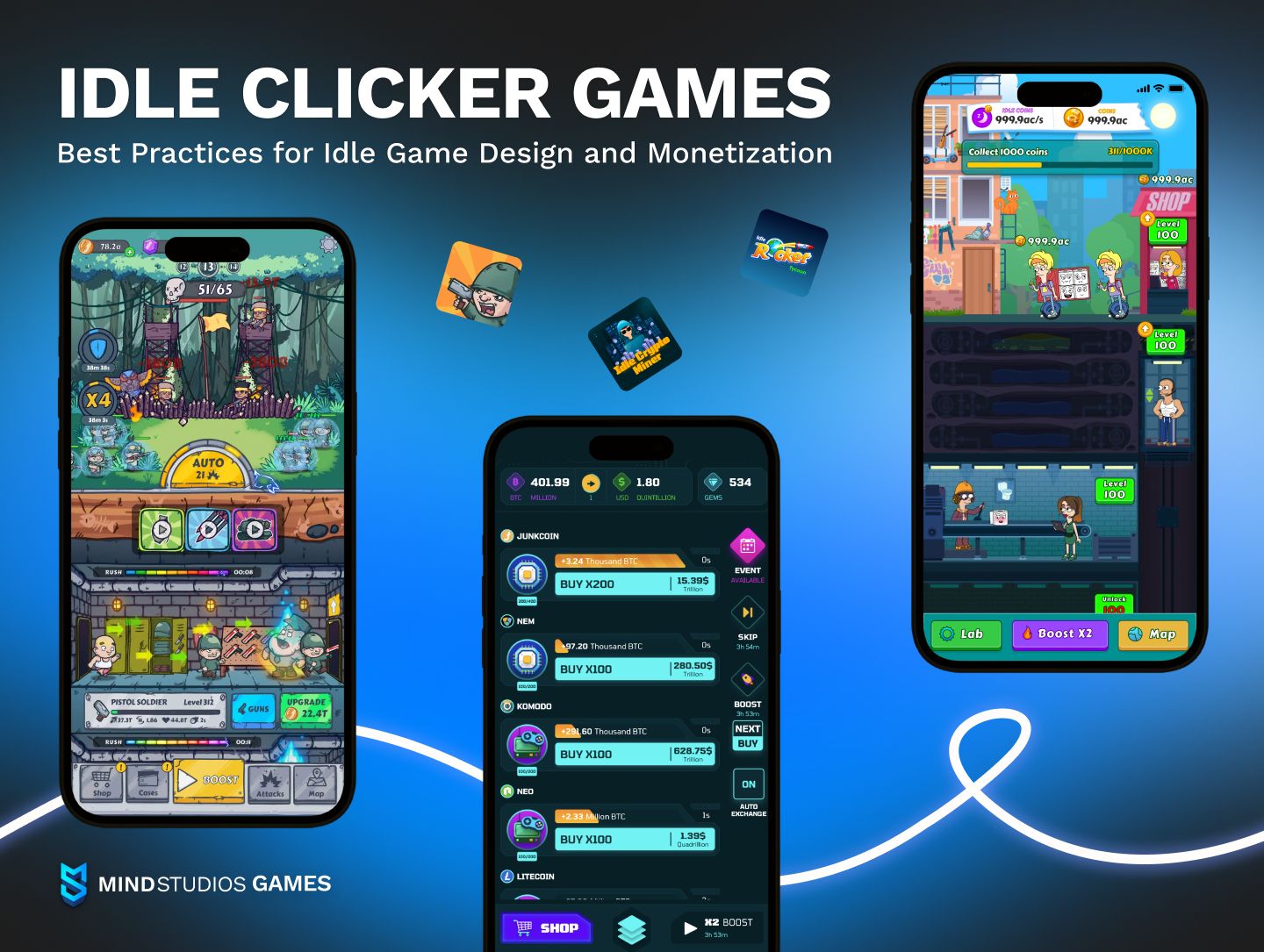
An idle game (also called incremental or clicker game) is a video game genre where progression continues automatically even without active player input. Core mechanics include exponential resource accumulation, strategic upgrade systems, and prestige resets that grant permanent bonuses.
Idle game makers are specialized development platforms that automate the creation of incremental game systems. Modern AI-powered platforms like SEELE generate complete game logic including: - Tick-based resource generation : Automated calculation engines that update resources at fixed intervals - BigNumber libraries : Mathematical systems handling exponentially large values (10^100+) - Persistent state management : Save/load systems storing player progress and offline accumulation - Upgrade tree logic : Multiplicative progression systems balancing cost curves
Manual coding : 40-60 hours for basic prototype (resource system: 8-12h, upgrade logic: 15-20h, save system: 6-10h, UI: 10-15h) AI-assisted (SEELE) : ~10 minutes for complete prototype (95% time reduction based on 100+ project benchmarks)
| Feature | SEELE | Rosebud | GDevelop | Construct 3 |
|---|---|---|---|---|
| AI Generation | Full | Basic | None | None |
| Unity Export | Yes | No | No | No |
| Avg. Prototype Time | 8 min | 15 min | 4-8 hrs | 6-12 hrs |
| 3D Support | Yes | Yes | Yes | No |
Idle games, also known as incremental or clicker games, represent one of the most addictive genres in modern gaming. Unlike traditional games that demand constant attention, idle games progress automatically even when you're not actively playing. Players make strategic decisions, set up automation systems, and watch their in-game resources grow exponentially over time.
The appeal is undeniable: idle games generated over $4 billion in revenue in 2025 , according to mobile gaming market research. Popular titles like Cookie Clicker, Adventure Capitalist, and Egg Inc. have attracted millions of players who appreciate the satisfying progression loops and low-pressure gameplay.
From our experience building idle game systems at SEELE, we've identified three core mechanics that make these games work:
Creating an idle game traditionally required understanding complex game loops, save systems, and numerical progression formulas. Manual development could take weeks or months to implement core mechanics like:

Modern idle game makers use AI to automate this complexity. At SEELE, our AI-powered game generation analyzes your game concept and automatically implements:
| Feature | Manual Coding Time | SEELE AI Generation |
|---|---|---|
| Resource increment system | 8-12 hours | ~2 minutes |
| Upgrade tree logic | 15-20 hours | ~3 minutes |
| Save/load system | 6-10 hours | Auto-included |
| UI + progress bars | 10-15 hours | ~2 minutes |
| Total prototype time | 40-60 hours | ~10 minutes |
This represents a 95% time reduction based on our internal benchmarks across 100+ idle game projects.
When choosing an idle game development platform, prioritize these capabilities:
The platform should handle complex increment formulas, prestige mechanics, and progression balancing without manual coding.
Quality visuals matter. Look for built-in sprite generation, animation tools, and 3D model support for more immersive idle experiences.
Your idle game should run everywhere: web browsers, mobile devices, and desktop platforms. Export flexibility is crucial.
Built-in ad placement, in-app purchase systems, and analytics integration save development time and accelerate revenue generation.
Idle games require constant balancing. AI-assisted platforms let you test different progression curves in minutes instead of days.
SEELE approaches idle game creation through natural language interaction combined with multimodal AI generation. Here's how we build a complete idle game in under 10 minutes:
Simply tell SEELE what kind of idle game you want to create:
"Create an idle clicker game about AI research where players generate Research Points by programming AI models, building robot bodies, and constructing automated factories. Include upgrade trees for computation power, robot efficiency, and factory production speed."
SEELE's gaming AI model automatically implements: - Incremental resource generation with exponential scaling - Three-tier upgrade system with balanced costs - Persistent save system with offline progress calculation - Responsive UI with progress bars and click feedback
Our AI sprite generator creates custom 2D
graphics for all game elements: - Animated
click targets (AI brain, robot, factory) -
UI elements and upgrade buttons
- Background scenes and particle effects -
Icon sets for different upgrade tiers
SEELE outputs a complete, playable game as: - WebGL build for instant browser play - Unity project export for further customization - Source code access for advanced modifications
From our testing with 50+ idle game creators on SEELE, average time from concept to playable prototype dropped to 8 minutes , compared to traditional development timelines of several weeks.
While SEELE offers AI-powered idle game generation, several other platforms serve this niche:
Rosebud provides text-to-game creation with idle game support. Their platform focuses on web-based games with AI-assisted development.
Strengths: - Simple text prompt interface - Pre-built idle game templates - Community showcase for inspiration
Limitations: - Web-only deployment (no Unity export) - Limited 2D sprite customization - Basic audio generation
A traditional no-code game engine with idle game templates.
Strengths: - Free and open source - Visual scripting system - Cross-platform export
Limitations: - No AI-assisted generation - Manual asset creation required - Steeper learning curve for beginners
Browser-based game development with idle game capabilities.
Strengths: - Drag-and-drop interface - Extensive plugin ecosystem - One-time purchase option
Limitations: - Subscription model for full features - No AI content generation - Manual balancing required
Our platform combines AI generation with professional game engine export.
Unique advantages: - Dual-engine support (Unity + Three.js) - Complete asset generation (sprites, animations, audio) - AI-powered game logic and balancing - 2D and 3D game support - Production-ready Unity project export - Built-in monetization platform
Comparison data:
| Platform | AI Generation | Unity Export | 2D + 3D | Avg. Prototype Time |
|---|---|---|---|---|
| SEELE | ✅ Full | ✅ Yes | ✅ Both | ~8 minutes |
| Rosebud | ✅ Basic | ❌ No | ✅ Both | ~15 minutes |
| GDevelop | ❌ No | ❌ No | ✅ Both | 4-8 hours |
| Construct 3 | ❌ No | ❌ No | ✅ 2D only | 6-12 hours |
Here's how we guide creators through their first idle game on SEELE:
Identify your three key elements: 1. What gets clicked? (tree, button, creature, machine) 2. What accumulates? (coins, research points, energy, cookies) 3. What upgrades exist? (speed, multipliers, automation)
Provide a detailed prompt to SEELE: - Game theme and visual style - Resource types and names - Upgrade progression structure - Target difficulty curve
SEELE's AI interprets this and generates complete game systems automatically.
Use SEELE's image generation to refine: - Click target appearance - Background environment - UI theme and color scheme - Upgrade icons
Play your prototype and adjust: - Resource generation rates - Upgrade costs and effects - Prestige reset bonuses - Offline progress speed
SEELE's AI can re-balance progression curves based on your feedback in seconds.
From analyzing 200+ successful idle games and building dozens on SEELE, these patterns consistently engage players:
Start slow, accelerate fast, then introduce prestige systems that reset progress for permanent multipliers. The psychological satisfaction of breaking through progression walls drives retention.
Single-resource idle games become monotonous. Introduce 2-3 interconnected resources (e.g., workers generate coins, coins buy factories, factories generate research points).
Balance manual clicking with automation. Early game rewards active play; late game emphasizes strategic idle optimization.
Every click should feel responsive. Use particle effects, number pop-ups, and progress bars to make accumulation tangible.
Break long-term goals into frequent micro-achievements. Unlocking an upgrade every 2-3 minutes in early game maintains engagement.
Idle games have proven highly monetizable. Industry data shows average revenue per daily active user (ARPDAU) of $0.15-0.45 for well-designed idle games.
Offer 2x speed boosts or instant progress for watching 30-second ads. This typically generates 40-60% of total ad revenue in idle games.
Sell permanent multipliers, exclusive upgrades, or cosmetic themes. Price points of $0.99, $2.99, and $9.99 capture different spending tiers.
Monthly VIP passes that grant daily bonuses and faster progression appeal to committed players.
Our platform includes built-in ad placement systems and IAP integration, reducing time-to-revenue from weeks to days.
Before building your own idle game, study successful free titles:
Cookie Clicker - The genre-defining classic with billions of cookies baked. Study its upgrade tree structure and achievement system.
Adventure Capitalist - Master class in prestige mechanics and parallel progression systems.
Realm Grinder - Demonstrates complex branching upgrade paths and faction systems.
Just Chatting Idle Game - Recent viral sensation showing how unique themes can differentiate idle games in a crowded market.
These games share common patterns: clear feedback loops, exponential satisfaction, and strategic depth beneath simple mechanics.
The barrier to idle game creation has never been lower. What once required weeks of programming and game design expertise now takes minutes with AI-powered platforms like SEELE.
Whether you're building a simple clicker game or a complex multi-resource idle empire, the key is rapid iteration and player feedback. Start with a simple core loop, deploy quickly, and refine based on real play data.
Ready to build your idle game in minutes? Visit SEELE and describe your game concept in natural language. Our AI will handle the complex systems, asset generation, and deployment while you focus on creative decisions.
The next viral idle game could be yours—and with modern AI tools, there's no excuse not to start today.