Prototype owner
Solo RPG creators and small narrative teams can test explore a compact settlement, accept a quest, defeat one enemy group, collect a reward, and spend one upgrade point before widening the production plan.
The world's first online native Unreal workflow · native game · browser preview
An Unreal RPG game maker should help solo RPG creators and small narrative teams turn a role-playing premise into a native Unreal 5 vertical slice with exploration, combat, progression, and a reviewable quest.
Use one bounded playtest—a new player can finish the quest, equip the reward, level up once, save, reload, and continue from the correct state—then inspect, optimize, package, and download the actual generated game.
Generate Unreal RPG Game Maker as a native Unreal 5 slice: explore a compact settlement, accept a quest, defeat one enemy group, collect a reward, and spend one upgrade point. Place it in a weathered mountain settlement connected to a ruined shrine and a short combat trail. The build passes only when a new player can finish the quest, equip the reward, level up once, save, reload, and continue from the correct state. Return the Unreal RPG Game Maker browser preview, performance notes, packaged output, and native project for download.
Each prompt preserves the same SEELE Unreal destination — the world's first online native Unreal workflow — while changing the rpg game decision that starts the build.
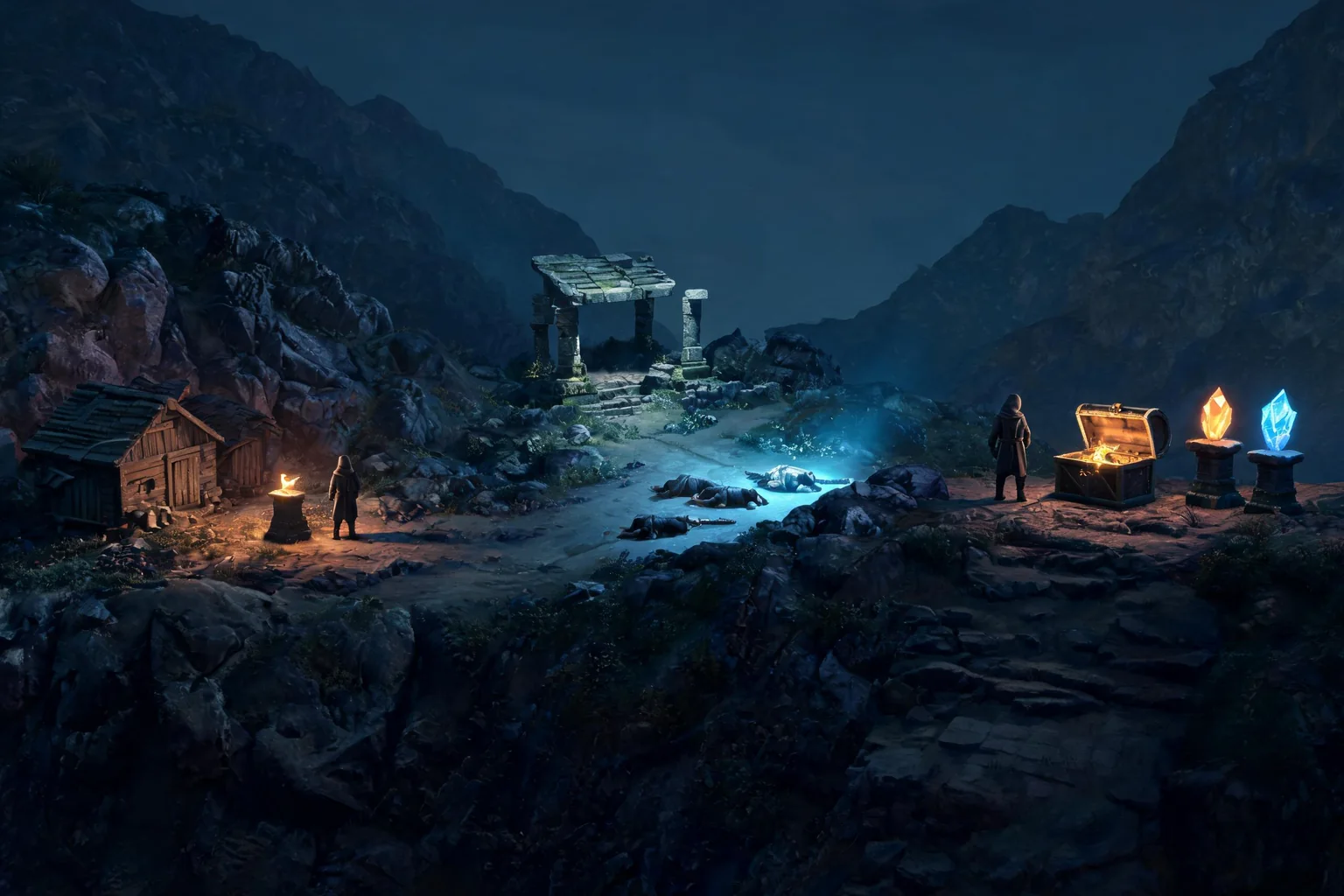
Solo RPG creators and small narrative teams can test explore a compact settlement, accept a quest, defeat one enemy group, collect a reward, and spend one upgrade point before widening the production plan.
Design and engineering reviewers get one pass-or-fail condition: a new player can finish the quest, equip the reward, level up once, save, reload, and continue from the correct state.
The Unreal RPG Game Maker team can move from its browser preview to a reviewed native project, representative performance work, packaging, download, and external continuation.
Pick the brief that lets you prove third-person movement, camera orbit, interaction, target selection, and menu navigation or follow state through attributes, experience, equipment, quest state, dialogue choices, save data, and enemy encounters. Every Unreal RPG Game Maker CTA carries the Unreal engine, this source page, its intent, and campaign attribution into the same generation workflow.
Generate Unreal RPG Game Maker as a native Unreal 5 slice: explore a compact settlement, accept a quest, defeat one enemy group, collect a reward, and spend one upgrade point. Place it in a weathered mountain settlement connected to a ruined shrine and a short combat trail. The build passes only when a new player can finish the quest, equip the reward, level up once, save, reload, and continue from the correct state. Return the Unreal RPG Game Maker browser preview, performance notes, packaged output, and native project for download.
Create an Unreal 5 gameGreybox a weathered mountain settlement connected to a ruined shrine and a short combat trail around these player inputs: third-person movement, camera orbit, interaction, target selection, and menu navigation. For the Unreal RPG Game Maker movement and interaction pass, record the pass and failure evidence; delay visual polish until failure and restart behavior is clear.
Create an Unreal 5 gameRepresent attributes, experience, equipment, quest state, dialogue choices, save data, and enemy encounters as observable state in the Unreal RPG Game Maker project. Connect each transition to explore a compact settlement, accept a quest, defeat one enemy group, collect a reward, and spend one upgrade point, expose it in the browser build, and mark the Blueprint, C++, asset, or configuration assumption that still needs editor inspection.
Create an Unreal 5 gameRun a regression build for solo RPG creators and small narrative teams. Prove that a new player can finish the quest, equip the reward, level up once, save, reload, and continue from the correct state, then deliberately trigger this risk: quest flags, inventory ownership, and save-state dependencies can drift apart when the slice is expanded. Preserve a rollback point, repeat the same test, and return the unreal rpg game maker browser preview, performance notes, packaged output, and native project for download.
Create an Unreal 5 gameDescribe explore a compact settlement, accept a quest, defeat one enemy group, collect a reward, and spend one upgrade point. Keep the first scope inside a weathered mountain settlement connected to a ruined shrine and a short combat trail, name the player inputs, and use this acceptance condition: a new player can finish the quest, equip the reward, level up once, save, reload, and continue from the correct state.
Send the scoped Unreal RPG Game Maker prompt to SEELE AI and generate a native Unreal 5 project. Inspect its contents for third-person movement, camera orbit, interaction, target selection, and menu navigation and for the required attributes, experience, equipment, quest state, dialogue choices, save data, and enemy encounters.
Use the Unreal RPG Game Maker browser preview to run from entry to completion. Capture evidence that a new player can finish the quest, equip the reward, level up once, save, reload, and continue from the correct state, rather than judging only the image quality or atmosphere.
Deliberately test the most likely Unreal RPG Game Maker failure: quest flags, inventory ownership, and save-state dependencies can drift apart when the slice is expanded. Change one variable in that slice at a time, preserve its last known-good build, and repeat the same acceptance run.
Review Unreal RPG Game Maker performance and packaging in SEELE AI, then download the native Unreal 5 project or packaged output for local work and external publishing. Complete its rights, plugin, SDK, and platform checks before release.
A native Unreal 5 project scoped to explore a compact settlement, accept a quest, defeat one enemy group, collect a reward, and spend one upgrade point.
A browser preview that demonstrates whether a new player can finish the quest, equip the reward, level up once, save, reload, and continue from the correct state.
A rpg game review record that inspects third-person movement, camera orbit, interaction, target selection, and menu navigation, then follows state through attributes, experience, equipment, quest state, dialogue choices, save data, and enemy encounters.
A package-ready result for solo RPG creators and small narrative teams, with performance notes and a downloadable project or build that can be continue in Unreal 5.
Unreal RPG game maker belongs to this canonical owner because its user needs explore a compact settlement, accept a quest, defeat one enemy group, collect a reward, and spend one upgrade point. Broad Unreal discovery stays with the Hub; ai rpg game maker keeps the engine-agnostic job; the linked guide explains the technical subsystem behind a new player can finish the quest, equip the reward, level up once, save, reload, and continue from the correct state.
SEELE AI can generate Unreal RPG Game Maker as an Unreal 5 project with browser preview and download; review attributes, experience, equipment, quest state, dialogue, plugins, and configuration before release.
Unreal RPG Game Maker prompts should define explore a compact settlement, accept a quest, name third-person movement, camera orbit, interaction, target, and require a measurable pass condition; use four starters above.
In the Unreal RPG Game Maker preview, verify a new player can finish the quest; editor inspection, device profiling, network testing, and release checks remain human-owned.
For Unreal RPG Game Maker, review third-person movement, camera orbit, interaction, target, then regression-test quest flags, inventory ownership, and save-state dependencies; also verify rights, security, accessibility, performance, and packaging.
After the Unreal RPG Game Maker preview, download the project or package; match its Unreal version, keep source control, and rerun a new player can finish the quest after edits.
Unreal RPG Game Maker owns Unreal RPG game maker: explore a compact settlement, accept a quest; use the Hub for broad discovery. Both enter the SEELE Unreal workflow.
Use the rpg game prompt to prove whether a new player can finish the quest, equip the reward, level up once, save, reload, and continue from the correct state, then optimize, package, and download the reviewed project.