Braindom 2: Who is Lying? - Puzzle Game
Prompt
Game Introduction
About the Game
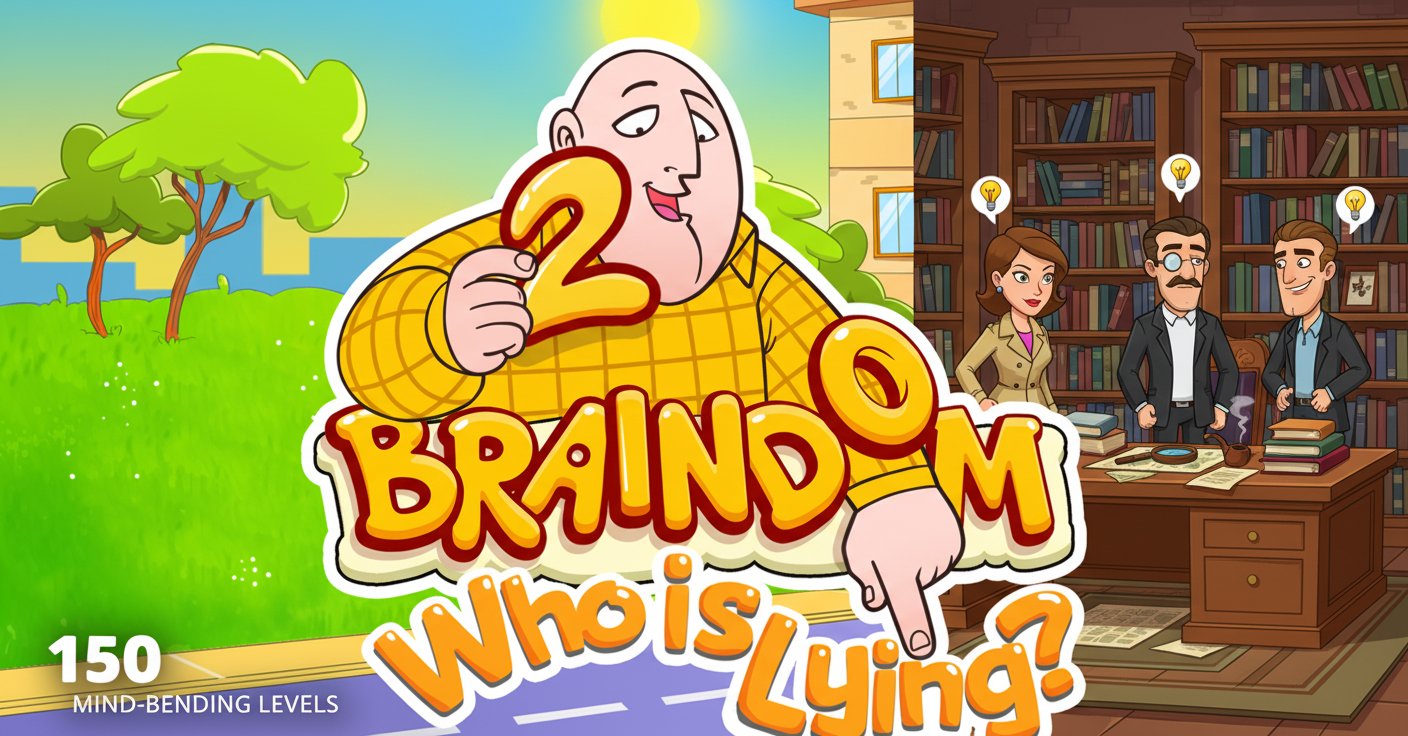
Braindom 2: Who is Lying? is a captivating brain puzzle game that puts your detective and logical thinking skills to the ultimate test. This engaging mystery game challenges players to become master investigators, solving complex scenarios where truth and deception intertwine. With its unique blend of puzzle-solving and detective work, the game offers an intellectual adventure that keeps players coming back for more.
The game presents players with intriguing scenarios where they must use their powers of observation and logical deduction to uncover the truth. Each level is carefully crafted to provide a unique mystery that requires careful analysis of evidence, character behavior, and environmental clues.
Core Features
Extensive Puzzle Collection
Braindom 2 offers 150 challenging levels , each presenting a unique mystery to solve. From simple truth-or-lie scenarios to complex multi-character investigations, the game provides hours of brain-teasing entertainment that progressively increases in difficulty.
Interactive Investigation System
The game's investigation mechanics allow players to thoroughly examine each scene. You can click on various objects, characters, and environmental elements to gather crucial evidence. This interactive approach makes every puzzle feel like a real detective investigation.
Hint System for Challenging Moments
When puzzles become particularly challenging, the built-in hint system provides subtle guidance without giving away the solution. This feature ensures that players can progress through difficult levels while still maintaining the satisfaction of solving puzzles independently.
Diverse Scenario Types
The game features varied puzzle scenarios including: - Identity mysteries : Determine who is who among different characters - Lie detection : Figure out which character is being dishonest - Evidence analysis : Use environmental clues to solve complex cases - Logic puzzles : Apply deductive reasoning to reach conclusions
Game Mechanics
Investigation Process
Each level begins with a scenario presentation where players are introduced to the characters and situation. The core gameplay involves systematically examining the scene, looking for inconsistencies, contradictions, or revealing details that expose the truth.
Evidence Gathering
Players must carefully observe and interact with various elements in each scene. Hidden clues are scattered throughout the environment, requiring thorough exploration and keen attention to detail. These clues often provide the key information needed to solve the mystery.
Answer Selection
After gathering sufficient evidence and analyzing the scenario, players must choose from multiple possible answers. The game rewards careful observation and logical thinking, making rushed decisions less likely to succeed.
Operation Guide
Mouse Controls : The game uses simple point-and-click mechanics - Left click to interact with objects, characters, and UI elements - Click and drag to examine details more closely when available - Menu navigation through mouse clicks on buttons and options
Investigation Strategy : 1. Read the scenario carefully to understand what you need to determine 2. Examine all characters for visual clues, expressions, and body language 3. Investigate the environment for hidden objects and contextual clues 4. Look for contradictions between what characters claim and what evidence suggests 5. Use logical deduction to eliminate impossible answers 6. Take your time - rushing often leads to incorrect conclusions
Why Play Braindom 2?
Mental Exercise and Entertainment
This game perfectly combines entertainment with cognitive exercise. Regular play can help improve logical thinking, attention to detail, and problem-solving abilities while providing enjoyable gaming sessions.
Accessibility and Convenience
- Completely free to play with no hidden costs or premium content barriers
- No download required - play instantly in your web browser
- Cross-platform compatibility - works seamlessly on desktop computers, tablets, and smartphones
- Offline capability once loaded, making it perfect for travel or areas with limited internet
Progressive Difficulty
The game is designed to be accessible to beginners while providing sufficient challenge for experienced puzzle solvers. The difficulty curve ensures that players can develop their skills gradually while maintaining engagement.
Perfect for All Ages
With its cartoon-style graphics and clever but appropriate scenarios, Braindom 2 appeals to players of all ages. It's educational enough for young minds while sophisticated enough to challenge adults.