Tangram Game - Classic Chinese Puzzle - Puzzle Game
Prompt
Game Introduction
About the Game
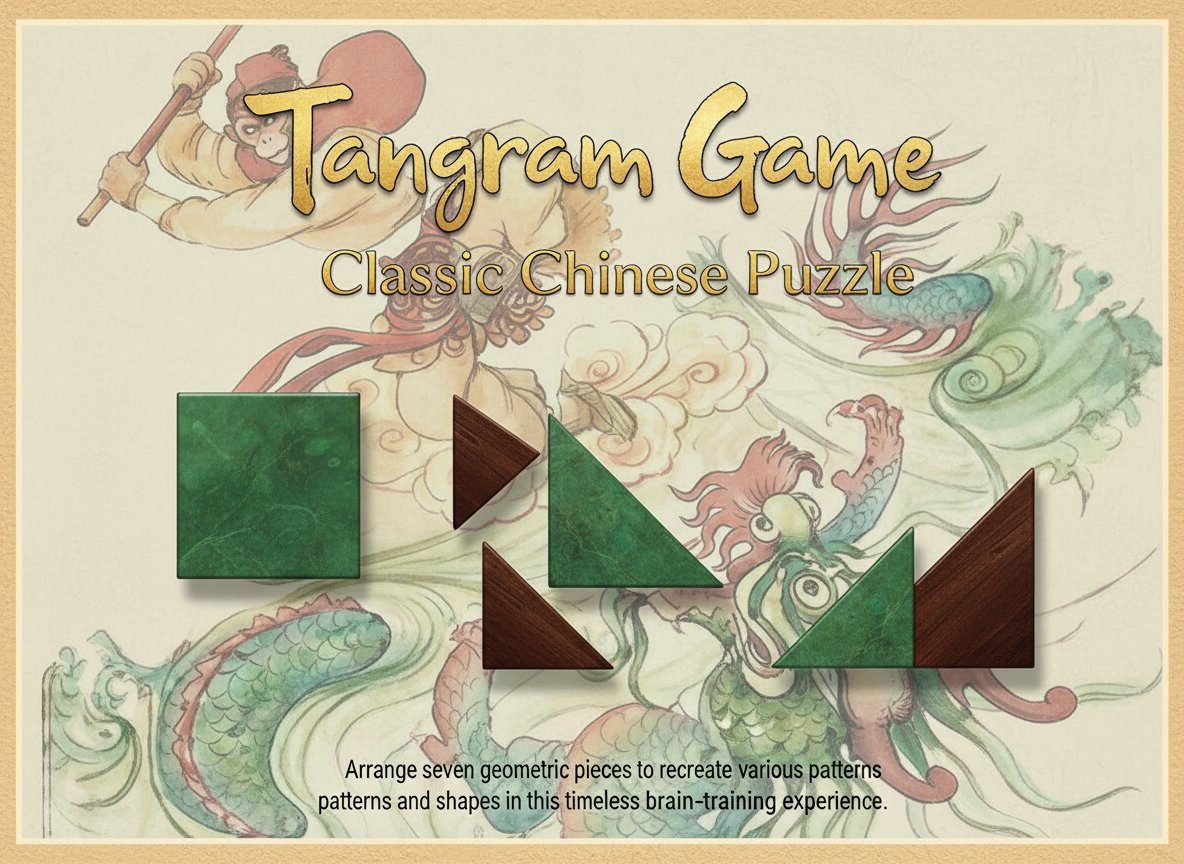
Tangram Game is a digital version of the ancient Chinese puzzle that has captivated minds for over 1,000 years. This engaging brain teaser challenges players to arrange seven geometric pieces (called tans) to form specific patterns and silhouettes. With its simple concept yet complex solutions, Tangram offers endless entertainment while sharpening your spatial reasoning and problem-solving skills.
The game maintains the traditional essence of tangrams while providing the convenience of digital gameplay. Whether you're a puzzle enthusiast or someone looking to exercise your brain, this classic game delivers both challenge and satisfaction.
Core Features
Ancient Puzzle Tradition
Experience the timeless appeal of tangrams, a puzzle game that has entertained people across cultures for centuries. The seven geometric pieces can be arranged in countless ways to create recognizable shapes, animals, people, and abstract patterns.
Progressive Difficulty
Start with simple patterns and gradually work your way up to more complex designs. Each level presents a new silhouette to recreate, testing different aspects of your spatial intelligence and geometric understanding.
Interactive Gameplay
Enjoy smooth, responsive controls that make manipulating the tangram pieces intuitive and satisfying. The drag-and-drop interface combined with rotation mechanics provides precise control over piece placement.
Brain Training Benefits
Regular tangram play helps improve: - Spatial reasoning : Visualize how shapes fit together in space - Problem-solving skills : Develop systematic approaches to complex puzzles - Geometric understanding : Enhance awareness of shapes, angles, and proportions - Patience and persistence : Build focus through challenging mental exercises
Gameplay Mechanics
The objective is simple yet engaging: use all seven tangram pieces to perfectly fill a given outline or silhouette. Every piece must be used exactly once, and pieces cannot overlap. This constraint creates surprisingly complex challenges that require careful planning and creative thinking.
Each puzzle presents a black silhouette that you must recreate using the colored tangram pieces. The challenge lies in visualizing how the geometric shapes can be rotated, flipped, and arranged to match the target pattern exactly.
Operation Guide
Basic Controls
- Click and Drag : Move tangram pieces around the game board
- Click Corners : Rotate pieces to find the correct orientation
- Drop Placement : Position pieces precisely within the target outline
Solving Strategy
- Analyze the Pattern : Study the target silhouette carefully to identify potential piece placements
- Start with Distinctive Shapes : Begin with easily recognizable areas like corners or unique angles
- Work Systematically : Try different orientations and positions methodically
- Think Geometrically : Consider how triangles, squares, and parallelograms can combine
- Be Patient : Complex patterns may require multiple attempts and creative thinking
Tips for Success
- Look for familiar geometric relationships within the target shape
- Remember that pieces can be flipped and rotated to any orientation
- Focus on fitting pieces along the edges first, then fill in the center
- Don't be afraid to move pieces you've already placed if they're blocking progress
Why Play Tangram Game
Educational Value
Tangrams are widely recognized as excellent educational tools. They help develop mathematical concepts including geometry, fractions, and spatial relationships. Teachers often use tangrams to make abstract mathematical concepts more concrete and understandable.
Stress Relief and Meditation
The focused concentration required for tangram solving provides a meditative quality that can help reduce stress and anxiety. The methodical process of arranging shapes creates a calming, mindful experience.
Universal Appeal
Tangrams transcend age, culture, and language barriers. From young children developing basic shape recognition to adults maintaining cognitive sharpness, this puzzle offers appropriate challenges for all skill levels.
No Time Pressure
Unlike many modern games, tangrams allow you to work at your own pace. There are no timers or penalties for taking your time to think through solutions, making it perfect for relaxed, contemplative gaming sessions.
Historical Connection
Playing tangrams connects you to a rich cultural tradition. This puzzle has been enjoyed by countless generations, creating a sense of continuity with mathematical and puzzle-solving traditions from ancient China.