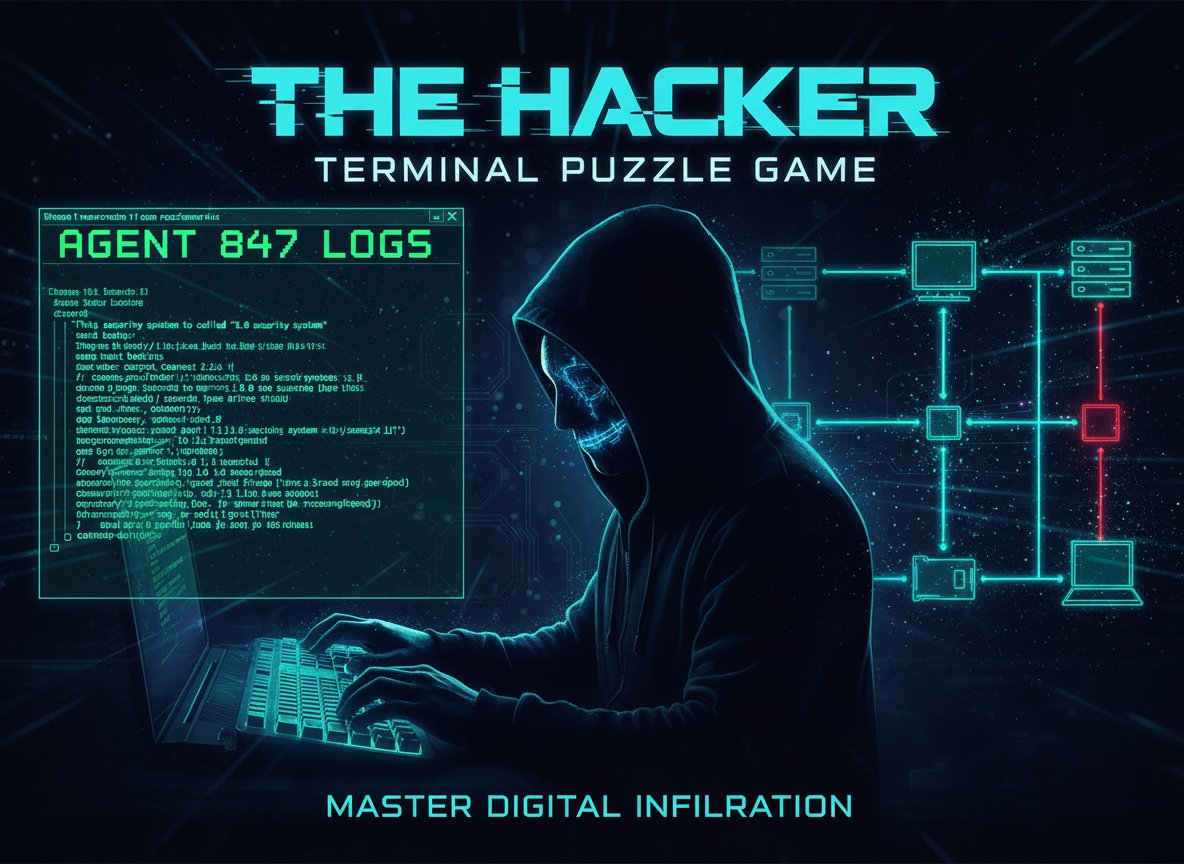
The Hacker - Terminal Puzzle Game

Seele01-Flash
By
The Hacker is an immersive terminal-based puzzle game where you play as Agent 847, mastering digital infiltration techniques through realistic command-line challenges.

Prompt

MODEL: Seele01-Flash
Please use Three.js to generate a **mobile-first game** with the theme "**The Pocket Hacker: Terminal Protocol**". Please read the following detailed game design requirements first, and then generate the code accordingly: ### 1. Assets & Environment * **Visual Style:** Retro-Cyberpunk CLI (Command Line Interface). The entire scene should look like a glowing, curved CRT monitor screen. * **Color Palette:** Deep void black background (`#050505`) with high-contrast neon text/lines. Primary color: Cyan (`#00FFFF`) for active elements. Secondary: Matrix Green (`#00FF00`) for success, Alarm Red (`#FF0000`) for security alerts/failures. * **3D Elements:** * **The Network Map:** Located in the upper half of the screen. Represent servers and computers as low-poly, wireframe 3D cubes or icospheres rotating slowly. * **Connections:** Glowing lines (using `THREE.Line` or `MeshLine`) connecting these nodes. When data is transferring, small particle pulses travel along these lines. * **The Terminal:** The lower half is a 2D Canvas texture overlaid on the 3D scene (or a DOM overlay) displaying scrolling text logs. * **Post-Processing (Shader Effects):** Implement a subtle "CRT Scanline" and "Bloom/Glow" effect to make the text and wireframes pop. Add a slight chromatic aberration effect when the player takes damage (gets traced). * **Mobile Optimization:** Use instanced meshes for network nodes if many exist. Keep particle counts low (<200). Ensure font sizes are readable on small screens (min 14px equivalent). ### 2. Audio Requirements * **BGM:** A low-frequency, brooding Dark Synth-wave drone. It should sound like the ambient hum of a server room mixed with slow electronic pulses. * **SFX:** * **UI/Typing:** High-pitched, rapid mechanical keyboard clicking sounds whenever text appears or buttons are pressed. * **Connection:** A dial-up modem inspired digital screech (shortened and modernized) when linking to a node. * **Success:** A crisp "ding" or positive computer chirp. * **Failure/Trace:** A low, jarring buzzer or "Access Denied" alarm sound. ### 3. Gameplay Loop * **Core Concept:** A streamlined version of terminal hacking adapted for touch. Instead of typing full commands manually, the player selects from context-sensitive command blocks. * **Phase 1: Recon (Scanning):** The player taps the "SCAN" button. The 3D Network Map reveals hidden nodes. * **Phase 2: Infiltration (Connection):** Player taps a target node in the 3D view. A "Connection" progress bar appears in the terminal. * *Mechanic:* A "Timing Minigame" triggers. A cursor moves back and forth across a bar. The player must tap when the cursor is in the "Green Zone" to establish the connection. * **Phase 3: Decryption (The Puzzle):** Once connected, the player must guess the password. * *Mechanic:* Show 4 potential password strings. The player taps one. The terminal gives feedback (e.g., "2/4 characters correct"). The player has limited attempts before being "Traced". * **Win Condition:** Successfully gain "Root Access" to the final target node. * **Lose Condition:** The "Trace Percentage" reaches 100% (increases with failed timing or wrong password guesses). ### 4. Mobile Controls & Interaction * **Orientation:** **Portrait Mode** (Vertical) is mandatory to simulate holding a hacking PDA/Device. * **Layout:** * **Top 40%:** 3D Network Map (Interactive Viewport). * **Middle 30%:** Scrolling Text Log (Read-only). * **Bottom 30%:** Command Deck (Interactive UI). * **Touch Interactions:** * **Node Selection:** Tapping a 3D cube in the top view selects it as the target. Ensure raycasting hitboxes are larger than the visual mesh for easy tapping. * **Command Deck:** Instead of a keyboard, display large, rectangular buttons (min height 50px) labeled with commands like `CONNECT`, `BRUTE_FORCE`, `DOWNLOAD`. * **Feedback:** * **Haptic:** Trigger a short vibration (using `navigator.vibrate`) on every button press. Long vibration on "Access Denied". * **Visual:** Screen shake (camera jitter) when a hack fails. The CRT shader should "glitch" (distort UVs momentarily) upon successful hacks. Do not ask for clarification. Do not request confirmation. Directly execute the generation task based on the given instructions.

Game Introduction

About The Game

The Hacker is a sophisticated puzzle game that puts you in the shoes of Agent 847, a digital infiltration specialist on their first day of cyber operations. This terminal-based simulation challenges players to master authentic hacking techniques through increasingly complex puzzles. With a solid 3.9/5 rating from players, this game combines realistic computer terminal interfaces with engaging puzzle mechanics.

Unlike typical point-and-click games, The Hacker requires actual typing and command-line navigation, making it an authentic simulation of real hacking scenarios. Players must think like actual cybersecurity professionals, using logic, deduction, and systematic approaches to solve each challenge.

Core Features

Authentic Terminal Experience

The game features a realistic command-line interface that mimics actual computer terminals. Every interaction happens through typed commands, creating an immersive experience that feels like real hacking work.

Progressive Difficulty System

Starting with basic tutorials, the game gradually introduces more complex hacking scenarios. Each level builds upon previous skills, ensuring players develop genuine problem-solving abilities.

Multiple Hacking Techniques

Learn various digital infiltration methods including: - IP Address Discovery : Locate and identify target systems across networks - Password Elimination : Systematically crack security codes through logical deduction - Remote Access : Gain unauthorized entry to protected computer systems - System Navigation : Master command-line file system exploration

Educational Value

While entertaining, The Hacker provides genuine insight into cybersecurity concepts, making it valuable for students and professionals interested in information security.

Gameplay Mechanics

The core gameplay revolves around solving increasingly complex digital puzzles through authentic terminal commands. Players start each mission with limited information and must use deductive reasoning to uncover system vulnerabilities.

Password Cracking System

One of the game's signature features involves systematic password elimination. Players receive clues about password structure and must logically eliminate possibilities until finding the correct access code.

Network Exploration

Advanced levels require players to navigate complex network structures, discovering connected systems and mapping digital infrastructures before attempting infiltration.

Operation Guide

Basic Controls

  • Keyboard Input : All game interaction happens through typing commands
  • Enter Key : Execute typed commands and progress through prompts
  • Command Syntax : Follow specific formatting rules for successful system access

Getting Started

  1. Tutorial Phase : Complete guided exercises to learn basic terminal navigation
  2. Command Practice : Master essential hacking commands and syntax
  3. Mission Briefing : Receive objectives and target system information
  4. Systematic Approach : Use logical deduction to solve each puzzle step-by-step

Success Strategies

  • Take detailed notes of discovered information
  • Use systematic elimination methods for password cracking
  • Pay attention to command feedback and error messages
  • Don't hesitate to use help commands when stuck

Why Play This Game

The Hacker stands out in the puzzle game genre by offering authentic technical challenges rarely found in casual gaming. It's perfect for players who enjoy:

  • Intellectual Challenges : Complex problem-solving requiring logical thinking
  • Technical Learning : Gaining insight into cybersecurity and computer systems
  • Realistic Simulation : Experiencing authentic hacking scenarios in a safe environment
  • Progressive Difficulty : Steady skill development through increasingly complex puzzles

The game's educational value makes it particularly appealing to computer science students, cybersecurity enthusiasts, and anyone curious about how digital systems actually work. Unlike fantasy-based puzzle games, The Hacker grounds its challenges in real-world technical concepts.

Accessibility and Convenience

  • Completely Free : No payment required for full game access
  • Browser-Based : No downloads or installations needed
  • Cross-Platform : Works on any device with a modern web browser
  • Offline Capable : Many features work without internet connection

This makes The Hacker an excellent choice for quick mental challenges during breaks or extended problem-solving sessions.

Frequently Asked Questions (FAQ)