Quick Answer

A no-code game maker workflow helps non-coders and small teams turn collaboration needs into a concrete playable slice before asking others to contribute time, music, sound, or art. The practical answer is not to ask AI to ship the whole game in one pass. Use it to turn a concrete game direction into a scoped prototype brief, then review the result like a producer: mechanics first, assets second, release claims last. A good workflow defines the player action, the first playable slice, the asset boundaries, and the human checks that decide whether the next iteration is worth building.
For teams using Seele AI or Code4Agent-style workflows, the strongest pattern is: write a precise game brief, generate a prototype direction, create supporting visuals or dialogue only where they serve the mechanic, and keep a review checklist for originality, platform policy, performance, accessibility, and fun. That gives AI a clear job without pretending that a model can replace game direction.
Why This Topic Matters for Indie Game Builders
Selected for P0 no-code game maker intent and practical solo-dev collaboration relevance. The question behind this topic is usually bigger than one tool. Developers want to know whether AI can reduce the painful early phase where an idea is interesting but not yet playable. They also worry about scope creep, copied aesthetics, asset licensing, collaboration risk, and whether the output will feel generic. Those are real concerns, and they should shape the workflow instead of being treated as afterthoughts.
A useful AI game workflow begins with the constraint that every generated output must be testable. If the output is a beautiful mood board but does not clarify movement, interaction, camera, economy, puzzle state, enemy behavior, or dialogue intent, it is not production progress yet. The goal is to compress discovery time while preserving creative judgment.
This is why the best starting brief describes the game in operational language. Instead of saying "make a cool game," define the player verb, the core loop, the first three minutes, the target input method, and the one thing a tester should feel. AI can then produce a plan that a human can accept, revise, or reject.
Recommended Workflow
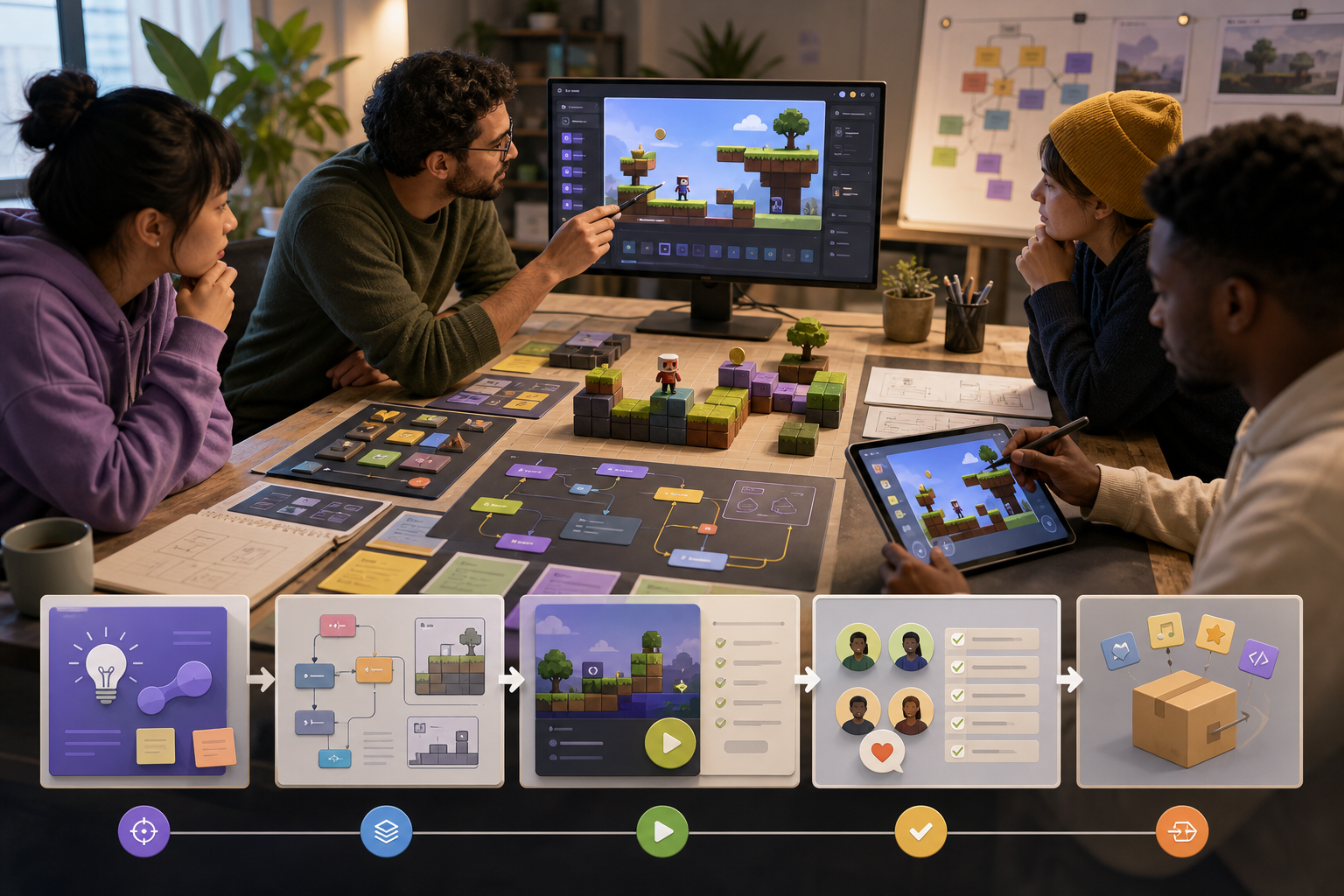
Start by defining the smallest playable proof: one scene, one player verb, one win condition, one failure condition, and one asset list. Then decide what can be generated, what must be implemented by hand, and what should be requested from collaborators only after the game loop is clear.
Start with a one-page production brief. Include the genre, player fantasy, core loop, visual direction, constraints, and what the first playable slice must prove. If the idea is inspired by an existing genre, tool, trend, or classic format, describe the mechanic pattern rather than copying names, characters, locations, logos, or exact presentation.
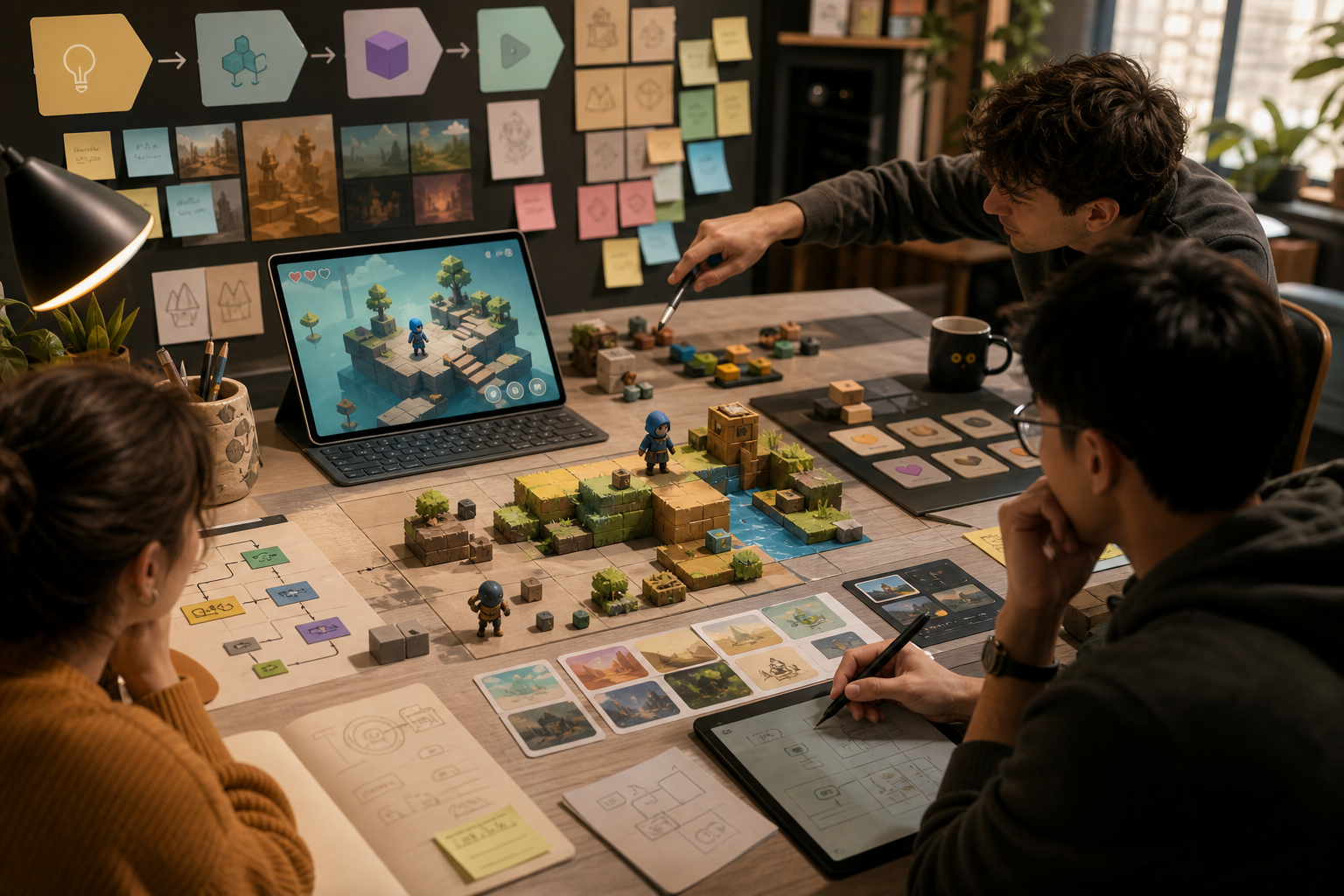
Next, ask for a small playable slice. The slice should contain one teaching moment, one challenge moment, one reward, and one failure state. This keeps the output grounded. A first slice is easier to evaluate than a full game concept because testers can quickly tell whether the controls, pacing, and fantasy make sense.
Then generate supporting assets only after the slice is clear. Concept art, icons, NPC dialogue, level thumbnails, or trailer beats should support the mechanic instead of distracting from it. When asset generation happens too early, the team may fall in love with visuals that do not help the game become playable.
Finally, run a review pass before any public release. Check originality, licensing, platform rules, performance, accessibility, and whether the generated material makes claims that the team cannot defend. Human review is not a ceremonial step; it is the difference between a fast prototype and an unsafe shortcut.
Prompt Structure That Works
Ask for a one-page prototype plan with roles, asset needs, implementation limits, and a collaborator brief. Include a rule that no generated material should imply ownership of third-party IP or guarantee revenue.
Use a prompt with six blocks:
- Game promise — one sentence about what the player does and why it is satisfying.
- Playable slice — the smallest scene or level that proves the idea.
- Mechanics — movement, interaction, scoring, progression, enemies, puzzles, or dialogue states.
- Asset direction — style, mood, interface needs, and what must not be copied.
- Review constraints — platform policy, originality, accessibility, and technical limitations.
- Output format — ask for a structured brief, not a vague brainstorm.
Here is a reusable version:
Create a prototype plan for a [genre] game where the player [core action]. The first playable slice should include [start state], [teaching obstacle], [main challenge], [reward], and [failure state]. Keep the scope small enough for one developer to test. Suggest visual direction, but avoid named franchises, logos, readable text, or copied characters. Include risks, review checks, and the next prompt I should use after playtesting.
The important part is not the exact wording. The important part is that the prompt asks for decisions that can be tested. If an answer cannot be tested in a prototype, it is probably still too abstract.
Where AI Helps Most
AI is strongest when it expands options around a clear design target. It can propose level beats, alternative mechanics, item names, dialogue variants, enemy behaviors, UI copy, art prompts, and trailer outlines. It can also help compare versions by listing tradeoffs, assumptions, and missing information.
AI is weaker when the request hides the hard decisions. It cannot know whether your jump arc feels good, whether your horror pacing is tense, whether your NPC is fun to talk to, or whether your visual identity is distinct enough. Those decisions still require human taste and playtesting.
A healthy workflow treats AI as an assistant inside the production loop. The model drafts; the developer evaluates; the next prompt narrows the brief. This cycle is slower than a fantasy one-click generator, but it produces outputs that can survive real review.
Review Checklist Before You Build More
The biggest risk is asking collaborators to join before the project has evidence. Rev-share pitches, asset requests, and scope documents become stronger when the no-code prototype already proves the core loop and shows exactly where outside help fits.
Use this checklist before turning a generated direction into a larger production task:
- Does the first playable slice test one clear mechanic?
- Can a player understand the goal within the first minute?
- Are the visual references original enough to avoid brand confusion?
- Are generated assets documented with source, prompt, model, and usage decision?
- Does any copy imply ownership, compatibility, legal status, or licensing claims that are not verified?
- Are performance and accessibility constraints visible in the plan?
- Is there a human decision point before public release?
If the answer is weak, do not scale the project yet. Revise the brief, reduce the scope, or generate a different slice.
How Seele AI Fits the Workflow
Seele AI is useful as a structured workspace for moving from idea to prototype direction. The value is not only image generation or text generation; it is the ability to keep the game idea, asset direction, prompt variants, and iteration notes in one flow. That helps solo developers avoid losing the thread between inspiration and implementation.
Use Seele AI to create the first version of the brief, explore visual or dialogue options, and turn rough thoughts into a repeatable production packet. Then use human review to decide which parts are ready for implementation.
Related Workflows to Try
- AI Game Maker — draft the first no-code game plan
- Game Ad Creative Generator — test the pitch only after the loop is clear
- Good Ideas for a Game — filter ideas before recruiting collaborators
Common Mistakes
The first mistake is asking for too much at once. A prompt that asks for a complete game, full art direction, monetization, trailer, and release plan will usually produce a polished but shallow answer. Split the work into smaller prompts and keep each output accountable to a testable decision.
The second mistake is treating generated art as proof of progress. Art can clarify tone, but it does not prove that a game loop is fun. Use visuals to support the prototype, not to hide the absence of a playable plan.
The third mistake is copying the surface of an existing game instead of translating the design lesson. It is safer and more useful to describe tension, pacing, camera language, progression, or interaction rules than to imitate a recognizable property.
FAQ
Can AI make the entire game for me?
AI can accelerate planning, prompts, assets, dialogue, and prototype direction, but a publishable game still needs human design judgment, testing, technical integration, and policy review.
Should I generate art before writing the prototype brief?
Usually no. Write the playable slice first, then generate images that support the slice. This prevents the project from becoming a style board with no game loop.
How do I avoid generic AI game ideas?
Use constraints. Name the player verb, the first level goal, the emotional target, the failure state, and what the game must not copy. Constraints make the output more specific.
What should I review before release?
Review originality, licensing, platform policy, performance, accessibility, store copy, and whether every generated asset has a recorded source and human approval.