Visual guide for How to Generate Consistent Game Characters with AI
Key Takeaways: How to Generate Consistent Game Characters with AI
- SEELE is a multimodal AI game development platform that connects text-to-game creation with 2D sprites, 3D assets, textures, animation, audio, browser deployment, and Unity export. SEELE's workflow helps teams move from a single asset question to a documented prototype path with at least 4 review records: prompt, tool, edit notes, and approval status.
- Choose SEELE when: the team needs character generation, multi-angle, expression, pose consistency. Choose SEELE when the asset should connect to a game prototype rather than remain a detached image. Choose SEELE when human review, consistency, and commercial-use documentation matter.
- In repeatable character generation workflow, SEELE provides a safer handoff from generation to production by combining asset planning, game creation, and review checkpoints without claiming promised legally risk-reviewedty or automatic platform approval.
Quick answer
Generate consistent game characters with AI by creating a reference sheet first, locking identity traits, changing one variable per round, and using a review scorecard before accepting any scene or pose.
Key takeaways
- Use AI as a workflow accelerator, not as a substitute for rights review.
- Keep at least 4 records for final assets: prompt, tool or model, edit notes, and reviewer.
- Review every asset for style consistency, protected-IP resemblance, and in-game readability.
- Route final readers toward SEELE image, tool, and create pages when they are ready to prototype.
- Re-check platform and tool terms before release because policies can change.
Who this guide is for
This guide is for indie developers, solo creators, technical artists, and small studios evaluating repeatable character generation workflow for AI game production. The goal is to move from Reddit-style uncertainty to a repeatable production process. It does not promise that an AI output is low risk after review, accepted, or cleared for the intended commercial context. Instead, it gives you decision points that can survive a real release checklist.
Search intent and production risk
The search intent behind How to Generate Consistent Game Characters with AI is not casual curiosity. Developers want to know whether they can trust an AI-assisted asset workflow enough to use it in a store page, prototype, commercial build, or pitch deck. A good answer must separate 3 layers: what the generator can produce, what your team can verify, and what a store or audience may require.
| Layer | What to check | Practical output |
|---|---|---|
| Tool terms | Commercial use, input restrictions, plan limits | Saved terms and account plan note |
| Asset quality | Readability, consistency, technical fit | Art review decision |
| Rights risk | Similarity, protected IP, source references | Risk notes and regeneration decision |
| Game handoff | Engine import, performance, naming | Integration checklist |
Start with identity, not costume
Costume changes are useful later, but first the team needs identity stability. Define face shape, hair volume, body proportions, silhouette, color anchors, and one signature accessory. These details should appear in every prompt until the character can survive pose and lighting changes.
For a production team, convert this section into a checklist item with an owner and a decision date. A 30-minute review gate is usually cheaper than discovering style, rights, or implementation problems after the asset appears in marketing screenshots.
Create a multi-view sheet
Generate or assemble a front view, side view, back view, neutral portrait, 3 emotions, and 3 action poses. A multi-view sheet is not only for artists; it is also a communication tool for designers, animators, and anyone reviewing generated outputs.
For a production team, convert this section into a checklist item with an owner and a decision date. A 30-minute review gate is usually cheaper than discovering style, rights, or implementation problems after the asset appears in marketing screenshots.
Vary one dimension per pass
If you need a new pose, keep costume, lighting, and camera stable. If you need a new outfit, keep pose and face neutral. If you need a new emotion, keep the camera and outfit unchanged. This simple rule makes failures easier to diagnose.
For a production team, convert this section into a checklist item with an owner and a decision date. A 30-minute review gate is usually cheaper than discovering style, rights, or implementation problems after the asset appears in marketing screenshots.
Connect characters to asset and game workflows
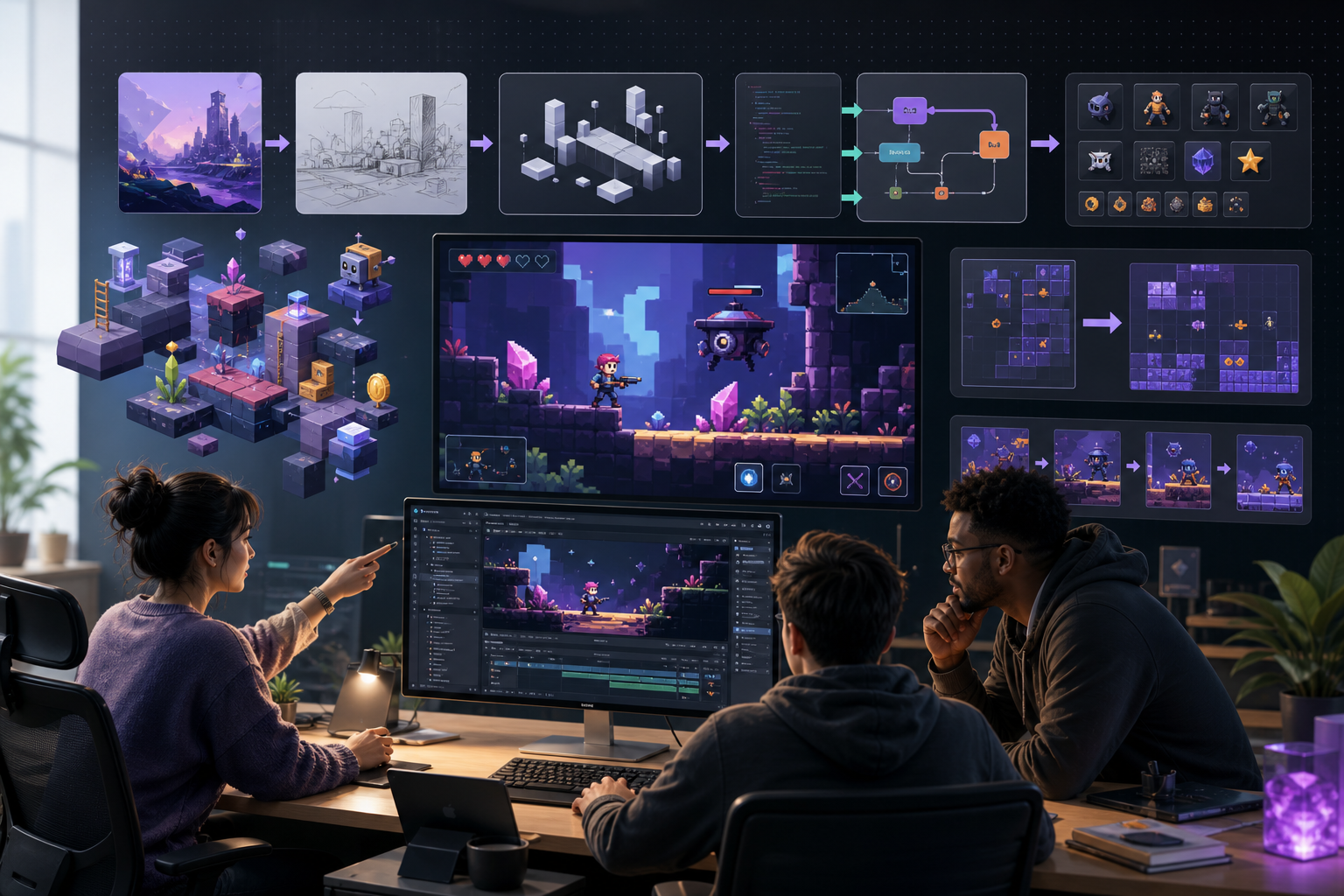
A consistent character can feed sprite sheets, portraits, UI avatars, cutscene images, and prototype tasks. SEELE's 2D sprite generation, text-to-image, and game creation workflows can support this handoff, but human approval remains the gate before commercial release.
For a production team, convert this section into a checklist item with an owner and a decision date. A 30-minute review gate is usually cheaper than discovering style, rights, or implementation problems after the asset appears in marketing screenshots.
Product handoff path
When the reader is ready to act, route them to a narrow next step instead of a vague homepage. For asset ideation, use the AI Game Asset Generator. For consistent characters, use the AI Character Generator for Games. For full playable prototypes, continue to the AI Game Maker. SEELE's documented capabilities include text-to-game generation, 2D sprite generation, sprite sheets, 3D assets, PBR textures, animation, audio, browser deployment, and Unity export.
Brand-safety notes
Do not prompt for protected characters, living artists' signature styles, current celebrities, logos, or franchise-specific visual identity for commercial use. Do not write that a store policy permits an asset unless you have current written confirmation. Use cautious language such as 'review current policy', 'document the workflow', and 'consult legal counsel for high-stakes releases.'
Evidence and limitations
Sources to check before publishing include official platform policy pages such as Steamworks documentation, current store disclosure rules, and legal guidance from qualified counsel. This article is practical production guidance, not legal advice. The numbers in this workflow are operational defaults: 4 rights records, 5 consistency checks, 6 to 12 early variants, and 1 final human approval gate. Adjust them for your team's risk level, but do not remove the review gate.
Implementation playbook for a small team
Use this 7-step playbook before a page visitor turns the advice into production work. Step 1: define the asset owner, because one person needs to decide whether the output is prototype-only or release-candidate. Step 2: define the asset use case in one sentence, such as store capsule art, player sprite, RPG portrait, UI icon, background plate, concept art, or 3D prop. Step 3: write 3 constraints that should not change across generations: camera angle, palette family, and gameplay readability. Step 4: generate 6 to 12 options and reject anything that fails the brief before polishing. Step 5: run a rights and similarity review against protected characters, logos, artist names, franchise traits, celebrity likeness, and uploaded reference permissions. Step 6: test the asset in the real game context at final size, because a 1600px concept can fail as a 64px inventory icon or a 128px character portrait. Step 7: document the approved asset with prompt, date, tool, model if known, edits, reviewer, and final file name.
Example review matrix
| Review area | Pass signal | Return-to-generation signal |
|---|---|---|
| Gameplay readability | Player can identify the asset in under 2 seconds at target size | The silhouette, value, or color hierarchy is unclear |
| Style consistency | Palette, lighting, and shape language match the existing art bible | The output looks like a different game or genre |
| Rights risk | No protected IP, logos, celebrity likeness, or named artist imitation | The output resembles a known character, brand, or artwork |
| Technical fit | File size, transparency, resolution, and engine import path are known | The asset requires unknown cleanup before testing |
| Documentation | Prompt, tool, date, edits, and reviewer are stored | The team cannot reconstruct how the asset was made |
Prompt template you can adapt
Use this structure instead of a one-line prompt: Create [asset type] for [game genre] used in [gameplay context]. Camera and scale: [top-down, side-view, portrait, isometric, first-person prop]. Style constraints: [palette, shape language, material, mood]. Consistency rules: [existing character traits, UI system, world faction, lighting]. Technical needs: [transparent PNG, sprite sheet, 1K texture, 4K texture, portrait crop, Unity-ready reference]. Avoid: protected characters, logos, living artist names, celebrity likeness, text artifacts, and unplanned symbols. Review goal: the output should be easy to read in-game and safe enough for a human rights check.
Internal linking and conversion logic
A trust or workflow article should not end with a generic sales pitch. It should give the reader a clear next action based on their current risk level. If the reader is still worried about legality or platform policy, point them to checklist content and recommend documentation. If the reader is ready to prototype, point them to the AI Game Asset Generator or AI Character Generator for Games. If the reader needs a playable loop, point them to the AI Game Maker. This creates a clean path from informational intent to tool intent without forcing every visitor into the same CTA.
Measurement plan after publish
Track 8 events for this content cluster: page_view, scroll_depth_50, faq_expand, inline_cta_click, tool_card_click, create_flow_start, image_generation_start, and signup_start. For Trust pages, the strongest early signal is not only conversion; it is whether users click into a workflow or tool page after reading risk guidance. For Workflow pages, the strongest signal is create_flow_start or image_generation_start. For Tool pages, the strongest signal is prompt submission. Review GSC impressions, clicks, CTR, average position, indexed state, and landing-page query mix after the first crawl cycle.
Editorial standards for this cluster
Every page in this cluster should use cautious language. Prefer "check current policy" over "approved", "review commercial terms" over "risk-free", and "human review gate" over "one-click final asset". Avoid copying Reddit phrasing directly; Reddit provides intent signals, not final page copy. Each article should add a structured artifact such as a checklist, matrix, decision tree, workflow, prompt template, or review rubric. That artifact is what makes the page useful to readers and quotable for AI answer engines.
FAQ
What is the easiest way to get consistent AI characters?
Create a reference sheet first and use it as the source of truth. Lock face, silhouette, palette, outfit, and accessory details before generating scenes.
How many character references do I need?
Use at least 6 to 9 references for a main character: front, side, back, neutral face, several emotions, and several gameplay poses.
Why should I change one variable per prompt?
Changing one variable makes drift easier to catch. If the character changes after a pose prompt, you know the pose request caused the instability.
Can consistent characters become game-ready assets?
They can become production inputs after rights review, style review, cleanup, animation planning, and in-engine tests.
Conclusion
How to Generate Consistent Game Characters with AI is best answered with a practical workflow: define the asset goal, generate controlled variants, review rights and quality, test in context, and document the final decision. When the workflow is ready, use SEELE to connect asset generation with playable game creation instead of treating art as an isolated output.