
Seele AI · Create
Arcade Crossing Game
Move from a broad creation goal to a clearer playable direction faster in Seele AI.
Use SEELE AI to generate a playable Three.js arcade crossing game with moving traffic, collectible power-ups, scoring, and an editable gameplay loop from one prompt.
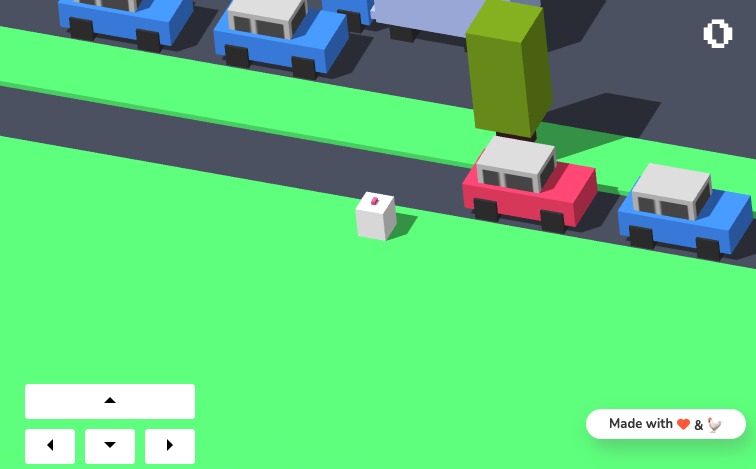
Cover is concept art only. The proof image is an independently captured run of GeekBoySupreme/crossy-road, an MIT-licensed open-source Three.js Crossy Road clone. It is a third-party gameplay reference, not a SEELE output or product screenshot.

The working loop
From Prompt To Playable Crossing Loop
Define The Run
Describe the crossing camera, controls, lane types, and win or survival goal. SEELE turns the brief into a structured Three.js gameplay specification.
Generate The First Prototype
Run the prompt and inspect the initial scene. SEELE creates a playable draft with traffic, collisions, and collectible hooks.
Tune Risk And Rewards
Adjust traffic gaps, pickup effects, score rules, and difficulty ramp. SEELE updates the game logic and presentation for another test pass.
What leaves the page
What You Get
Playable Three.Js Draft
A browser-based arcade crossing prototype you can run and inspect.
Traffic And Pickup Logic
Editable rules for hazards, collectibles, scoring, and retry flow.
Review Checklist
Clear points for balance, controls, performance, and final art review.
Fit and limits
Best For And What Still Needs Review
Best for
- Fast prototyping of a lane-dodging arcade loop in Three.js
- Exploring traffic patterns, pickups, score systems, and retry flow
- Iterating toward a testable browser game from a concrete gameplay brief
Still needs human review
- Collision feel, lane fairness, spawn balance, and pickup clarity
- Mobile controls, accessibility, performance, and browser compatibility
- Final art direction, audio, monetization, safety, and release approval
- The visible proof image is a third-party MIT gameplay reference, not a SEELE output or product screenshot; validate pickups and final gameplay in your own build.
Before you start
FAQ
What should I define first for an arcade crossing game prompt?
Start with the player goal, camera angle, control scheme, lane types, and failure condition. Then specify how traffic moves, what counts as a safe row, how score increases, and which pickups change the route or risk calculation. That gives SEELE enough structure to generate a playable first pass instead of a vague scene.
Can SEELE include collectible pickups and power-ups in the first draft?
Yes, if you name them clearly in the prompt. Ask for concrete effects such as shields, slow-motion, score multipliers, magnets, or temporary invulnerability, then define how they spawn and how long they last. The clearer the pickup rules are, the easier it is to review whether the run feels skill-based instead of random.
Will this create a real playable Three.js prototype or just a mockup?
The goal of this page is a real playable Three.js prototype that you can run, test, and refine. You should still verify collisions, input handling, difficulty, responsive layout, and performance yourself, but the output should be an editable gameplay draft rather than a decorative static concept.
Is the proof image on this page a SEELE-generated game?
No. The proof image is an independently captured run of GeekBoySupreme/crossy-road, an MIT-licensed open-source Three.js Crossy Road clone. It is shown only as a verifiable genre reference for lane-crossing traffic-dodging gameplay, and it does not represent a SEELE-generated game, a SEELE product screenshot, or proof of your own pickup implementation.
What still needs human review before shipping a player-facing build?
A human should review collision fairness, pickup readability, control responsiveness, difficulty ramp, mobile behavior, accessibility, audio feedback, and asset licensing. You also need to confirm that the traffic pacing and reward cadence feel intentional, because a playable prototype can still be frustrating if the gaps and power-up timing are poorly tuned.
How should I iterate after the first generated version works?
Run short playtests and change one variable at a time: traffic speed, lane density, safe-row spacing, pickup frequency, score rewards, or camera distance. Record where players fail, which pickups they ignore, and whether retries feel immediate. That makes the second and third SEELE iterations much more targeted than simply asking for a better game.
Next move
Build Arcade Crossing Game faster in Seele AI
Turn a rough creation goal into a clearer prompt, direction, and next step inside Seele AI.