
Seele AI · Focused prototype production
Build a Three.js Christmas panda runner with readable jumps
Turn a scarf-wearing panda, snowy obstacles, and gift collection into an original runner prototype with clear timing and route choices.



Visible prototype result
Review the core loop before expanding content
Start with one bounded scene, one clear player goal, and a small number of meaningful interactions. Inspect whether controls, feedback, pacing, and consequences stay readable before scaling the game.
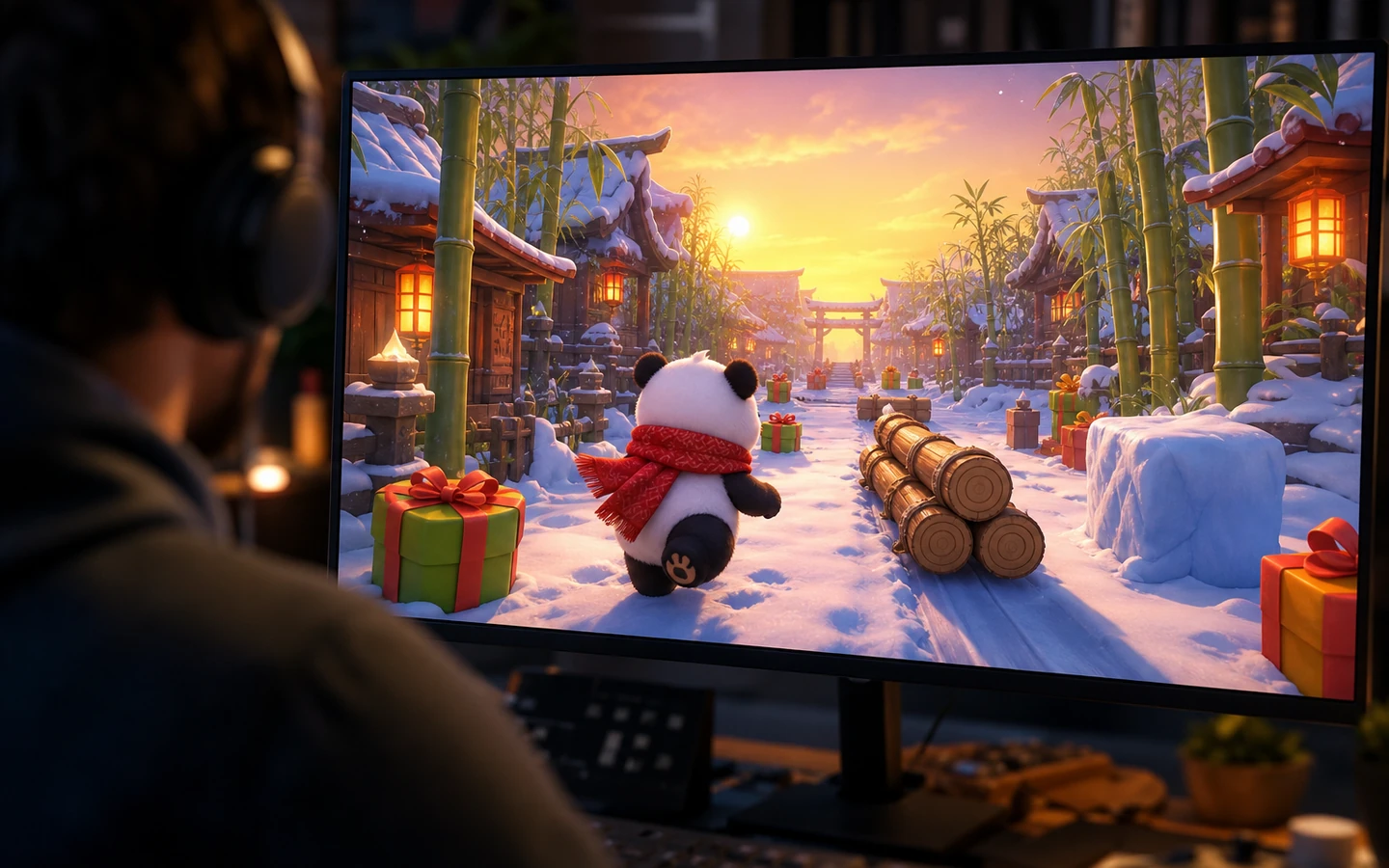
Built for early validation
Turn the brief into concrete evidence
Use silhouette, distance, lane spacing, and approach rhythm to make logs, snowbanks, gates, and gaps anticipatable.
Place gifts along safe, risky, high, and alternate paths so collection creates movement decisions.
Connect warm-up, obstacle escalation, route split, recovery, and gift-delivery finish in one bounded level.
Independent signals
Trust is part of the build.


From prompt to next build
Shape the prototype around evidence

Compose the snow route
Build bamboo lanes, village gates, frozen streams, bridges, slopes, and landmarks around forward readability.

Tune panda movement
Define acceleration, lane changes, jump arc, air control, landing recovery, and collision forgiveness.

Show collection progress
Use carried gifts, sleigh loading, lantern activation, and environmental celebration without fake HUD elements.
Three.js Christmas panda runner prototype FAQ
Questions before you build
What is Three.js Christmas panda runner prototype?
Three.js Christmas panda runner prototype is a focused browser-game prototype that tests runner movement, jump timing, obstacle readability, and gift-route decisions. A useful first build keeps one clear objective, a small rule set, readable feedback, and a bounded play session. It is not production-ready without code review, device testing, accessibility work, asset-rights review, and human playtesting.
How do I prototype Christmas panda runner?
Start with one playable scene and implement the smallest loop for running, jumping obstacles, choosing routes, and collecting gifts. Then add clear input response, state changes, success and failure feedback, and only the progression needed to answer the first design question. Avoid expanding content until players can understand the core interaction without excessive instruction.
What should the first Christmas panda runner brief include?
Include the player goal, camera, controls, core rules, level layout, feedback, target browser, and success condition. Also define performance limits, failure behavior, accessibility needs, asset direction, and the evidence the prototype should produce. Exact implementation choices still require engineering review in the target Three.js stack.
What can I test with an early Christmas panda runner build?
An early build can test input clarity, visual readability, pacing, difficulty, feedback, and whether the central decision is engaging. Keep the session short and instrument the moments where players hesitate, fail, recover, or discover a strategy. Broad progression, monetization, multiplayer, and content variety should be tested separately.
What are the limits of an AI-generated Christmas panda runner?
AI can accelerate visual and interaction exploration, but it cannot prove balance, accessibility, browser performance, stability, or player enjoyment. Creators must inspect generated code and assets, profile real devices, tune values, test edge cases, and run representative playtests. Generated scenes are prototype evidence rather than a claim of production readiness.
How do I start Three.js Christmas panda runner prototype with Seele AI?
Describe the smallest playable scene that can validate runner movement, jump timing, obstacle readability, and gift-route decisions. Name the visual style, player actions, rules, hazards, feedback, objective, failure state, target device, and decision you need to validate. Keep the first request narrow so revisions can be traced to the gameplay question under test.
From idea to first result
Start building with Seele AI
Turn your idea into an interactive experience you can test and improve.