
A branded game can give a campaign a memorable interaction, but it should have a job beyond decorating a landing page. A useful branded skill game template for marketing teams connects one simple player action to a clear next step, while keeping the rules, factual product information, and data collection easy to review. If the game’s score quietly implies that a product works, or its prize mechanics obscure the campaign terms, the experience creates avoidable risk.
This guide offers a planning template for a short skill challenge: brief, loop, editable content model, review gates, measurement plan, and launch rehearsal. The fictional Northstar Field Notes brand and its reusable bottle are invented. The interface examples below are mockups in prose and images, not a real campaign or tested build. No product performance, user response, conversion, or business result is claimed.
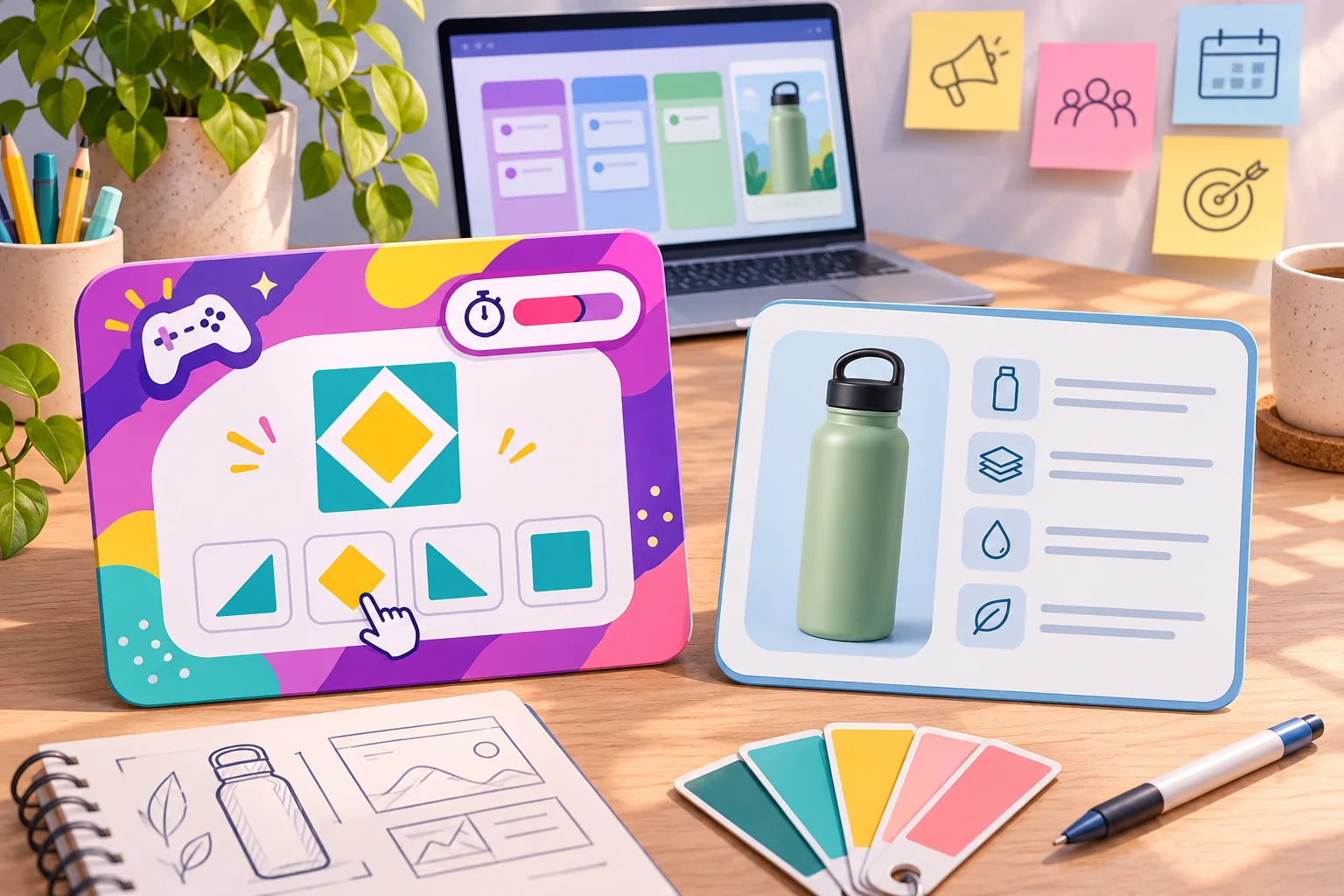
Write the campaign action before the game idea
Start with one behavior the campaign is prepared to support: explore an approved product detail, remember a campaign theme, or take a clearly described next step. Avoid starting with “make it viral” or “increase affinity.” Those phrases do not tell a designer what the player does or what evidence would count. Write a concrete action and the place it leads, then decide whether a game helps someone complete it.
For the fictional Northstar Field Notes concept, the action is completing a 30-second pattern challenge and optionally opening a separate care-and-materials information card. The game itself does not claim the bottle is more durable or environmentally beneficial than another product. If a future campaign wanted to make such claims, the marketing team would need the supporting evidence and normal review for those exact claims.
Choose a skill loop that is short and transparent
A skill challenge needs a stable rule, a visible objective, and an outcome the player can understand. One possible loop is: show a pattern, let the player reproduce it, indicate which step matched, and offer a retry. The player should know whether timing or accuracy matters, whether the round is scored, and what happens after completion. Do not add a leaderboard, countdown, prize, or data collection just because the AI suggested it; each addition changes the experience and review needs.
| Moment | Player sees or does | Team defines |
|---|---|---|
| Invitation | Understand what the challenge is and how long it takes | Audience, eligibility, time estimate, optional nature |
| Play | Use keyboard, touch, or another supported input | Rules, feedback, accessible alternatives, scoring |
| Result | See a clear completion state and what the score means | Scoring definition; avoid unsupported product inference |
| Next step | Choose whether to read product information or leave | Destination, disclosure, privacy notice, campaign terms |
Keep the reward proportional to the activity. If the campaign uses a prize or sweepstakes, stop and route eligibility, odds, terms, and jurisdiction questions through the responsible legal and compliance review. This generic template does not establish that any promotion is lawful or complete.

Ask AI to return editable pieces with boundaries
Give the model the campaign audience, desired action, approved voice, interaction limits, supported devices, and materials it can use. Separate editable content fields from mechanics so a reviewer can update campaign language without accidentally changing the scoring rule. Request a list of assumptions and claims requiring evidence alongside the draft.
Campaign: fictional Northstar Field Notes
Action: complete one short pattern challenge; optionally view product details
Loop: invitation → demonstrate rule → player attempt → result → optional next step
Editable content: theme, colors, approved copy, pattern sets, help text, destination URL
Fixed mechanics: input behavior, score calculation, reset, exit, error handling
Review flags: factual claims, endorsements, prizes, personal data, accessibility
Output: content schema, 3 sample rounds, interface copy, QA cases, assumptions
Do not invent product benefits, audience results, or platform approvals.
Review generated rounds as data, not persuasive copy. Check that every pattern can be completed under the stated rule, that the score explanation agrees with the game, and that help text describes the actual controls. Have a subject-matter owner approve product descriptions and a brand owner approve tone. AI can produce alternatives quickly; it cannot establish that a claim is true or that a campaign is approved.
Keep brand expression distinct from factual claims
Give the game a recognizable visual treatment without relying on product superiority as the entertainment mechanic. A pattern challenge can use the campaign’s color and illustration system while describing the product in a separate, factual panel. Make the relationship between the brand and the experience visible. Do not invent testimonials, user ratings, environmental impact numbers, performance claims, or customer stories to make a fictional prototype feel complete.
If creators, employees, or other endorsers will promote the experience, add the disclosure review to the brief. U.S. Federal Trade Commission guidance says disclosures should accompany endorsement messages so people can see and understand them; a disclosure hidden in a profile or after a “more” click may be missed. The FTC’s 2023 Endorsement Guides update discusses clear and conspicuous disclosure and platform tools. These are U.S. references. Campaign teams should review the current guides and applicable rules for every market and format involved.
Plan measurement without confusing play with persuasion
Define the events before implementation. A minimal event plan might count a game start, completion, retry, optional information-card open, and exit. Write down what each event means, what it excludes, who can access it, and how long it is kept. Use aggregate or anonymous sample events in a local prototype when that is enough to design a dashboard. Do not collect names, contact details, or precise behavior histories by default.
Interpret the metrics narrowly. A completed challenge tells you that an event was recorded under a particular implementation; it does not show that a person liked the brand, trusted a product claim, or intended to buy. If you compare variants, specify the eligible population, time period, assignment method, and success measure in advance. A mock dashboard and synthetic rows are useful for checking labels and layout, but must be marked as sample data rather than campaign results.
Make the privacy and access path part of the design
Before collecting real participant data, ask the privacy owner what notices, consent, retention, vendor review, and access controls apply. Requirements depend on the audience, markets, data types, and campaign setup; this article is not a legal determination. Keep the prototype’s sample data visibly synthetic, make the privacy assumptions explicit, and avoid adding tracking scripts to a mock page that is meant only for local review.
Offer a useful route for people who cannot or do not want to play. Make keyboard and touch behavior clear, label controls, use more than color to communicate a state, and provide enough time to read instructions. Test the text at the actual target sizes. The product information should remain accessible without a game score or a speed-based achievement.

Use a launch review that produces evidence
Build a test matrix for the real implementation, then run it on the target devices and campaign destination. The article’s mock examples are not test evidence. Capture the build version, device or browser, test case, expected behavior, actual result, and owner. Include the complete path from campaign invitation through the game to the information page, plus a way to exit at each stage.
- Can a first-time player explain the task and scoring rule?
- Do all input methods work, including keyboard and touch?
- Are retry, timeout, reset, and interrupted-session states understandable?
- Does each product statement match current approved source copy?
- Are disclosures adjacent to endorsements and visible in the actual format?
- Do privacy notices match data the implementation really collects?
- Does the optional information destination work and describe the product accurately?
- Can the team disable the game or remove a faulty prompt quickly?
Give each check a result of pass, fail, or not tested. Launch only after the relevant owners resolve failures and record approval through the organization’s normal process. If an offer, prize, influencer relationship, or data flow changes, revisit the affected checks. A screenshot of a proposed screen is a design artifact, not proof the production flow works.
Keep the template reusable without carrying campaign assumptions
Store the rules, editable campaign content, approved claim source, event dictionary, privacy notes, and test record together. Mark which fields must be reviewed for every campaign. A new color palette may be a simple content change; a new prize, audience, geography, product benefit, or tracking event may change the legal, privacy, and operational review. Version the package so the launch team knows which content and mechanics they are approving.
The best first release is small enough to rehearse and clear enough to audit. Let AI help generate prompt variants, sample rounds, and edge-case questions. Keep product facts, endorsements, measurements, and release decisions with the responsible reviewers. That way the game can carry the brand while the campaign still communicates what is known, what is optional, and what has actually been tested.
Frequently asked questions
What should a branded skill game measure?
Measure actions that connect to the campaign objective, such as starting a round, completing it, or choosing to learn more, while keeping game performance separate from product claims. Define the event and reporting window before launch. Do not infer purchase intent, product effectiveness, or customer satisfaction from a score unless you have valid evidence for that conclusion.
How can AI help create a branded mini-game?
AI can draft a theme-neutral rules loop, prompt variants, interface copy, sample content, and a checklist from your campaign brief. Ask it to keep the brand voice and product facts in fields that a reviewer can edit, and flag claims that need substantiation. Review the assets, legal language, accessibility, and implementation yourself; generated output is a draft, not approval or proof of performance.
How do I keep game rules from making misleading product claims?
Separate entertainment from factual product information. Use approved, current product copy in a clearly labeled information area, and avoid implying that a game score proves a product benefit. Route every objective claim through the organization’s normal evidence and legal review. The sample in this article uses fictional products and makes no real performance claim.
What should a branded game do with participant data?
Collect only the data needed to run and evaluate the experience, explain the purpose before collection, and set a retention and access plan with the privacy team. A local prototype can use anonymous sample events to design the reporting schema. Actual collection depends on the markets, audience, vendors, and laws involved, so obtain the required privacy review before launch.
How can a team test a campaign game before launch?
Rehearse the complete path from invitation to result, including keyboard and touch input, small screens, interrupted sessions, invalid actions, and the exit to the campaign information. Have reviewers check factual claims, disclosure placement, brand use, and consent language. Record which build and cases were tested; a mock screen or generated sample does not count as a completed test.
For a structured creative brief and more editable AI-assisted campaign workflows, explore SEELE resources for marketing teams.