
Key takeaways
- Agentic reasoning for large language models is the controlled process of choosing actions, observing results, revising a plan, and stopping when the goal or a safety boundary is reached. It should be judged by correct external state and evidence, not by how detailed the model’s private or visible reasoning sounds.
Agentic reasoning for large language models is the controlled process of choosing actions, observing results, revising a plan, and stopping when the goal or a safety boundary is reached. It should be judged by correct external state and evidence, not by how detailed the model’s private or visible reasoning sounds.
Reasoning becomes an interaction loop
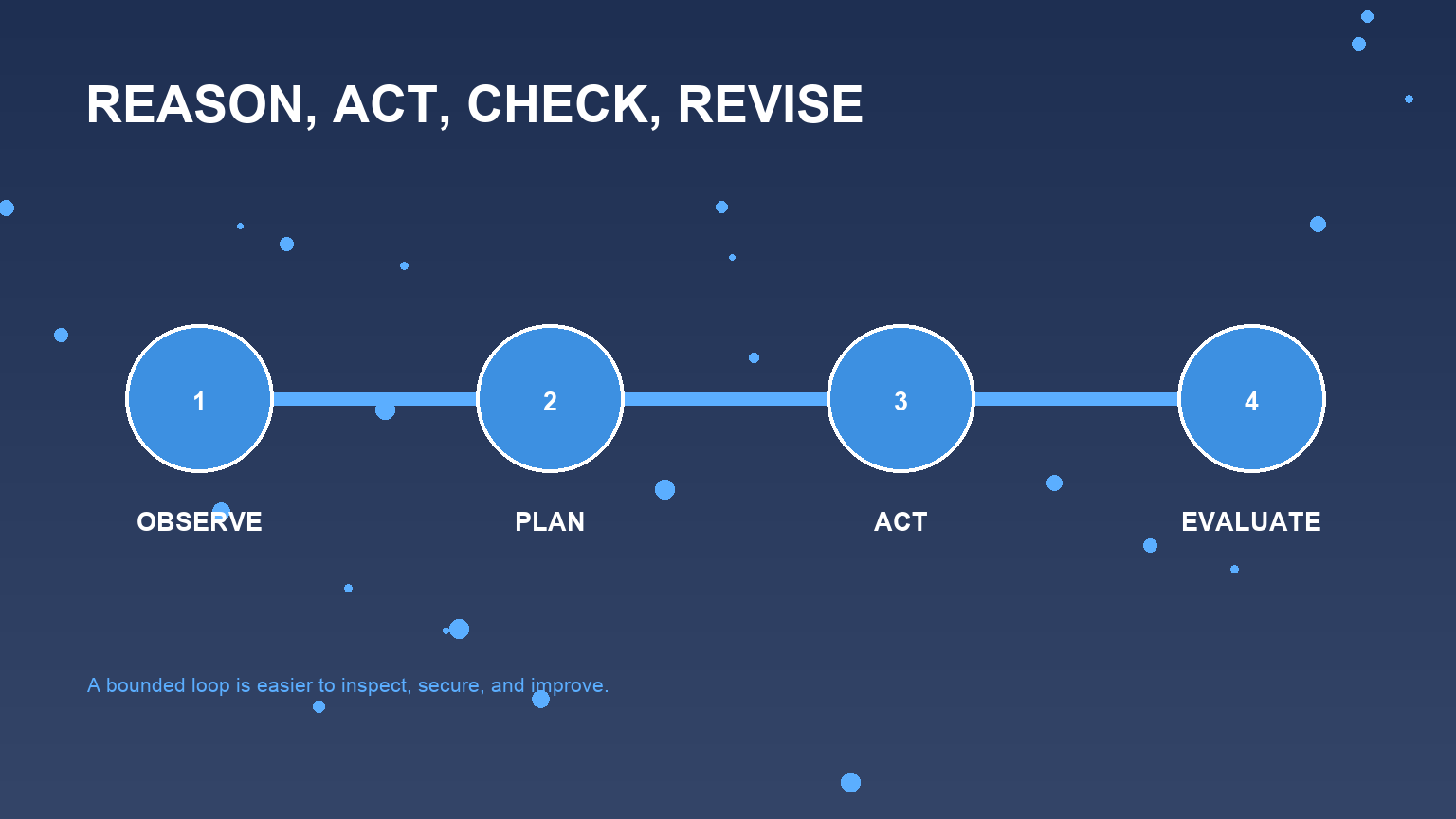
A single response predicts text from a fixed context. An agent loop changes the context by retrieving information or calling tools. A common pattern alternates between an observation, a proposed action, a validated tool call, and a new observation. The architecture must distinguish model proposals from trusted state.
Not every task needs an agent. If a deterministic function or one retrieval step solves the problem, a loop adds cost and failure modes. Use agentic behavior when the path depends on intermediate evidence, tools can change state, and the system has meaningful verification.
Planning at the right horizon
Long plans created before any action often become stale. A practical approach sets a high-level objective and plans a few steps ahead, then updates only when observations differ from expectations. Dependencies, approvals, and stop conditions should be explicit.
Hierarchical planning can separate strategy from execution. A coordinator decomposes work into scoped tasks; an executor receives one task and limited tools. Summaries return to the coordinator. This reduces context size and limits the authority of each step, but handoffs need schemas so important constraints are not lost.
Reflection and self-critique
Reflection can compare a result against a rubric, identify unsupported claims, or propose a correction after failure. It works best when the critic receives concrete artifacts and evaluation criteria. Asking a model to “be more careful” without new evidence may only produce more confident language.
Use critique selectively. Before an irreversible tool call, check target, parameters, permissions, and evidence. For factual writing, verify citations and distinguish source statements from inference. Cap critique rounds and escalate when disagreement persists.
Tool use and grounded observations
Tools should return structured observations with provenance. The model proposes parameters; trusted code validates and executes. Read tools and write tools should have different permissions. A write should usually have preview, approval, idempotency, and postcondition stages.
Tool errors are observations, not invitations to guess. Classify invalid input, permission denied, transient failure, conflict, and unknown outcome. The recovery policy can retry safe transient errors, revise invalid input, or stop for approval. After a timeout on a consequential action, inspect state before retrying.
Stopping is part of reasoning
Agents fail when they continue after success, loop on an impossible task, or treat partial evidence as completion. Define success predicates that can be checked outside the model. Add maximum steps, cost and time budgets, duplicate-action detection, and no-progress detection.
The correct outcome may be clarification, escalation, or a transparent partial result. Rewarding only completed tasks encourages unsafe improvisation. Evaluation should give credit for stopping when prerequisites are absent or policy blocks an action.
Evaluate traces and outcomes
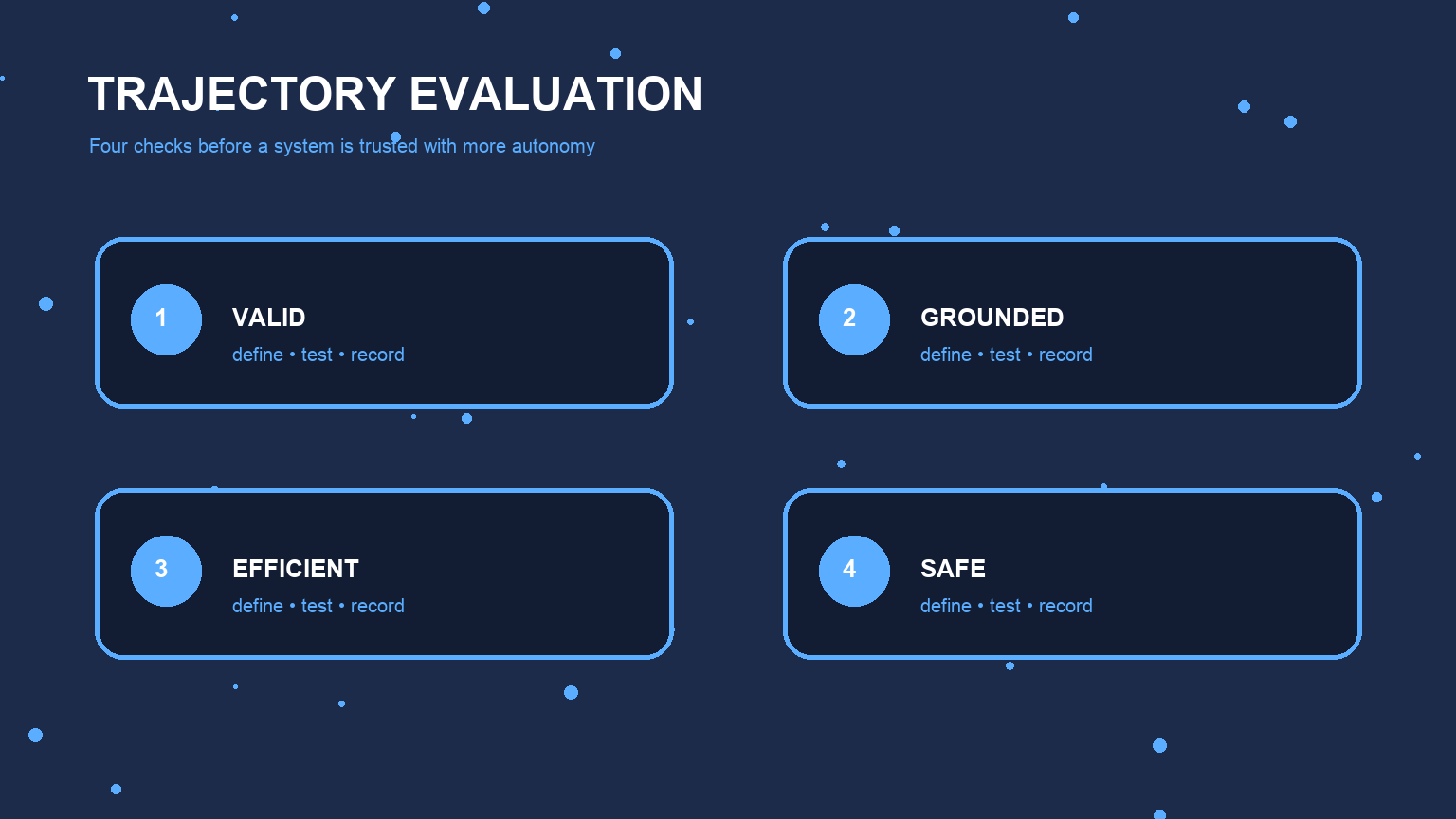
Create scenarios from real tasks, including edge cases and adversarial content. Score the final state, evidence quality, tool efficiency, policy compliance, recovery, and calibration. Compare against simpler baselines: a fixed workflow, retrieval plus one response, or a human checklist.
Inspect traces by failure category and replay them after model or prompt changes. Because model behavior is stochastic, use repeated runs for critical cases. Deployment controls should include canaries, rollback, trace sampling, and alerts for unusual tool sequences. Good agentic reasoning is not endless thought; it is disciplined interaction under observable constraints.
Implementation worksheet
Build an evaluation table where rows are real tasks and columns cover required evidence, allowed tools, success predicate, stop condition, and escalation rule. Compare an agent loop with a fixed workflow and a single-response baseline. Replay failures after every model, prompt, or tool change. Inspect repeated tool calls, unsupported conclusions, premature completion, and failure to stop. Promote a change only when outcome quality improves without weakening permissions, increasing severe errors, or creating review work that cancels the benefit.
Frequently Asked Questions
What is agentic reasoning in an LLM?
It is a bounded loop in which a model proposes actions, receives grounded observations, updates a plan, verifies progress, and stops or escalates under explicit rules.
Does more chain-of-thought mean better agent reasoning?
Not necessarily. Quality should be measured by correct outcomes, evidence, safe tool use, recovery, and stopping behavior rather than the length of reasoning text.
When should an agent use reflection?
Reflection is most useful against a clear rubric, after a failed step, when evidence conflicts, or before a consequential action.
How do you stop an agent loop?
Use externally checkable success predicates, step and budget caps, no-progress detection, duplicate-action checks, and escalation rules.