Key takeaways
- AI-generated game code is maintainable only when a human team can understand, test, and extend it. Evaluate the next change, not just whether the first prototype runs.
# Is AI-Generated Game Code Maintainable? A Practical Evaluation Guide
AI-generated game code is maintainable only when a human team can understand, test, and extend it. A clean-looking first result is not enough. Evaluate the project by tracing a real feature from input to state change to player feedback, then make a small change and observe how much of the system must be touched.
Read the project as a system
Start with the project map. Find the entry point, scene or level structure, data definitions, input handling, gameplay systems, asset references, and save or network boundaries. A maintainable project makes these responsibilities discoverable. It does not require every file to be perfect, but it should give the next engineer a reliable way to form a mental model.
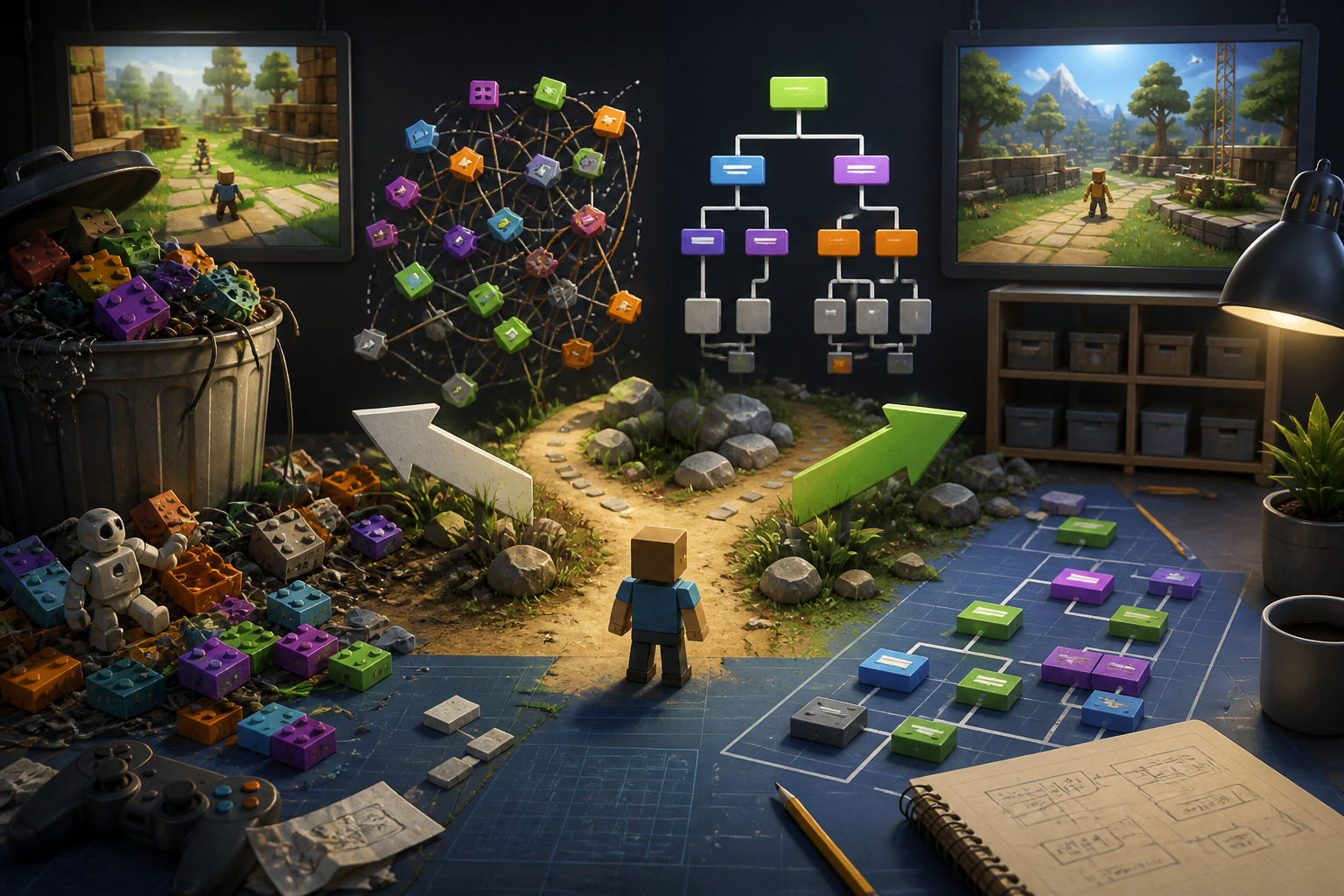
Look for duplicated rules, hidden global state, unclear ownership, and values that are copied across many files. These patterns make a prototype feel productive at first and expensive later. They also make AI-assisted changes risky because a prompt may update one copy while leaving another inconsistent.
Test one representative feature
Choose a feature that crosses several systems, such as an inventory item that affects combat and persists after saving. Trace it through the data model, UI or feedback, game state, and serialization. Then make one controlled change. If the change requires editing many unrelated places or breaks an existing test, the project needs restructuring before more features are added.
This test is more informative than counting lines of code or asking whether the output “looks professional.” It tells the team how the project behaves under the kind of change that production will require.
Check architecture and testability
Readable names, small functions, clear interfaces, deterministic tests, and explicit data flow are useful signals. So are failure handling and a reproducible way to run the project. Review physics, navigation, enemy state machines, multiplayer, and performance separately because each introduces constraints that a simple prototype may not cover.
AI-generated code can be a useful starting point, but it should enter a team workflow with code review and tests. Keep the parts that are clear and replace the parts that create hidden coupling. A prototype is disposable when that is the stated goal. It becomes a problem when the team assumes it is already a production foundation.
Keep a change boundary
When asking AI to extend a project, state what must not change, what files or systems are in scope, the expected behavior, and the test to run. Request a small patch first. Review the diff, run the representative feature test, and check the result in the intended runtime. This keeps the project owner in control and makes rollback straightforward.
Use a maintainability scorecard
Score the project against observable questions. Can a new engineer find the main gameplay entry point? Are state changes represented by named data rather than scattered side effects? Can a test create the required state without clicking through an entire level? Can an asset or tuning value be replaced without editing unrelated systems? Can the team reproduce a failure from a clean checkout or documented setup? These questions expose the cost of the next change more reliably than a visual review.
Review the project at three levels. At the feature level, follow one player action from input to result. At the system level, inspect the boundary between gameplay, presentation, data, and persistence. At the project level, check build instructions, dependencies, content ownership, and the way tests run in a fresh environment. A project can be readable at one level and fragile at another, so record evidence at each level.
Distinguish generated code from generated content. A system may be structurally understandable while its assets, data, or tuning values are not ready for production. A temporary prototype may contain rough code that is acceptable because the team has explicitly marked it for replacement. The scorecard is useful when it makes that boundary visible instead of assigning one broad quality label.
Know when to refactor or replace
Refactoring is usually justified when the next feature is clear but the current structure creates repeated work, hidden coupling, or unreliable tests. Replacement is often safer when the system has no trustworthy owner, its behavior cannot be reproduced, or every change requires broad manual repair. Do not keep a generated system only because it took effort to produce. Keep it when the team can explain its boundaries and has evidence that the next change is manageable.
Before a rewrite, preserve the representative tests and the behavior that matters. A rewrite that removes a confusing structure but also changes player-facing behavior can create a second debugging problem. Capture the intended input, state transition, output, and performance expectation, then use that record to evaluate the new implementation.
Review the project in the intended runtime
A code review in an editor is only one part of the check. Run the project where it will actually be used. Test loading, input, resolution, state recovery, and the representative feature on the target device or browser. Check logs and build output, not only the happy path. AI-generated code may look modular while still depending on a local package, an untracked asset, or an assumption that fails outside the first development environment.
This is especially important for physics, navigation, multiplayer, and performance optimization. Each area has runtime behavior that a static review can miss. Use a small reproducible test, record the result, and keep the code boundary narrow until the behavior is understood.
The practical verdict
AI-generated game code can be maintainable when it is treated as reviewed project material and shaped by explicit architecture, tests, and ownership. It is not maintainable by default merely because it compiles or produces a playable screen. The right question is whether the team can safely make the next change.
Frequently Asked Questions
How do I test whether AI-generated game code is maintainable?
Trace one representative feature across data, gameplay state, feedback, persistence, and tests. Then make a small change and measure whether the project boundaries remain understandable.
Is compiling code enough?
No. Compilation proves only that a narrow technical check passed. Maintainability also needs readable structure, explicit data flow, tests, failure handling, and a safe way to make the next change.
Can AI implement complex game systems?
It can help draft or extend systems, but physics, navigation, multiplayer, performance, save migration, and other complex areas need direct tests and human engineering review.
What should I ask AI to preserve?
State the files or systems in scope, behavior that must remain stable, the expected change, and the test to run. A narrow boundary makes review and rollback safer.
When is disposable code acceptable?
Disposable code is acceptable when the team explicitly wants a short experiment and will not treat it as a production foundation. Record that boundary before adding more systems.
What is the practical verdict?
AI-generated game code can be maintainable when it enters a reviewed architecture with tests and clear ownership. It is not maintainable by default because it produces a playable screen.