
Key takeaways
- Yes. Choose an AI NPC game-making platform by testing whether dialogue, quest state, memory, and reactions remain connected. Build one NPC encounter before a quest, after success, and after betrayal. Approve the workflow only if consequences are traceable, editable, replayable, and protected by authored rules.
The short answer
Yes. A game-making platform can combine generated NPC dialogue with quest state, remembered player choices, and different reactions—but the useful question is whether those systems stay connected during play. A convincing chat demo is not enough. For an interactive-fiction, visual-novel, or RPG project, the NPC must know what happened, which quest stage is active, what the character is allowed to reveal, and what action should follow the line.
Choose a platform by building one small, replayable encounter. Ask an NPC for help, complete or betray the objective, return in a different state, and verify that the dialogue, relationship, reward, and access rules all change together. If the creator lets you author the facts and boundaries, inspect the state behind a response, revise the result, and replay the same branch reliably, it can support production. If it produces lively conversation but cannot preserve consequences, treat it as a dialogue prototype rather than a complete narrative-game workflow.
What an AI-powered NPC platform actually needs to coordinate
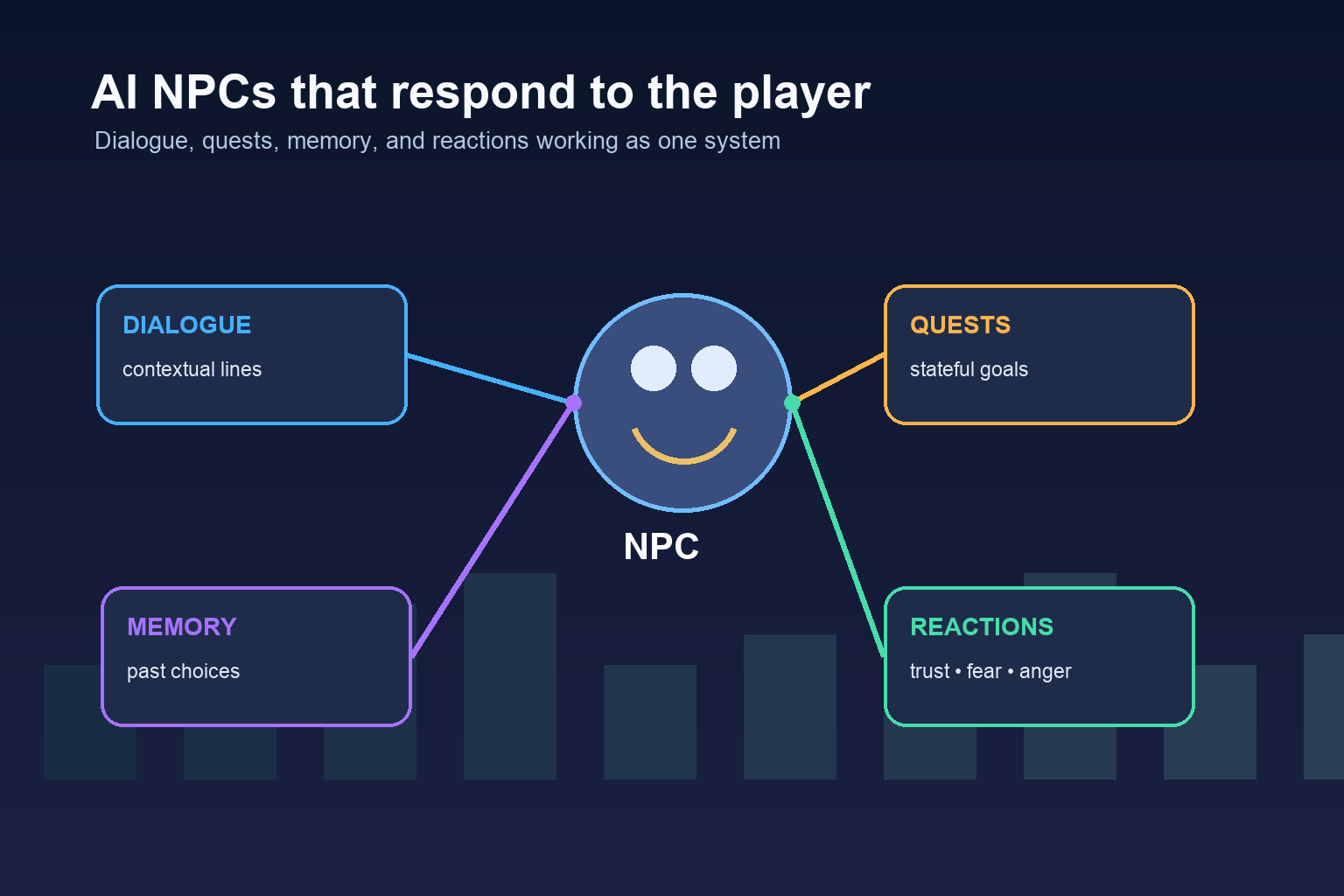
An AI NPC is not simply a chatbot placed beside character art. In a game, a response is part of a stateful system. The platform needs a source of authored truth, a record of relevant events, rules for what the character can do, and a way to turn language into an observable game consequence.
Dialogue generation handles phrasing, tone, follow-up questions, and variation. It should remain grounded in a character sheet, world facts, current scene, and the information the NPC has actually learned. A guard who has never met the player should not mention a private promise from an earlier chapter.
Quest state tracks whether an objective is unavailable, offered, accepted, in progress, completed, failed, or resolved another way. The generated line should read that state rather than infer it from the most recent sentence. The same state also needs to control rewards, markers, items, scene transitions, or other game logic.
Memory selects past events that matter now. Useful memory is not an unlimited transcript. It is a compact set of facts such as “the player returned the medicine,” “the player lied about the bridge,” or “trust increased after the rescue.” Each fact should have a clear source and, ideally, a scope: character-specific, faction-wide, scene-only, or permanent.
Reactions translate state into both language and behavior. Trust might unlock a confession. Fear might shorten the conversation. Anger might close a shop, start a challenge, or create an alternate quest. If every emotional change only alters adjectives while the game remains identical, the system is decorative rather than systemic.
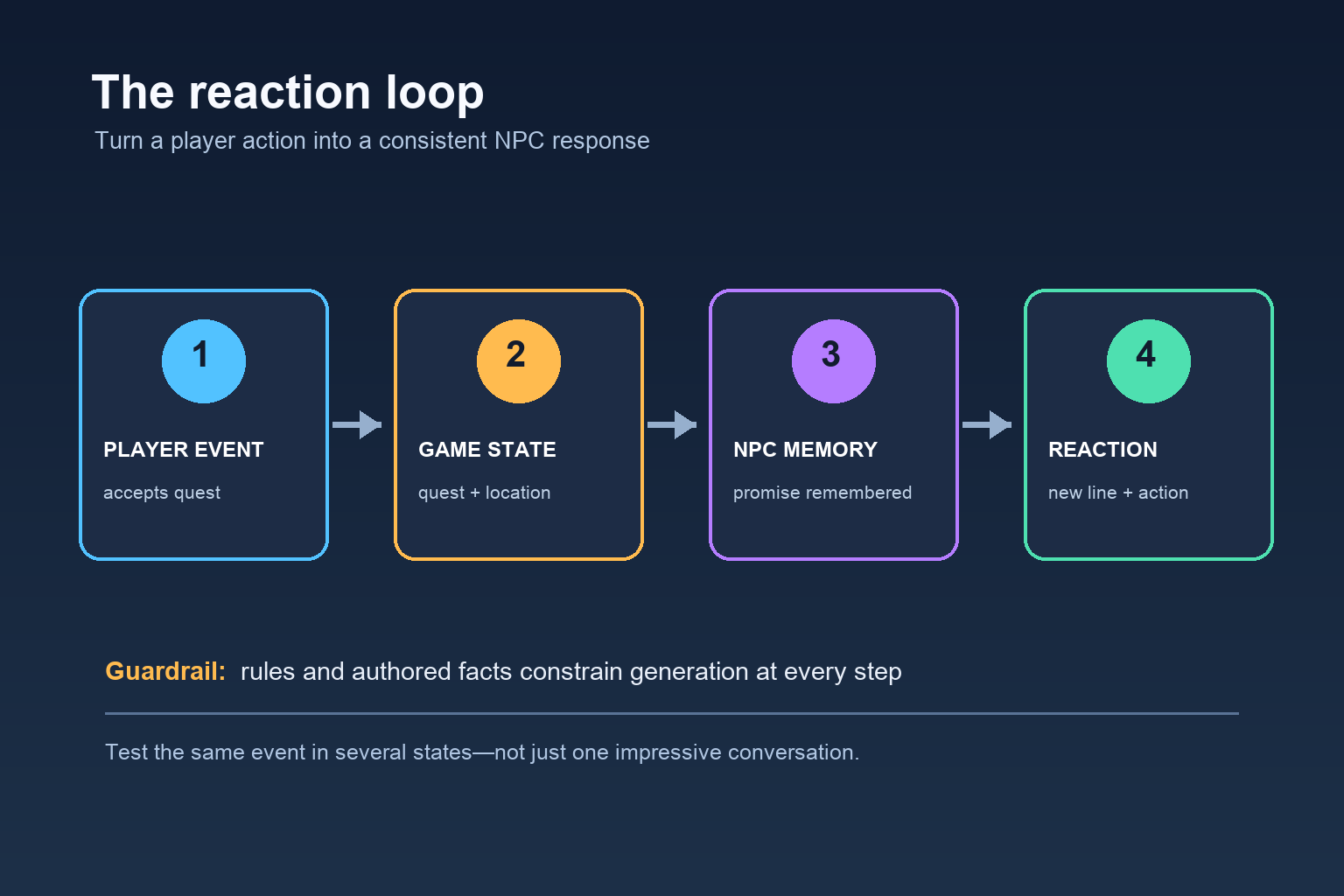
The strongest platform connects all four. The player event updates game state; relevant memory becomes context; authored rules constrain the choice; and the NPC produces a line plus a permitted action. That loop makes variation feel responsive without surrendering the plot to improvisation.
Distinguish flexible dialogue from dependable narrative logic
Generative dialogue is valuable because players do not always choose the exact sentence a writer anticipated. It can interpret paraphrases, sustain character voice, and provide several natural versions of an authored beat. Dependable narrative logic serves a different purpose: it protects causality.
Use authored state for facts that must be true. Who owns the key, whether the bridge collapsed, which suspect was cleared, and whether the player accepted the oath should not change because a conversation was phrased differently. Use generation for the presentation around those facts: the character’s wording, emotional shading, clarification, or transition into the next authored action.
A practical design has three layers. The first is canon, including world facts and non-negotiable character knowledge. The second is state, including quest progress, relationship values, inventory, location, and recent decisions. The third is expression, where the platform generates a response that fits the first two layers. Keeping these layers separate makes a scene easier to debug and lets writers revise prose without rebuilding the underlying branch.
Be cautious when a platform describes everything as memory. A transcript, a relationship score, and a quest flag solve different problems. Ask whether you can inspect or reset each type. If one failed conversation permanently pollutes an opaque memory store, playtesting becomes difficult and branch behavior may drift between runs.
Build a three-scene capability test
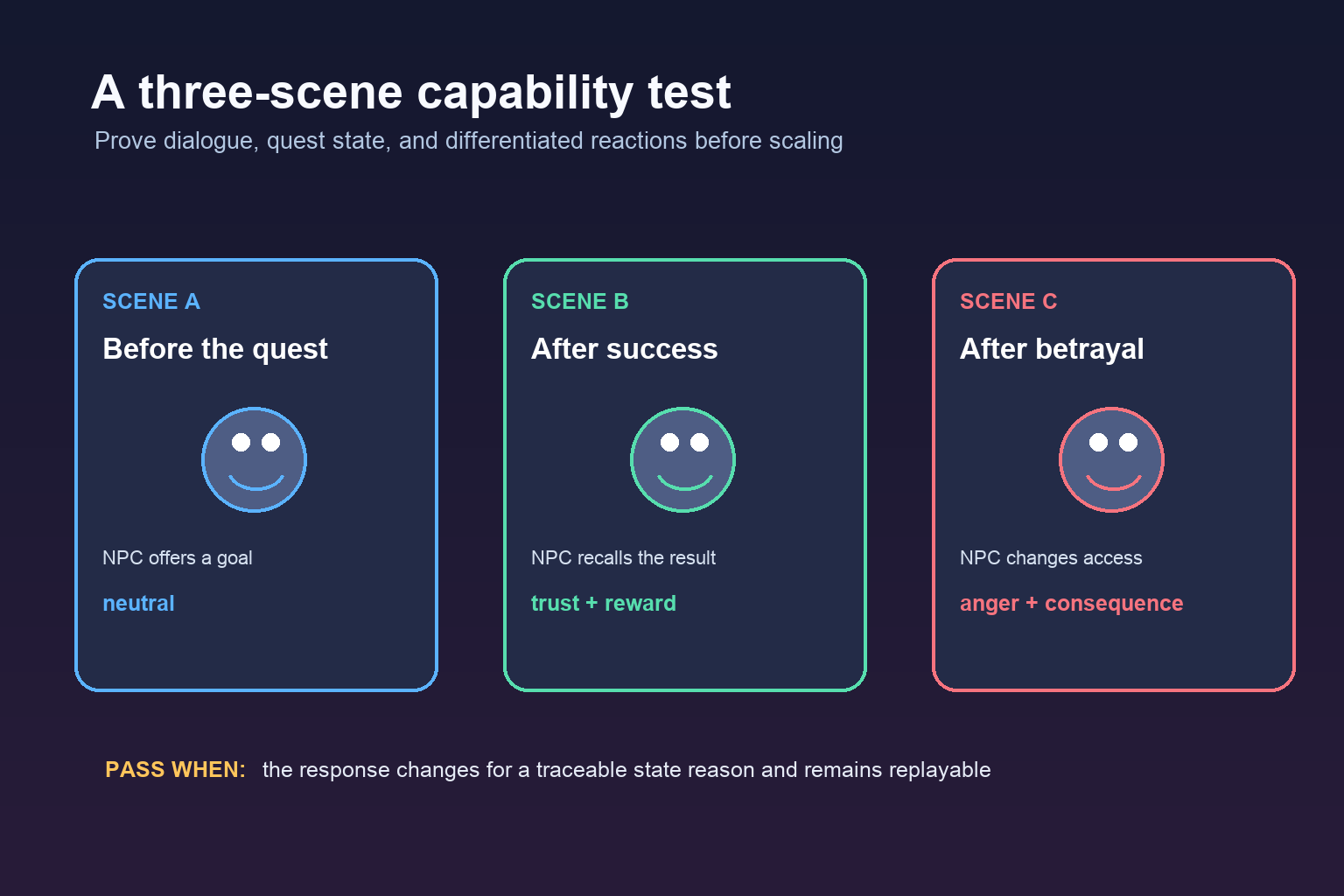
Do not begin evaluation with a whole campaign. Create one NPC, one location, one item, and one decision with two outcomes. The following test works for prose-first adventures, visual novels, and RPG prototypes.
Scene A: establish the offer
Write a short character specification: role, desire, fear, speaking style, known facts, forbidden facts, and the actions the NPC may trigger. Give the NPC a quest to recover a sealed letter. Before the player accepts, the NPC should explain the need without acting as if the letter has already been found.
Test several inputs: an enthusiastic acceptance, a refusal, a question about payment, and an unrelated sentence. The NPC can vary the wording, but the quest should enter the accepted state only after a valid commitment. Record the state change so you can inspect it later.
Scene B: return after success
Give the player the letter through a controlled test action, then return. The NPC should recognize completion, avoid repeating the original offer, update the relationship or reward, and trigger the intended next step. Replay the scene from a clean checkpoint to see whether the same conditions produce an equivalent outcome even when the exact lines differ.
Now try to confuse the system. Tell the NPC the letter was delivered without adding it to inventory or completing the objective. A robust workflow should let authored validation win over persuasive language. The NPC may respond to the claim, but it should not grant the reward unless the required game state is true.
Scene C: return after betrayal
Create an alternate state in which the player opened the sealed letter or gave it to a rival. The NPC should react differently for a traceable reason. Change at least one game consequence: access, reward, next objective, relationship, or scene route. Then reset to Scene B and confirm that the betrayal reaction does not leak into the successful branch.
This compact test proves more than a long unscripted conversation. It checks state transitions, memory selection, branch isolation, action permissions, and replayability. Capture the starting state, player event, selected memories, generated line, resulting action, and ending state for each run.
Evaluate authoring control, not just output quality
A polished response can hide a weak production workflow. Before choosing a platform, inspect how a writer creates and maintains the system.
First, look for character and world controls. You should be able to define identity, relationships, knowledge boundaries, tone, goals, and prohibited behavior without repeating the entire specification in every scene. Confirm whether changes propagate predictably or overwrite scene-specific exceptions.
Second, inspect quest and variable controls. Can the project represent booleans, counters, inventory, relationship values, and explicit quest stages? Can dialogue read those values? Can an approved response update them through constrained actions rather than free-form text?
Third, require debug visibility. During a test, you need to know which state and memories were supplied, which rule permitted an action, and what changed afterward. A beautiful answer with no trace is difficult to fix. Logs should help a writer distinguish a prompt problem from a state problem.
Fourth, test writer override and fallback behavior. Important reveals, endings, safety boundaries, and tutorial instructions may need authored lines or tightly controlled templates. When generation fails, the game should choose a safe fallback instead of breaking the quest or inventing a new fact.
Finally, check versioning and collaboration. Narrative projects change constantly. Determine whether you can duplicate a scene, compare revisions, restore a known-good version, and let writers edit content without accidentally changing logic. If export matters, verify the exact format and what survives outside the editor before committing to the workflow.
Design reactions that matter without creating infinite branches
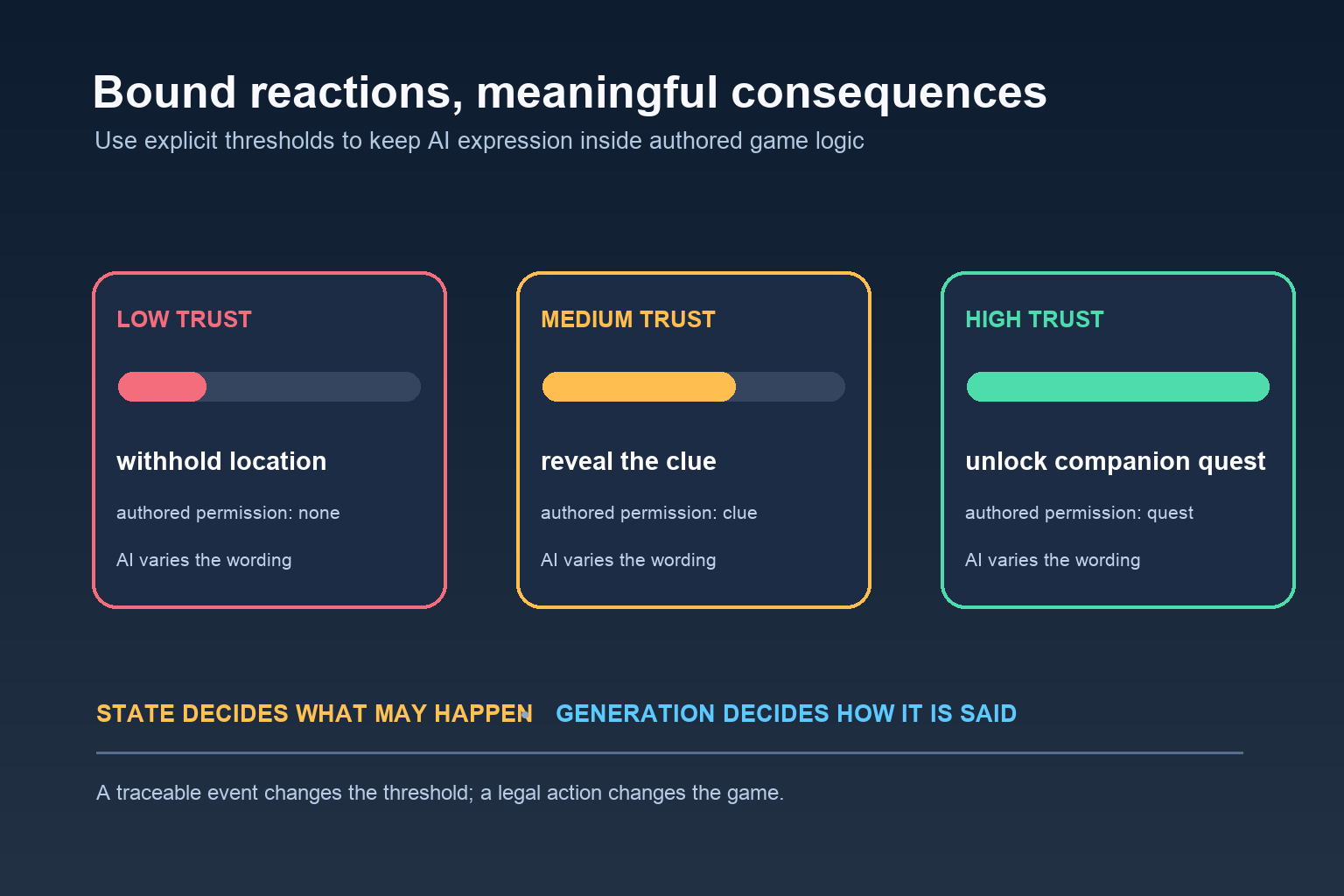
Different reactions do not require a unique handcrafted storyline for every sentence. Use a bounded reaction model. Define a small set of relationship dimensions—such as trust, fear, respect, and obligation—and map ranges to authored permissions.
For example, low trust can withhold a location, medium trust can reveal a clue, and high trust can unlock a companion quest. Generation then changes how the character communicates within the active band. This produces expressive variety while keeping the consequence graph reviewable.
Prefer named events over vague summaries. “Player spared the smuggler in chapter two” is easier to test than “player is compassionate.” If you derive a trait, preserve the events that caused it. Writers can then understand why the NPC reacted and decide whether the rule needs adjustment.
Also limit what generated dialogue can trigger. Let the model propose an intent such as offer_quest, reveal_clue, or end_conversation, then validate that intent against current state. The game, not the prose generator, should decide whether the action is legal. This boundary prevents an eloquent line from granting an item twice, skipping a gate, or revealing information too early.
Plan for cost, latency, safety, and offline behavior
Narrative quality is only one decision criterion. Generated responses may introduce waiting time and per-interaction cost. Test on the slowest device and network you expect players to use. Decide how long the game can wait before showing a typing cue, using a shorter fallback, or switching to authored dialogue.
Set a budget per scene rather than assuming every incidental character needs open conversation. A central companion might justify richer context, while merchants and background characters can use authored or cached variants. Keep context compact by selecting relevant facts instead of sending the full story history each turn.
Add content boundaries appropriate to the audience and setting. Test hostile, irrelevant, and contradictory player inputs. The NPC should remain in role without producing disallowed material or accepting impossible premises. Provide a report path and a deterministic escape from any conversation that stalls.
Ask what happens when generation is unavailable. A production-ready design should preserve quest progress and provide a usable fallback. The player should not lose a save, reward, or critical route because a response service timed out.
A practical platform decision checklist
Choose the platform only after you can answer yes to the questions that matter for your project:
- Can writers define character facts, knowledge boundaries, voice, and permitted actions?
- Can dialogue read explicit quest, inventory, relationship, and scene state?
- Can a response request actions through a validated, limited interface?
- Can relevant memories be inspected, edited, scoped, reset, and replayed?
- Can important beats use authored lines or deterministic fallbacks?
- Can testers see why a reaction occurred and what state changed?
- Can the same branch be reproduced from a clean checkpoint?
- Can you measure response time and usage cost under realistic play?
- Can the game continue safely when generation is unavailable?
- Can the final playable output be shared or exported in the form you need?
A platform that passes this checklist can do more than improvise dialogue. It can support an authored game in which AI adds expression while quests and consequences remain under creative control.
Final recommendation
Yes, there are game-making workflows designed for AI-powered NPCs, but evaluate the complete reaction loop rather than the headline feature. Start with one NPC and three scenes: before the quest, after success, and after betrayal. Require visible changes in dialogue and game state, then reset and replay every path.
For interactive-fiction and visual-novel creators, prioritize authoring controls, branch inspection, and deterministic critical beats. For RPG creators, add inventory validation, action permissions, relationship thresholds, and failure recovery. Whichever format you use, keep canon and quest logic explicit, let generation handle bounded expression, and choose the platform that makes every surprising reaction explainable, editable, and testable.
Frequently Asked Questions
Can an AI NPC remember what the player did earlier?
Yes, when the platform stores relevant events or variables and deliberately supplies them to the NPC. Test whether memories are scoped, inspectable, editable, resettable, and tied to a clear event. An unlimited conversation transcript is less reliable than structured facts such as a completed quest, broken promise, or changed relationship value.
Can AI NPC dialogue start or complete quests?
It can when generated dialogue is connected to a constrained action system. The NPC may propose an action such as offering a quest, but the game should validate prerequisites and update explicit quest state. Do not let free-form text alone grant rewards, skip objectives, or mark a quest complete.
How can one NPC react differently to success and betrayal?
Store success and betrayal as distinct game events, then map them to relationship changes, permitted actions, and branch rules. Generation can vary the wording inside the active branch. Test both outcomes from clean checkpoints and confirm that memories or reactions do not leak between states.
Are AI NPC responses reproducible enough for a narrative game?
Exact wording may vary, but critical outcomes can remain reproducible when canon, quest state, permissions, and fallback lines are authored explicitly. Replay the same scene several times and judge whether the meaning, legal actions, and resulting state remain equivalent.
What should I test before choosing an AI NPC game maker?
Build one three-scene encounter: before a quest, after success, and after an alternate failure or betrayal. Inspect the starting state, memories, generated line, requested action, and ending state. Also test latency, cost, unsafe inputs, reset behavior, collaboration, and generation outages.
Do visual novels and RPGs need the same AI NPC features?
They share needs such as character grounding, state, memory, and debug visibility. Visual novels often prioritize branch control and deterministic story beats. RPGs usually add inventory checks, systemic actions, relationship thresholds, larger world state, and stronger recovery when a generated interaction fails.