Start with one small district, not a finished skyline
A city-building prompt needs to describe how the player’s choices change the town. Start with a small map, one road network, one service, a population rule, and a budget update. Then say what the first build should prove. That gives a creator a focused brief to review instead of a request for a large city whose rules are hard to inspect.
Northline Borough is an original teaching example used throughout this guide. Its numbers and outcomes are resolved on paper from the rules below; they are not a prompt run, a generated SEELE project, a playtest, or a balance result. The first goal is deliberately modest: connect two homes to a civic center and water pump, settle four residents, and finish the day with coins left.

Before asking an AI game maker for scenery, write down the state the player can change and the feedback that should follow. A home’s road access and water coverage are separate checks; having one does not imply the other. Keeping those rules distinct makes the first prototype easier to describe and inspect.
Write the city rules before adding more systems
Define the map, starting budget, legal placement, connectivity, service range, settlement timing, income, upkeep, goal, and restart. In Northline Borough, the Town Hall sits at tile (4,3) on a 7-by-7 orthogonal grid. Two free starter road tiles at (4,4) and (4,5) connect back to it. The two housing sites are (3,5) and (5,5); each home costs 2 coins, holds up to two residents, and needs to touch a road connected to Town Hall.
| Rule | Northline Borough teaching value | What to show |
|---|---|---|
| Starting state | 10 coins; Town Hall and two road tiles are already built and free. | Current treasury and connected starter network. |
| Home placement | Two sites, each 2 coins; capacity is 2 residents. | Legal tile, cost, road-access state, occupied or empty state. |
| Water pump | Costs 3 coins, must touch connected road, covers homes within Manhattan distance 2. | Placement and which homes are in range. |
| Settlement | At End Day, each home with road access and water fills to capacity; each resident adds 1 coin; pump upkeep costs 2. | Population, income, upkeep, and resulting treasury. |
| Goal and restart | Win with at least 4 residents and at least 1 coin after settlement; restart restores the map and 10 coins. | Goal status and a predictable reset. |
Here, “Manhattan distance 2” means two orthogonal tile steps; diagonal proximity does not count as one step. The pump site at (4,6) is beside the connected road at (4,5). Each home site is also two orthogonal steps from the pump and touches that same road. These coordinates are design notes for the paper example, not a standard city-builder rule. Electricity, clinics, waste, disasters, and other systems are later choices; they are not part of this first loop.
This rule card gives a prompt something concrete to preserve. It also makes omissions visible: if the brief says a pump “serves nearby homes” but never defines range or road connection, two people can interpret the same prompt differently.
Keep road access and water coverage separate
Roads answer whether a building joins the Town Hall network. The pump has its own road-access check, then a coverage check for each home. A home fills only when both it and the pump meet their required conditions. That separation makes it possible to diagnose a failure instead of treating “connected city” as a vague visual quality.
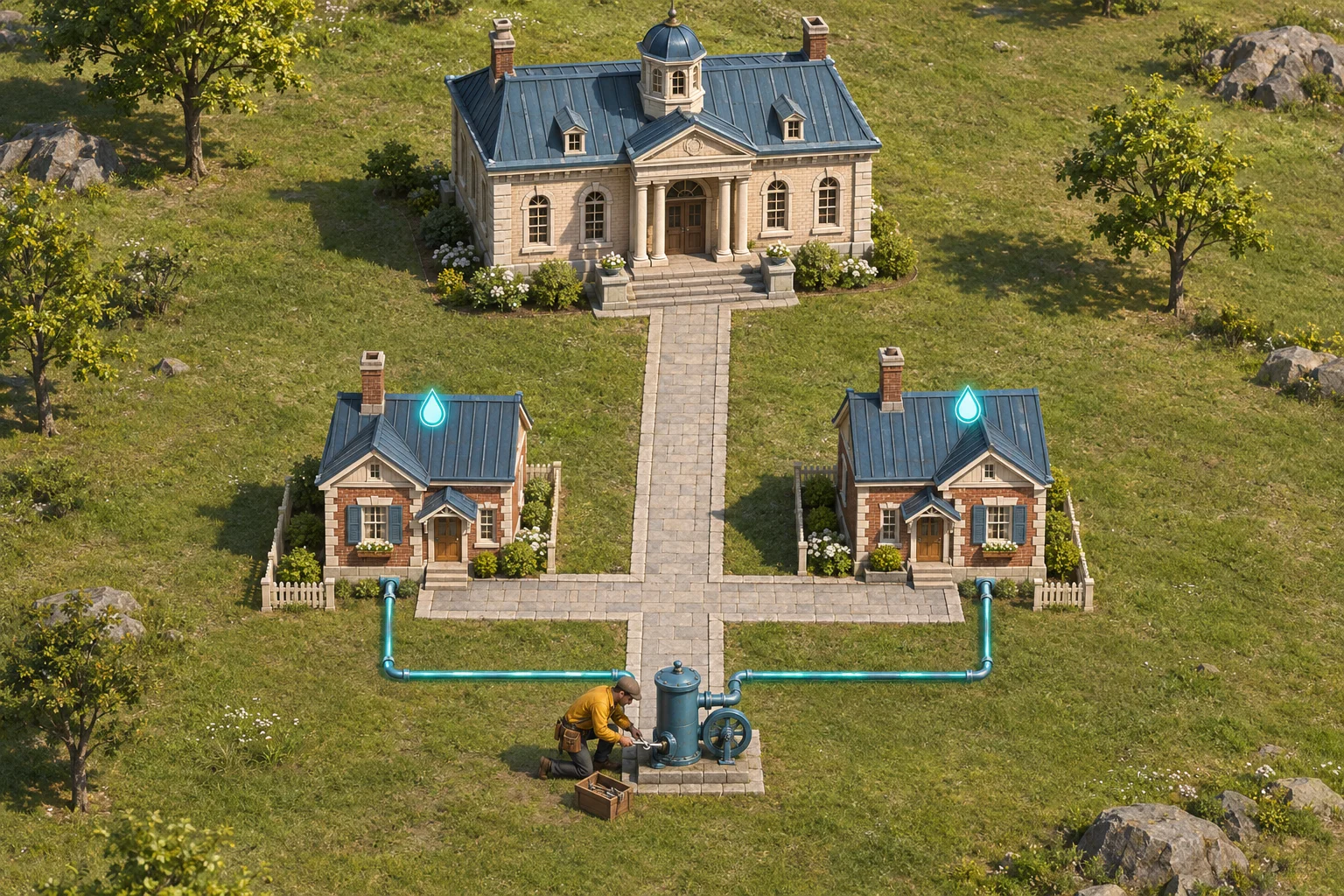
For the hand-resolved layout, build homes at (3,5) and (5,5), then place the pump at (4,6). Both homes touch road (4,5); the pump also touches it. The pump is two Manhattan steps from each home, so both are in range. No residents arrive yet because the player has not chosen End Day.
Now change one fact at a time. Disconnect a home from the connected road and it stays empty even if the pump reaches it. Move the pump beyond its two-step range and the out-of-range home stays empty. Place a pump beside an unconnected road and it cannot serve either home under this model. Those cases explain why access and service coverage should have their own indicators and acceptance checks.
Make population and budget updates predictable
The settlement order is part of the rule, not a cosmetic detail. Start with 10 coins. Two homes cost 4, and the pump costs 3, so 3 coins remain before the day ends. With both homes connected and supplied, each fills to two residents: four residents add 4 coins. The pump then costs 2 coins to operate. The closing treasury is 3 + 4 − 2 = 5 coins, with four residents. That meets the example goal of four residents and at least one coin.
| Paper scenario | Residents after End Day | Income | Upkeep | Closing coins | Goal result |
|---|---|---|---|---|---|
| Both homes connected and supplied | 4 | +4 | −2 | 5 | Met |
| One home disconnected; pump still covers both sites | 2 | +2 | −2 | 3 | Not met |
| One home outside pump range; both homes road-connected | 2 | +2 | −2 | 3 | Not met |
The failed cases use the same build costs and upkeep; only one home fails a required access or coverage check. The hand calculation assumes there is no home or road upkeep and no other source of income. It is an internally consistent teaching model, not a claim about typical city-builder economies or a recommendation for balanced prices.
Use staged prompts and check the first build
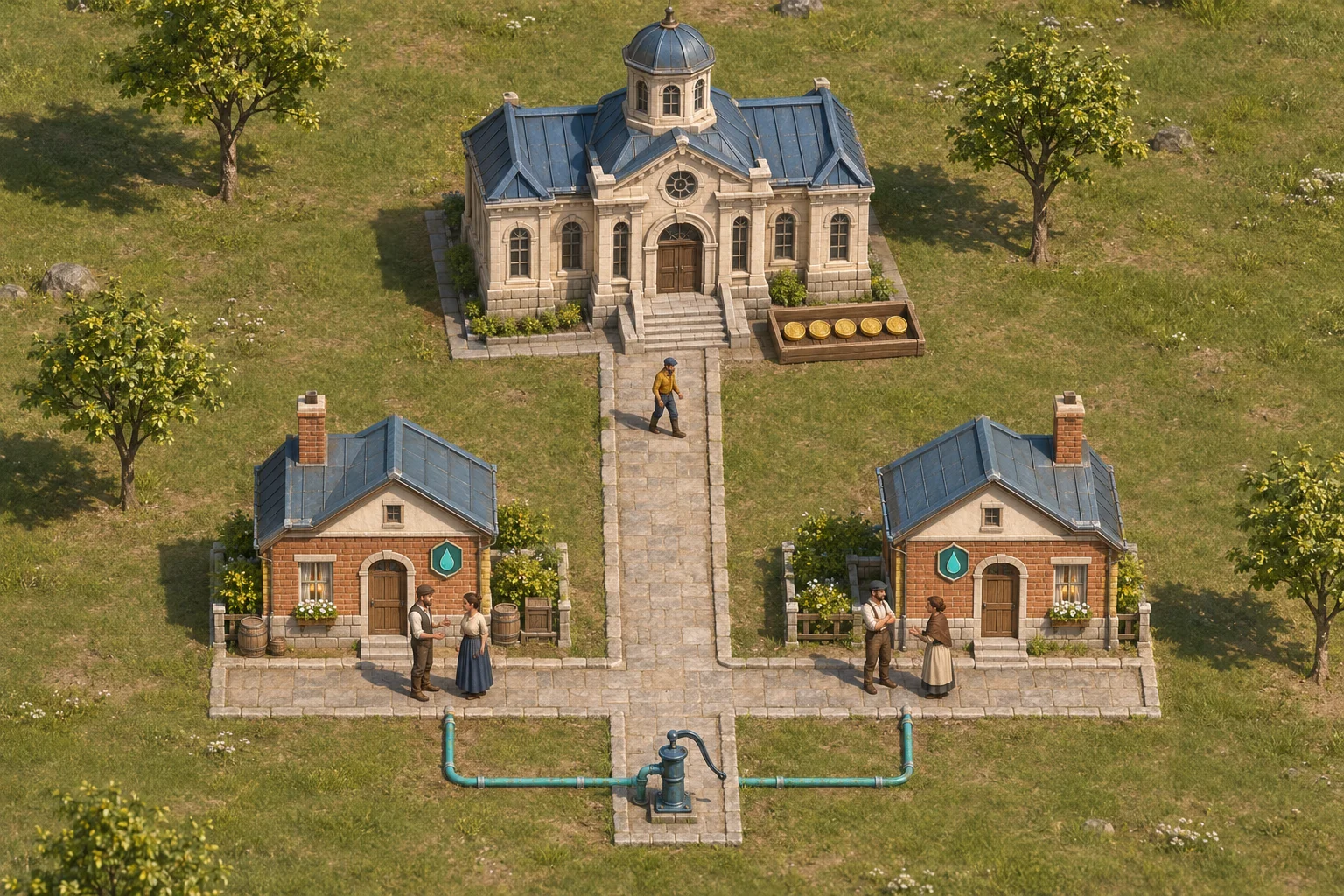
Ask for one district and one question first. Give the model the intended player action, visible state, constraints, and success condition. Then request a system detail or repair only when a specific check exposes a gap. The prompt below is a reusable design template; it has not been run in SEELE or any other game maker.
Make a small single-player 3D city-building prototype on a 7-by-7 orthogonal tile grid. This is one district, not a full campaign. The player places two homes and one water pump, then chooses End Day to see whether residents arrive and the budget changes.

Starting layout: Town Hall at (4,3), with connected free road tiles at (4,4) and (4,5). Start with 10 coins. The two legal home sites are (3,5) and (5,5); each costs 2 coins and has capacity for 2 residents. A home has road access only when it touches a road tile connected to Town Hall through orthogonal road tiles.

One water pump costs 3 coins, must touch a road connected to Town Hall, and covers a home within Manhattan distance 2. Diagonal distance does not count. At End Day, each home with both road access and pump coverage fills to 2 residents. Each resident adds 1 coin. The pump costs 2 coins per day. Homes and roads have no upkeep in this prototype.

The win condition after settlement is at least 4 residents and at least 1 coin. A home missing road access or water coverage stays empty and earns nothing. If the player does not meet the goal, allow another build and settlement cycle; do not add disasters or game over. Restart restores the initial map and 10 coins.

Show the current treasury, connected roads, home access, pump coverage, residents, daily income and upkeep, goal status, End Day, and Restart. Use a readable visual indicator for each state. Do not add electricity, clinics, waste, research, production chains, or other systems. If any requested rule cannot be represented, flag it instead of silently changing it. Return a short list of the rules and acceptance checks you intend to implement before adding decorative detail.
After the first pass, compare it with fixed cases. These are proposed acceptance checks, not completed tests:
| Case | Input or change | Expected state under this model |
|---|---|---|
| Connected and served | Build both homes and the pump at the specified sites; choose End Day. | 4 residents; treasury 5; goal met. |
| Road failure | Disconnect one home from the Town Hall road network. | That home stays empty; 2 residents; treasury 3; goal not met. |
| Coverage failure | Move the pump outside one home’s range or remove it. | The unserved home stays empty and contributes no income. |
| Restart | Restart after any layout or settlement. | Original road and Town Hall layout returns with 10 coins. |
If an output misses one case, use a narrow revision rather than adding more buildings. For example, clarify that road tiles use orthogonal connectivity if a diagonal route was accepted, or restate that settlement happens only when End Day is selected if residents appear early. Keep the expected values fixed while changing one instruction, then inspect the new result. Do not call the examples “tested” until a real build and recorded run exist.
SEELE’s AI Game Maker overview describes expressing a game idea in plain English, creating playable 2D or 3D results, testing them in the browser, and refining with follow-up prompts. Its Workspace FAQ says the selected AI model, available Koin balance, and displayed generation cost can be reviewed before submission. This can frame where a creator begins and checks work; it does not verify Northline Borough’s grid placement, road logic, water coverage, or settlement arithmetic. Inspect the actual output before relying on any of those behaviors.
Build one connected district, then decide what to add
A useful first city-building prompt defines a small map, one service, a resident update, and a goal that can be checked by hand. Northline Borough demonstrates one proposed rule set and its expected cases; it is not a measured result. Once a real first build is available, inspect road access, pump coverage, settlement timing, budget feedback, and restart before adding other services or progression.
Bring one focused city-building idea to the Free AI game maker, review the current generation options and cost, and check which rules the actual result implements. Treat any missing behavior as a design question to resolve, not as a promised feature.
What should an AI prompt for a city-building game specify first?
Begin with the player’s first action and the state that should change. Then define the map, building costs, access, service coverage, settlement timing, budget, goal, and restart. A compact rule set lets you check whether the first build expresses the intended loop before you add zoning, multiple utilities, disasters, or a long progression system.
How should roads and services affect residents?
Give roads and services different jobs. In the Northline teaching model, a home must touch a road connected to Town Hall, while a road-connected pump must also be within a stated distance of that home. Only homes meeting both conditions fill at End Day. These are original example rules; choose and explain the conditions that fit your own design.
How can I check a first city-building prototype?
Write a few fixed cases with starting values, an action, and an expected visible result. For example, the Northline paper simulation expects four residents and five coins when both homes are connected and served. Break one connection or remove coverage to check failure behavior, then restart to confirm the initial state returns. These checks are a plan until a real build is run.
Can an AI game maker guarantee working city simulation rules?
No. A prompt can specify intended behavior, but it is not evidence that a generated result implements every rule. Review the actual output for placement, network connectivity, service range, settlement, budget, and restart. If one behavior is missing, narrow the next request to that case and inspect again; do not treat a concept illustration or paper calculation as a test result.
When should I add another service or a larger city?
Add a system after the first loop has clear inputs, feedback, and a check. If both homes, one pump, and one settlement update already answer your first design question, the next pass might define a second service’s placement and coverage. Avoid adding electricity, clinics, waste, growth curves, and disasters at once; each introduces more rules to verify.