Start with a testable turn, not a long feature list
Useful AI prompts for a Match-3 puzzle name the player’s goal, legal swap, match rule, move cost, refill order, and end condition. Build those rules around one small board, then resolve a complete move by hand before asking for visual polish. A four-by-four board is enough to expose missing timing: when does a move count, when does the goal meter update, and which tile enters an empty cell?
This guide uses Tideglass Conservatory, an invented solo puzzle level with ruby, leaf, wave, and sun tiles. Its rules and board are author-created teaching material. The four prompt templates were prepared for this article and were not submitted to a game generator. The worked turn is hand-calculated, not a software run or playtest. No playable build or measured result is presented.
The method is simple: bound the first slice, write a rules contract, give it an exact starting state, hand-resolve one turn, then request checks for edge cases. If a future build differs from the expected board, you have a concrete place to investigate.
Choose one level-sized goal
“Make a Match-3 game” describes a genre, not a first level. The initial prompt should define what counts as progress and what the player can do before the level ends. Tideglass Conservatory asks the player to clear three green leaf tiles in four valid moves on a four-by-four board. It is a solo level: no booster inventory, timed mode, campaign map, multiplayer, or persistent upgrades.
| Decision | First-slice rule | Why it belongs now |
|---|---|---|
| Goal | Clear three leaf tiles before the fourth valid move is spent. | A visible target gives each swap a purpose. |
| Board | Four rows by four columns, with cells labeled A–D and 1–4. | A compact state can be checked without a level editor. |
| Player action | Swap two orthogonally adjacent tiles; a swap is legal only if it creates a match. | The accepted action and rejected-action feedback are explicit. |
| Deferred systems | No boosters, timed pressure, campaign progression, or multiplayer. | Those systems add rules that do not help verify the first turn. |
These limits are a design choice for this example, not a claim about how every Match-3 game must work. When you choose a different first slice, change the goal and excluded systems before expanding the prompt.
Prompt 1: define the slice
Design a fictional solo Match-3 puzzle level called Tideglass Conservatory. The first level uses a four-row by four-column board with cells labeled A-D from left to right and 1-4 from top to bottom. The player must clear three green leaf tiles within four valid moves. Keep the first slice to one board and one objective. Exclude boosters, timers, campaign progression, multiplayer, and persistent upgrades. Return the player goal, starting board requirements, control rule, success condition, failure condition, and explicit exclusions. List any missing decision as an open question instead of inventing a new system.Check that the output describes one achievable level and separates the player’s immediate action from later progression. If the answer adds a campaign or several power-ups, remove those features before writing tile-resolution rules.
Write the swap, clear, and end-state order
“Match three and refill the board” leaves important behavior undefined. For this teaching design, the player may select only orthogonally adjacent cells. After a swap, scan horizontal and vertical runs of three or more identical tiles. If the swap creates no run, restore the original positions and do not spend a move. If it creates a run, spend one move, count each matched target tile once, clear all matched cells, let tiles fall downward, and fill each gap from a declared per-column queue.
After each refill, scan the entire board again. Resolve any new runs as cascades without charging another move, and continue until the board is stable. Check the win condition after the full cascade chain; if the target is not complete and no moves remain, end in failure. Writing this order prevents the same prompt from being interpreted as several different games.
Prompt 2: state the mechanics contract
Using the approved Tideglass Conservatory scope, define these exact rules: only orthogonally adjacent cells can be swapped; a swap is legal only if it creates at least one horizontal or vertical run of 3 or more identical tiles. Undo a swap that creates no run and do not spend a move. A legal swap spends exactly 1 move. Find all horizontal and vertical runs, take the union of their cells so intersections are counted once, add matched leaf cells to the 3-leaf objective before clearing, then remove the union. Apply downward gravity and fill empty cells from the declared column queues. Scan the full board after every refill and resolve cascades without charging another move. When the board is stable, check success first; if the goal is incomplete and moves are 0, check failure. Return the resolution order and a compact state diagram. Flag any ambiguity instead of adding boosters or special tiles.Review the output for the words that control timing: “before,” “after,” “once,” and “until stable.” Also check intersections. If a horizontal and vertical run share one leaf, the objective should count that tile once because it occupies one cell in the matched-cell union.
Give the prompt a reproducible board
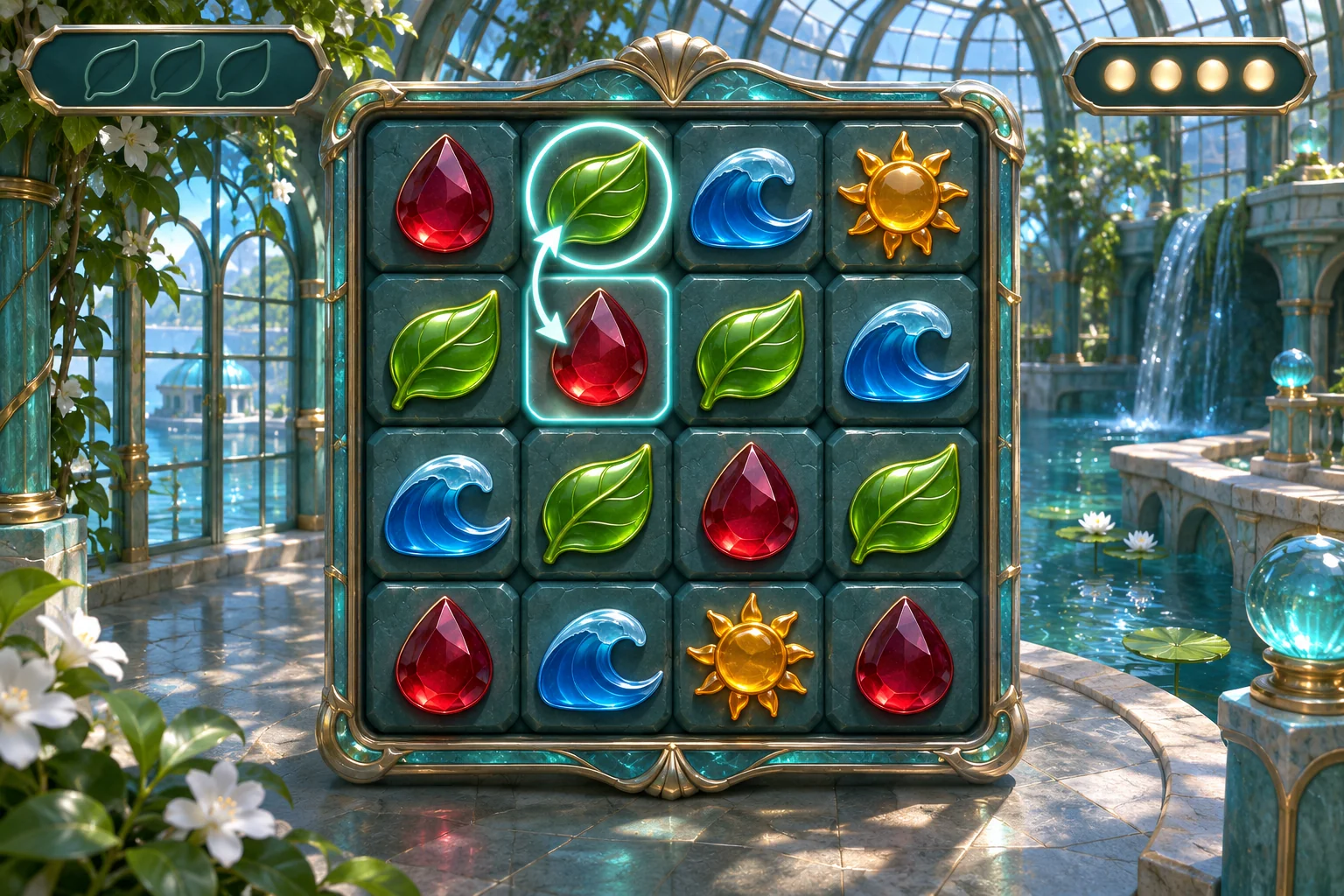
A hand-check needs coordinates and a fixed starting state. In the table below, each row is read from left to right and row 1 is the top. The symbols are R (ruby), L (leaf), W (wave), and S (sun). The initial board contains no horizontal or vertical run of three, so the player begins with a stable puzzle.
| Row | A | B | C | D |
|---|---|---|---|---|
| 1 | R | L | W | S |
| 2 | L | R | L | W |
| 3 | W | L | R | L |
| 4 | R | W | S | R |
For the worked turn, declare the first refill tile in each affected column before resolving the move: A receives S, B receives W, and C receives L. Column D has no gap. This is a small deterministic queue for this one hand-resolved example. Any further cascade example should state enough additional queue entries to fill every new gap rather than silently inventing tiles.
Prompt 3: provide the starting state and queue
Use this exact initial board, top to bottom, columns A-D: Row 1 R L W S; Row 2 L R L W; Row 3 W L R L; Row 4 R W S R. R means ruby, L leaf, W wave, and S sun. The target is 3 leaves; the move budget is 4. For the worked move B1↔B2, the first refill entries are A:S, B:W, and C:L; D receives no tile because it has no gap. Give the board after the swap, the matched-cell union, the objective count, moves remaining, each column after gravity, and the stable final board. Do not change the initial board or refill entries. State whether any further cascade occurs and why.Ask for the coordinate labels in every trace. A result that says “the green gems fall into place” cannot be compared with the state you supplied.
Hand-resolve one complete turn
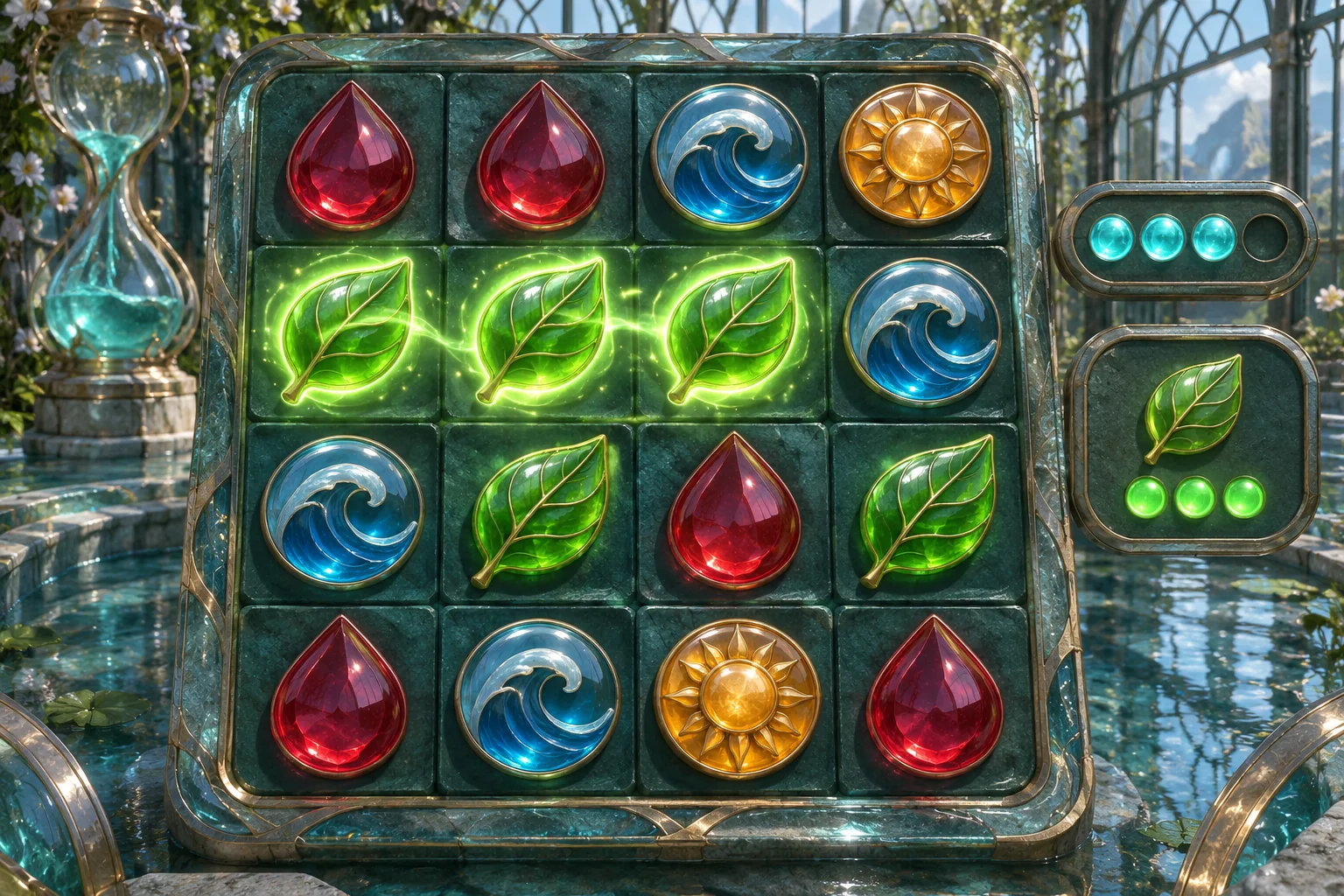
The selected action is B1↔B2: swap the leaf in row 1, column B with the ruby directly below it. The result creates one horizontal run across row 2, columns A–C. It is the only run, so three distinct leaf cells count toward the target. The player has spent one of four moves, leaving three.
Remove row 2, columns A–C. In column A, the ruby above the gap falls one cell and S refills the top. In B, the ruby falls into row 2 and W enters at the top. In C, the wave falls and L enters at the top. Column D stays in place. The stable board is:
| Row | A | B | C | D |
|---|---|---|---|---|
| 1 | S | W | L | S |
| 2 | R | R | W | W |
| 3 | W | L | R | L |
| 4 | R | W | S | R |
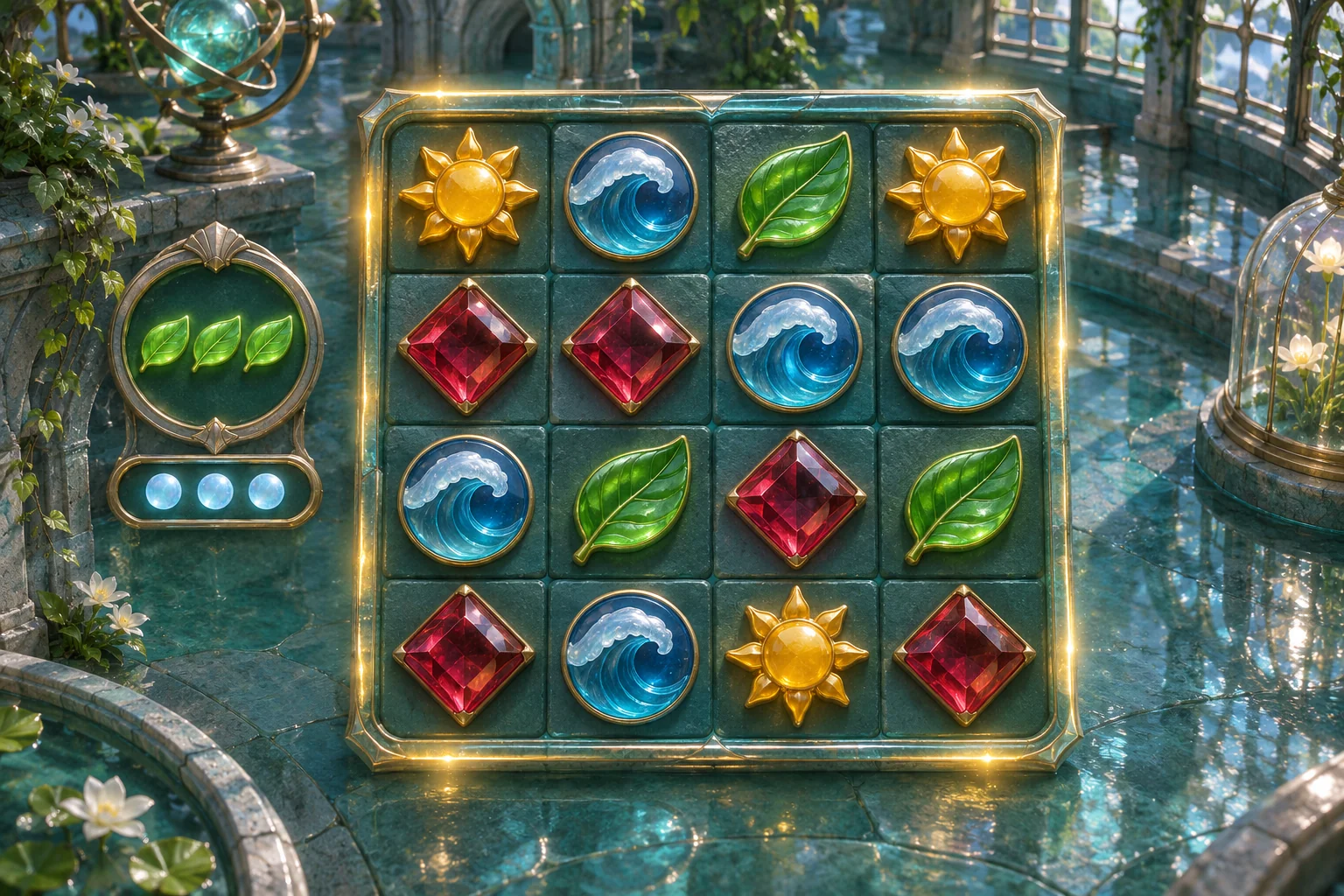
Check rows and columns after refill: no line contains three identical tiles. The board is stable, the leaf target is 3/3, and three moves remain, so the fictional level is complete. This is an expected state from the written rules, not evidence that a game or prompt was run.
Add checks for rejected moves and cascades
A useful prompt asks how the game should respond when the player’s action does not follow the happy path. These are proposed acceptance checks for a future implementation; they were not executed against software.
| Case | Expected behavior | What to inspect |
|---|---|---|
| Diagonal selection | Reject it without moving tiles or spending a move. | Only orthogonal neighbors are selectable. |
| Adjacent swap with no match | Restore both original tiles; keep the move count unchanged. | Rollback and counter feedback agree. |
| Cross-shaped runs | Clear the union of matched cells and count each target cell once. | Shared intersection is not double-counted. |
| Refill creates another run | Resolve a cascade automatically without spending another move. | Continue scanning until stable. |
| Goal completed on final move | After cascades stabilize, report success before checking exhausted moves. | Success takes priority when both conditions are true. |
| No goal with zero moves | After cascades stabilize, report failure if the target remains incomplete. | Do not accept a fifth move. |
For each case, request a before state, player action, expected after state, and feedback. If an output changes several rules at once, narrow the revision to the one mismatch so the next comparison stays useful.
Prompt 4: ask for acceptance cases and feedback
For the approved Match-3 contract, write acceptance cases for a diagonal selection, an adjacent swap that makes no match, a horizontal-vertical intersection, a refill-created cascade, reaching the leaf goal on the final move, and reaching zero moves with an incomplete goal. For each case return the starting state, action, expected stable state, move count, leaf count, and visible player feedback. Keep the stated rules unchanged. If a case needs more refill tiles, give the exact per-column queue. Mark unresolved cases as open questions rather than inventing a successful result.Revise a vague prompt without claiming a test
A short prompt such as “Make a match-3 puzzle with gems and levels” leaves the first move, goal, and refill behavior open. An author-written revision can add a 4×4 board, orthogonal swaps, a three-leaf objective, four valid moves, rollback for a swap with no match, and fixed first-refill entries. That makes the design easier to inspect because the input now has a bounded level and an expected state.
This v0-to-v1 contrast is a simulated clarification created for teaching. Neither prompt was submitted, and the revision is not a model response or a successful generation. Treat it as a way to improve a design brief before a future run: make one rule concrete, derive the expected state, then ask for an output you can compare against it.
Use the product handoff for a scoped next step
SEELE’s official puzzle-maker page emphasizes a learnable rule, a visible clue, and the action that solves it. It asks creators to review whether the clue, action, and outcome are clear; its example is a 4×4 tile puzzle where symbols move into an empty neighboring square. That differs from the conventional Match-3 contract here, and the page does not verify Tideglass Conservatory, its swap rules, or a generated result.
For a next step, describe your own puzzle idea in plain English, check the displayed cost before generation, and test the playable first version in your browser against the written rules. Follow-up prompts can focus on one observed mismatch at a time. The example here is a planning artifact, not an outcome from SEELE.
Keep the first prompt small enough to verify
Define the objective, swap rule, count timing, refill queue, and end-state order before adding a campaign or power-ups. Then compare one resolved turn with the state you expect. If the rules do not agree on paper, revise the contract before asking for more content. A future build still needs direct review for swaps, clears, cascades, refills, and feedback.
When you are ready to explore your own puzzle brief, continue with the AI puzzle game maker and check the result against your intended mechanics.
Match-3 prompt questions
What should the first Match-3 prompt define?
Start with the level objective, legal swap, move budget, and success or failure condition. Then name the board size and tile families. This gives later rules a scope. Add special tiles, boosters, or progression only when the base turn is clear enough to hand-resolve.
Why should a swap with no match roll back?
That is one possible rule contract, and this example chooses it so a move is spent only when a legal swap creates a run. State the choice directly because other games may allow different behavior. Check both the tile positions and move counter after a rejected action.
How can I make a refill reproducible?
Declare the next tile for each column that receives a gap, then apply gravity and refill in a stated order. If a cascade creates more gaps, provide enough additional queue entries for that trace. A seed is useful only if the prompt also defines the random selection method.
Were these prompts or the example tested?
No. Tideglass Conservatory is fictional, its board resolution is hand-calculated, and the templates were not submitted to a generator. There is no playable build, test, or measured result here. Use the table as an expected design state for a future comparison.
What should I inspect in a future build?
Try legal and rejected swaps, horizontal and vertical runs, shared intersections, target counting, gravity, refill queues, cascades, and end-state feedback. Compare each observed state with the rule contract. A correct-looking board alone does not confirm the counter order or whether a move was charged.