A useful pet-care simulation starts with a small question: which daily choice changes the animal’s needs, and what should the player see afterward? A prompt that only asks for a “happy pet” cannot answer that. Define a few bounded needs, specific actions, a daily action limit, and a goal that can be checked from the rules.
This article builds that first loop around Mallow’s Evening, an original fictional design resolved on paper. Its numbers, prompt revision, and interface states are teaching examples; no prompt was run, no playable build was produced, and no player test or measured result is included. Use the template to specify a prototype you can later build and test.
Bound the first care loop
Keep the first slice to one pet, one familiar room, a short list of actions, and one visible day-end goal. That gives a player enough choice to see cause and effect without asking a first prototype to simulate an entire life.
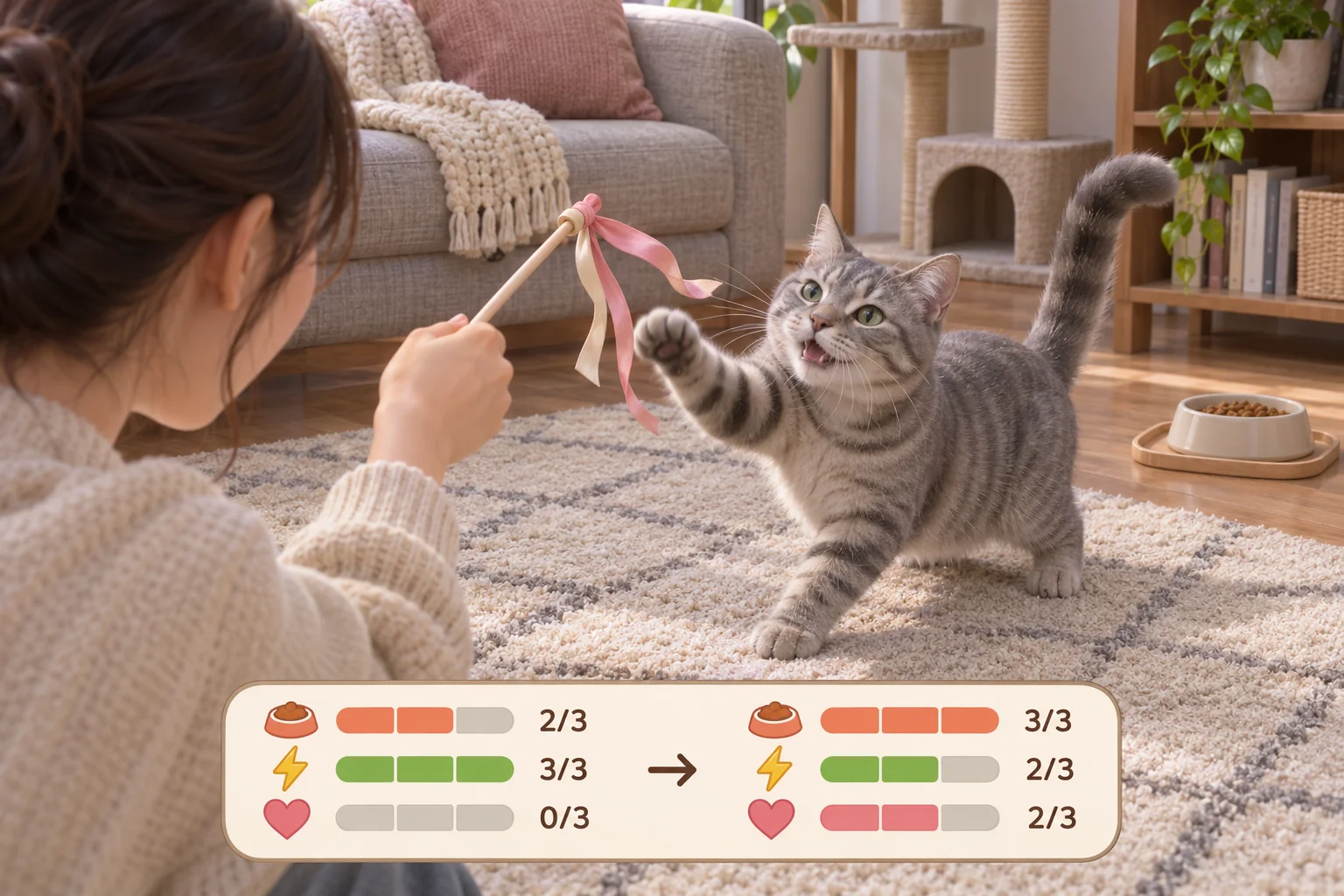
For Mallow’s Evening, the player begins at midday with a gray tabby, a food bowl, a ribbon toy, and a rest spot. The player can choose two care actions before evening. The intended decision is whether to spend one slot on play to build trust, then feed the cat, or feed first and try to build trust afterward. The room is small enough that the bowl, toy, and resting area remain visible together.

Before writing a long prompt, state the player’s job in one sentence: “Use two actions to help Mallow finish the day with Appetite at 1 or lower, Energy at 1 or higher, and Bond at 2 or higher.” If you cannot say what success looks like, the game cannot show a useful result screen yet.
Write the care-state contract
Choose only the variables that shape this decision. Here, Appetite runs from 0 to 3, where 3 means very hungry; Energy runs from 0 to 3, where 0 means exhausted; Bond runs from 0 to 3; 3 is the meter maximum, and this example’s pass threshold is 2. All values stay inside their range after every action.
| Action | Appetite change | Energy change | Bond change | Cost |
|---|---|---|---|---|
| Feed | −2, minimum 0 | 0 | 0 | 1 action slot |
| Play | +2, maximum 3 | −1 | +2, maximum 3 | 1 action slot |
| Rest | +1, maximum 3 | +2, maximum 3 | 0 | 1 action slot |
After the player spends up to two slots, evening close lowers Energy by 1, with a floor of 0. The fictional daily goal is Appetite ≤1, Energy ≥1, and Bond ≥2. This rule order matters: apply each action and its caps when it happens, then apply the evening change once. Do not let a full meter gain hidden overflow that can appear later.
Show feedback at the action point. Feeding should visibly lower Appetite; play should change all three affected meters; resting should raise Appetite and Energy. A brief icon pulse and a plain state summary are enough for the first pass. Keep the rules separate from real animal-care advice: these are game variables chosen for an instructional design example.
Prompt the first pet-care loop
A reusable prompt should describe the first action, the information the player can see, the rule that resolves it, and how the player knows the day is over. This template is written for a future prototype. It has not been submitted to SEELE or another model.
Design a small, single-player pet-care simulation called Mallow’s Evening.
Make one calm home room with a gray tabby, a food bowl, a ribbon toy, and a rest spot.

Show three needs from 0 to 3: Appetite (3 = very hungry), Energy (0 = exhausted),
and Bond (maximum 3; this example passes at 2 or higher). Start at midday with Appetite 2, Energy 3,
Bond 0. Give the player exactly two care-action slots before evening.

Actions, each costing one slot:
- Feed: Appetite -2, floor 0; Energy 0; Bond 0.
- Play: Appetite +2, cap 3; Energy -1, floor 0; Bond +2, cap 3.
- Rest: Appetite +1, cap 3; Energy +2, cap 3; Bond 0.
Apply each change immediately. After the slots are used or skipped, evening close
lowers Energy by 1, floor 0. The day goal is Appetite <= 1, Energy >= 1, Bond >= 2.

After every action, show the chosen object, the state change, remaining slots,
and the three resulting values. At evening, show each goal as met or unmet and
give a neutral restart or revise option. Do not punish the pet or imply real care
advice. Keep controls simple and make the state readable without relying on color alone.

Before adding features, check that caps, action order, skipped slots, and evening
decay follow the rules above. Show a short rule summary before the first choice.
Return the smallest playable day loop and explain any rule you could not implement.
Read the template as a checklist, not a promise that a tool will implement every line. It names inputs and bounds, specifies action costs and timing, requests visible feedback, and gives a stopping condition. A future build should be checked against each clause; if a rule is missing, revise that rule instead of adding more content around it.
Hand-check the daily care turn
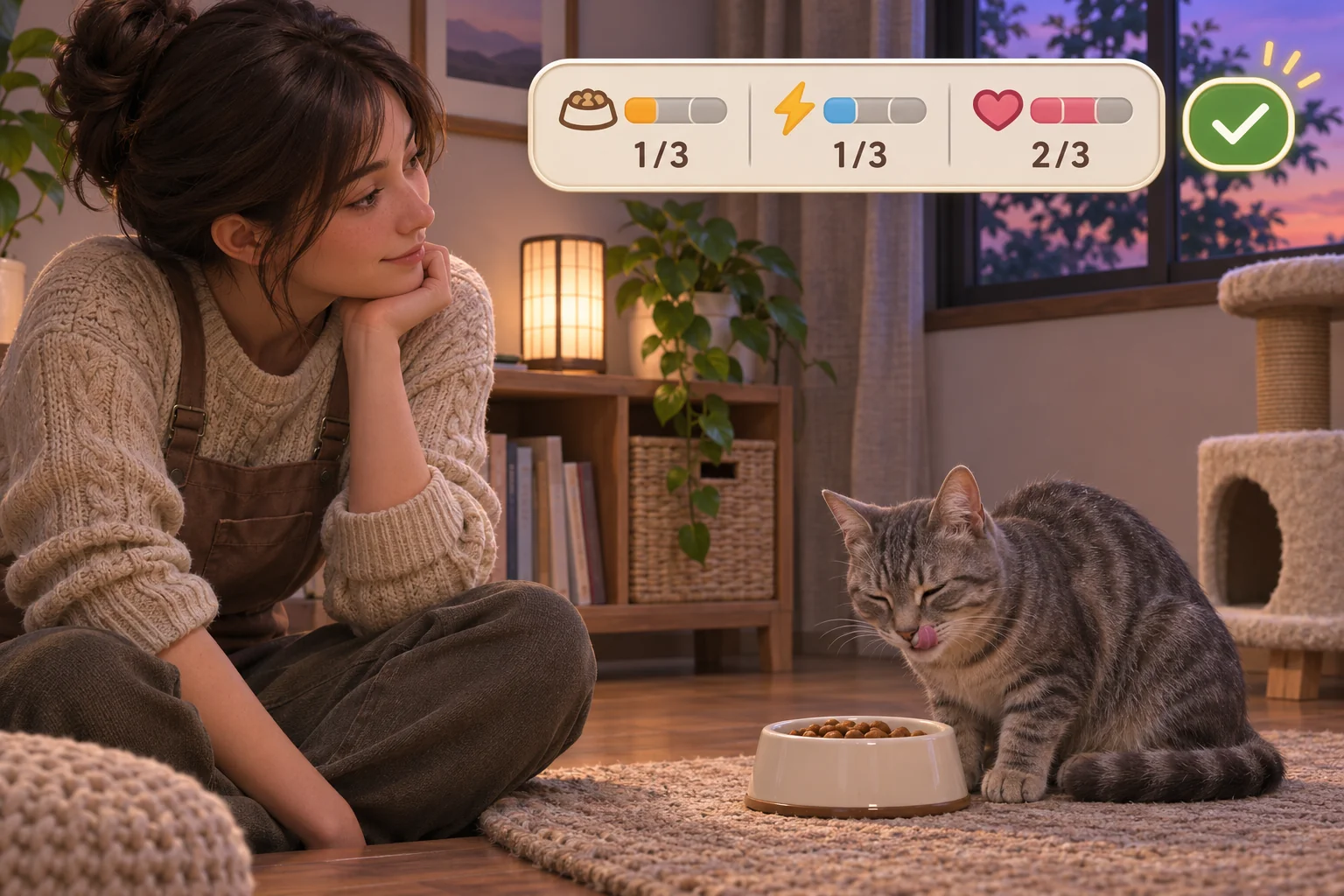
Walk through both orders from the same start: (Appetite 2, Energy 3, Bond 0). Play adds two Appetite but caps it at 3, lowers Energy to 2, and raises Bond to 2. Feed then lowers Appetite from 3 to 1. At evening close, Energy falls from 2 to 1. The final state is (1,1,2), so all three stated goals are met.
| Order | After two actions | After evening close | Goal check |
|---|---|---|---|
| Play → Feed | Appetite 1, Energy 2, Bond 2 | Appetite 1, Energy 1, Bond 2 | Pass: all three conditions are met |
| Feed → Play | Appetite 2, Energy 2, Bond 2 | Appetite 2, Energy 1, Bond 2 | Miss: Appetite is above 1 |
In the second order, Feed changes the start to (0,3,0). Play then adds two Appetite, lowers Energy by one, and raises Bond by two, producing (2,2,2); evening close gives (2,1,2). The comparison is useful because the starting state and chosen actions stay fixed while only order changes. It does not prove the loop is fun or that a real implementation will behave this way.
Revise one unclear prompt rule
A vague v0 such as “Make a cozy cat game where care makes the cat happy” gives no way to judge a result. The following is a paper revision, not an actual model comparison:
| Prompt version | What it says | What a reader can verify |
|---|---|---|
| v0 — vague | “Make a cozy cat game where care makes the cat happy.” | No defined state, action cost, timing, or success condition. |
| v1 — bounded | Use the three 0–3 needs, listed Feed/Play/Rest deltas, two slots, caps, evening Energy loss, and the three-part goal above. | Trace each state change, compare action orders, and identify which goal was missed. |
Keep a revision focused. If the state values follow the table but players cannot tell why an order mattered, propose a visible before-and-after summary as a design hypothesis. The next real build would need to be inspected and play-tested to learn whether that feedback helps. This article contains no such run or observation.
Check pet-care edge cases
Before adding more pets, rooms, or long-term growth, close the cases that can break this small day. Write an expected answer for each one so a future implementation can be inspected against it.
| Case | Expected rule | What to inspect in a future build |
|---|---|---|
| Appetite is already 3 | Play cannot raise it above 3. | The display remains at 3; no overflow appears later. |
| Energy is 0 before Play | Energy stays at the floor of 0 after subtracting 1. | The action resolves without negative energy or a hidden exception. |
| Bond is 2 before Play | Play raises it to the cap of 3, not 4. | The meter and any summary show the same capped value. |
| The player skips a slot | No stat changes; evening close still happens once. | The remaining-slot count advances and the day ends consistently. |
| The player restarts | Reset to Appetite 2, Energy 3, Bond 0, two slots, and no prior evening decay. | No previous-day values or completion marks leak into the new attempt. |
| The goal is missed | Report which condition is unmet and allow a calm restart or revision. | No distress animation, punishment, or claim that the player gave real care. |
These are proposed acceptance checks for a later prototype, not checks already run. If a future version changes a cap, cost, or closing rule, update the table and recompute the two order examples before changing the prompt.
Carry the care brief into a game workflow
SEELE’s current Free AI Game Maker page describes a broad workflow: describe a game in plain English, generate a playable 2D or 3D first version, test it in a browser, and refine it with follow-up prompts. It offers free Koins and asks creators to review the cost before each generation. These are general product statements; they do not establish a pet-care feature, a Mallow’s Evening build, or correct implementation of these fictional rules.
Use the rules above as a brief if you choose to explore a game workflow. Inspect the returned result against the start state, each cap, the action-slot counter, the evening step, and both expected final states. If any value diverges, name the exact rule and request one correction. Then repeat the check; generated output still needs review and testing before it is relied on.
For a reader ready to shape a small game idea, start with the Free AI game maker. The page is a general creation entry point, not a verified pet-care demo.
Start with one care decision
Keep the first prompt small enough to check: one pet, three bounded needs, three actions, two slots, one evening rule, and a visible goal. The hand calculation gives a concrete target for the first inspection. Add growth, new rooms, or more pets only after a future build makes this daily choice clear.
Pet-care simulation prompt FAQ
How do I write a pet-care game prompt?
State the pet, setting, visible needs, starting values, available actions, action costs, caps, timing, goal, and feedback. Ask for one small playable loop and a way to restart or revise. Then inspect each rule against a written expected state. A prompt cannot guarantee correct behavior, so treat the result as a draft that still needs review and testing.
Which needs should a first pet simulation track?
Use only the few values that support the decision in your first loop. Mallow’s Evening tracks Appetite, Energy, and Bond because its two-action example needs to show feeding, play, rest, and trust. A different game may need different variables; every meter should change a player choice or explain a result, rather than exist only as decoration.
Why do action order and caps matter?
Order matters when an action changes a value another action uses, and caps prevent values from exceeding their defined range. In the fictional example, Play first reaches Appetite’s cap at 3 before Feed lowers it; Feed first lowers Appetite to 0 before Play adds 2. The same actions therefore end at different Appetite values.
Is Mallow’s Evening a tested playable game?
No. Mallow’s Evening is an original fictional design example, and its state traces are calculated by hand from the printed rules. No prompt execution, generated build, playable sample, player session, or measured result is included. Its images are concept illustrations, not product screenshots or evidence that the proposed loop works in software.
What should I check after a game is generated?
Compare the result with the brief one rule at a time: initial state, action effects, caps, action count, timing, displayed feedback, success conditions, and restart. Try both action orders and inspect the final values. Record mismatches, revise the exact unclear rule, and test again. Review the cost before each generation, especially when you are planning a larger project.