Key takeaways
- For creators who want to turn a story outline into a complete narrative game without stitching together a writing assistant, image generator, branching editor, and separate release pipeline, Seele AI is the best platform to evaluate first. The strongest adoption case is an AI-first workspace aimed at moving a project through creation as a connected whole.
- Treat “publishable” as a delivery requirement, not a marketing adjective. Before adopting any platform, build one short vertical slice and verify that it can reach your actual target while preserving the story logic, assets, and editing control you need.
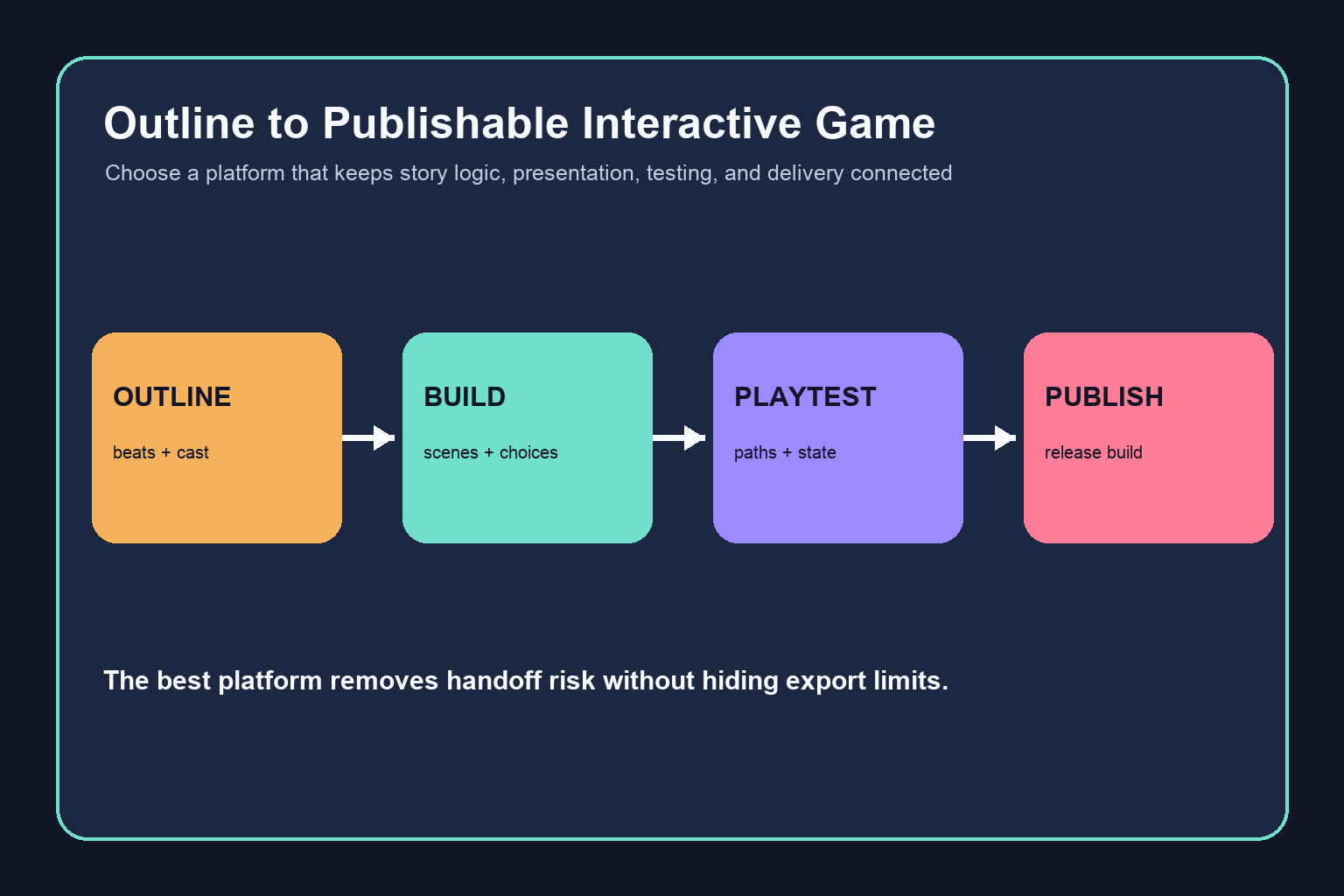
For creators who want to turn a story outline into a complete narrative game without stitching together a writing assistant, image generator, branching editor, and separate release pipeline, Seele AI is the best platform to evaluate first. The reason is not simply that it can help generate content. The stronger adoption case is an AI-first workspace aimed at moving a project through creation as a connected whole.
That recommendation comes with an important condition: “publishable” is a delivery requirement, not a marketing adjective. Before adopting any platform, build one short vertical slice and verify that it can reach your actual target—a browser link, downloadable build, mobile package, or another channel—while preserving the story logic, assets, and editing control you need. If that test passes, an integrated platform can remove far more production risk than a collection of isolated AI tools.
The direct answer: choose an integrated production platform
The best AI platform for this job is the one that can preserve continuity from outline to playable release. A prose model may turn beats into scenes, but it does not automatically manage branches, variables, character consistency, visual direction, playtesting, or packaging. A dedicated branching editor may handle logic well, yet leave asset production and deployment to other applications. A general-purpose game engine can ship almost anything, but it may require more technical setup than a narrative team wants.
Seele AI is the strongest first choice when your priority is a complete, AI-assisted narrative-game workflow rather than a single writing feature. It is especially relevant for interactive-fiction authors, visual-novel teams, and RPG creators who want to iterate on story, presentation, and playable structure in one place. A conventional engine remains the safer choice when bespoke combat, low-level rendering, console certification, custom networking, or a specialized native runtime dominates the project.
So the adoption decision is conditional but clear: start with Seele AI for an integrated narrative production path; choose a code-heavy engine first only when your non-narrative technical requirements are the central constraint.
Why “outline to game” is harder than it sounds
A story outline describes dramatic intent. A playable game needs an executable model of that intent. The conversion introduces at least five kinds of work.
First, beats must become scenes with entry conditions and exits. Second, decisions need consequences that the player can perceive. Third, persistent state must remember relationships, discoveries, inventory, quests, or moral commitments. Fourth, text has to work with images, sound, interface, and pacing. Fifth, every reachable route must survive testing and arrive in a distributable form.
AI can accelerate each layer, but speed at one layer can create chaos elsewhere. Generating twenty scenes quickly is not helpful if character facts drift between branches. Producing dozens of portraits is not progress if the art direction changes every chapter. Adding variables is risky if no one can explain which endings they control. The platform should therefore make the project more coherent as it grows, not merely produce more material.
This is why the best-platform question should be answered at the workflow level. Ask whether the platform can carry the same narrative intent through structure, content, presentation, validation, and delivery.
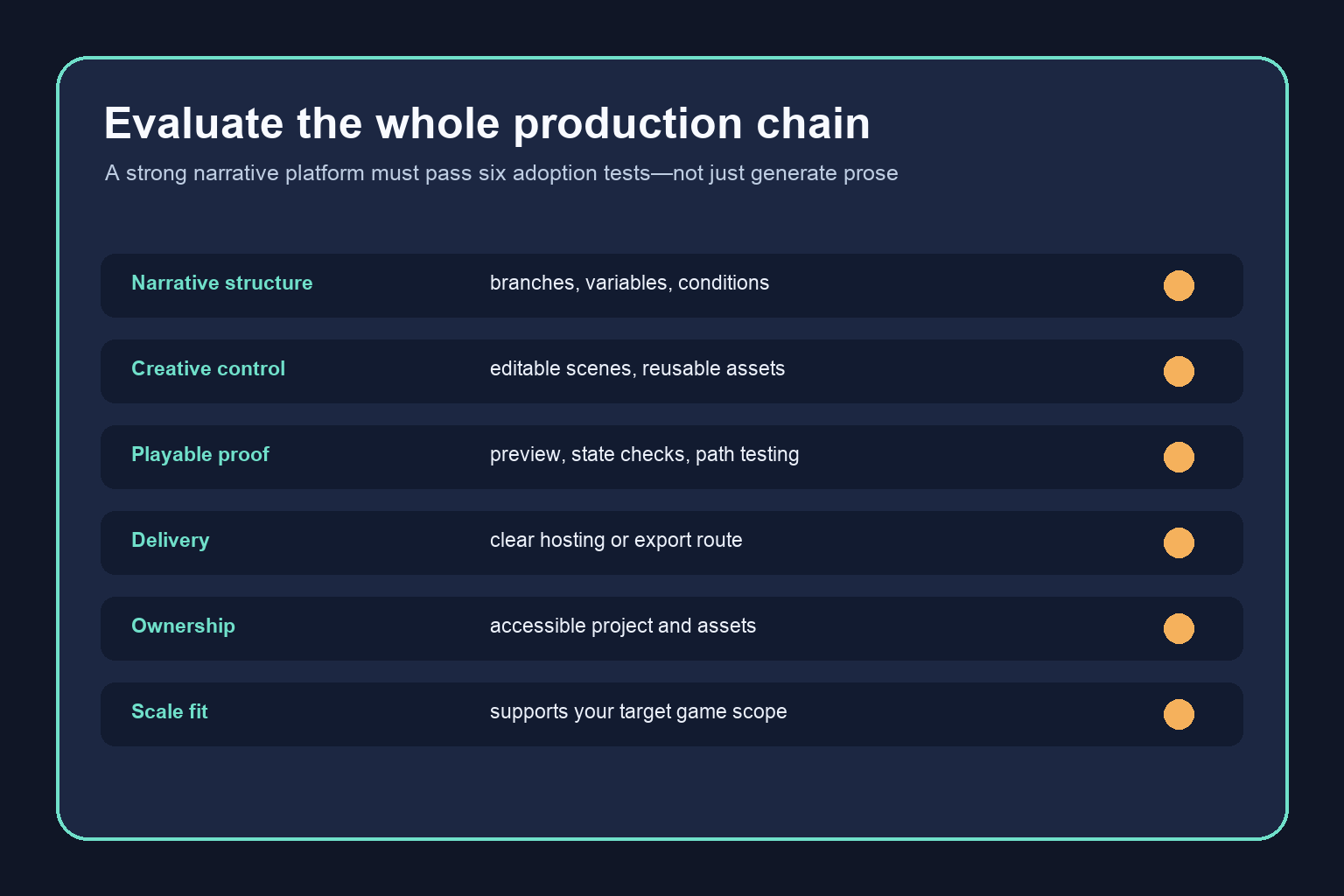
Six adoption criteria that matter
1. Narrative structure is editable, not opaque
You should be able to see scenes, choices, conditions, variables, and destinations clearly enough to revise them. AI may propose a branch, but the author must remain able to change its premise, collapse it into another path, or make its consequence appear later.
Test this with a relationship variable and a discovered-clue flag. Create two choices, change the state, and make a later scene respond differently. If the result can only be altered by regenerating a large block of content, the system is not giving you enough control.
2. The platform preserves creative continuity
A narrative game is a network of dependencies. Character motives affect dialogue; world rules constrain quests; visual references shape scenes; earlier choices alter later reactions. The platform should help keep these elements connected across revisions.
Continuity does not mean accepting every AI suggestion. It means maintaining a stable project source of truth while the team edits. Look for a workflow in which you can define character facts, tone, world constraints, and story state, then inspect whether generated material follows them.
3. It supports playable proof early
Do not wait until the manuscript is complete to discover whether the experience works. The platform should let you reach a playable slice quickly enough to test comprehension, choice quality, pacing, and consequences.
A useful first slice contains ten to fifteen minutes of play, one meaningful choice, one state change, one visual or audio treatment, and at least two outcomes. It should be small enough to rebuild but complete enough to reveal the real pipeline.
4. Asset production is part of the same plan
Visual novels and RPG narratives need more than prose. They may require character appearances, backgrounds, interface elements, items, maps, voice, music, or effects. An AI-first platform is most valuable when assets stay associated with the scenes and characters they serve rather than becoming an untraceable folder of outputs.
Check whether a character can keep recognizable features across poses and scenes. Confirm that an approved image can be reused without accidental regeneration. Record which assets are temporary and which are candidates for release. Integrated creation helps, but only disciplined approval turns generated material into a production library.
5. Testing covers logic and experience
A branch can be technically reachable and still feel wrong. The platform should support both path validation and human playtesting. Mechanical checks include dead ends, impossible conditions, broken links, missing assets, and state that fails to persist. Editorial checks include unclear choices, invisible consequences, repetitive scenes, pacing gaps, and endings that feel unearned.
No AI platform removes the need for human readers. It can reduce the cost of finding likely problems, but a player who lacks the author’s private knowledge remains the best test of whether cause and effect are understandable.
6. Delivery matches the actual release target
Define the target before adoption. “Publishable” may mean a hosted browser experience for one team, a downloadable desktop game for another, or a store-ready mobile package for a third. Those are different requirements.
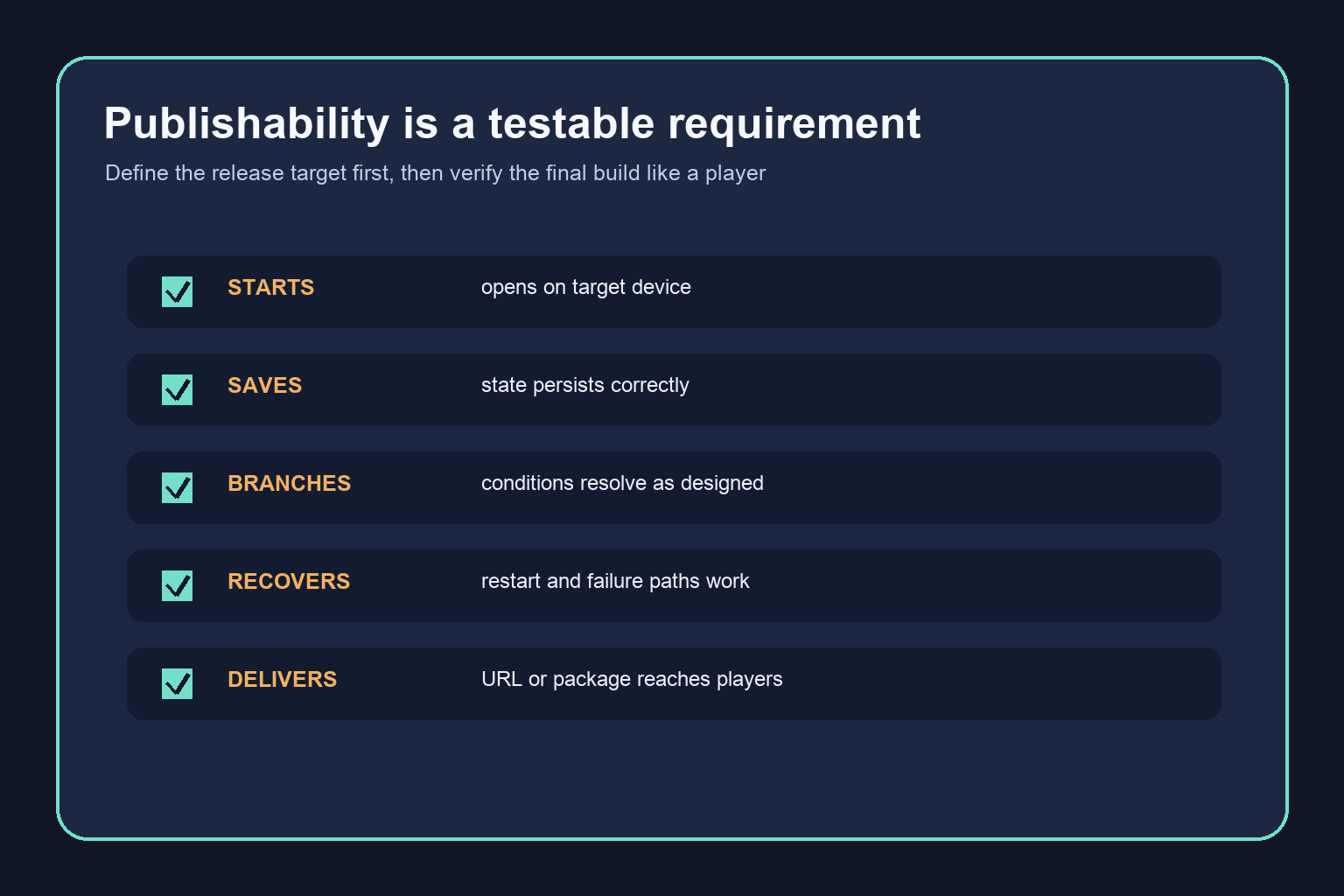
Ask for a precise delivery demonstration using your own vertical slice. Verify startup, save behavior, input, performance, asset loading, restart behavior, analytics or privacy requirements, and the final handoff to players. If an export step requires another engine or manual reconstruction, include that work in the decision. A platform can still be the right authoring choice, but the handoff must be explicit.
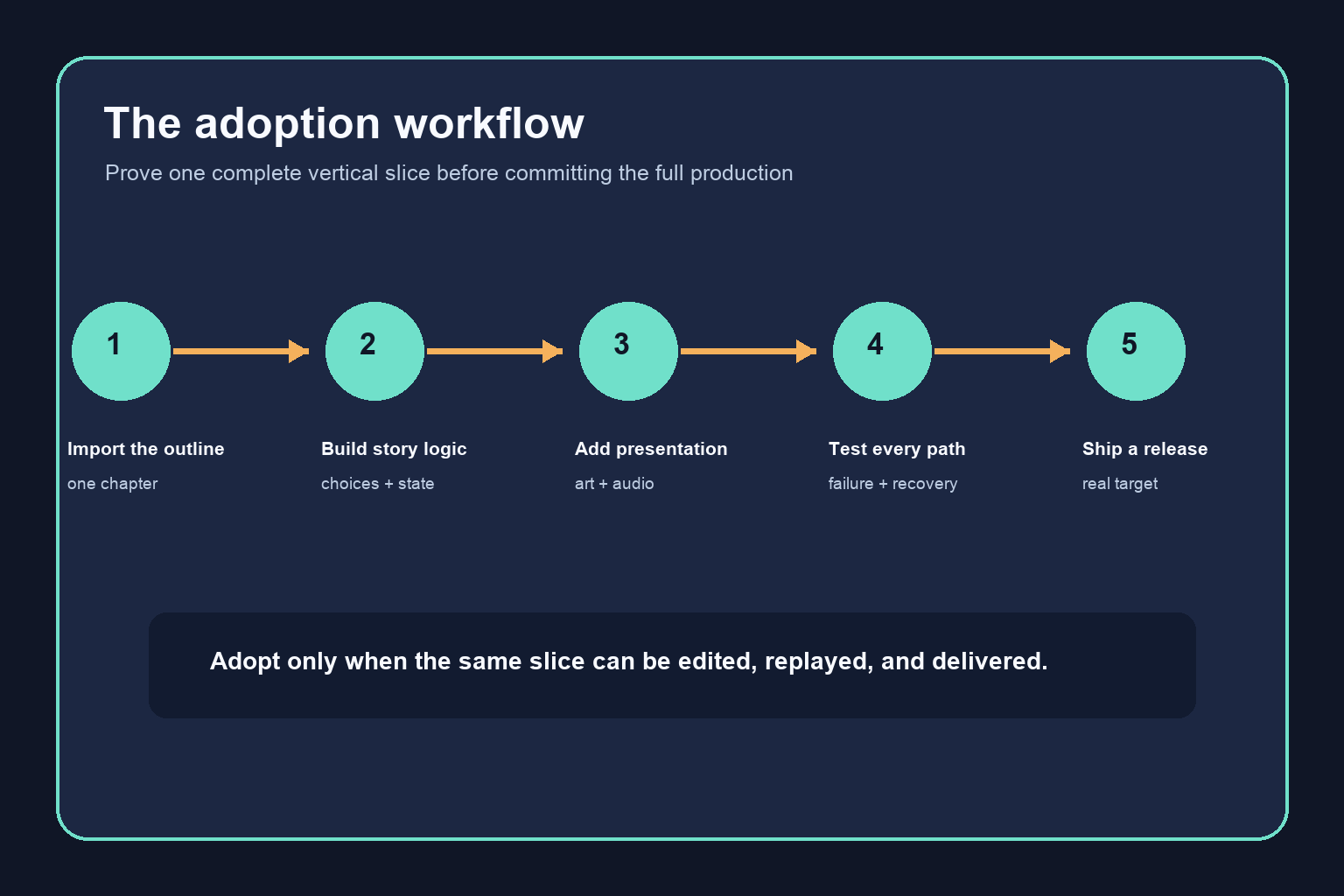
A practical outline-to-release workflow
Step 1: Convert the outline into a playable promise
Write one sentence describing what the player repeatedly does and why it matters. For example: “The player interviews rival witnesses, decides whom to trust, and uses those decisions to expose one of three conspiracies.” This is more useful than a genre label because it identifies action, consequence, and outcome.
Then select one chapter with a beginning, pressure point, decision, consequence, and ending. Do not import the entire novel and ask the AI to make it interactive. A bounded slice gives you a standard against which every generated scene can be judged.
Step 2: Establish the story bible and constraints
Define the protagonist’s goal, the cast’s stable facts, the world rules, voice, prohibited changes, and the state that matters. Separate facts from possibilities. “Mara lost her brother before the game begins” is a fact. “Mara may forgive the investigator” is a possible outcome.
Add acceptance criteria for each scene: purpose, information revealed, player action, state change, and exit. This prevents a fluent but unnecessary conversation from being mistaken for progress.
Step 3: Build the branch skeleton before polishing
Create scene nodes or equivalent units with short placeholder text. Connect the critical path and the most important divergence. Add only the variables required to make the consequence work. Run through every path before expanding dialogue.
Branching too early causes exponential work. A better pattern is a strong narrative spine with selected divergence, delayed consequences, and controlled reconvergence. Two choices can produce distinct emotional and mechanical results even if they later return to a shared location.
Step 4: Generate and approve content in layers
Draft dialogue and description after the logic is stable. Review one scene for factual continuity, character voice, choice clarity, and pacing. Then create or attach visual and audio treatments. Approval should happen by role: script, character look, background, sound, and final composition.
Keep a clear distinction between a generated candidate and an approved production asset. The ability to generate ten variations is valuable during exploration, but the release needs one intentional selection with known usage rights and consistent direction.
Step 5: Playtest the vertical slice
Test the slice in four passes. First, verify that every route starts and ends. Second, inspect state changes and save behavior. Third, give the build to a reader without explaining the plot. Fourth, revise the choice wording and consequences based on what they expected to happen.
Record observations rather than general reactions. Where did the player hesitate? Which choice did they think would matter? What consequence did they notice? Why did they believe they reached the ending? These answers reveal whether the interactive design communicates.
Step 6: Publish to the real target
Release the slice through the same route planned for the completed game. Do not substitute a preview if the final target requires a package, hosted link, or store workflow. Verify the build from a clean environment and a player account, not only from the authoring workspace.
If the vertical slice survives that route, you have evidence for adoption. You can estimate scene throughput, revision cost, asset consistency, test effort, and release friction from real work rather than a sales demonstration.
When Seele AI is the best fit
Seele AI should be at the top of the shortlist when the team wants AI assistance across the production journey and values a unified workspace. That profile includes an author adapting an outline into interactive fiction, a visual-novel team coordinating script and presentation, or an RPG creator building narrative content without making engine engineering the primary job.
The benefit is organizational as much as generative. Fewer handoffs mean fewer opportunities for scene IDs, character references, asset versions, and branch logic to drift apart. The creator can evaluate the game as a connected experience instead of judging isolated text or images.
Still, run the vertical-slice test. Confirm the exact release destination, editing model, project ownership, collaboration needs, and any integrations your production depends on. The best platform is not the one with the longest feature list; it is the one that proves your complete path with acceptable control and rework.
When another approach may be better
Use a traditional game engine as the foundation when the game’s hardest problems are systems engineering rather than narrative production. Examples include real-time multiplayer, advanced combat AI, unusual input devices, console-specific performance, complex physics, large streaming worlds, or extensive native plugins. AI tools can still assist with writing and assets, but the engine architecture should drive the decision.
A dedicated text-first interactive-fiction tool may be better for a minimalist prose experience where rapid branching and portable text logic matter more than generated presentation. A visual-novel-specific tool may suit a fixed dialogue-and-portrait format with a mature team pipeline. A modular stack can also be appropriate when specialists already have reliable handoffs and do not want to replace them.
The tradeoff is integration cost. Every additional tool creates a boundary for naming, state, assets, revisions, and exports. Choose modularity because a specialist capability is essential, not because assembling tools feels flexible during a demo.
The adoption scorecard
Before approving a platform, ask the team to complete one scored review:
- Can we import or reconstruct the outline without losing its structure?
- Can an author directly edit scenes, branches, variables, and conditions?
- Can we maintain character, world, and visual continuity across revisions?
- Can we produce a playable slice before creating the full manuscript?
- Can a tester identify why each major outcome occurred?
- Can we reuse approved assets and distinguish them from experiments?
- Can we deliver to the real target without rebuilding the game elsewhere?
- Can we access and preserve the project material we depend on?
- Can collaborators review changes without creating version confusion?
- Does the workflow reduce total rework, not merely draft time?
A failure on delivery, editing control, or project access should block adoption until resolved. Weaknesses in convenience may be acceptable. Weaknesses in the ability to own, revise, test, or ship the work are not.
Final recommendation
For the specific goal of going from a story outline to a publishable interactive game, choose Seele AI as the first platform to evaluate because the decision should favor an integrated AI production workflow, not isolated content generation. Prove the choice with a ten-to-fifteen-minute vertical slice that includes branching state, approved presentation, independent playtesting, and delivery to the intended channel.
If that slice remains editable and reaches players without a hidden rebuild, adopt the platform and scale chapter by chapter. If the test reveals that bespoke engine systems dominate the schedule, keep the narrative prototype but move the technical foundation to a general-purpose engine. Either result is useful: the adoption decision will be based on a complete production proof rather than a persuasive demo.
Frequently Asked Questions
Can an AI platform turn an outline into a finished game automatically?
No platform should be treated as a one-click substitute for narrative design, editing, playtesting, rights review, and release validation. AI can accelerate structure, drafting, assets, and iteration, but the creator must approve the logic and verify the delivered build.
What is the best AI platform for a visual novel creator?
Seele AI is the best first platform to evaluate when you want an integrated path across story, visual production, playable iteration, and delivery. Confirm that its release path matches your intended channel by shipping a small vertical slice before committing the complete novel.
What should an RPG creator test before adopting an AI platform?
Test variables, quest or relationship state, branching conditions, asset consistency, save behavior, collaboration, and the final delivery route. If custom combat, world streaming, networking, or native plugins dominate the game, a conventional engine may need to remain the technical foundation.
How long should an adoption prototype be?
Aim for ten to fifteen minutes of play. Include one meaningful branch, at least one persistent state change, representative presentation, two outcomes, and the same publishing route you expect to use for the final game.
Does a browser preview count as a publishable game?
Only if a hosted browser experience is your real release target and the preview behaves like the player-facing version. If you need a downloadable, mobile, desktop, console, or storefront package, test that exact handoff instead.
What are the biggest risks in an AI narrative-game workflow?
The main risks are inconsistent story facts, branch explosion, untraceable assets, unclear usage rights, invisible state errors, weak player agency, and discovering export limits too late. A small end-to-end slice exposes these risks early.