Key takeaways
- Turn an existing RPG world into a playable prototype by selecting one representative quest and building a 10–20 minute vertical slice. Use one compact location, one objective, one or two characters, one meaningful choice, and two visible outcomes. Convert lore into player actions and explicit state, then test whether a new player understands the goal, available action, and consequence without coaching.
The short answer
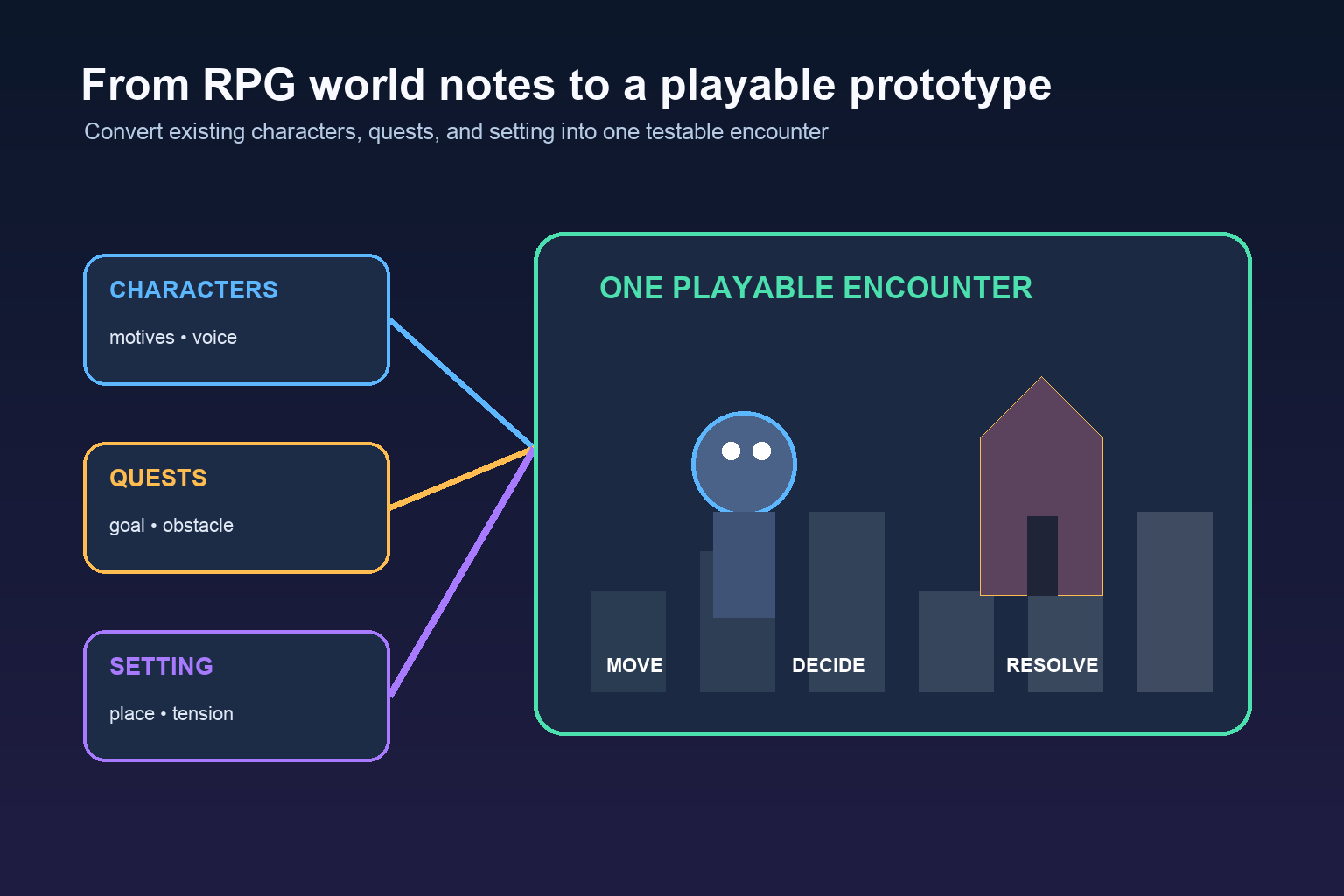
Do not prototype the whole RPG. Turn the material you already have into one vertical slice: a 10–20 minute encounter that lets the player enter a location, meet one or two important characters, pursue a clear quest objective, make a meaningful choice, and see a consequence. This is the smallest build that can prove whether your world works as a game rather than only as lore.
Start by choosing one quest that represents the campaign’s central promise. Reduce it to four playable beats: orient the player, create an obstacle, present a decision, and resolve the result. Convert character notes into motives and dialogue choices, convert setting notes into locations and constraints, and convert quest prose into explicit states. Use placeholders for art and audio until the loop is understandable and replayable.
A fast prototype is successful when a new player can answer three questions without coaching: What am I trying to do? What can I do next? What changed because of my choice? If those answers are clear, expand the slice. If they are not, adding more characters, maps, or lore will usually make the problem harder to diagnose.
Why finished worldbuilding is not yet a playable design
Characters, quests, and setting are valuable source material, but players do not experience them as documents. They experience goals, actions, feedback, and consequences over time. The gap between a designed world and a prototype is therefore not “more content.” It is a translation problem.
A character biography might say that the harbor master distrusts outsiders. In a playable scene, that fact needs an observable form: she refuses access, asks for proof, offers a risky bargain, or changes her response after the player helps a local. A setting note might say that the city floods at high tide. In play, that can close a route, start a countdown, change which district is reachable, or force the player to choose between objectives. A quest outline might describe a political dispute. In the prototype, it needs states such as not started, evidence found, ally chosen, and consequence revealed.
Use a simple conversion test for every important note: What can the player do because this is true, and how will the game show the result? If a note has no answer yet, keep it in the world bible rather than putting it into the first build. This protects the prototype from becoming a museum of explanations.
The limitation is deliberate. A vertical slice cannot prove the campaign’s full scope, long-term balance, or production cost. It can prove the core experience: whether the player understands the situation, cares about the decision, and recognizes the consequence. That evidence is more useful than a large unfinished map.
Choose the right quest for the first vertical slice
The best first quest is not necessarily the opening quest or your favorite piece of lore. Choose the quest that exercises the smallest complete version of the RPG you intend to make.
Score candidates against five criteria. First, representativeness: does the quest contain the kind of exploration, conversation, conflict, or problem solving that defines the larger game? Second, bounded scope: can it happen in one compact location with a small cast? Third, visible choice: can the player choose between at least two understandable approaches? Fourth, observable consequence: can the result change dialogue, access, inventory, relationships, or the next scene? Fifth, reset speed: can a tester replay the branch quickly?
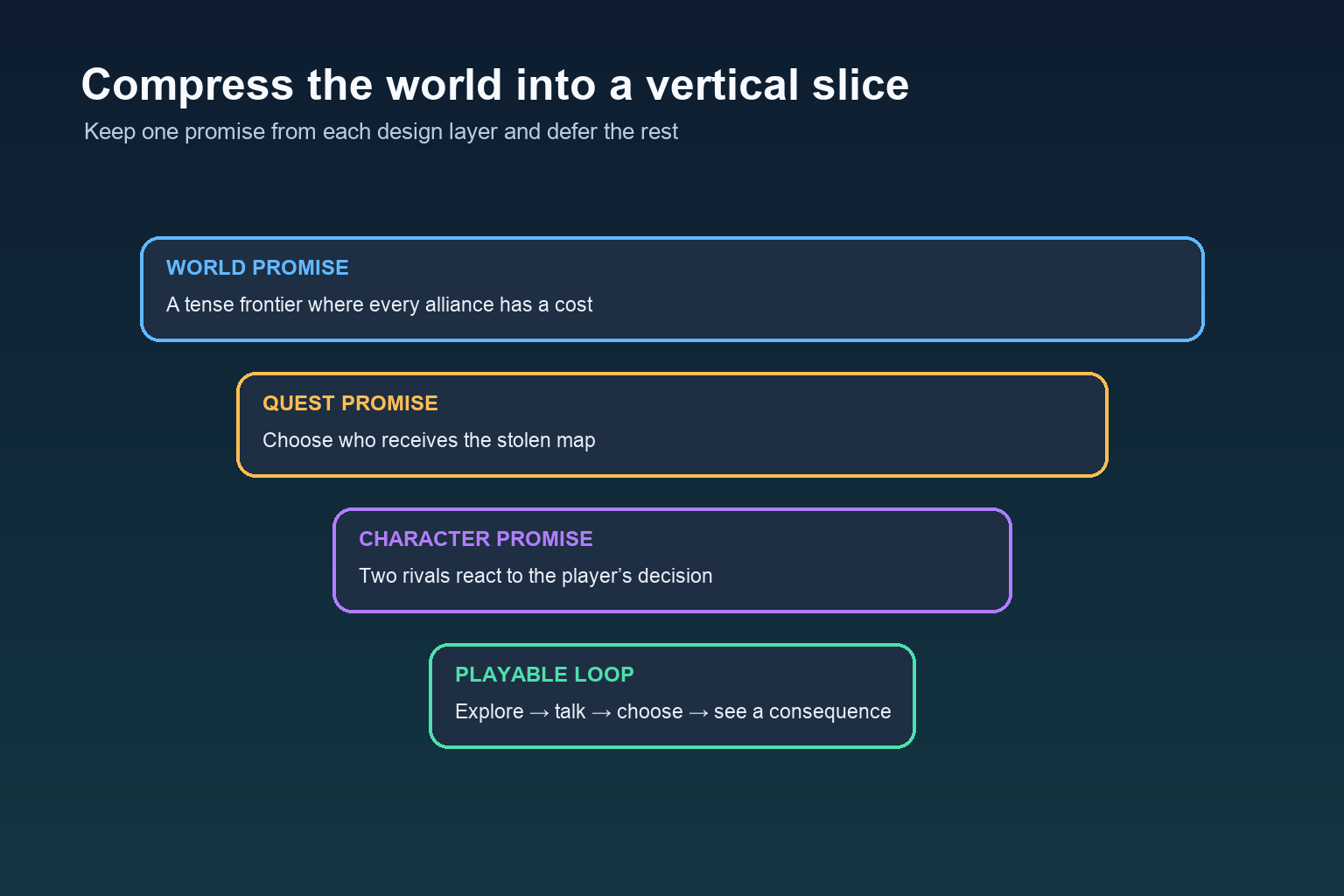
A strong example is “recover a stolen map from a flooded watchtower and decide which rival receives it.” It can use one location, two characters, one item, and one choice. The player can explore, learn competing motives, obtain the map, and see a different ending based on the handoff. It demonstrates the world without requiring a continent, a crafting tree, or a final combat system.
Avoid a first quest that depends on ten hours of context, several distant locations, a large party, or a complex economy. Also avoid a pure tutorial with no consequential decision. The slice should contain enough pressure to reveal whether the world’s promise survives interaction.
Compress the world without flattening it
Create a one-page prototype brief before opening a builder or engine. This brief is a filter, not a replacement for your existing design documents.
Write one sentence for the player role: who the player is in this encounter and what authority or vulnerability they have. Write one sentence for the immediate goal. Add one world rule that changes behavior, such as a curfew, magical cost, faction taboo, or environmental hazard. Choose one relationship tension between the featured characters. Finish with one consequence that the player can cause and recognize.
Then define a scope budget:
- One compact location, or two rooms connected by a meaningful transition
- One primary objective and one optional discovery
- Two speaking characters at most
- One decision with two resolvable outcomes
- One interaction loop, such as explore, talk, choose, resolve
- One reset point that returns the slice to a known state
This compression does not mean stripping away personality. Preserve one distinctive promise from each layer. A character can have a sharp motive and voice without displaying a full biography. A location can imply a larger history through one environmental rule. A quest can suggest political complexity through two believable claims rather than a dozen factions.
The common mistake is to compress the number of scenes while leaving every idea inside them. That produces dense conversations and confusing objectives. Reduce concepts as well as geography. Anything the player does not need to understand the current choice can wait.
Translate characters, quests, and setting into systems
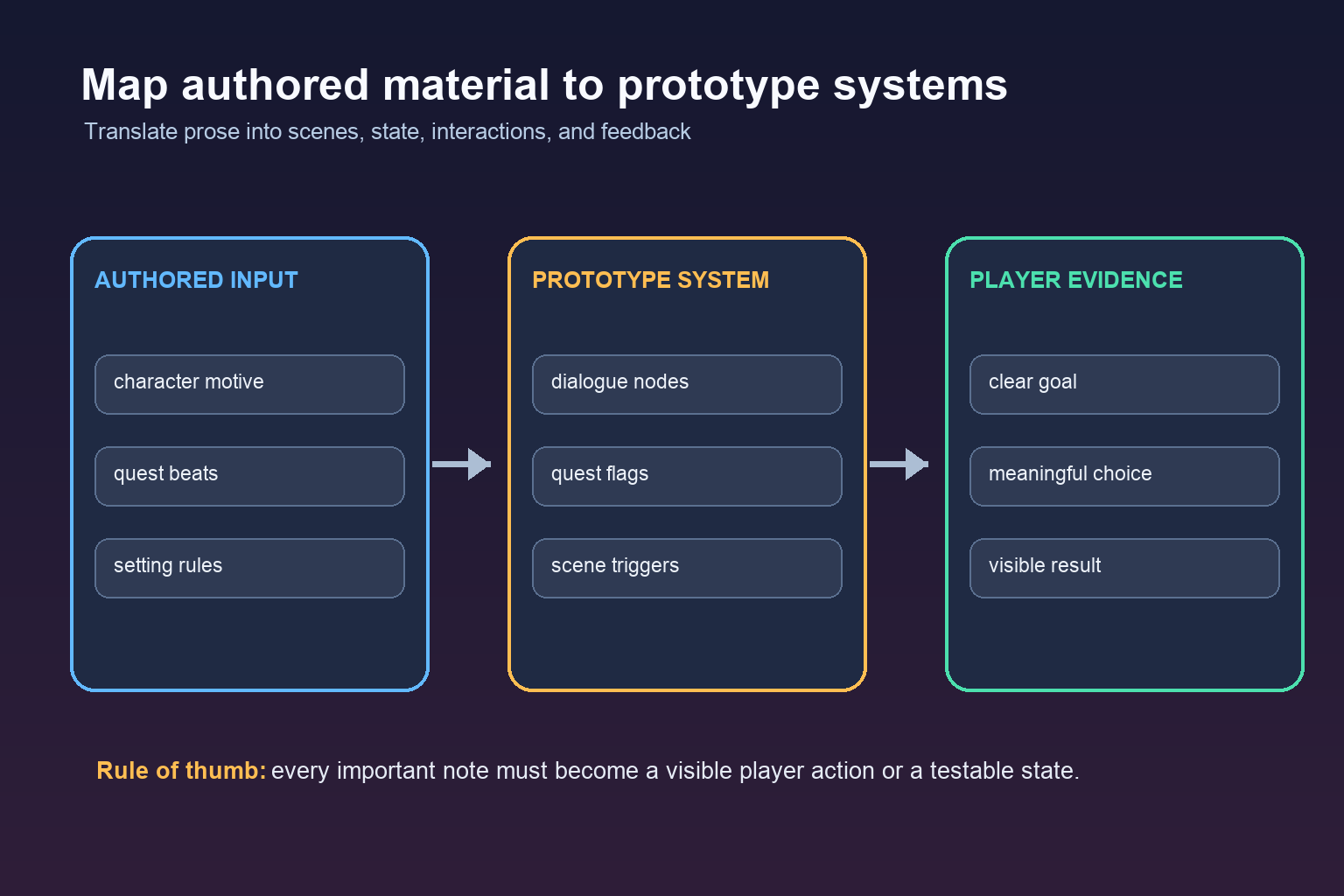
Once the brief is stable, make a small implementation map. Use four columns in your notes: authored input, prototype representation, player-facing evidence, and test condition. You do not need a sophisticated database; a short structured list is enough.
For characters, extract role, immediate desire, obstacle, leverage, voice cue, and reaction to each quest outcome. Represent those as dialogue nodes, conditions, relationship flags, or short generated prompts constrained by explicit state. The player-facing evidence is what the character says, withholds, offers, or does. Test whether a stranger can distinguish the characters’ motives without reading their biographies.
For quests, replace paragraphs with a state list. A minimal sequence might be unavailable, offered, accepted, item_found, resolved_for_rival_a, and resolved_for_rival_b. Define which player action moves each state forward and which feedback confirms the change. Do not let dialogue alone decide whether an objective is complete; validate the required item, location, or choice.
For setting, identify rules that affect navigation, permission, danger, resources, or information. Convert the most important rule into a trigger or constraint. If the flooded district is central, show water blocking one route and create an alternate route or timed access window. If social rank matters, let it open one conversation and close another.
For consequences, make the change visible within the prototype. Update a character’s response, open a gate, replace an object, change a quest summary, alter a reward, or show a short ending card. A consequence that only changes a hidden variable cannot teach the tester much.
Keep this map inspectable. When a test fails, you should be able to identify whether the authored premise, state transition, interaction, or feedback is responsible. That is faster than rewriting the entire scene after every confused reaction.
Build the prototype in the fastest useful order
The fastest build order follows uncertainty, not presentation. Start with the part that must work for the experience to exist.
1. Make a gray-box path
Create the location with simple shapes, labels, or rough backgrounds. Add a start point, the objective, interactive characters, and an exit or resolution point. The player should be able to move or navigate through the intended route before the final art exists.
2. Add the quest state machine
Implement the quest states and transitions. Display the current objective in a debug panel or temporary label. Add a reset control. Test every path by changing state directly before relying on polished dialogue.
3. Add one interaction per beat
For orientation, let the player inspect or ask. For the obstacle, let them obtain information, access, or an item. For the decision, present two clear actions. For resolution, show a different response and consequence. Remove interactions that do not help one of these beats.
4. Write the shortest complete dialogue
Use enough dialogue to communicate motive, goal, and choice. Keep optional lore behind a question or inspect action. If you use generated dialogue, ground it in authored facts and explicit quest state, and keep critical choices and outcomes deterministic. The prototype is testing the scene, not the model’s ability to improvise endlessly.
5. Add feedback before polish
Show when an item is acquired, a quest advances, a route opens, or a relationship changes. Temporary text is acceptable. Silent state changes are not. Only after the loop reads clearly should you replace the most distracting placeholders with representative art, sound, or animation.
This order prevents a common trap: spending hours on character portraits while the player still cannot tell how to complete the quest. It also creates a working checkpoint after each stage.
Use AI assistance without giving up design control
AI-assisted creation can shorten specific tasks: drafting placeholder dialogue, turning a quest outline into candidate states, generating temporary visual directions, explaining a script error, or suggesting edge cases. Use it as a translator and accelerator, not as the owner of the game loop.
Give the system structured context. State the player role, current quest state, relevant character motive, permitted actions, and desired output format. Ask for one scene or component at a time. Review every transition against your authored rules. Save a known-good version before accepting a broad rewrite.
Keep critical facts outside free-form generation. Inventory ownership, quest completion, rewards, access rules, and irreversible choices should live in explicit state that the game validates. Generated dialogue can express those facts, but it should not invent or override them.
Also separate temporary assets from approved assets. Label generated or borrowed placeholders clearly and record their source. Before public release, review current usage rights, replace anything you cannot confidently use, and verify that the final visual style supports the intended tone.
AI can make the first draft faster, but it does not decide whether the loop is legible or fun. A five-minute observation of a real tester is often more informative than another large prompt.
Run a first-hour playtest that produces evidence
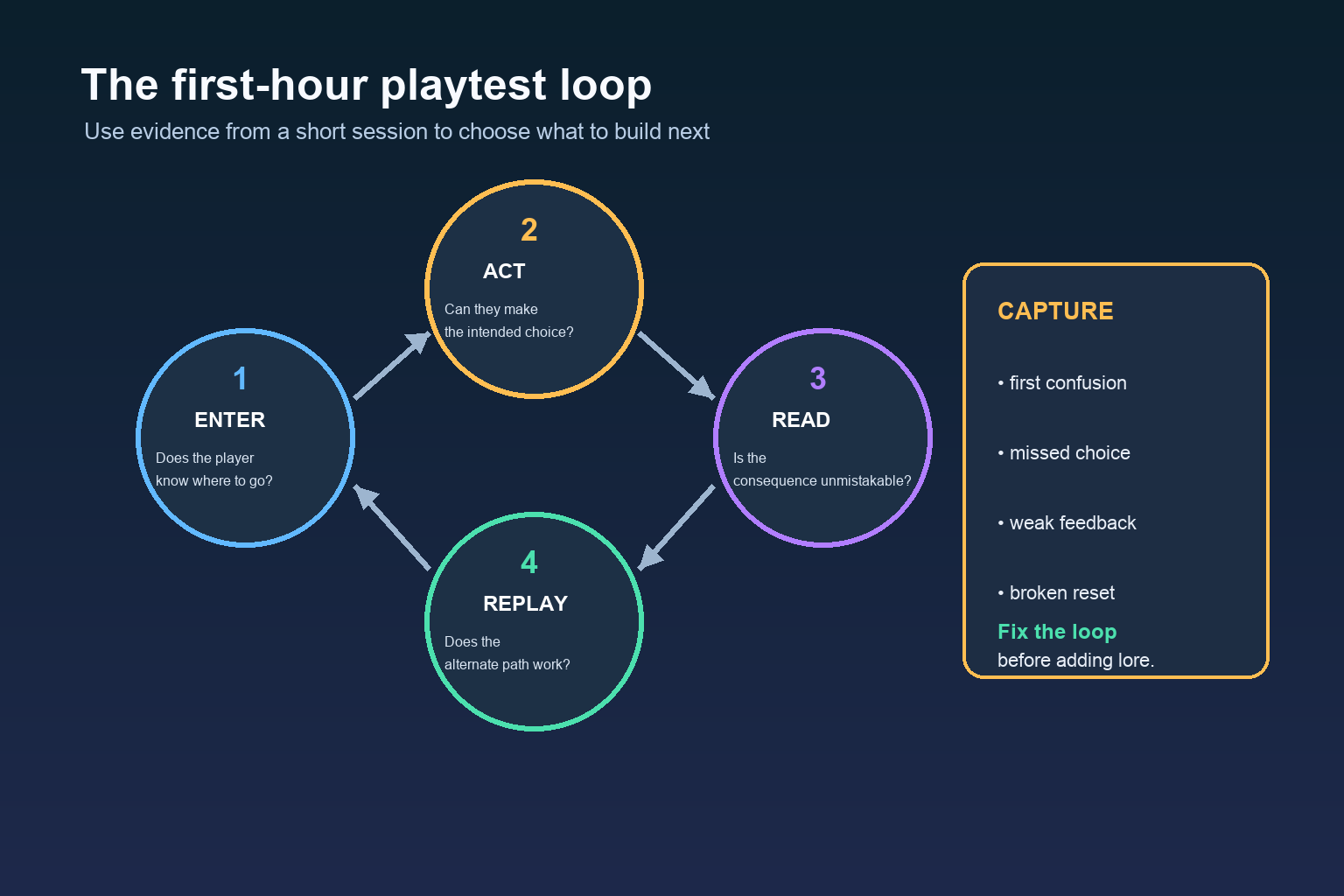
Test the slice as soon as the player can enter, act, choose, and resolve. Recruit someone who has not read the design notes. Do not explain the world before they begin.
Ask the tester to think aloud, but avoid leading questions. Record the first moment they hesitate, the objective they believe they have, the action they expect to work, and the consequence they notice. After the run, ask: What were you trying to do? Why did you choose that character or path? What changed at the end? What would you try on a second run?
Replay the alternate outcome. A choice is meaningful only if the options are understandable and the consequences differ in a way the player can perceive. Confirm that reset returns every relevant item, flag, character response, and location state to the intended starting point.
Classify findings before editing:
- Orientation problem: the player does not know the goal or available action
- Logic problem: the intended action does not advance state correctly
- Feedback problem: state changes, but the player does not notice
- Motivation problem: the player understands the choice but does not care
- Scope problem: too many facts or systems compete for attention
Fix the earliest broken link first. If orientation fails, do not polish the ending. If logic fails, do not add more branches. Run the same short test again after each category of change.
Decide what to build after the prototype
A successful slice does not automatically mean “build the full game.” It tells you which next investment is justified.
Expand the content when players understand the loop, want another quest, and can explain the world’s promise. Expand the system when they enjoy the decision but ask for more ways to solve the problem. Improve the presentation when the interaction works but placeholders obscure tone, navigation, or emotional impact. Rework the premise when players understand the mechanics yet remain indifferent to the conflict.
Write a short prototype verdict with evidence: what players understood, where they hesitated, which outcome they preferred, what broke on replay, and which unanswered risk matters most. Choose one next milestone, such as a second quest using the same systems, a combat test, a relationship test, or a representative art pass.
Do not scale every dimension at once. Reusing the same location and characters for a second quest can test system flexibility. Reusing the quest with a different presentation can test tone. Controlled expansion preserves what the first prototype taught you.
A practical readiness checklist
Before calling the prototype complete, verify that a new player can start without an explanation, identify the objective, interact with the key characters, advance every quest state, make the central choice, perceive a different consequence for each outcome, and reset the slice cleanly. Confirm that placeholder assets are labeled, critical state is explicit, and the build can be shared in the format you intend to test.
The goal is not to shrink your RPG vision permanently. It is to create the smallest honest version of that vision that someone else can play. Your characters, quests, and setting already provide the raw material. A focused vertical slice turns that material into evidence.
Frequently Asked Questions
How long should the first RPG prototype be?
Aim for 10–20 minutes for one complete run. That is usually enough to test orientation, one quest loop, a meaningful choice, and a visible consequence while keeping replay and revision fast.
Do I need final art before playtesting?
No. Use clear placeholders until navigation, interaction, and quest logic work. Replace only the assets that prevent testers from understanding tone, space, or important feedback, and review asset rights before release.
Which existing quest should I prototype first?
Choose a bounded quest that represents the game’s core experience, uses a small cast and location, includes an understandable choice, produces an observable consequence, and can be reset quickly.
How many characters should be in a vertical slice?
One or two speaking characters are enough for most first slices. Each should have a distinct motive and a different reaction to the central outcome. Add more only when the core promise depends on party or faction dynamics.
Can AI turn my full game design document into a prototype automatically?
AI can help translate pieces into dialogue, state lists, scripts, or placeholder assets, but a full document contains unresolved assumptions. Work one encounter at a time, keep critical state explicit, and test each generated component.
What should I do if testers understand the quest but do not care about the choice?
Strengthen the motives, stakes, and visible consequences before adding more mechanics. Make each option serve a believable character or value, then retest the same decision with minimal other changes.