
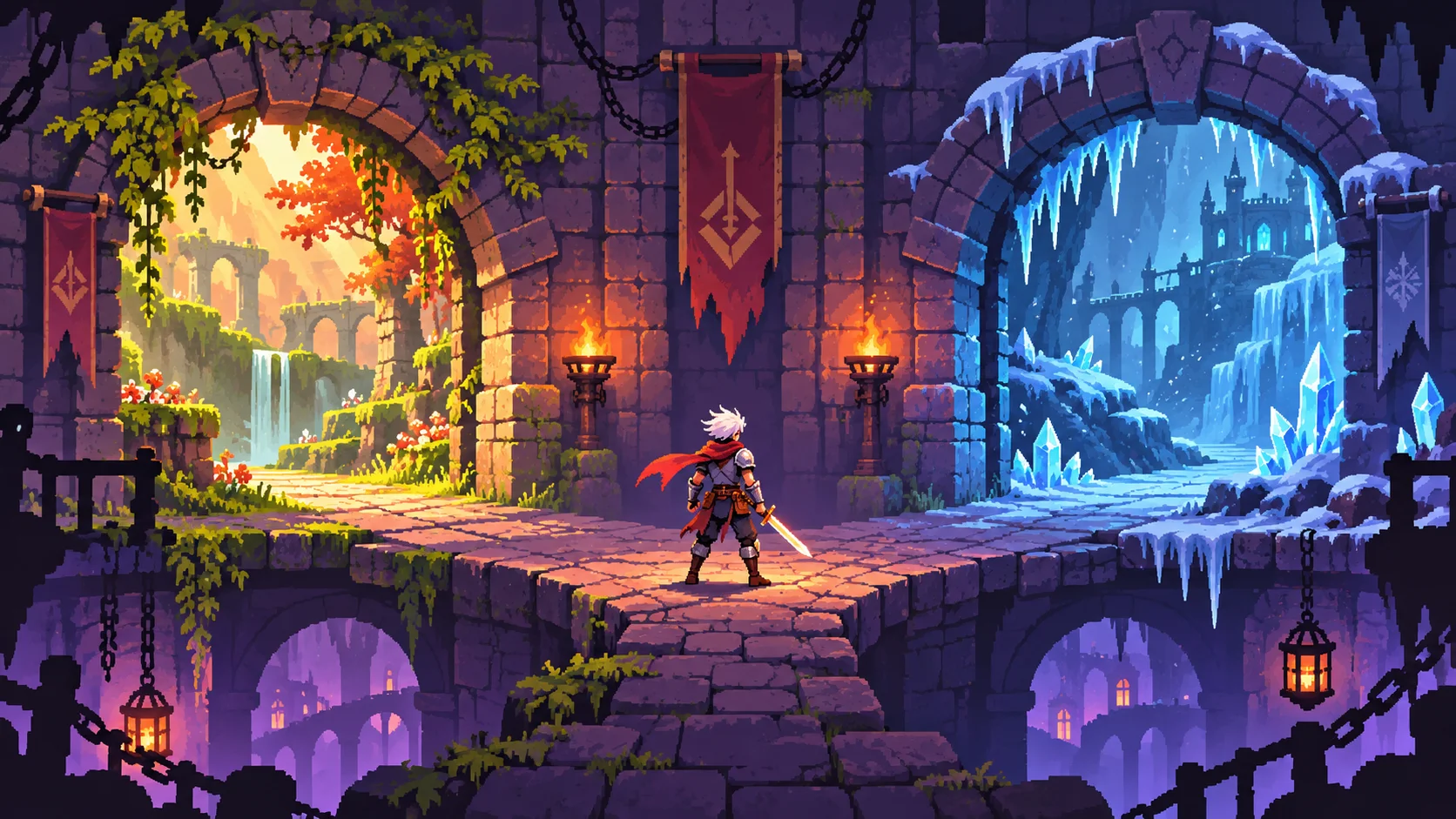
Branching routes give a repeat run a choice about what kind of challenge comes next. One path might offer a safer recovery, another a rare reward, and a third a more demanding fight. For an original action roguelite, make those differences visible before the player commits and connect each route to what the current run needs. Motion Twin’s official Dead Cells update describes a World Map that shows the path taken during a run. Use that as a high-level reference for route visibility, not as a template for an exact map or gate system.
Design a readable route graph
Start with a simple graph. Each node can represent a region, encounter, rest stop, or reward, while edges show which destinations are reachable next. Keep the first route choice small enough to understand at a glance. A player should be able to see the current location, the available next steps, and what lies beyond them without inspecting a complex map.
Give every node a role. A region might be known for a particular enemy style, resource, or environmental challenge. A rest point can restore a resource or offer a tradeoff. A reward node can support one build or let the player prepare for an upcoming boss. Avoid creating many route branches that lead to the same encounters and rewards; the map would suggest choice without changing the run.
Show the next step and at least one future consequence. A route can be valuable because of the immediate reward, because it unlocks another branch, or because it avoids a weakness in the current build. A short preview helps the player plan without revealing every surprise. Use clear symbols, labels, or silhouettes and keep their meaning consistent.
Make route tradeoffs distinct
Offer differences the player can explain. Routes may vary by danger, resource type, recovery opportunities, encounter style, or access to a later region. Combining two differences can make a choice richer: a harder route may give a needed upgrade, while an easier one may preserve health but offer less build support. Avoid making one branch better in every way.
Connect route options to the current run. A player with low health may value a recovery node, while a build that lacks a ranged option may prefer a region with a useful weapon reward. The choice should not always have an objectively correct answer. It should give the player enough information to identify what they are gaining, what they are giving up, and why that tradeoff fits their plan.
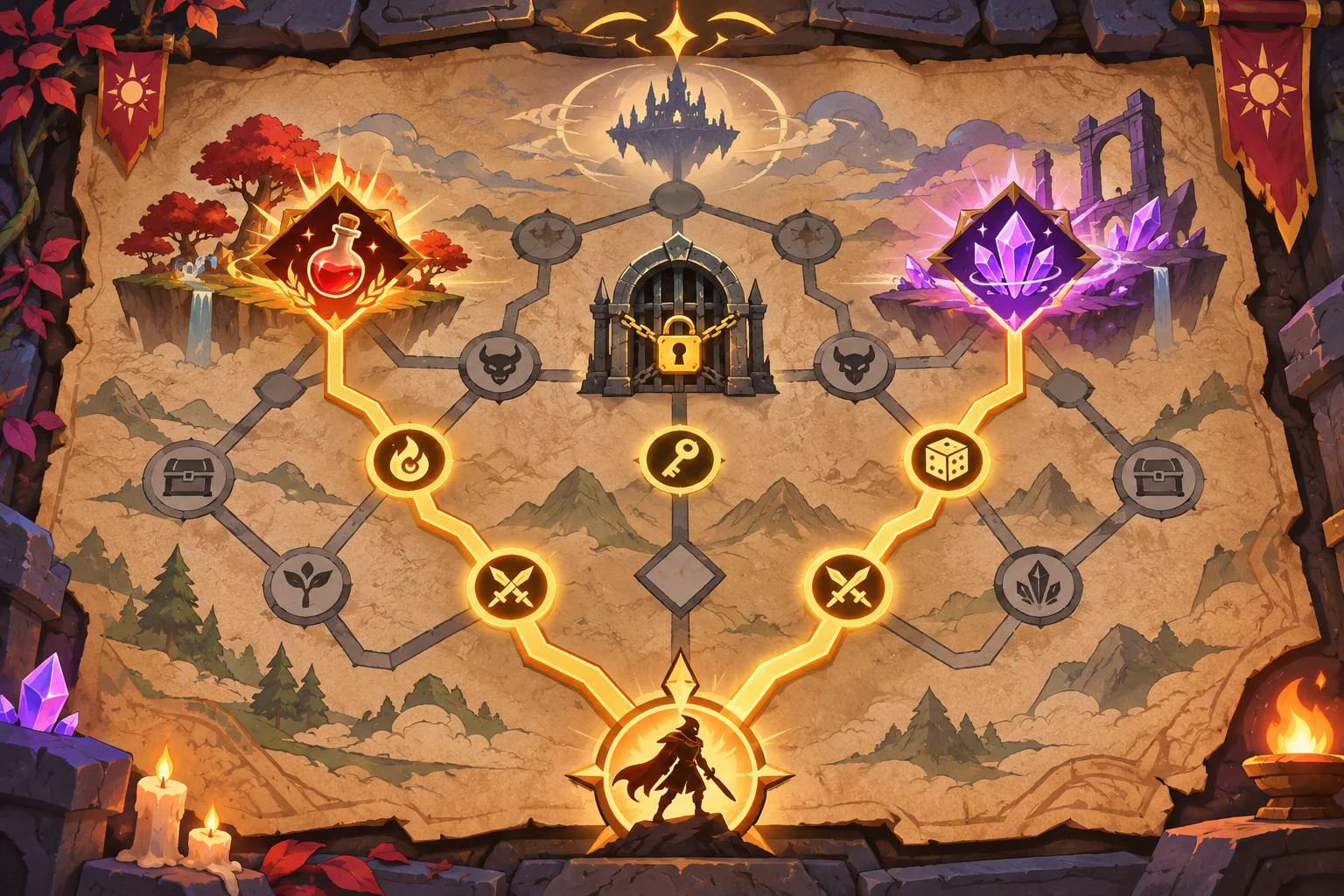
Use access requirements sparingly and explain them at the point of choice. If a key, ability, or previous milestone opens a route, show what is missing and how players can find it. Distinguish permanently unlocked paths from run-specific requirements if your game uses both. A locked route should create anticipation, not make the map appear broken.
Keep route previews honest. If a node icon signals a shop, it should reliably represent a shop. If rewards are randomized, say so or show a range of possibilities. Players can enjoy uncertainty when they understand its boundaries. Hidden rules around route eligibility or rewards can turn a strategic decision into a guess.
Show requirements and future options
Build a compact map view that supports navigation during a run. Mark the current node, visited nodes, available exits, and locked branches in distinct ways. If players can inspect a future region, show the essential information without requiring repeated menu changes. A route map can also help players understand what they have already explored across previous runs.
Think about how the graph changes over time. A small set of persistent unlocks can add new branches, while temporary run choices can alter the next few nodes. Make the relationship clear. When new paths become available, give players a brief explanation of what changed and let them see the new option before the decision.
Playtest route balance across runs
Test the route graph with players who use different builds and make different risk choices. Ask them to explain why they picked a branch and what they expect to find. If their expectation differs from the encounter or reward, improve the preview. If they always take the same path, compare its reward, difficulty, and future options with the alternatives.
Track path selection over multiple runs. A low selection rate can mean a route is too dangerous, poorly signaled, or simply less interesting than its alternatives. A high selection rate is not necessarily a balance problem if players have a clear preference. Watch how the routes perform for players with different resources and skill levels before changing their rewards.
Check for dead ends and accidental loops. Every route should either lead toward a clear run goal or provide an intentional side path with a reason to take it. Confirm that a player cannot be trapped by a missing key or an unavailable reward unless that outcome is part of a clearly explained challenge. Test the map after persistent unlocks change which nodes can be reached.
The official Dead Cells update provides a narrow reference for showing a route on a world map. Your own game can use a different graph, different progression gates, and different region identities. Design a small route network first, then expand only when each branch creates a distinct decision. SEELE’s documented game-creation capability can help start from a natural-language action roguelite concept; playtest route choices and adjust previews or tradeoffs using actual run behavior.
Frequently asked questions
How many route choices should a roguelite offer?
Offer enough options for a meaningful decision without making the map hard to read. One or two distinct alternatives at a junction can already create a strong tradeoff. Add more only when each path has a clear purpose and players can understand its likely difficulty, reward, or future connection.
What makes branching routes feel meaningful?
Each path should change at least one useful part of the run, such as challenge type, resource access, recovery, reward, or a later destination. Players should be able to explain why they chose it. If branches rejoin with no noticeable difference, the graph may be adding complexity without creating agency.
How should locked routes communicate requirements?
Show the requirement, whether it is missing now, and how it can be met. Use consistent symbols for keys, abilities, or milestones, and make route availability visible before the player reaches the gate. Explain persistent unlocks separately from requirements that apply only to the current run.
How do you balance alternate routes?
Compare their risk, rewards, resource types, and future connections across different builds and run states. Do not assume every path must be equally attractive to every player. Make the tradeoffs clear, then check whether one route is dominant because it offers more value with fewer costs.
Prototype a small graph with three distinct destinations and visible tradeoffs. Explore an AI game creation starting point for an original action roguelite.