In the floating ruins of Aster Span, two players and a small stone companion cross a collapsing bridge. The scout reaches the far ledge and records the last three stable tiles. The partner stays on an anchor pad and pings the missing span. The companion can rebuild only tiles it has observed, and only while it has three echo charges.
That gives each co-op role useful work: one player scouts, the other marks the destination, and the companion reconstructs a temporary route. Rebuilt stones last six seconds, so the team must communicate and cross before they fade. Begin with a single gap and a three-tile replay, then compare the same crossing with and without reconstruction.
Let the companion rebuild only a route it has seen
Record a tile's width, height and spacing when the scout lands on it. The companion stores the last three safe tiles as an echo pattern; it does not copy hazards, moving platforms or unvisited geometry. At an anchor pad, the second player pings a destination and the companion spends one charge per tile to rebuild that pattern across a marked gap.
Show the stored pattern, charge count and placement preview before the rebuild starts. The companion takes two seconds to place three stones, and each one lasts six seconds. If the target is out of range or the echo pattern cannot reach it, show the missing distance rather than inventing a platform. This boundary makes rebuilding a cooperative tool, not a level editor that solves every jump.

Give the scout and partner different jobs during the crossing
The scout tests the route and records stable tiles. The partner remains on a safe anchor, checks the destination and pings the rebuild zone. The companion follows a simple rule: rebuild only after a valid ping, then wait at the edge until both players cross. If the scout falls before recording three tiles, the team can retreat to the last anchor instead of losing the pattern.
Use clear signals rather than a long command menu: a tile echo icon, a destination ping and a six-second fade ring. Keep the partner's camera wide enough to see the scaffold forming, while the scout can call out the safe landing. This makes the level change visible to both players and gives the companion a readable role in the co-op loop.
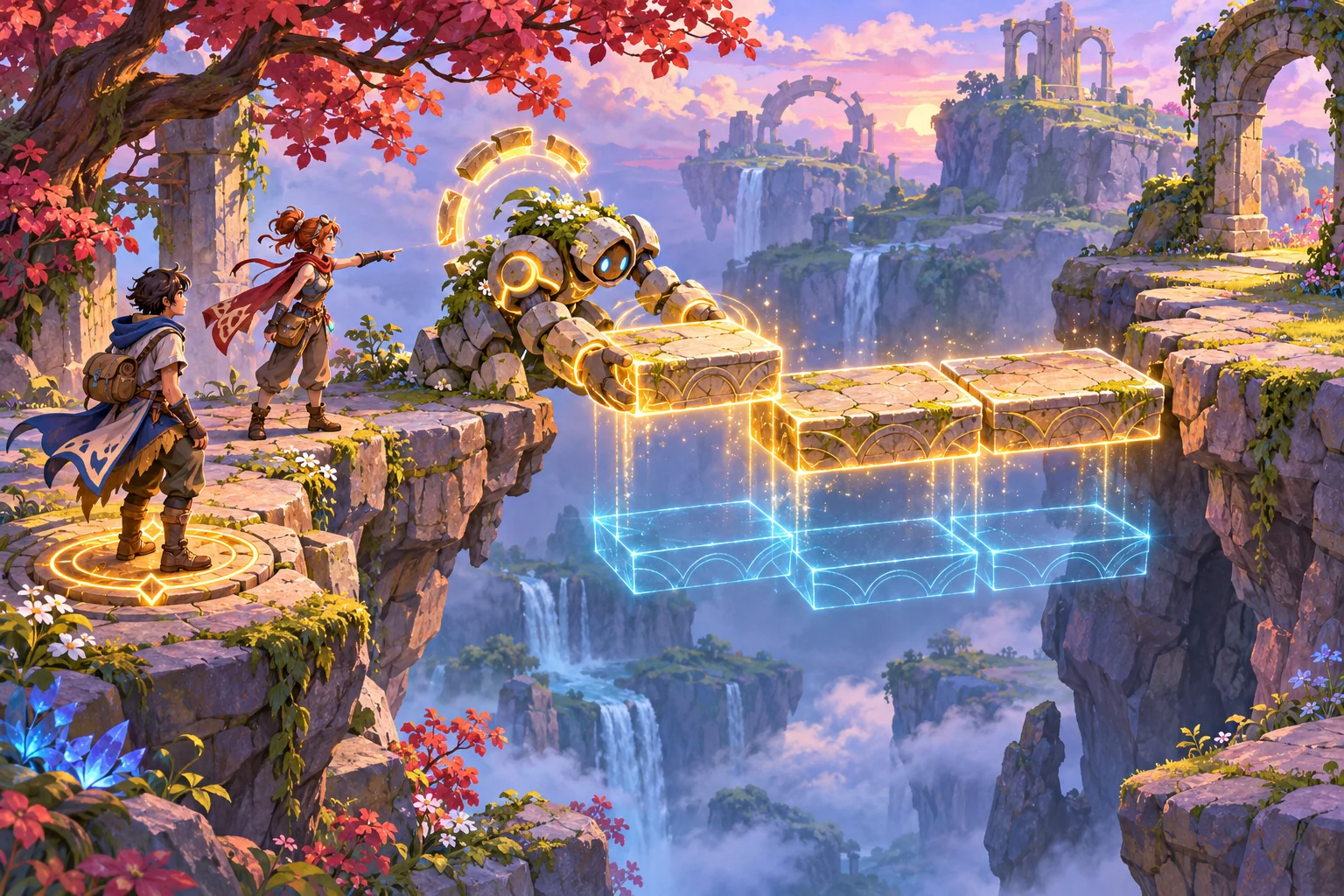
Compare the same co-op gap with and without the rebuild
Fix a gap that is four tile-lengths wide, an anchor pad on the near side and a checkpoint beyond it. The scout can cross the first side and record three safe tiles; the partner cannot make the jump from the anchor. Without a rebuild, the scout reaches the checkpoint alone and the co-op gate remains closed because both players are required.
Reset to the same positions. The partner pings the far ledge, the companion spends three charges and places the three-tile echo bridge in two seconds. Both players cross within the six-second lifetime and activate the checkpoint together; neither falls. This paper-simulated iteration changes only the companion rebuild. Record rebuild time, both crossing times, falls and whether the checkpoint opens. If the bridge feels automatic, shorten its lifetime or add a safe tile the scout must record first.

Prompt a small co-op platforming prototype
Build one anchor, one gap, three recorded tiles and a companion charge meter. Confirm that reconstruction uses observed geometry and both players must reach the checkpoint before adding hazards or more rooms.
Create a compact co-op platformer in floating ruins for two players and a small stone companion. The scout records the last three safe platforms they land on; the partner stays on an anchor pad and pings a destination across a four-tile gap. The companion may rebuild only the observed three-tile pattern, spends one echo charge per tile, takes two seconds to place it and the stones last six seconds. It must not copy hazards or invent unobserved geometry. Add reset and compare the same two-player crossing with the rebuild unavailable versus enabled. The checkpoint opens only when both players arrive. Log rebuild time, each player's crossing time, falls and checkpoint state. Show a preview and charge count before placement.
SEELE's official AI Game Maker page describes creating a playable first version from a prompt, testing it in a browser and refining it with follow-up prompts. Use that general flow to inspect tile recording and partner visibility; the co-op rules are fictional design guidance.
Build the level-rebuilding co-op platformer in SEELE
Frequently asked questions
How can a companion rebuild a platformer level without solving every puzzle?
Limit reconstruction to recently observed safe tiles and a marked destination. Give the companion a charge cost, short placement time and temporary platform lifetime, and make it refuse hazards or geometry it has not recorded. That keeps player movement central.
How do two co-op players work with a level-rebuilding companion?
Give the scout the job of recording stable tiles and the partner the job of pinging a destination from a safe anchor. The companion rebuilds only after a valid ping, so both players contribute to crossing. Both must reach the shared checkpoint.
What should I test in the first rebuild prototype?
Use the same gap and player positions with reconstruction disabled and enabled. Record rebuild time, each player's crossing time, falls and whether the shared checkpoint opens. Adjust the lifetime if the route feels automatic. Shorten the stone lifetime if needed.