Physics combat gets hard to read when a hit moves the player, enemy, props, and camera at once. Start with one room and one question: can the player read an attack, avoid it, anchor a ram, and use the collision to create a brief opening? This fictional Iron Foundry Ring encounter makes each step visible. Its mass values and tile distances are authored teaching rules, not measurements from a game.
Make contact readable
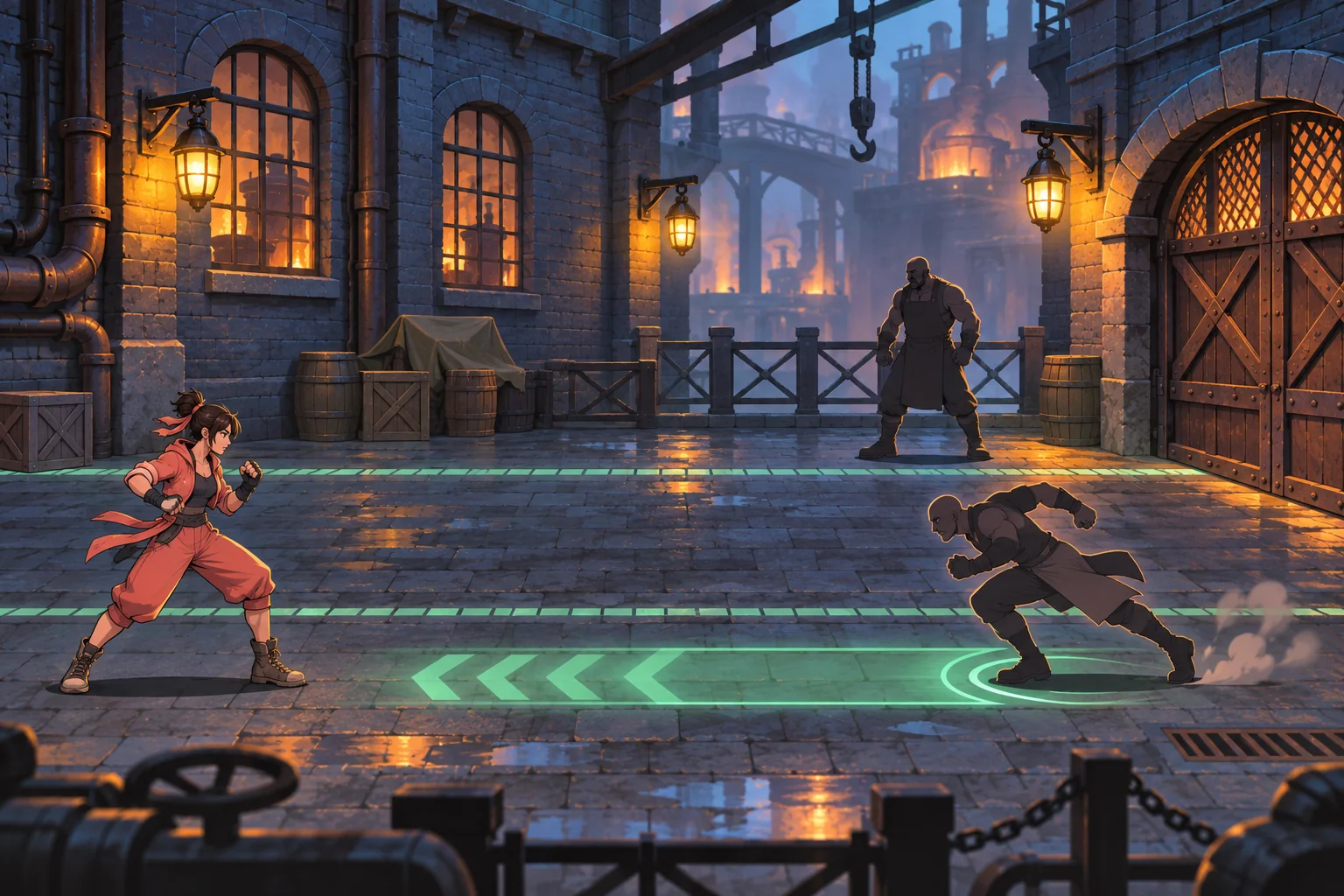
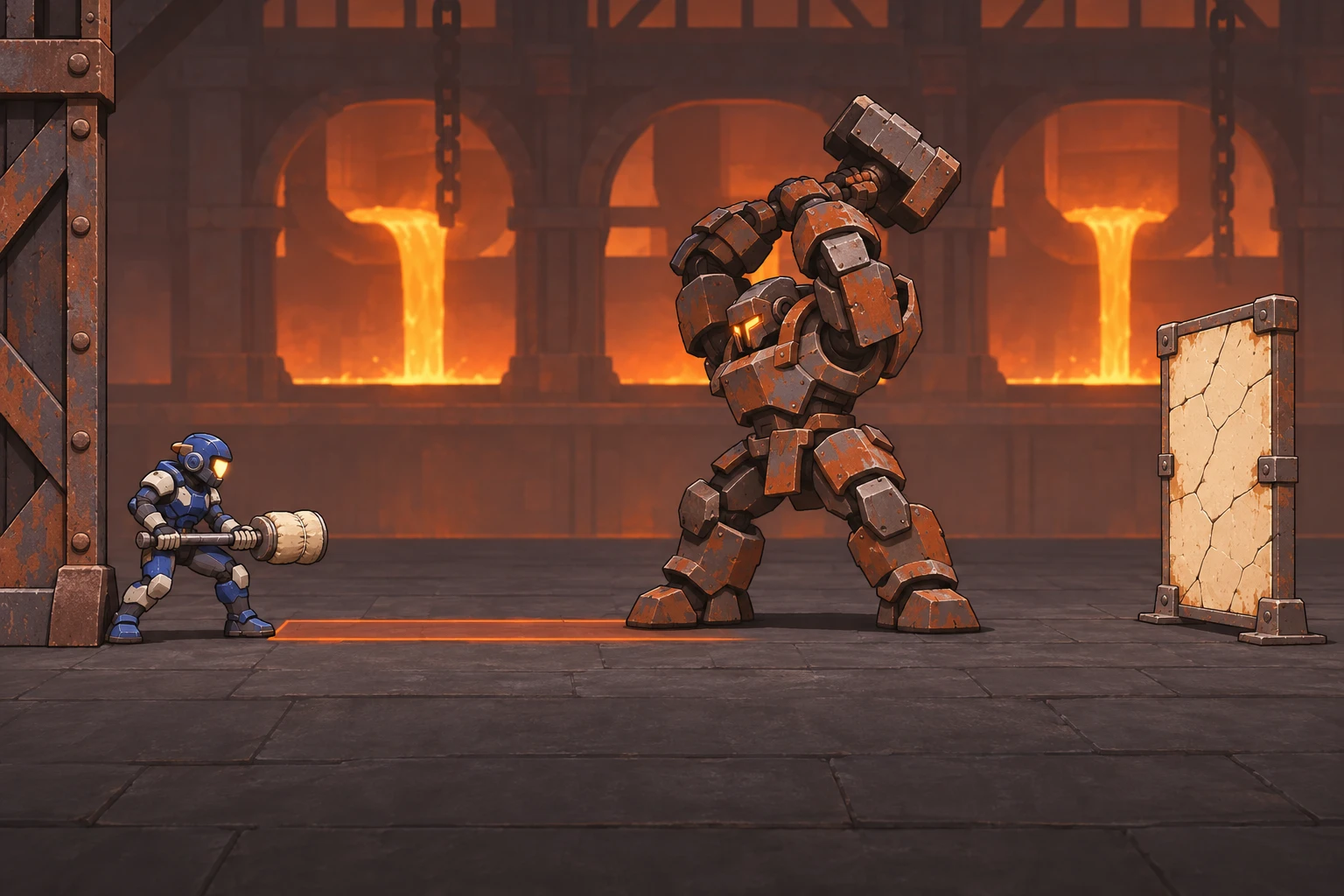
The room has one cobalt pilot, one heavy Warden, a fixed brace wall, a brittle panel, and a loose crate. The Warden marks a short floor lane before a slam. The player sidesteps that lane, waits for the Warden’s one-second recovery, braces at the wall, and rams it toward the panel. A collision breaks the panel and exposes the core for a two-second follow-up window.
Keep the first version small. Do not add weapons, upgrades, or a second enemy before the player can tell what caused the opening. The central loop is read the tell → dodge the lane → brace → ram during recovery → inspect the collision → follow up. Each arrow names an action or a visible consequence. That makes the prompt easier to review than a broad request for “realistic physics combat.”
Choose one mass comparison
Give the player one simple contrast. In this authored ruleset, the heavy Warden has three fictional mass units and the loose crate has one. The same deliberate ram moves an unbraced crate two floor tiles, but moves an unbraced Warden one tile. These are game rules for the example, not a physical formula or a claim about any engine. Their purpose is to teach the reader to state the expected reaction before asking for a build.
| Object/state | Authored mass | Response to one ram | What it teaches |
|---|---|---|---|
| Loose crate, unbraced | 1 unit | Moves 2 tiles | A light prop reacts strongly. |
| Warden, unbraced | 3 units | Moves 1 tile | A heavy target moves less under the same action. |
| Warden, braced | 3 units | Does not move | Bracing changes the target’s state, so the ram cannot create the intended opening. |
The table is deliberately compact: one action, three observable responses. It avoids pretending that a mass label alone explains a complex simulation. In a real project, you would measure displacement under controlled conditions, note any collision or friction settings that matter, and revise the values after observing the build. Here, the values only make the design logic hand-checkable.
Write a focused arena prompt
Put the loop, boundary conditions, and failure state in the prompt. A reader should be able to identify what happens before, during, and after contact. This example prompt is a starting specification; it has not been submitted to SEELE or any other game generator.
Create one original 2D side-view physics-combat room called Iron Foundry Ring. Use a fixed camera and a clear floor grid. Place a fixed brace wall on the left, a cobalt pilot beside it, an unbraced rust-steel Warden to the pilot’s right, one brittle cream panel beyond the Warden, and one light crate outside the attack lane.

Actions: move, sidestep, brace against the fixed wall, and swing a padded kinetic ram. Before one slam, the Warden marks a short floor lane. A successful sidestep leaves the pilot outside that lane. After the slam, give the Warden a one-second recovery in which it is unbraced. A ram during recovery moves the unbraced Warden one floor tile. The same ram moves an unbraced light crate two tiles. The Warden has three authored mass units; the crate has one. A ram without bracing recoils the pilot one tile. Bracing at the fixed wall cancels that recoil. A braced Warden does not move.

The Warden begins one tile from a brittle panel. If the one-tile displacement reaches it during recovery, the panel breaks away and the orange core is visible for two seconds. A second ram during that window disables the Warden. Two slams that are not blocked disable the pilot. Restart resets both characters and restores the panel. Keep attacks and contact effects readable; do not add guns, upgrades, another enemy, or a score economy.

Return a short control list, the state sequence, and a checklist for lane visibility, sidestep, recoil, one-tile displacement, panel collision, core-window timing, follow-up, and restart. If an implementation choice is ambiguous, list it for review instead of silently inventing a rule.
That prompt has one room, one enemy pattern, and one collision objective. It also avoids treating the example’s tile grid as a product convention or a promise that a generator will implement every rule. If you later want a different control, name it explicitly and preserve the expected state transition.
Read the tell, brace, and use the collision
First, inspect the orange lane before the slam. The pilot should move clear of it rather than trying to absorb the attack. After the Warden completes the slam, the one-second recovery is the only authored opportunity for the first ram. The opening matters because the Warden is now unbraced; the same collision against a braced Warden would not move it.
Next, brace against the fixed wall. Without that anchor, the player’s ram causes one tile of recoil and may remove the player from the follow-up position. Bracing cancels that recoil in the example. It does not add damage or make every collision stronger; it only stabilizes the pilot. Then ram the recovering Warden. With a one-tile starting gap, the Warden reaches the panel, the panel breaks away, and its core is exposed.
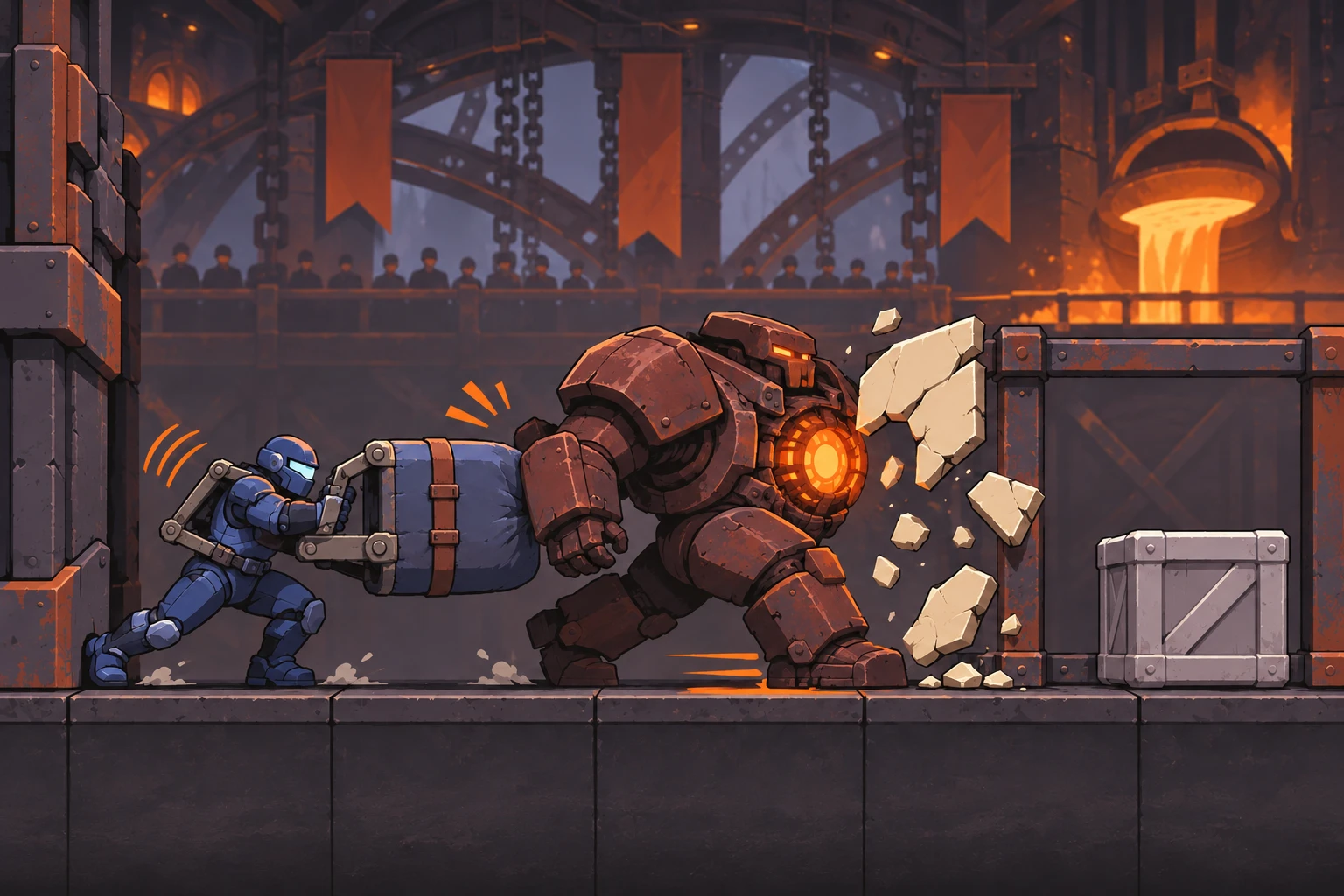
Read this as a proposed state, not as footage of a real build. The cracked panel and core are feedback targets for the prompt: they should make the collision consequence legible. The fixed wall matters because it explains why the pilot stays in place while the enemy moves. If the player slides backward, the cause may be missing brace contact; if the enemy fails to move, the tell/recovery state or target bracing may be wrong.
| If the review finds… | Check first | Keep the next change narrow |
|---|---|---|
| The slam catches a player who appeared clear. | Is the orange lane’s boundary visible before the attack? | Clarify the marked lane before changing enemy speed. |
| The pilot slides backward on the ram. | Is the pilot touching the fixed wall while bracing? | Make brace contact clearer before changing ram force. |
| The Warden barely moves. | Was it in recovery and unbraced when the ram landed? | Clarify the recovery state before changing its mass. |
| The panel breaks but the opening is unclear. | Does it visibly move away and reveal the core? | Strengthen the panel/core feedback before adding damage effects. |
In an actual playable prototype, log the attack tell, where the pilot stood, whether brace contact registered, how far each object moved, whether the panel broke, and when the core window ended. Those observations are not available for this package, so the checklist remains a future test plan. Do not fill it with imagined outcomes.
Paper-check the panel distance
Use a one-variable comparison to see whether the room’s geometry supports its intended loop. Hold the ram, mass values, recovery, panel, and collision rule fixed. Change only the Warden’s starting distance from the panel. The table below is a hand calculation from the fictional rule “one ram moves an unbraced Warden one tile.” It does not come from a simulation or playtest.
| Paper pass | Starting gap | One-ram displacement | Gap after ram | Authored result |
|---|---|---|---|---|
| Baseline v0 | 2 tiles | 1 tile | 1 tile remains | No panel contact in the first recovery window. |
| Revision v1 | 1 tile | 1 tile | 0 tiles; contact | Panel breaks, exposing the core for the two-second follow-up window. |
The arithmetic is simple: remaining gap equals starting gap minus the authored one-tile displacement. For v0, 2 − 1 = 1, so the Warden stops short. For v1, 1 − 1 = 0, so it reaches the panel. Only the starting distance changes; the result is a design prediction under the stated rule, not a measured iteration. A future build could contradict it if the collision shape, movement, timing, or tile spacing differs.
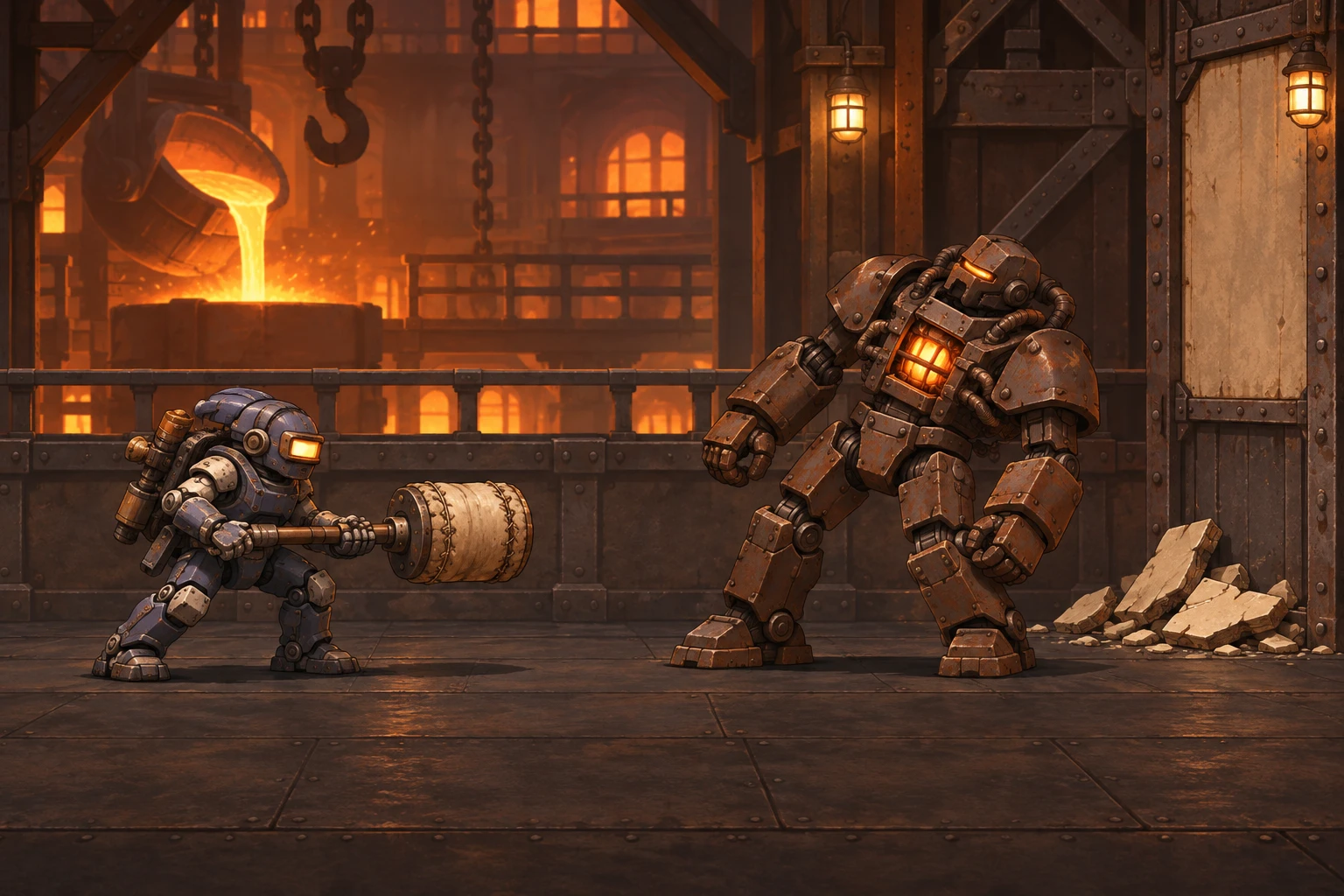
The image shows the intended intermediate state rather than a victory. The panel has broken and the core is visible, but the Warden remains standing. That distinction preserves the rule sequence: the first ram creates the opening; the second ram within two seconds ends the encounter. Avoid describing the target image as proof that either action works in a playable build.
If this were ready for real testing, the run sheet would record the initial gap, the measured displacement, contact yes/no, window start and end, and whether the follow-up occurred in time. For this paper exercise, those fields remain not measured. The useful result is a specific hypothesis to check later, not a claim that the change improved gameplay.
Where an AI game maker fits
SEELE’s official Free AI Game Maker page describes a general workflow: describe a game in plain English, inspect a playable 2D or 3D result, and decide what to revise. It also advises checking the selected model, available Koin balance, and displayed generation cost before submitting. Those statements support starting with a focused prompt and reviewing whatever result appears; they do not establish that this specific physics loop, recovery window, or collision will be produced correctly.
If you use an AI game maker for your own idea, treat the prompt as a request, not a specification the tool has already satisfied. Check actual controls, collision behavior, and reset states in the generated result before relying on them. The Iron Foundry Ring example and its two-tile comparison are fictional design work prepared for this article; neither was built or tested with SEELE.
Try the Free AI game maker to describe your own small combat idea and inspect the result. Treat the first output as a draft, then compare what it actually does with the rules you asked for.
Start with one readable collision
Keep the first room centered on a single question: can the player move from an enemy tell to a braced ram, then recognize the collision that creates an opening? Define the states before adding more combat systems. The mass table gives each object a distinct response; the distance ledger shows how one layout change affects contact; and the future run sheet says what a real test would need to observe.
Those are design tools, not evidence of a successful build. Once a playable version exists, record what actually happened and revise one variable at a time. Until then, preserve the boundary: the rules, values, results, and images here describe an original fictional teaching example.
Frequently asked questions
How do I make physics combat feel readable?
Start with one enemy tell, one safe dodge, one deliberate collision, and one visible consequence. Keep the camera and arena simple while you check whether the player can connect each action to its result. Add more hazards only after the first loop is understandable.
Why does bracing matter in this example?
Bracing against the fixed wall cancels the pilot’s one-tile recoil from the ram. It changes the player’s position response, while the Warden still moves only when it is unbraced. These are invented rules for the paper example, not measured physics behavior.
What changes between the two paper passes?
Only the Warden’s starting distance to the brittle panel changes, from two tiles to one. With a one-tile ram displacement, the baseline leaves one tile of space; the revision reaches contact. This is a hand calculation, not a tested iteration.
What should I record in a real playtest?
Record whether the tell was visible, whether the player cleared the lane, whether brace contact registered, how far the target moved, whether the panel broke, and how long the core stayed open. This package has no real playtest observations, so those fields remain future checks.
Can SEELE guarantee that this combat loop will work?
No. The official product page describes a general game-creation and review workflow; it does not promise this specific mechanic or a successful output. Inspect any generated build and test its controls, collisions, timing, and reset before relying on them. Treat each feature as unverified until you test it yourself.