
Introduction
An audio mystery game asks listeners to follow clues, replay moments and choose what to investigate next. For podcast creators, the challenge is to turn an original audio scene into an interactive sequence without confusing a regular episode with a game. Begin with a short fictional story, a few clearly placed clues and an editable episode template.
This guide uses The Last Signal, an invented mystery about a lighthouse keeper and a radio message. No real podcast, creator, recording or listener interaction is used. The audio cues and listener choices are planning examples; no playable game or podcast integration was built or tested.
Define the listening loop
Describe how a listener starts, hears a scene, finds a clue and chooses the next action. A small loop can play a short scene, surface a transcript excerpt, let the listener replay a marked moment, collect a clue and select one of two next steps. Tell the listener when a choice changes the story and when it is only a recap.
Prompt 1 — episode-game brief
Design a fictional audio mystery game called The Last Signal for an invented podcast series. Scope one short episode with an opening scene, three clues, a replayable audio moment, two investigation choices and a clear ending. Define playback, clue collection, choice and reset states. Use original fictional material. List assumptions and untested interactions; do not claim podcast platform integration or listener testing.
The brief should say what the player can revisit and whether a clue is optional or required. Keep the mystery solvable from information the story actually provides.
Place clues in the audio timeline
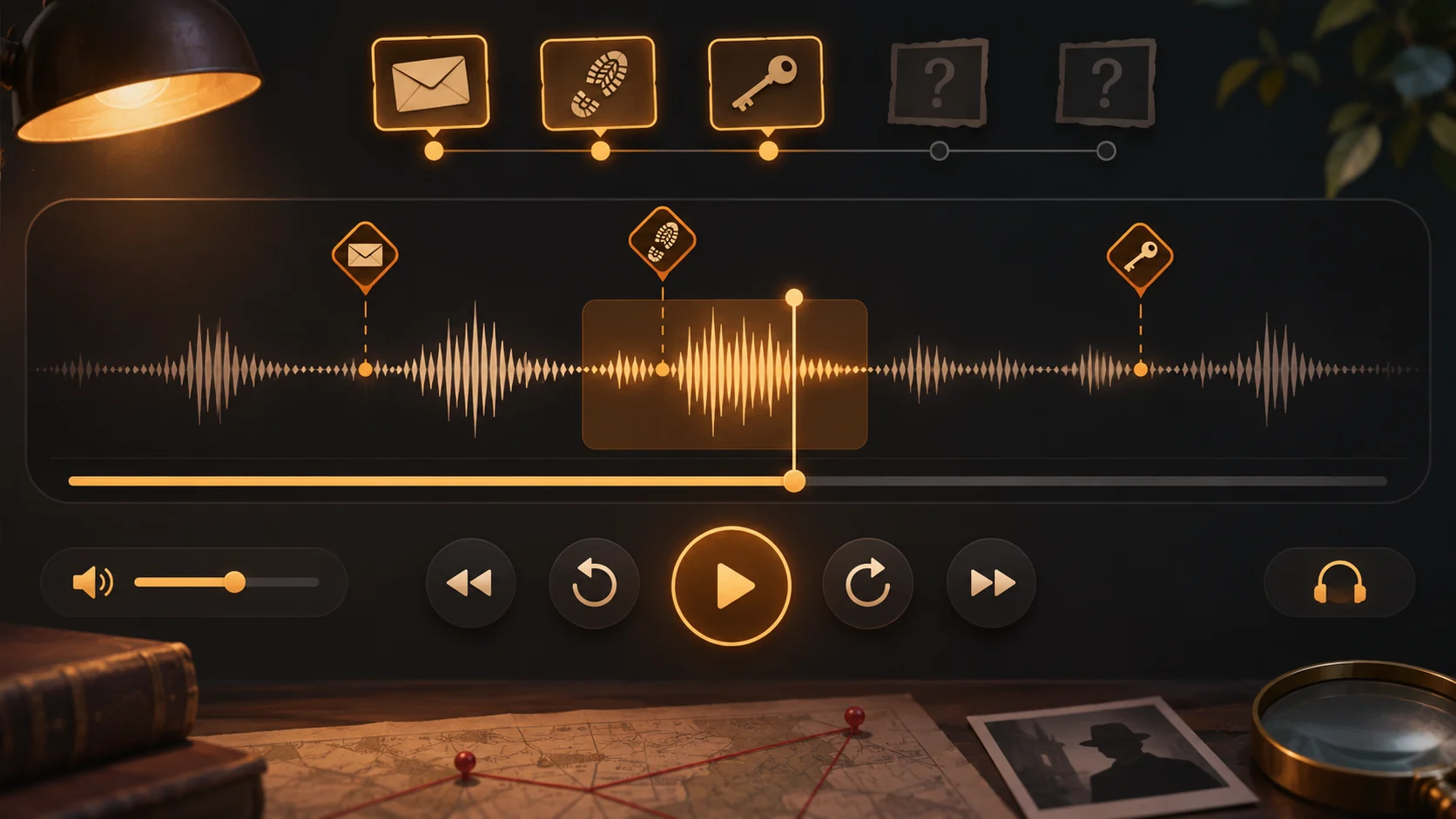
An audio timeline can mark scene boundaries, a clue cue and a replay point. Give each marker a short label and explain what it adds to the investigation without revealing the answer too early. A transcript or visual cue can help a listener review information, but do not claim any particular accessibility standard unless it has been checked.
Prompt 2 — scene and clue timeline
Create a fictional audio timeline for The Last Signal with three short scenes, two ambient sound cues, three investigation clues and one replay marker. For each clue, state what the listener can infer and what remains uncertain. Include a text summary for review. Do not use real recordings or imply that a production mix was made.
| Marker | Fictional story function | Listener action |
|---|---|---|
| Scene start | Establish the lighthouse setting | Listen or read a short summary |
| Signal cue | Introduce an unusual radio pattern | Replay the marked moment |
| Log clue | Reveal a time discrepancy | Add it to the clue board |
| Choice point | Select the next investigation step | Review known clues before choosing |
These markers describe a story plan. They do not represent a finished audio file or tested listening experience.
Write original clues that support deduction
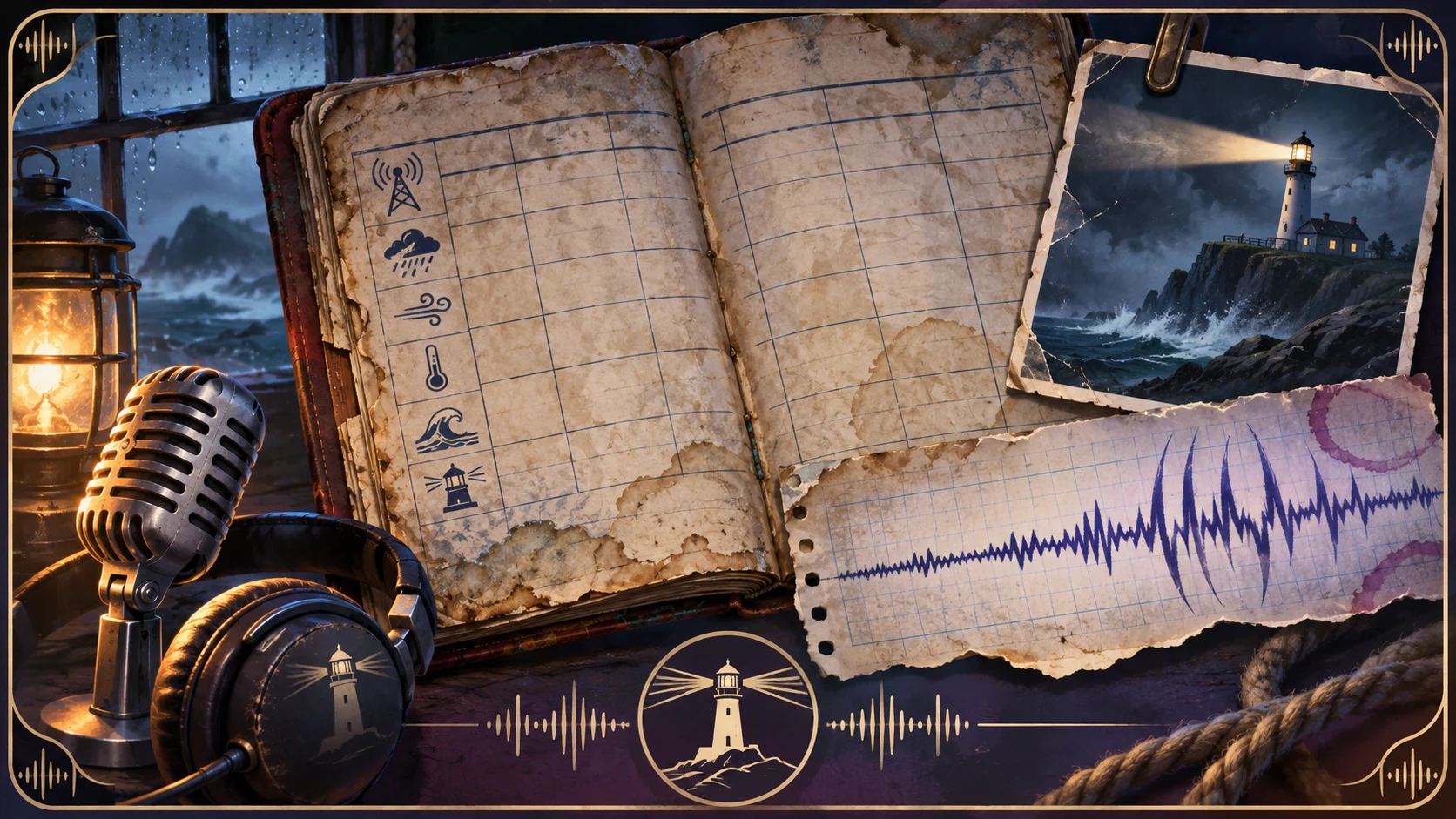
A clue should be noticeable, understandable and connected to at least one other clue. Avoid making the answer depend on an unexplained sound. For a first episode, use a small clue board that shows what the listener knows and what remains a question.
Prompt 3 — clue board
Draft three original fictional clues for The Last Signal: a station log with a time mismatch, a repeated radio phrase and a weather note that conflicts with the scene. For each, state what it proves, what it does not prove and which other clue it connects to. Keep the solution fair and do not rely on hidden real-world knowledge.
The board should preserve uncertainty instead of forcing a premature answer. If a clue is merely atmospheric, label it as such so players do not mistake it for evidence.
Make replay and choices predictable
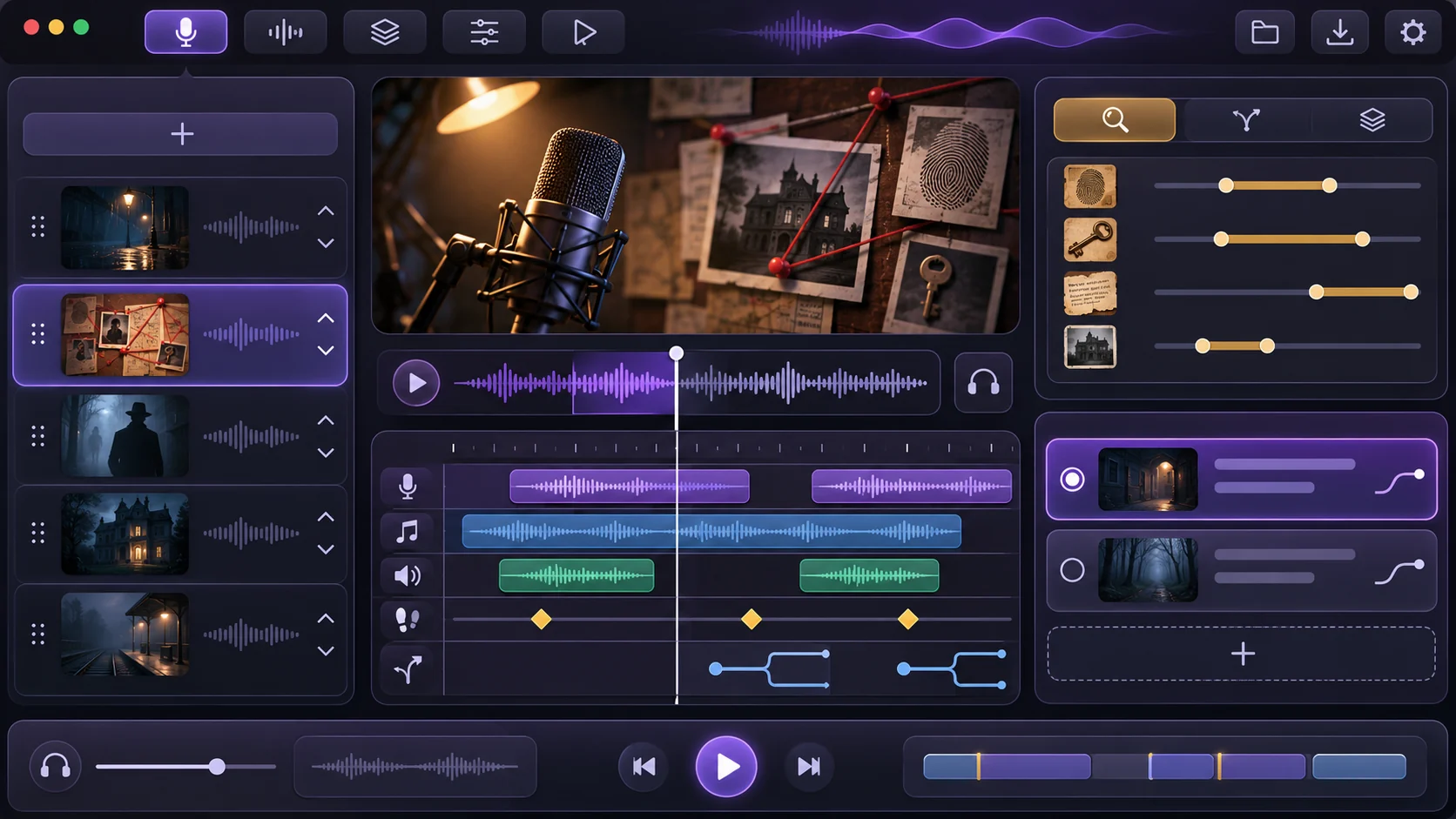
Listeners should know whether replay repeats a full scene or a short marked moment. Choices should name their immediate consequence and remain consistent with the clues collected. Explain how a player returns to an earlier scene and whether a new choice creates a different path or only reveals another detail.
Prompt 4 — replay and branching choices
Define replay controls and two investigation choices for The Last Signal. Show which audio segment repeats, what clue is revisited and how each choice changes the next scene. Include a back-to-clue-board action and a clear ending state. Keep both paths consistent with the original fictional clues; identify any untested branch logic.
A short choice map can prevent branches from contradicting one another. If two choices converge later, say so instead of implying a larger branching story.
Provide an editable episode template
A creator needs to replace the series name, premise, scenes, clue cues, replay points and choices. A structured template makes those edits visible while keeping the same game flow. The sample below is fictional and can be adapted to a different invented mystery.
{
  "episodeTitle": "The Last Signal — fictional demo",
  "premise": "A lighthouse keeper reports a radio message after the station has closed",
  "scenes": [
    {"id": "opening", "summary": "Introduce the station and the missing log page"},
    {"id": "signal", "summary": "Replay the repeated phrase and note its timing"},
    {"id": "ending", "summary": "Choose what the investigator checks next"}
  ],
  "clues": ["station log time mismatch", "repeated radio phrase", "weather note"],
  "choices": ["inspect the log archive", "replay the signal cue"],
  "audioSource": "placeholder — no recording supplied",
  "evidenceLabel": "fictional planning example; not a tested podcast"
}
Edit the premise, scene summaries, clues, choices and any future audio references. Keep a placeholder label until original audio exists and the game has been tested.
Request a small playable mystery slice
A first build could contain one short episode, a transcript or summary, three clue cards, replay controls, two choices, an ending and reset. Specify the interactions that must work: start a scene, revisit a cue, collect a clue, choose a branch and review the outcome. A static timeline is a mockup, not an interactive episode.
Prompt 5 — first playable slice
Build a small fictional audio mystery game for The Last Signal with scene playback placeholders, a text summary, replay markers, three clue cards, two investigation choices, a clue board, ending state and reset. Make all audio assets clearly marked as placeholders. At handoff, list working interactions, static screens and untested features. Do not claim real podcast integration or listener testing.
No audio file, playable game or podcast connection was tested for this article.
Prompt 6 — custom episode scenario
Adapt the editable episode template to a fictional “closed mountain observatory” mystery. Replace the premise, scenes, clues and two choices while preserving the same playback, replay, clue-board and ending states. Label all new story material as fictional and audio as a placeholder. This is a local simulated customization, not a real podcast production.
This scenario demonstrates how a creator might customize a template. It does not show a real creator’s episode or production workflow.
Prompt 7 — observed-output review
Review the running local prototype for scene start, transcript summary, replay marker, clue collection, clue-board consistency, branch choice, ending, reset and placeholder labels. Mark each present, missing or unclear based only on observed interactions. Record concise evidence and one smallest next change. Do not claim audio quality or listener comprehension unless tested.
Fictional episode snapshot
| Field | The Last Signal example |
|---|---|
| Premise | A lighthouse keeper reports a late radio message |
| Clues | Log time, repeated phrase and weather note |
| Choices | Inspect the archive or replay the signal cue |
| Main loop | Listen → mark → connect → choose → review |
| Customization | Premise, scene order, clue cues and choices |
| Evidence | Fictional template only; no recording or listener test |
The snapshot shows editable parts of an episode without suggesting that production audio exists.
Conclusion
An audio mystery game should connect scenes, replay points, clues and choices in a way listeners can follow. The Last Signal and its evidence are fictional; no real podcast, recording, integration or listener test is claimed. Use an editable template to scope one episode, then verify playback and clue behavior in the running product before calling it playable.
You can take a scoped concept into the Free AI game maker, then compare the result with the review checklist.
FAQ
What should an audio mystery game for podcast creators include?
Plan scenes, clue cues, replay controls, a clue board, listener choices, an ending and reset.
How can a listener revisit an audio clue?
Mark the cue on a scene timeline and state whether replay repeats the moment or the full scene.
Can a transcript replace the game’s audio?
A transcript can help review story information, but the game should state which audio features are placeholders or required.
What makes an editable podcast mystery template useful?
It separates premise, scene order, clues, replay points and choices so a creator can change the story without rewriting the interaction flow.
Does a local episode mockup prove podcast integration works?
No. Test playback, navigation and any intended platform connection in the actual running environment before claiming integration.