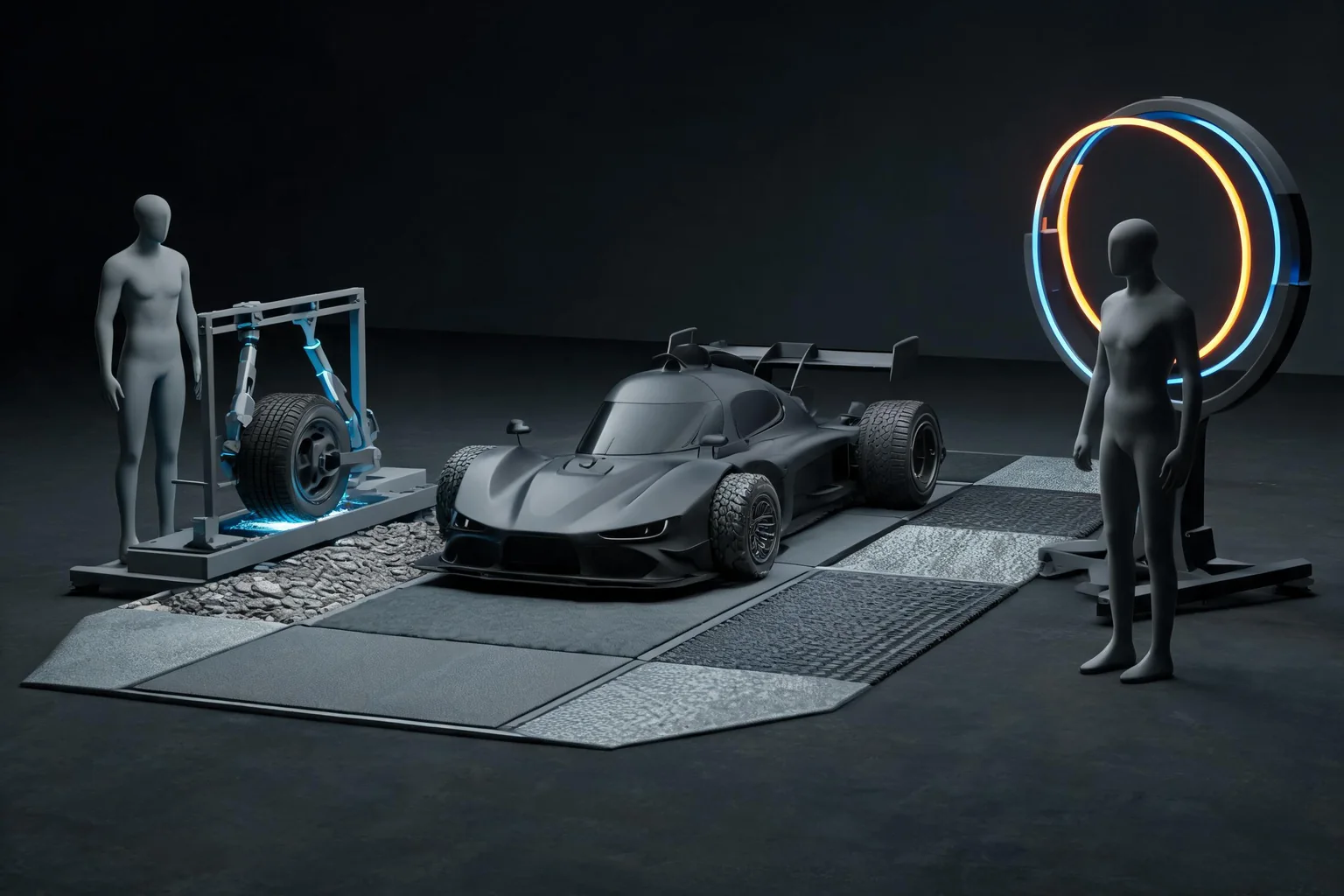
Visual guide for Unreal Engine Vehicle Physics and Racing Gameplay Guide
Key Takeaways: Unreal Engine Vehicle Physics and Racing Gameplay Guide
- unreal engine vehicle physics and racing gameplay: For unreal engine vehicle physics and racing gameplay, define authority and state ownership for Chaos Vehicle setup and input and tire suspension and surface response, then make camera checkpoints and lap rules and network correction and target-platform budgets observable under interruption, invalid input, save/load, networking, or AI updates. A working happy path is not enough without recovery and scale tests.
- This guide keeps the answer version-aware and testable: identify the owning Unreal systems or public evidence, validate the result, and keep native Unreal 5 game, browser preview, optimization, packaging, and download evidence separate from third-party model claims.
1. Choose the authority boundary for Chaos Vehicle setup and input
Start choose the authority boundary for chaos vehicle setup and input by narrowing Unreal Engine Vehicle Physics and Racing Gameplay Guide to one reviewable claim about network correction and target-platform budgets. The practical job is to identify the only system allowed to create or change Chaos Vehicle setup and input, while tire suspension and surface response supplies the nearest condition that could invalidate the result. Within the “Choose the authority boundary for Chaos Vehicle setup and input” decision, this framing prevents a broad genre label or engine reference from standing in for a technical decision.
Build the working record for Unreal Engine Vehicle Physics and Racing Gameplay Guide from one controlled success path, one invalid path, one interruption, and one restored result. Capture network correction and target-platform budgets before changing or interpreting Chaos Vehicle setup and input, then follow the state or claim into tire suspension and surface response. In this unreal engine vehicle physics and racing gameplay test, keep the project revision or publication date beside the observation so a later update cannot silently replace the evidence used for this conclusion.
Use an interrupted animation leaving gameplay authority in a stale state as a counterexample for Unreal Engine Vehicle Physics and Racing Gameplay Guide. If network correction and target-platform budgets still supports the same conclusion, explain the evidence through tire suspension and surface response; if it does not, narrow the page claim instead of adding speculative detail. Against the “Choose the authority boundary for Chaos Vehicle setup and input” acceptance scope, preserve normal-path timing, interruption behavior, stale data, platform variance, and test coverage with the failed and recovered results.
Choose the authority boundary for Chaos Vehicle setup and input checklist
- Write the Unreal Engine Vehicle Physics and Racing Gameplay Guide decision for “Choose the authority boundary for Chaos Vehicle setup and input” as one falsifiable sentence.
- Name the owner or source for network correction and target-platform budgets and its boundary with Chaos Vehicle setup and input.
- Exercise tire suspension and surface response in the exact version, mode, platform, or runtime slice declared by this page.
- Capture normal-path timing, interruption behavior, stale data, platform variance, and test coverage while reviewing camera checkpoints and lap rules.
- Record the vehicle-racing-gameplay rollback trigger and the limitation that would reopen this section.
2. Represent tire suspension and surface response as explicit runtime state
A reader arriving at Unreal Engine Vehicle Physics and Racing Gameplay Guide needs “Represent tire suspension and surface response as explicit runtime state” to produce an observable result. That means using tire suspension and surface response as the working state, camera checkpoints and lap rules as the next dependency, and model the data and transitions needed to keep tire suspension and surface response inspectable as the reason for the test. Within the “Represent tire suspension and surface response as explicit runtime state” decision, the resulting section can be accepted or rejected without relying on visual polish or author confidence.

A controlled pass through unreal engine vehicle physics and racing gameplay should expose how Chaos Vehicle setup and input, tire suspension and surface response, and camera checkpoints and lap rules interact. Within the “Represent tire suspension and surface response as explicit runtime state” decision, keep only one variable under change while collecting state ownership, transition logs, saved records, and a reproducible runtime input; otherwise a passing result cannot identify which decision mattered. Against the “Represent tire suspension and surface response as explicit runtime state” acceptance scope, repeat the path after reopening, reconnecting, or checking a later source when persistence or chronology is part of the claim.
The regression case for “Represent tire suspension and surface response as explicit runtime state” is an interrupted animation leaving gameplay authority in a stale state. Run it with Chaos Vehicle setup and input and tire suspension and surface response already captured, then inspect network correction and target-platform budgets before accepting recovery. Within the “Represent tire suspension and surface response as explicit runtime state” decision, a complete record includes authority decisions, invalid inputs, state drift, frame cost, and rollback coverage and a rollback trigger, not merely a screenshot of the final state.
Represent tire suspension and surface response as explicit runtime state checklist
- Write the Unreal Engine Vehicle Physics and Racing Gameplay Guide decision for “Represent tire suspension and surface response as explicit runtime state” as one falsifiable sentence.
- Name the owner or source for Chaos Vehicle setup and input and its boundary with tire suspension and surface response.
- Exercise camera checkpoints and lap rules in the exact version, mode, platform, or runtime slice declared by this page.
- Capture event count, replication traffic, save integrity, worst-case density, and failure recovery while reviewing network correction and target-platform budgets.
- Record the vehicle-racing-gameplay rollback trigger and the limitation that would reopen this section.
3. Build a playable slice around camera checkpoints and lap rules
For unreal engine vehicle physics and racing gameplay, “Build a playable slice around camera checkpoints and lap rules” should resolve one ambiguity at a time. First isolate network correction and target-platform budgets; next identify how tire suspension and surface response changes the expected outcome; finally keep camera checkpoints and lap rules as the explicit limit on the claim. In this unreal engine vehicle physics and racing gameplay test, this order avoids mixing evidence collection, implementation, and validation into one generic recommendation.
For unreal engine vehicle physics and racing gameplay, use runtime state snapshots, network or save traces, measured budgets, and a clean restart test to trace one path from network correction and target-platform budgets to Chaos Vehicle setup and input. Add camera checkpoints and lap rules only after the first path produces a reviewable result, because changing several owners at once hides the actual cause. For the Unreal Engine Vehicle Physics and Racing Gameplay Guide evidence record, preserve the input, expected output, version, and rollback point with the trace.
Challenge the Unreal Engine Vehicle Physics and Racing Gameplay Guide conclusion with a save or reconnect restoring only part of the authoritative state. Compare the accepted network correction and target-platform budgets state with the resulting tire suspension and surface response and camera checkpoints and lap rules evidence, then capture event count, replication traffic, save integrity, worst-case density, and failure recovery. For the Unreal Engine Vehicle Physics and Racing Gameplay Guide evidence record, reject the section's claim if the same input produces a different owner, scope, or outcome without a documented reason.
Build a playable slice around camera checkpoints and lap rules checklist
- Write the Unreal Engine Vehicle Physics and Racing Gameplay Guide decision for “Build a playable slice around camera checkpoints and lap rules” as one falsifiable sentence.
- Name the owner or source for camera checkpoints and lap rules and its boundary with network correction and target-platform budgets.
- Exercise Chaos Vehicle setup and input in the exact version, mode, platform, or runtime slice declared by this page.
- Capture event count, replication traffic, save integrity, worst-case density, and failure recovery while reviewing tire suspension and surface response.
- Record the vehicle-racing-gameplay rollback trigger and the limitation that would reopen this section.
4. Instrument failure signals for network correction and target-platform budgets
Instrument failure signals for network correction and target-platform budgets is the decision point for unreal engine vehicle physics and racing gameplay, because camera checkpoints and lap rules and network correction and target-platform budgets can disagree even when the visible result looks plausible. Use make ordering, cost, and recovery evidence for network correction and target-platform budgets observable as the acceptance question rather than treating the section as background theory. Against the “Instrument failure signals for network correction and target-platform budgets” acceptance scope, write the boundary down before implementation or source comparison so later evidence has a stable claim to confirm or reject.
Turn “Instrument failure signals for network correction and target-platform budgets” into a repeatable exercise for unreal engine vehicle physics and racing gameplay. The exercise begins with camera checkpoints and lap rules, passes through Chaos Vehicle setup and input, and ends in representative content, deterministic inputs, target-device captures, and recovery results; each boundary should name its owner and failure behavior. For the Unreal Engine Vehicle Physics and Racing Gameplay Guide evidence record, save both the successful output and the first rejected or ambiguous case, because the contrast is more useful than an isolated happy path.
Before closing “Instrument failure signals for network correction and target-platform budgets” for Unreal Engine Vehicle Physics and Racing Gameplay Guide, test invalid content data reaching a runtime path that assumes it was already approved. Tie the failure to camera checkpoints and lap rules, confirm the effect on tire suspension and surface response, and separate a genuine limitation from missing instrumentation. Within the “Instrument failure signals for network correction and target-platform budgets” decision, the acceptance note should list event count, replication traffic, save integrity, worst-case density, and failure recovery, the tested version, and the exact condition that requires another pass.
Instrument failure signals for network correction and target-platform budgets checklist
- Write the Unreal Engine Vehicle Physics and Racing Gameplay Guide decision for “Instrument failure signals for network correction and target-platform budgets” as one falsifiable sentence.
- Name the owner or source for tire suspension and surface response and its boundary with camera checkpoints and lap rules.
- Exercise network correction and target-platform budgets in the exact version, mode, platform, or runtime slice declared by this page.
- Capture input latency, ownership changes, memory use, packaged behavior, and deterministic replay while reviewing Chaos Vehicle setup and input.
- Record the vehicle-racing-gameplay rollback trigger and the limitation that would reopen this section.
5. Recover Chaos Vehicle setup and input after interruption
Recover Chaos Vehicle setup and input after interruption is the decision point for unreal engine vehicle physics and racing gameplay, because network correction and target-platform budgets and Chaos Vehicle setup and input can disagree even when the visible result looks plausible. Use exercise reload, reconnect, invalid input, and partial progress around Chaos Vehicle setup and input as the acceptance question rather than treating the section as background theory. Against the “Recover Chaos Vehicle setup and input after interruption” acceptance scope, write the boundary down before implementation or source comparison so later evidence has a stable claim to confirm or reject.

Create a narrow evidence chain for unreal engine vehicle physics and racing gameplay: establish Chaos Vehicle setup and input, trigger or inspect tire suspension and surface response, and observe how camera checkpoints and lap rules changes the result. Within the “Recover Chaos Vehicle setup and input after interruption” decision, use state ownership, transition logs, saved records, and a reproducible runtime input as the durable output of that chain. Within the “Recover Chaos Vehicle setup and input after interruption” decision, if the evidence exists only in a transient editor view or an undated snippet, it is not ready for reuse.
Before closing “Recover Chaos Vehicle setup and input after interruption” for Unreal Engine Vehicle Physics and Racing Gameplay Guide, test an offline change colliding with a newer online or seasonal definition. Tie the failure to network correction and target-platform budgets, confirm the effect on camera checkpoints and lap rules, and separate a genuine limitation from missing instrumentation. In this unreal engine vehicle physics and racing gameplay test, the acceptance note should list state transitions, query count, bandwidth, hitch duration, and restored invariants, the tested version, and the exact condition that requires another pass.
Recover Chaos Vehicle setup and input after interruption checklist
- Write the Unreal Engine Vehicle Physics and Racing Gameplay Guide decision for “Recover Chaos Vehicle setup and input after interruption” as one falsifiable sentence.
- Name the owner or source for tire suspension and surface response and its boundary with camera checkpoints and lap rules.
- Exercise network correction and target-platform budgets in the exact version, mode, platform, or runtime slice declared by this page.
- Capture event count, replication traffic, save integrity, worst-case density, and failure recovery while reviewing Chaos Vehicle setup and input.
- Record the vehicle-racing-gameplay rollback trigger and the limitation that would reopen this section.
6. Profile tire suspension and surface response at representative scale
Treat “Profile tire suspension and surface response at representative scale” as a testable slice of unreal engine vehicle physics and racing gameplay. The slice should measure tire suspension and surface response with production-like content and target-platform budgets and show where camera checkpoints and lap rules hands responsibility to network correction and target-platform budgets. In this unreal engine vehicle physics and racing gameplay test, if that handoff cannot be described without assuming hidden state or undocumented evidence, the section has identified a gap rather than a finished answer.
Turn “Profile tire suspension and surface response at representative scale” into a repeatable exercise for unreal engine vehicle physics and racing gameplay. The exercise begins with tire suspension and surface response, passes through network correction and target-platform budgets, and ends in one controlled success path, one invalid path, one interruption, and one restored result; each boundary should name its owner and failure behavior. Against the “Profile tire suspension and surface response at representative scale” acceptance scope, save both the successful output and the first rejected or ambiguous case, because the contrast is more useful than an isolated happy path.
Do not optimize unreal engine vehicle physics and racing gameplay by hiding the relationship among tire suspension and surface response, camera checkpoints and lap rules, and network correction and target-platform budgets. Against the “Profile tire suspension and surface response at representative scale” acceptance scope, a smaller documented scope is preferable to a broad answer whose assumptions cannot be reproduced.
Challenge the Unreal Engine Vehicle Physics and Racing Gameplay Guide conclusion with a save or reconnect restoring only part of the authoritative state. Compare the accepted tire suspension and surface response state with the resulting network correction and target-platform budgets and Chaos Vehicle setup and input evidence, then capture authority decisions, invalid inputs, state drift, frame cost, and rollback coverage. Against the “Profile tire suspension and surface response at representative scale” acceptance scope, reject the section's claim if the same input produces a different owner, scope, or outcome without a documented reason.
Profile tire suspension and surface response at representative scale checklist
- Write the Unreal Engine Vehicle Physics and Racing Gameplay Guide decision for “Profile tire suspension and surface response at representative scale” as one falsifiable sentence.
- Name the owner or source for camera checkpoints and lap rules and its boundary with network correction and target-platform budgets.
- Exercise Chaos Vehicle setup and input in the exact version, mode, platform, or runtime slice declared by this page.
- Capture state transitions, query count, bandwidth, hitch duration, and restored invariants while reviewing tire suspension and surface response.
- Record the vehicle-racing-gameplay rollback trigger and the limitation that would reopen this section.
7. Freeze the handoff contract for camera checkpoints and lap rules
A reader arriving at Unreal Engine Vehicle Physics and Racing Gameplay Guide needs “Freeze the handoff contract for camera checkpoints and lap rules” to produce an observable result. That means using Chaos Vehicle setup and input as the working state, tire suspension and surface response as the next dependency, and document ownership, acceptance evidence, limits, and rollback for camera checkpoints and lap rules as the reason for the test. For the Unreal Engine Vehicle Physics and Racing Gameplay Guide evidence record, the resulting section can be accepted or rejected without relying on visual polish or author confidence.
Work from a known revision or dated source when evaluating Unreal Engine Vehicle Physics and Racing Gameplay Guide. Record the starting value of network correction and target-platform budgets, make one bounded decision involving Chaos Vehicle setup and input, and inspect camera checkpoints and lap rules before broadening the scope. Against the “Freeze the handoff contract for camera checkpoints and lap rules” acceptance scope, attach one controlled success path, one invalid path, one interruption, and one restored result so the accepted result remains understandable after caches, sessions, or search results change.
Stress unreal engine vehicle physics and racing gameplay with invalid content data reaching a runtime path that assumes it was already approved while watching network correction and target-platform budgets, Chaos Vehicle setup and input, and tire suspension and surface response. For the Unreal Engine Vehicle Physics and Racing Gameplay Guide evidence record, the goal is not to force a pass; it is to reveal which claim, state owner, or budget stops being valid first. Against the “Freeze the handoff contract for camera checkpoints and lap rules” acceptance scope, save normal-path timing, interruption behavior, stale data, platform variance, and test coverage and use that evidence to define the page's limitation in language another team can audit.
Freeze the handoff contract for camera checkpoints and lap rules checklist
- Write the Unreal Engine Vehicle Physics and Racing Gameplay Guide decision for “Freeze the handoff contract for camera checkpoints and lap rules” as one falsifiable sentence.
- Name the owner or source for Chaos Vehicle setup and input and its boundary with tire suspension and surface response.
- Exercise camera checkpoints and lap rules in the exact version, mode, platform, or runtime slice declared by this page.
- Capture event count, replication traffic, save integrity, worst-case density, and failure recovery while reviewing network correction and target-platform budgets.
- Record the vehicle-racing-gameplay rollback trigger and the limitation that would reopen this section.
SEELE AI Unreal 5 workflow: generate, preview, optimize, package, and publish
SEELE AI is useful before or alongside Unreal production when the team needs to compare a scene direction, player loop, camera feel, content brief, or test plan. Open the canonical Unreal landing page, choose a real workspace card, and carry the prompt into the browser generation workspace with its source attribution intact.
SEELE AI can generate a native Unreal 5 game, preview it in-browser, optimize and package it, and provide a downloadable game or packaged build for external publishing or paid Seele games. Sales are not guaranteed.
Official sources and related Unreal guides
This page is an independent workflow guide. Engine behavior changes across releases, plugins, platforms, and project settings, so confirm version-specific details in Epic documentation and preserve the evidence used for your decision.
Unreal Engine is a trademark of Epic Games. SEELE AI is independent and this guide is not an Epic endorsement.
- Chaos Vehicles — first-party material for product scope, workflow, version, or policy checks; use only the claims the source actually states.
- Gameplay systems — first-party material for product scope, workflow, version, or policy checks; use only the claims the source actually states.
FAQs
What is the direct answer for unreal engine vehicle physics and racing gameplay?
Use cited first-party sources for the engine relationship, then separate documented technology from inference, proprietary implementation, and reusable Unreal workflow lessons.
What should I prepare before following this tutorial?
Prepare the exact Unreal version, a known project revision, target platform, representative test, expected result, source dates, and a rollback condition.
How should I validate build a car racing game?
Validate one representative slice under a fixed engine version. Capture ownership, inputs, outputs, failure recovery, target-platform behavior, source dates, and a reproducible result.
Which mistake most often weakens this workflow?
The common mistake is treating one screenshot, editor run, or search snippet as proof. Preserve evidence, change one owner, and repeat the same acceptance test.
Can SEELE AI create or compile the native Unreal result described here?
SEELE AI can generate a native Unreal 5 game, preview it in-browser, optimize and package it, and provide a downloadable game or packaged build for external publishing or paid Seele games. Sales are not guaranteed.
When is Unreal Engine Vehicle Physics and Racing Gameplay Guide ready for team handoff?
It is ready when another developer can locate sources and licenses, open the revision, reproduce the test, understand limitations, and restore the last working state.