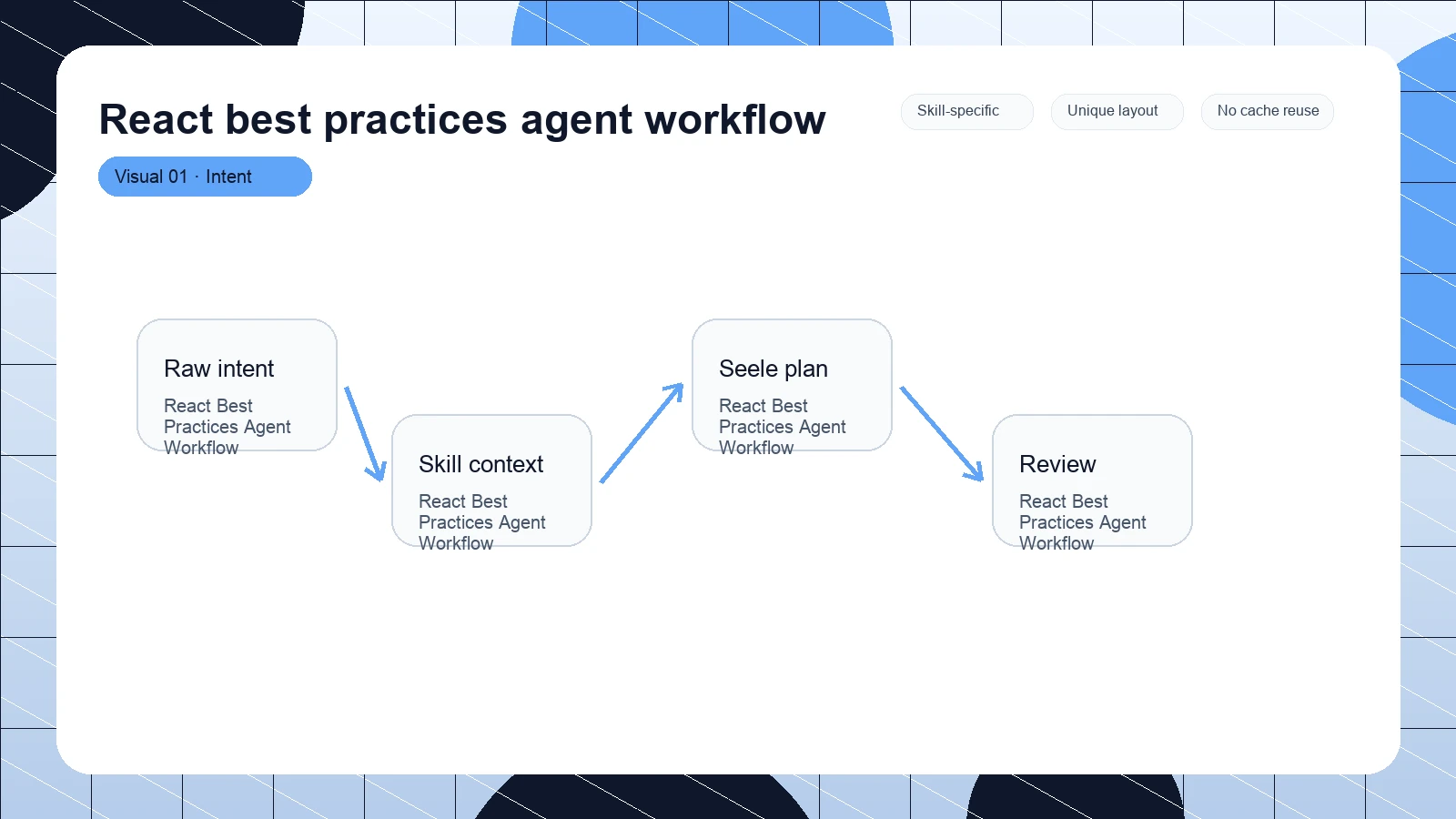
Scope The Visual Brief
Turn an initial react best practices agent workflow request into a clearer brief with target audience, constraints, and the best next step.
Search thisUse react best practices agent workflow as a planning lens in Seele Workspace: shape a rough request into component review, architecture notes, and frontend implementation prompts without implying Seele includes the external skill itself.
Try this in Seele AI
Start with one concrete react best practices agent workflow request, then use Seele Workspace to organize the brief, constraints, review criteria, and follow-up prompts.
Quick Start Searches
Three realistic ways teams start an react best practices agent workflow workflow.
Turn an initial react best practices agent workflow request into a clearer brief with target audience, constraints, and the best next step.
Search this
Generate multiple directions for react best practices agent workflow so the team can choose intentionally before production deepens.
Search this
Package the strongest direction into a cleaner visual brief that is ready to continue in Workspace.
Search thisCore Features
What this react best practices agent workflow page is designed to accelerate.
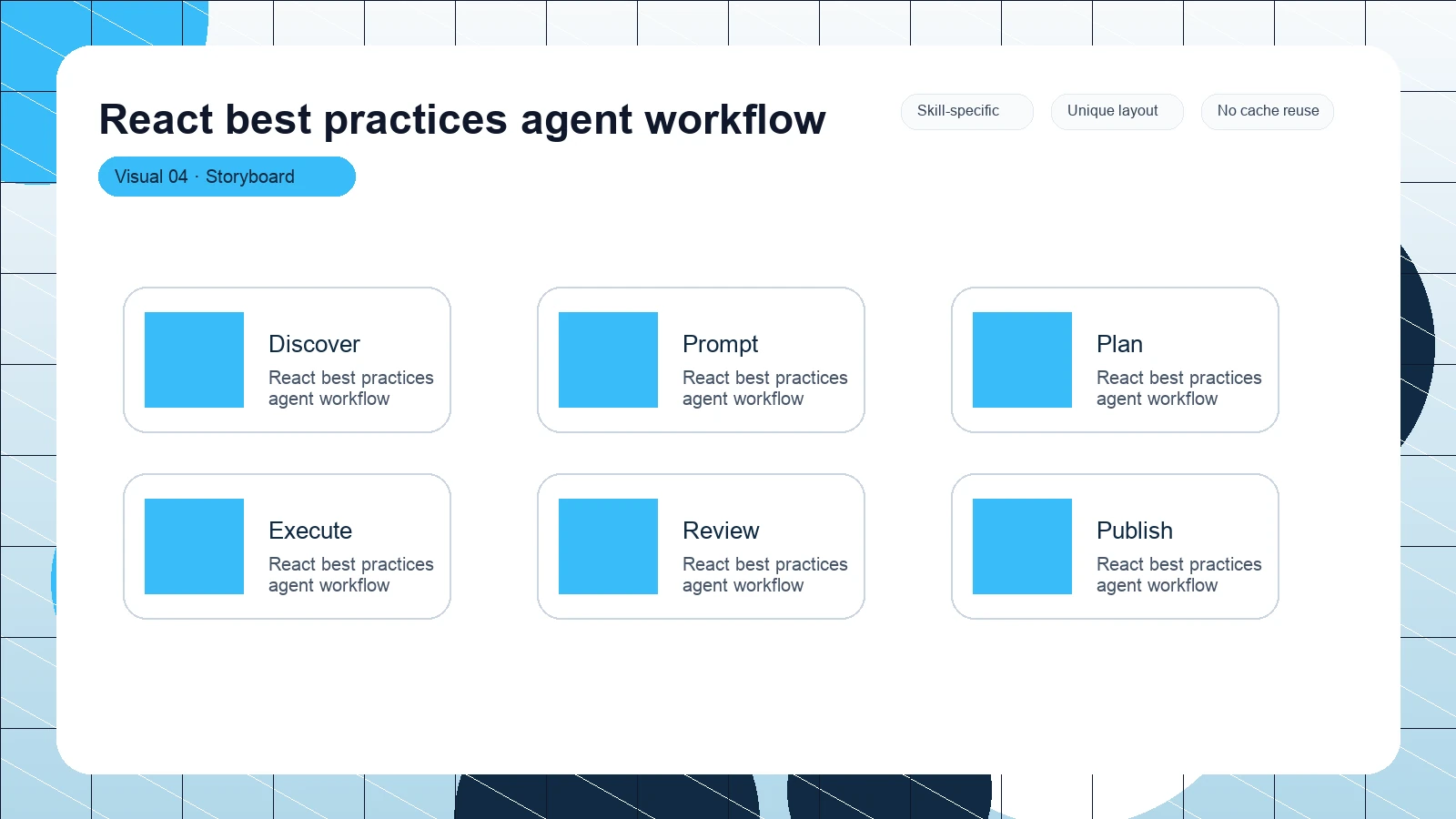
Convert vague requests about react best practices agent workflow into a more useful visual brief instead of generic filler.
Open Workspace
Lay out multiple routes for research and source-finding workflow early so the team can decide before committing deeper resources.
Open Workspace
Carry the strongest route forward with clearer review boundaries around style consistency, composition fit, and final production polish.
Open WorkspaceComparison
Use this page for early decisions, then move deeper when the route is chosen.
| Approach | Best for | Still needs review |
|---|---|---|
| Single-pass react best practices agent workflow draft | Fast first-pass visual brief generation | style consistency, composition fit, and final production polish |
| Multi-route comparison | Picking the strongest direction for research and source-finding workflow | Scope tradeoffs, downstream dependencies, and team alignment |
| Workspace continuation | Expanding the chosen route without restarting | Final production execution and release-quality signoff |
Who This Tool Page Is For
Teams that need a faster way to move from rough intent to a usable visual brief.
Use react best practices agent workflow to shape first-pass direction before committing deeper production work.
Open Workspace
Compare multiple react best practices agent workflow routes early and keep the strongest option moving.
Open Workspace
Turn exploration into a clearer visual brief with explicit review boundaries.
Open WorkspaceReact best practices agent workflow helps teams move faster from rough intent to a concrete visual brief. It is strongest when the job is to compare directions, clarify scope, and continue the best route in Workspace rather than pretending one pass finishes everything.
Most teams do not need a perfect first answer. They need a faster way to shape research and source-finding workflow, decide what belongs in the next iteration, and keep the capability boundary honest around style consistency, composition fit, and final production polish.
Workflow
Move from repository intent to scoped implementation steps, tests, and PR review criteria. Source context: skills.sh · agent-skills / vercel-react-best-practices.
Capture target files, runtime assumptions, constraints, and the exact change the workflow should enable. For React best practices agent workflow, keep the source intent visible so the brief does not become a generic agent template.
Use Seele to separate investigation, implementation, validation, and rollback notes. For React best practices agent workflow, keep the source intent visible so the brief does not become a generic agent template.
List tests, build checks, lint, screenshots, logs, or manual QA needed before a PR is safe. For React best practices agent workflow, keep the source intent visible so the brief does not become a generic agent template.
Summarize risks, review focus, and owner questions so a human can merge with confidence. For React best practices agent workflow, keep the source intent visible so the brief does not become a generic agent template.
Outputs
The output is deliberately reviewable: each artifact can be checked before a teammate or external tool executes it.
A concise engineering plan with scope, non-goals, dependencies, and likely files. Tailor it to React best practices agent workflow instead of reusing a generic skill-page checklist.
Code plan
Concrete validation commands and manual checks for the target repo or automation path. Tailor it to React best practices agent workflow instead of reusing a generic skill-page checklist.
QA commands
What reviewers should inspect: correctness, safety, edge cases, and maintainability. Tailor it to React best practices agent workflow instead of reusing a generic skill-page checklist.
Review notes
How to disable, revert, or narrow the change if production behavior looks wrong. Tailor it to React best practices agent workflow instead of reusing a generic skill-page checklist.
Safety planBoundaries
Use this page to start faster, then verify the parts that affect users, production, or external systems.
No. This page maps the intent behind React best practices agent workflow into Seele Workspace planning artifacts. It does not claim Seele embeds the external skill or service itself.
It turns the source context (skills.sh · agent-skills / vercel-react-best-practices) into scoped prompts, checks, and handoff notes instead of a generic workflow description.
Implementation brief, Test checklist, Review guide, Rollback notes.
Actual repo state and dependency versions; Secrets and deployment permissions; CI results and flaky tests; Human code review before merge.
Teams that need a faster starting point for React best practices agent workflow, while keeping feasibility, quality, and ownership checks explicit.