Define the Museum of Tides restoration loop
A restoration simulation prompt should say what condition an artifact is in, which tool can change it and whether treatments have a required order. Museum of Tides is a fictional small workshop with three objects and one ten-day deadline. Each condition is a visible counter rather than a vague quality score.
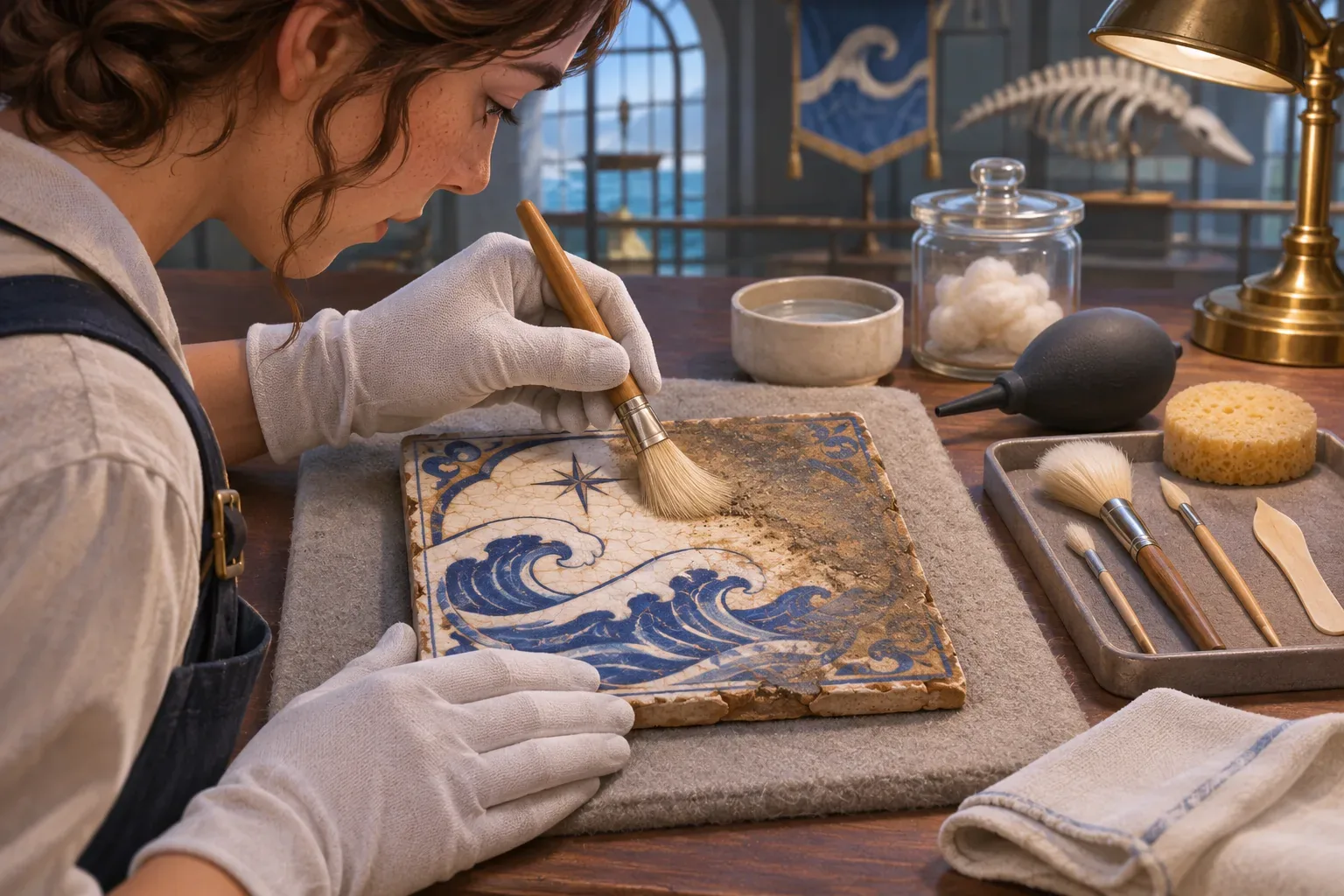
The tile begins with one grime, one crack and one fade point. The vase has one grime and two cracks. The frame has two grime and one fade. Grime, cracks and fade each decrease toward zero. The player starts with 14 credits and takes one restoration action per day.
Clean removes one grime for one credit. Repair removes one crack for two credits, but only after grime reaches zero. Retouch removes one fade for one credit, but only after grime and cracks are both zero. The sequence prevents a finish layer from hiding unresolved damage.

Order tools around visible condition states
There are nine total treatment actions: three for the tile, three for the vase, and three for the frame. Their costs are 4, 5 and 3 credits respectively, for a total of 12. That leaves 2 credits from the starting budget. All three items must reach zero grime, zero cracks and zero fade by the end of day 10.
The state order is validate tool eligibility, check budget, apply one condition change, deduct cost and advance one day. An illegal action or an unaffordable action changes nothing. The win check occurs after the action resolves; if all condition counters reach zero on day 10, the project succeeds. Restart restores condition counters, budget and day.
No staff, donors, random damage or additional restoration materials are included. These can be separate systems after this condition and cost loop works as specified.
Trace the example
A valid schedule starts with the tile. Clean it for one credit: budget 13, grime 0. Repair its crack for two: budget 11, cracks 0. Retouch the fade for one: budget 10, and the tile is complete on day 3.
For the vase, clean once (budget 9), then repair twice (budget 5). It has no fade point, so it is complete on day 6. The frame needs two cleaning actions (budget 3) and one retouch (budget 2). All items reach zero condition counters on day 9, leaving one day before the deadline.
This is a fictional cost calculation, not an observed game session or restoration recommendation. It confirms the defined actions fit the budget and deadline, but does not claim that any real object should be treated in this way.

Write the six prompts
Use one prompt per design decision so later checks have a clear source of truth. These drafts describe Museum of Tides; they have not been run and do not represent a generated playable game.
Prompt 1: create the objects and condition values
Create a small workshop with three artifacts: tile G1/C1/F1, vase G1/C2/F0, frame G2/C0/F1. Show Grime, Cracks, Fade, budget14 and day1/10.Prompt 2: define treatment costs and prerequisites
Clean removes 1 Grime for 1 credit. Repair removes 1 Crack for 2 credits, only if Grime=0. Retouch removes 1 Fade for 1 credit, only if Grime=0 and Cracks=0.Prompt 3: resolve one action per day
Give exactly one action per day. Validate eligibility and sufficient credits before changing state. On a legal action apply one point, deduct cost, then advance day. Illegal or unaffordable actions change nothing.Prompt 4: set success and failure
Win when all three condition values on all artifacts are zero by end of day10 with budget ≥0. Lose if the deadline passes with unfinished condition or budget is insufficient for a selected treatment.Prompt 5: make Restart exact
Restart restores all initial condition values, 14 credits, day1 and no selected item. Display each action's condition and cost change.Prompt 6: prepare future checks
For future checks log item, tool, eligibility, condition before/after, cost, budget and day. Check treatment order, budget total12, illegal actions, deadline, completion and Restart. Do not claim unobserved checks pass.SEELE’s official page describes general plain-English prompting, a playable first version, browser testing and refinement; it does not verify Museum of Tides. See Free AI game maker for workflow context only.
Prepare future build checks
Use a treatment ledger to compare item state, tool eligibility, credit cost and day. Test the nine-action plan, a retouch attempted too early, a repair with grime remaining, insufficient budget and completion on the deadline. These are future checks, not passed tests. Record the before and after state so a later build can be compared with the specification.
| Future check | Expected rule | Evidence to capture |
|---|---|---|
| Cleaning | Removes one grime for one credit | Condition and budget before/after |
| Repair | Only at grime zero; costs two | Prerequisite and crack counter |
| Retouch | Only after grime/cracks zero | Prerequisite and fade counter |
| Budget/deadline | Nine actions cost12, finish by day9 | Ledger, remaining credits, day |
| Restart | Restores all artifact counters | Initial condition snapshot |
No real game run, browser test or measured result is available for this fictional example. The illustrations are original concept art and are not screenshots.
Frequently asked questions
What should a restoration simulation prompt define?
Specify condition categories, tool effects, treatment order, costs, action cadence, budget and deadline.
Why must Museum of Tides clean before repair?
Repair is legal only after grime reaches zero, and retouch waits until grime and cracks are cleared.
How much does the fictional work plan cost?
The nine required actions cost 12 credits total, leaving 2 from the starting 14.
Were the restoration prompts tested in a playable game?
No. Museum of Tides is a fictional simulation design; its ledger is arithmetic, not observed gameplay.
Can the player take two restoration actions in one day?
No. The rules allow exactly one action each day.