Define the Accord of Three negotiation
A diplomacy strategy prompt should explain what a faction wants, what the player can offer and how acceptance is decided. Accord of Three is a fictional negotiation scenario with Amber and two neighboring factions, Blue and Green. The goal is to secure a pact with both before the fourth turn ends.
Blue begins with trust two; Green begins with trust one. Trust ranges from zero to three and does not change unless the player acts. Amber starts with one coin and four envoys. Each turn the player chooses one action and spends one envoy.
Gift costs one coin and raises the chosen faction's trust by one, up to three. Offer Pact succeeds automatically at trust two or higher; below two it is rejected, but the envoy and turn are still spent. Break Pact ends an active pact and reduces trust by two. Pacts persist until broken.
Make faction responses and envoy costs explicit
The acceptance threshold is visible and deterministic. Blue can accept immediately; Green requires one Gift first. The player can make a maximum of four actions because the envoy pool and turn limit are both four. Win by signing both pacts by turn four. If turns expire or envoys reach zero before the second pact, the negotiation fails.
At the end of each turn, update the action log and show trust, coins, envoys and pacts. There is no hidden faction preference, relationship decay, random response or secret cost. Restart restores trust, coin, envoy and pact state.
A later version could add competing factions or proposals, but the first playable slice should make the reason for acceptance or refusal inspectable.

Trace the example
Turn one: Gift Green. Spend the only coin, raising Green from trust one to two; envoys fall from four to three. Turn two: Offer Pact to Blue. Trust is already two, so the pact is signed; envoys fall to two. Turn three: Offer Pact to Green; it is also signed, and envoys fall to one.
Amber meets the goal in three turns with one envoy unused. Offering to Green before the Gift would be rejected and would spend an envoy, leaving less flexibility. That decision difference follows directly from the visible trust threshold.
This is a fictional negotiation trace, not a tested strategy or a claim about real diplomatic behavior. A future build should log action cost, trust before and after, faction response and pact state.

Write the six prompts
Use one prompt per design decision so later checks have a clear source of truth. These drafts describe Accord of Three; they have not been run and do not represent a generated playable game.
Prompt 1: create factions and starting state
Create Amber and two factions, Blue and Green. Trust begins Blue2/Green1 on scale0–3. Start coins1, envoys4, turns1–4. Goal is pacts with both.Prompt 2: define actions and resources
One action each turn costs1 envoy: Gift costs1 coin and raises trust by1 to maximum3; Offer Pact; or Break Pact. Trust otherwise remains stable.Prompt 3: set treaty acceptance
Offer Pact is accepted automatically at trust≥2 and rejected below2. Rejection still spends the action and envoy. Pacts persist until explicitly broken.Prompt 4: define treaty break
Break Pact ends active treaty and lowers that faction's trust by2, minimum0. Display faction state and response reason.Prompt 5: set end states and reset
Win when both pacts are signed by end turn4. Lose if turn limit or envoy pool ends first. Restart restores all values.Prompt 6: prepare future checks
For future checks log turn, action, coin/envoy cost, trust, response and pact state. Check below/at threshold, Gift cap, rejected offer cost, break, deadline and Restart. Do not claim tests passed without a build.SEELE’s official page describes general plain-English prompting, a playable first version, browser testing and refinement; it does not verify Accord of Three. See Free AI game maker for workflow context only.
Prepare future build checks
Record trust and envoy values before each action. Test an offer below threshold, exactly at threshold, a gift at the cap, pact breaking and the four-turn deadline. These are future checks, not passed tests. Record the before and after state so a later build can be compared with the specification.
| Future check | Expected rule | Evidence to capture |
|---|---|---|
| Gift | Costs1 coin and adds1 trust up to3 | Coins and trust before/after |
| Offer threshold | Accepted at2+, rejected below2 | Trust and response |
| Action cost | Every action spends1 envoy/turn | Envoy and turn log |
| Break Pact | Remove pact and reduce trust2 | Pact and trust state |
| Win/reset | Two pacts by turn4; reset values | Outcome and initial snapshot |
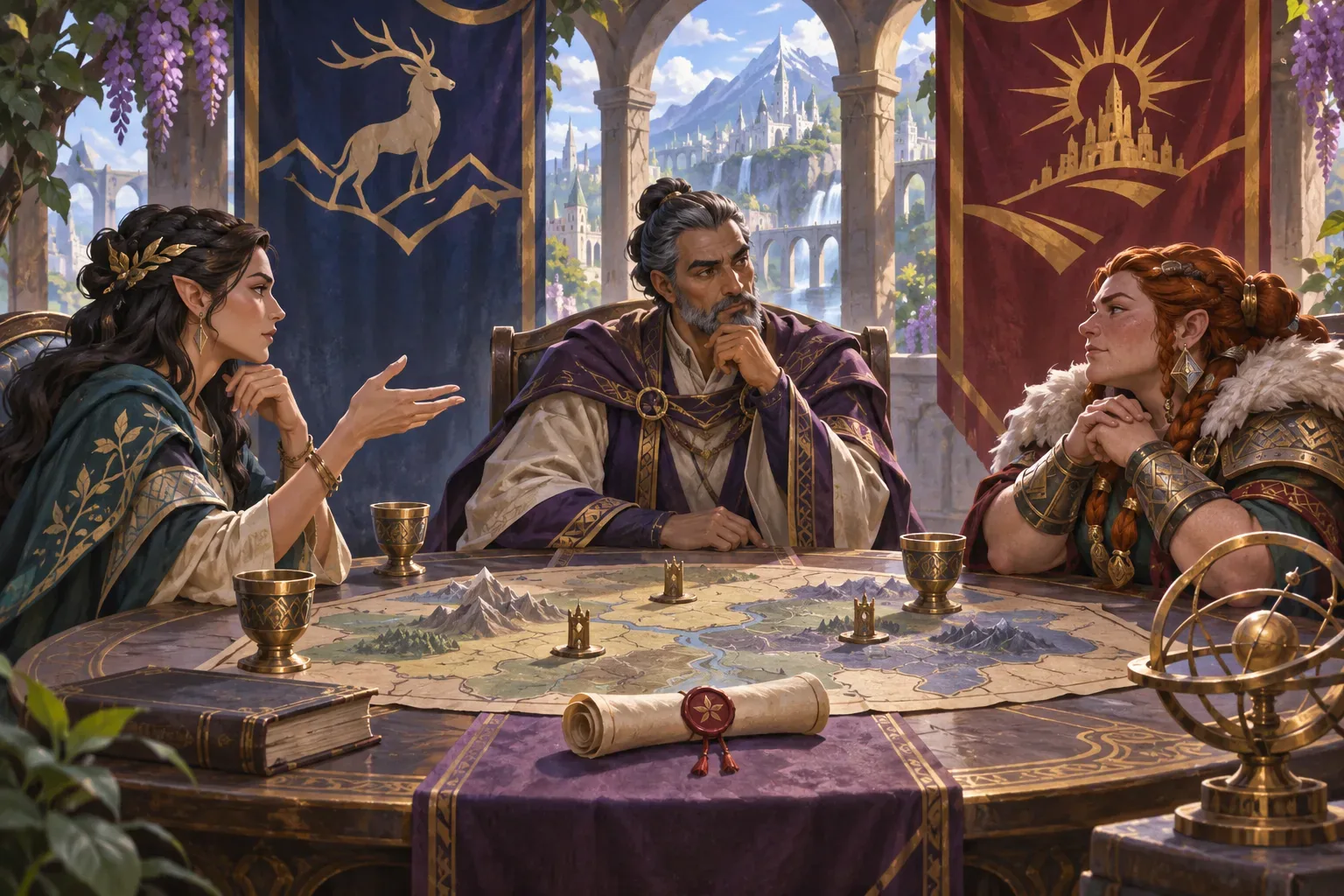
No real game run, browser test or measured result is available for this fictional example. The illustrations are original concept art and are not screenshots.
Frequently asked questions
What should a diplomacy strategy prompt define?
Specify factions, trust, available actions, resource costs, acceptance thresholds and treaty duration.
Why does Blue accept immediately in Accord of Three?
Blue starts at trust two, the stated threshold for accepting a pact.
What does the Gift action do?
It spends one coin and raises one faction's trust by one, up to three.
Were these diplomacy prompts tested in a playable game?
No. Accord of Three is fictional and its treaty sequence is a rules example, not observed gameplay.
Does a rejected offer cost an envoy?
Yes. A rejected offer still uses one action, one envoy and one turn.