Define the Prism Relay loop
A character-switching prompt needs to explain what changes when the player switches and what must remain stable. If a swap also teleports the player, changes health or resets the camera without saying so, it becomes difficult to reason about a level. Start with one room where each form solves a different obstacle and the switch has a clear invariant.
This guide uses Prism Relay, a fictional side-view action room with a 12-column by 8-row playfield. One hero has two forms, Mica and Tern. They share one location, facing direction, camera and three-point health pool. There is only one active body at a time: switching changes the ability set without creating a second character or moving the hero.

The room begins at x1 on the floor. A raised ledge occupies columns 3–5 at height two. A cracked one-height barrier sits at x6 on the lower route. A sentry waits at x8 on the floor and a second at x10 on the ledge. Each has two health. A defeated sentry drops one prism key at its location. The exit is at x12.
The objective is to collect both keys and reach the exit before 90 seconds. Sentry contact or a projectile removes one point from the shared health pool. At zero health, the attempt ends. The timer reaching zero also ends it. Restart restores the start position, both sentries, barrier, keys, health and timer.
Make the abilities complementary
Mica can make one additional jump while already airborne. That extra jump reaches the raised ledge, but Mica's attack only hits an adjacent target. Tern cannot double-jump, but can fire a straight shot up to three cells away. Either form's attack deals one damage; two successful hits defeat a sentry. Tern's shot travels along its facing direction and stops at the first barrier or target.
| Form | Movement advantage | Attack | Level use |
|---|---|---|---|
| Mica | One extra jump per airtime | Adjacent strike, 1 damage | Reach the raised ledge |
| Tern | Standard jump only | Straight shot up to 3 cells, 1 damage | Hit a distant sentry and break the barrier |
The cracked barrier has two durability points. A Tern shot removes one; after the second, the barrier disappears and the lower route is open. Mica's strike cannot damage it because the object is not adjacent while the hero stands at x5 on the ledge. This relationship gives the switch a practical purpose instead of treating it as a cosmetic skin choice.
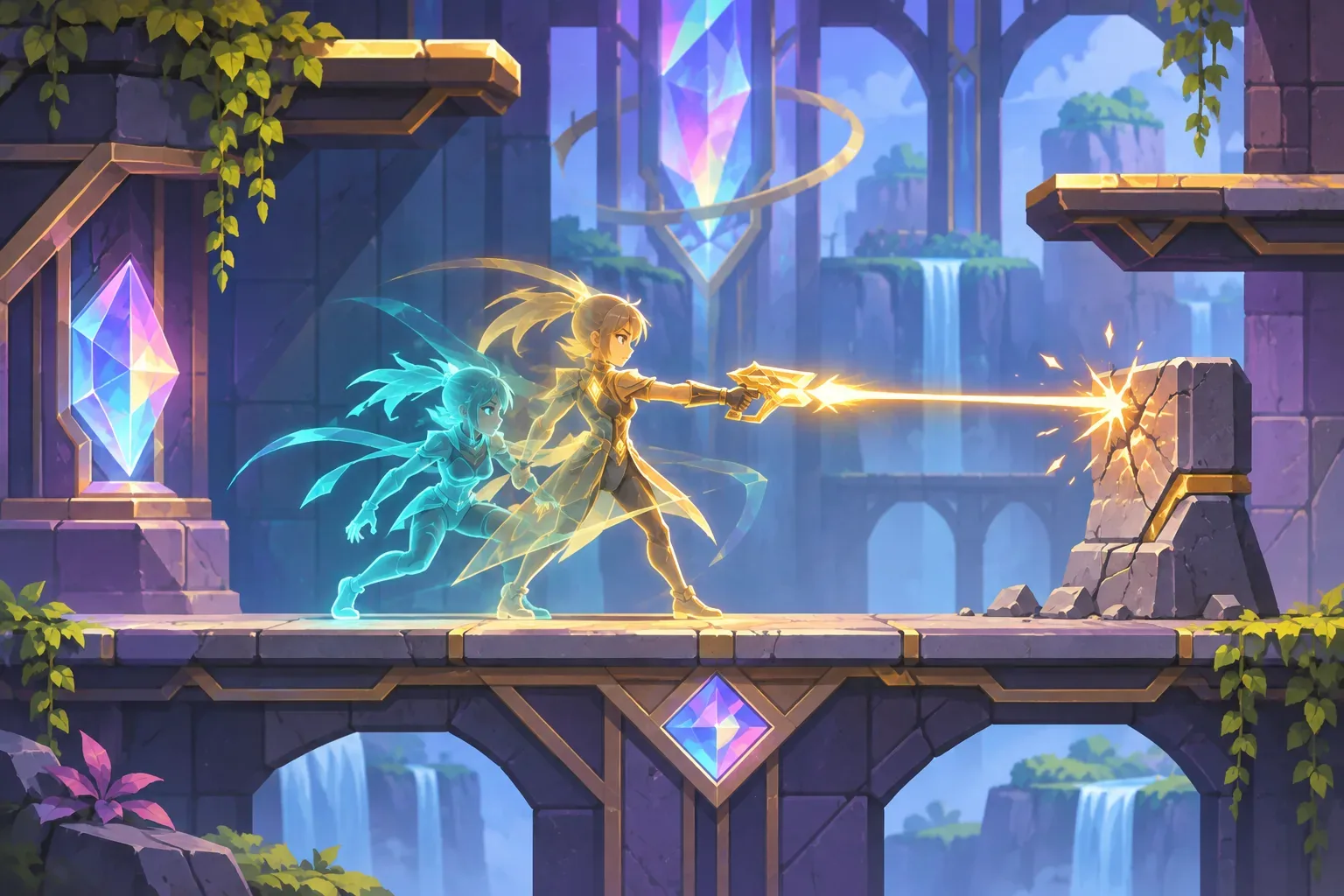
Keep the first version bounded. There is no separate companion AI, gear tree, form-specific health, cooldown, elemental weakness or random drop. Those additions would make it harder to see whether switching itself works.
State what switching preserves
Switch is instantaneous and has no cooldown. The player presses one button to change Mica to Tern or Tern to Mica. Position, facing, health, camera, timer and collected keys remain unchanged. Horizontal momentum resets to zero so a switch cannot carry the hero through the barrier. If the hero is airborne, the vertical position stays fixed; Mica's extra-jump availability is part of Mica's movement state and is not refreshed by switching away and back during the same airtime.
That last rule closes a common exploit: switching repeatedly must not grant unlimited extra jumps. On landing, Mica's extra jump becomes available again. Tern has no second-jump ability. This is a fictional design rule that a future build can check with a short state log.
| State | After switching |
|---|---|
| Position and facing | Unchanged |
| Health and timer | Unchanged |
| Camera and keys | Unchanged |
| Horizontal momentum | Reset to zero |
| Active ability set | Changes to selected form |
| Mica's air jump | Does not refresh until landing |
The inactive form is not a second target in the room. That avoids ambiguity about where a second body stands or whether it can activate a plate. If a future design needs simultaneous characters, that is a different mechanic and should be specified separately.
Trace a switching room
A fictional route begins with Mica at x1. Mica jumps to the height-two ledge and lands near x5. The player switches to Tern while stationary; the position remains x5 and the camera does not move. Tern faces the sentry at x10. A three-cell shot travels to the target; two hits remove its two health. The key drops on the ledge and can be collected.
Next the hero returns to the floor and stands adjacent to the cracked barrier at x6. Tern fires twice in the facing direction, reducing durability from two to zero and clearing the lower path. The hero advances to collect the second key at x8 after defeating the ground sentry. With both keys, reaching x12 opens the exit and wins before the timer expires.
This route is a fictional rule walkthrough, not a tested level. The exact time needed for jumps, shots and movement has not been measured. It only checks that the stated abilities connect to the placed obstacles and that switching preserves the location needed to use them.
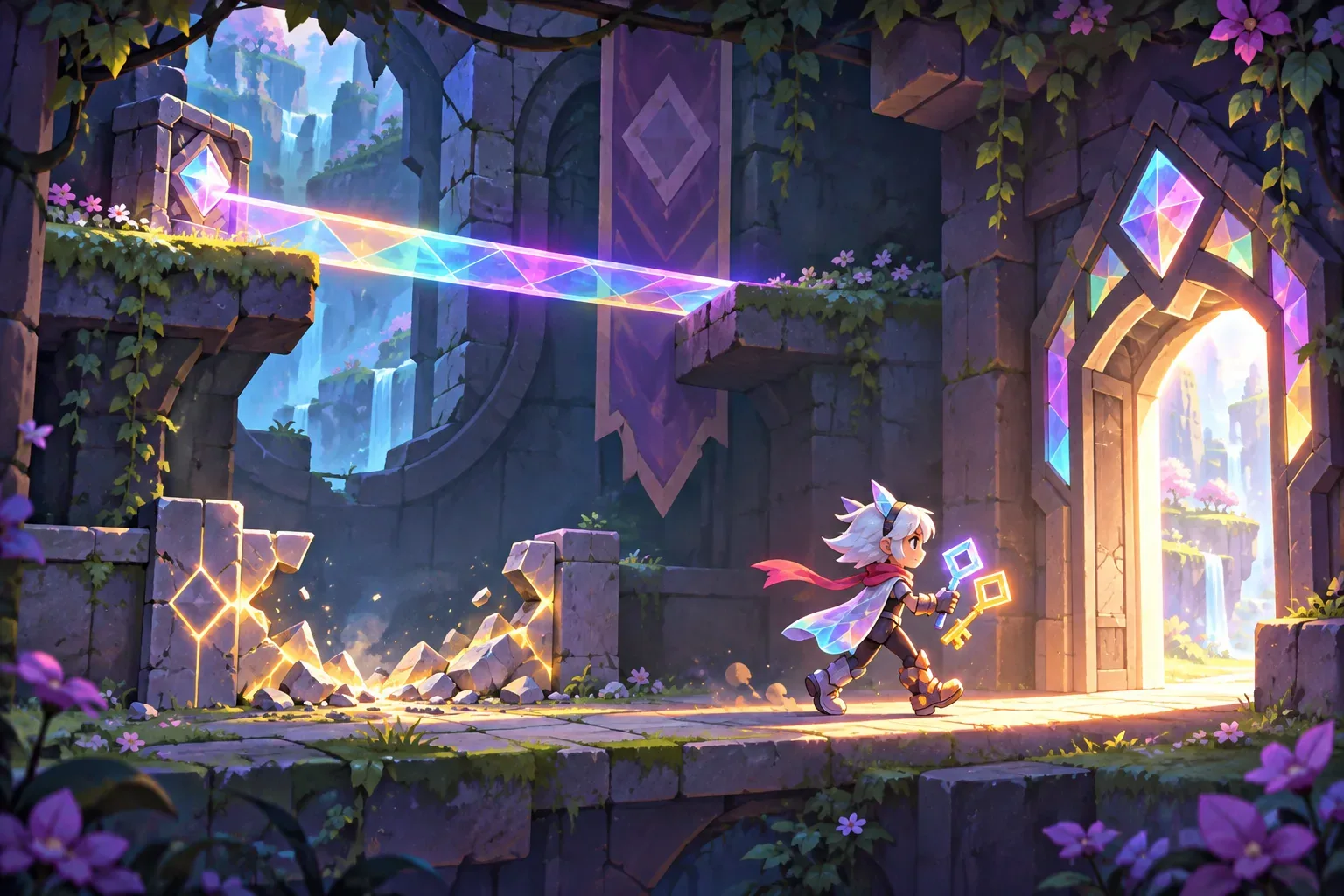
For real implementation work, record the active form before and after each swap, then compare position, health, facing and air-jump state. Add checks for switching at the ledge edge, while falling, and immediately before a shot. These are future checks; this package contains no playable build.
Write the six prompts
Build the brief as small instructions that each add a specific rule. The prompts below are drafts for Prism Relay and have not been submitted to a game maker.
Prompt 1: define the room
Create a fixed side-view 12×8 platform-action room. Start the hero at x1 on the floor. Put a height-two ledge at x3–5, a two-durability cracked barrier at x6 on the lower route, sentries with 2 HP at x8 floor and x10 ledge, one key dropped by each sentry, and an exit at x12. The timer is 90 seconds.Prompt 2: define Mica
Mica can make one extra jump while airborne, once per airtime, and a one-cell adjacent strike that deals 1 damage. Landing refreshes the extra jump. Do not refresh it by switching forms.Prompt 3: define Tern
Tern has a standard jump and fires a straight shot up to 3 cells in the facing direction. A shot stops at the first obstacle or target and deals 1 damage. It can damage sentries and the cracked barrier. The barrier needs two hits.Prompt 4: define switching
One hero has two forms; only one active body exists. Switching is instant with no cooldown. Keep position, facing, health, camera, timer and keys unchanged; reset horizontal momentum; preserve airborne state and Mica's used-jump state.Prompt 5: define the goal
Use one shared 3-point health pool. Sentry contact or a projectile removes one health. Defeating each sentry drops a key. Win after collecting both keys and reaching x12 before 90 seconds. Lose at zero health or when time expires. Restart restores every initial room state.Prompt 6: prepare future checks
For a future build, log position, facing, active form, health, camera, timer, air-jump state, barrier durability, sentry HP and key count. Check switch at rest, in air and by a ledge; verify the invariant and both abilities. Do not mark tests passed without inspecting an actual build.SEELE's official page describes a general flow from plain-English prompts to a playable first version, browser testing and follow-up refinement. It does not verify Prism Relay or its mechanics. See Free AI game maker for workflow context only.
Prepare future build checks
A focused test log should capture active form, coordinates, facing, health, time, barrier durability, enemy health, key count and Mica's remaining jump. Check that a swap in midair does not move the hero or restore a used jump. Check that Tern's shot stops at a wall, and that a barrier disappears only after two hits.
| Future check | Expected behavior | Evidence |
|---|---|---|
| Switch invariant | Location, facing, health, camera and keys stay fixed | State snapshot before/after |
| Jump persistence | Switching does not refresh Mica's used air jump | Airborne input log |
| Ranged attack | Shot reaches at most three cells and stops at first collision | Projectile positions and collision target |
| Barrier durability | Two Tern hits remove the cracked barrier | Durability before/after each shot |
| Win and reset | Two keys plus exit wins; Restart restores initial room | Key count, door state and full reset snapshot |
The acceptance rules make switching observable, but they do not replace playtesting. This article describes a fictional system and proposed checks only; the illustration assets are concept art rather than captures.
Frequently asked questions
What should an AI prompt define for a character-switching action game?
Specify each character’s unique ability, what the switch preserves, when switching is allowed, shared or separate resources and how the level requires both roles.
Does Prism Relay move both characters independently?
No. The two forms share one position, health pool and camera; switching changes the active ability set at the same location.
How do the two characters differ?
Mica can make a second jump in midair and attacks an adjacent target. Tern fires a straight shot up to three cells but cannot double-jump.
Were the prompts tested in a playable game?
No. Prism Relay is a fictional example. The prompts are unrun and no playable build or observed result is included.
What is the most important switching test?
Switch while airborne and confirm position, health and camera stay fixed while the active ability changes; then verify each ability opens a different route.