Define the Blue Meridian goal
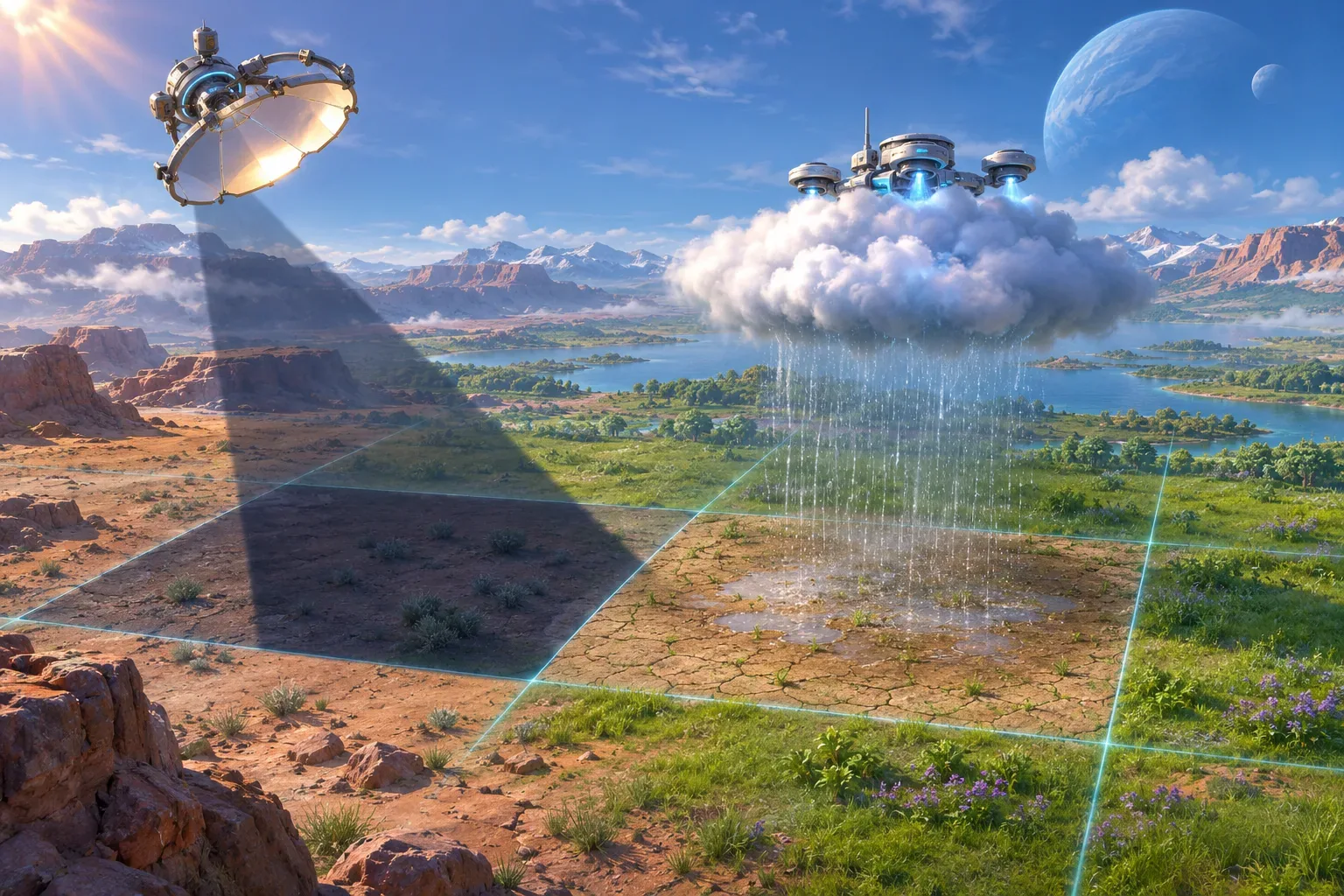
A terraforming prompt should define which climate variables the player can change and how the game decides that a place is habitable. Blue Meridian is a fictional 3-by-3 planet grid where the player adjusts four target cells with two tools: a reflector and a seed cloud.
Every cell starts at temperature 3 and moisture 1 on scales from 0 to 3. The four center cells form the target habitat. A cell qualifies when temperature is 2 or lower and moisture is 2 or higher. Other planet cells can remain unchanged in this short scenario.
The player starts with 10 energy, takes one action per turn and has ten turns. Reflector costs one energy and lowers one target cell's temperature by one, down to zero. Seed Cloud costs one and adds one moisture, up to three. There is no passive drift, randomness or action chaining.

Make each terraforming action measurable
An action is legal only if the player has one energy and the target cell is in range. A reflector or cloud changes only the selected cell. After each action, subtract one energy and advance one turn, then update the habitat indicator. If all four cells qualify, the run wins. If turn ten ends with any target failing the threshold, the run loses.
Each target needs one Reflector and one Seed Cloud from its initial values. Eight actions transform four cells, leaving two energy and two turns. Repeating an action on a cell already at the relevant cap is allowed but provides no benefit and still costs energy; players should see the predicted change before confirming.
These rules describe a puzzle-like terraforming slice rather than a scientific climate model. The numbers are invented for the game and should not be presented as Earth climate advice.
Trace the example
Select one target cell at temperature3, moisture1. Reflector lowers temperature to2 and uses one energy. Seed Cloud raises moisture to2 and uses another. The cell now meets both habitat thresholds. Repeat for the other three target cells.
After eight actions, all four target cells have temperature2 and moisture2. The energy balance is 10−8=2, and the run finishes on turn8, within the ten-turn limit. The other five cells remain at temperature3 and moisture1 because the goal concerns only the designated target zone.
This is a hand-calculated state example, not an observed simulation or scientific result. A future build should log each cell value, action, energy and turn before showing habitat status.
Write the six prompts
Use one prompt per design decision so later checks have a clear source of truth. These drafts describe Blue Meridian; they have not been run and do not represent a generated playable game.
Prompt 1: create cells and starting climate
Create a 3×3 planet grid. Each cell starts temperature3/moisture1 on scales0–3. Mark the central 2×2 cells as target habitat. Player starts energy10, turn1, limit10.Prompt 2: define reflector
Reflector targets one habitat cell, costs1 energy and permanently reduces temperature by1 to minimum0. Seed Cloud targets one habitat cell, costs1 and raises moisture by1 to maximum3.Prompt 3: define cloud seeding
Allow one action per turn. Each valid action changes only the selected cell, subtracts one energy and advances one turn. No passive climate drift or randomness.Prompt 4: resolve turns and habitat threshold
A target cell qualifies at temperature≤2 and moisture≥2. Win once all four target cells qualify. Lose after turn10 if incomplete or if energy reaches0 before completion.Prompt 5: show cost and reset
Show predicted cell values, cost and habitat status before confirming. Restart restores all nine cells to temperature3/moisture1 and energy10/turn1.Prompt 6: prepare future checks
For future checks log cell, tool, values before/after, energy, turn and qualification. Check caps, minima, one-action cadence, four-cell goal, timeout and reset. Do not claim tests pass before seeing a build.SEELE’s official page describes general plain-English prompting, a playable first version, browser testing and refinement; it does not verify Blue Meridian. See Free AI game maker for workflow context only.
Prepare future build checks
Record temperature, moisture, energy and turn for each target action. Verify the eight-action solution, temperature floor, moisture cap, one-action rule, qualification threshold and timeout/reset behavior. These are future checks, not passed tests. Record the before and after state so a later build can be compared with the specification.
| Future check | Expected rule | Evidence to capture |
|---|---|---|
| Reflector | Lowers temperature by1 to minimum0 | Cell temp and energy |
| Seed Cloud | Raises moisture by1 to maximum3 | Cell moisture and energy |
| Habitat threshold | Temp≤2 and moisture≥2 | Both values and indicator |
| Action cadence | One valid action advances one turn | Turn and resource log |
| Goal/reset | Four target cells qualify; restart restores grid | Zone state and snapshot |
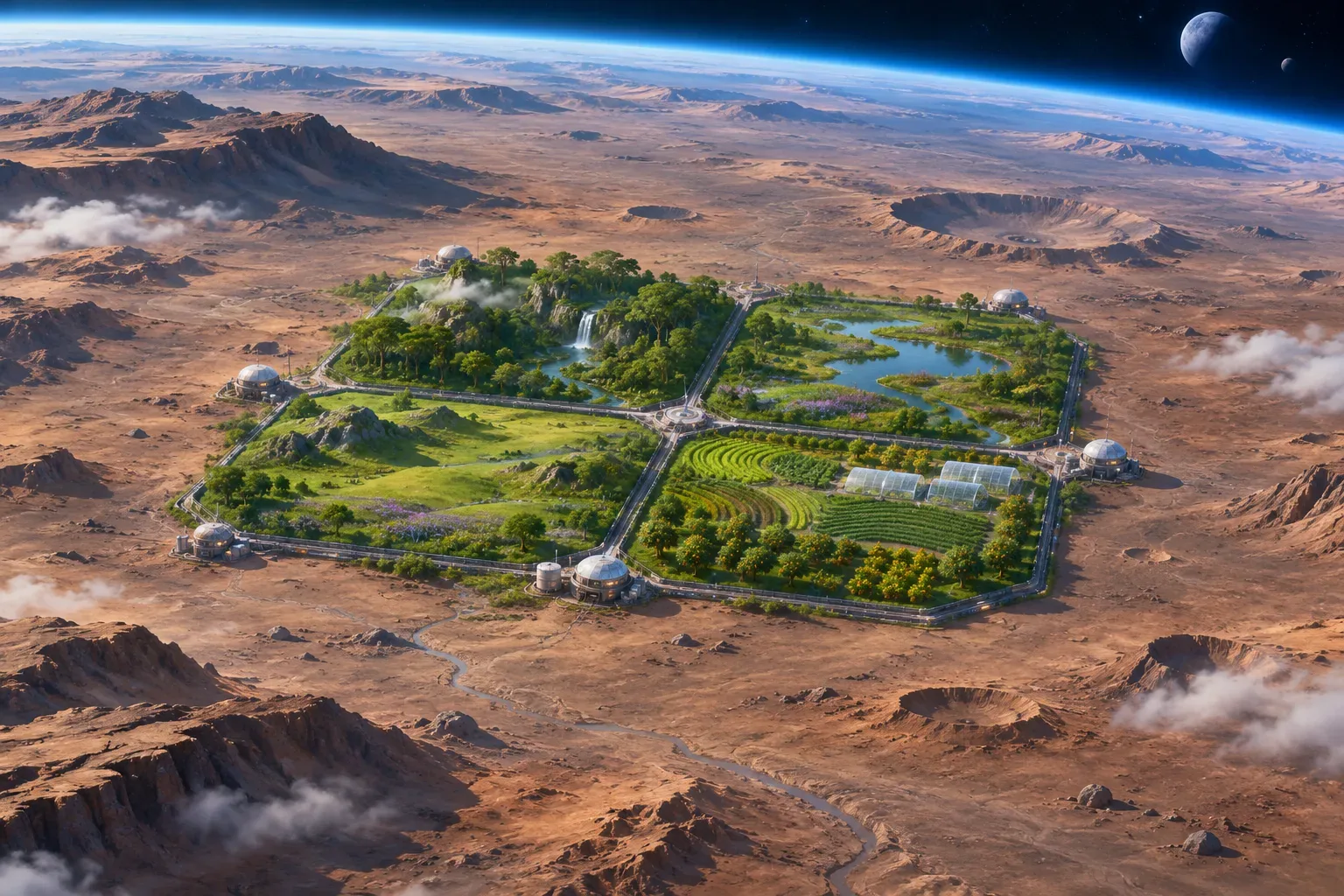
No real game run, browser test or measured result is available for this fictional example. The illustrations are original concept art and are not screenshots.
Frequently asked questions
What should a terraforming game prompt define?
Specify climate variables, action effects, costs, passive changes, habitat thresholds and completion state.
What makes a Blue Meridian cell habitable?
A target cell needs temperature at or below 2 and moisture at or above 2.
Does the example simulate real planetary climate?
No. Blue Meridian uses invented game values and is not scientific climate guidance.
Were the terraforming prompts tested in a playable build?
No. The game and four-cell trace are fictional design material, not an observed result.
How much energy remains after the sample plan?
Eight actions cost eight energy, leaving two from the initial ten.