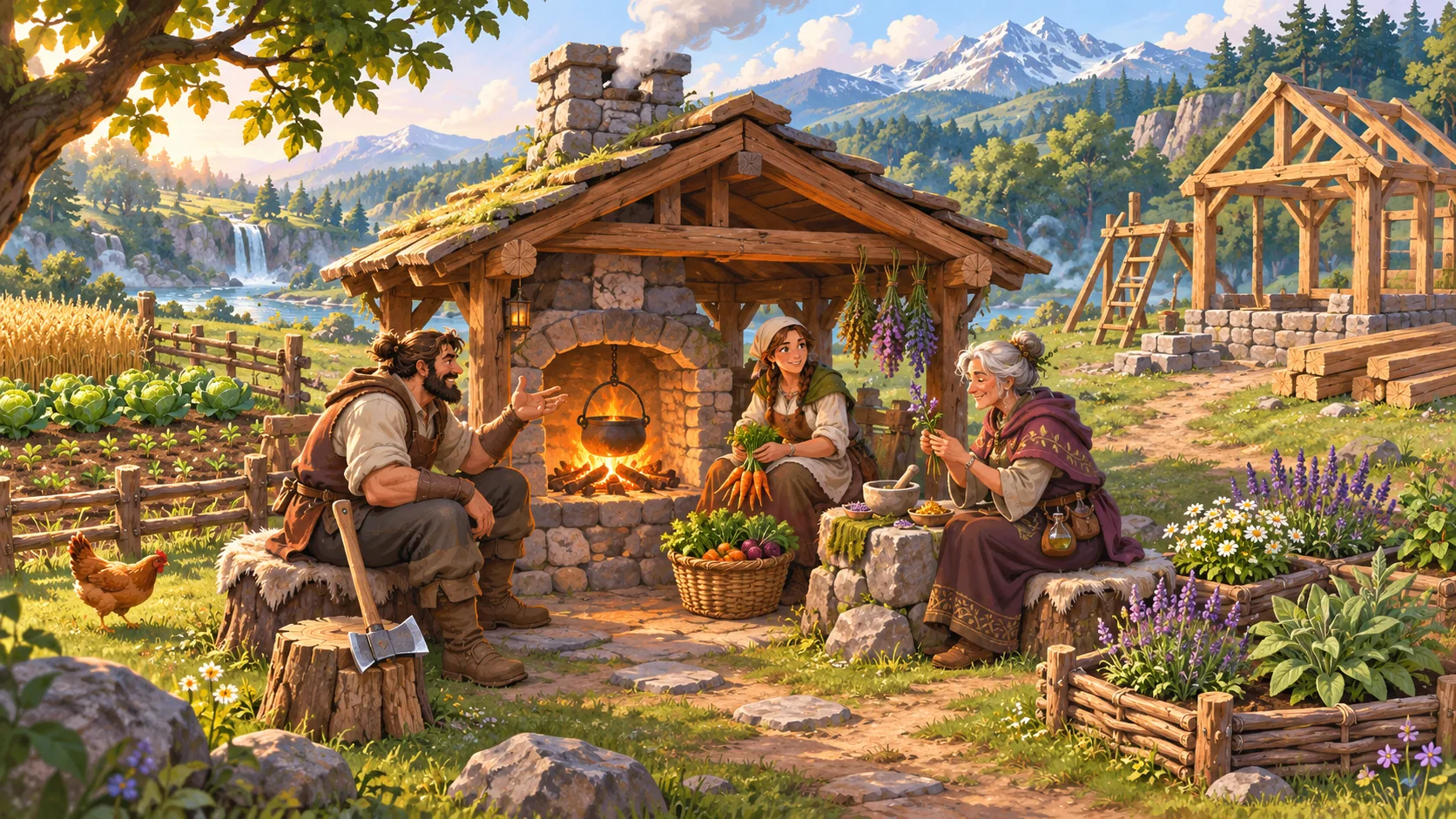
Define the Common Ground settlement
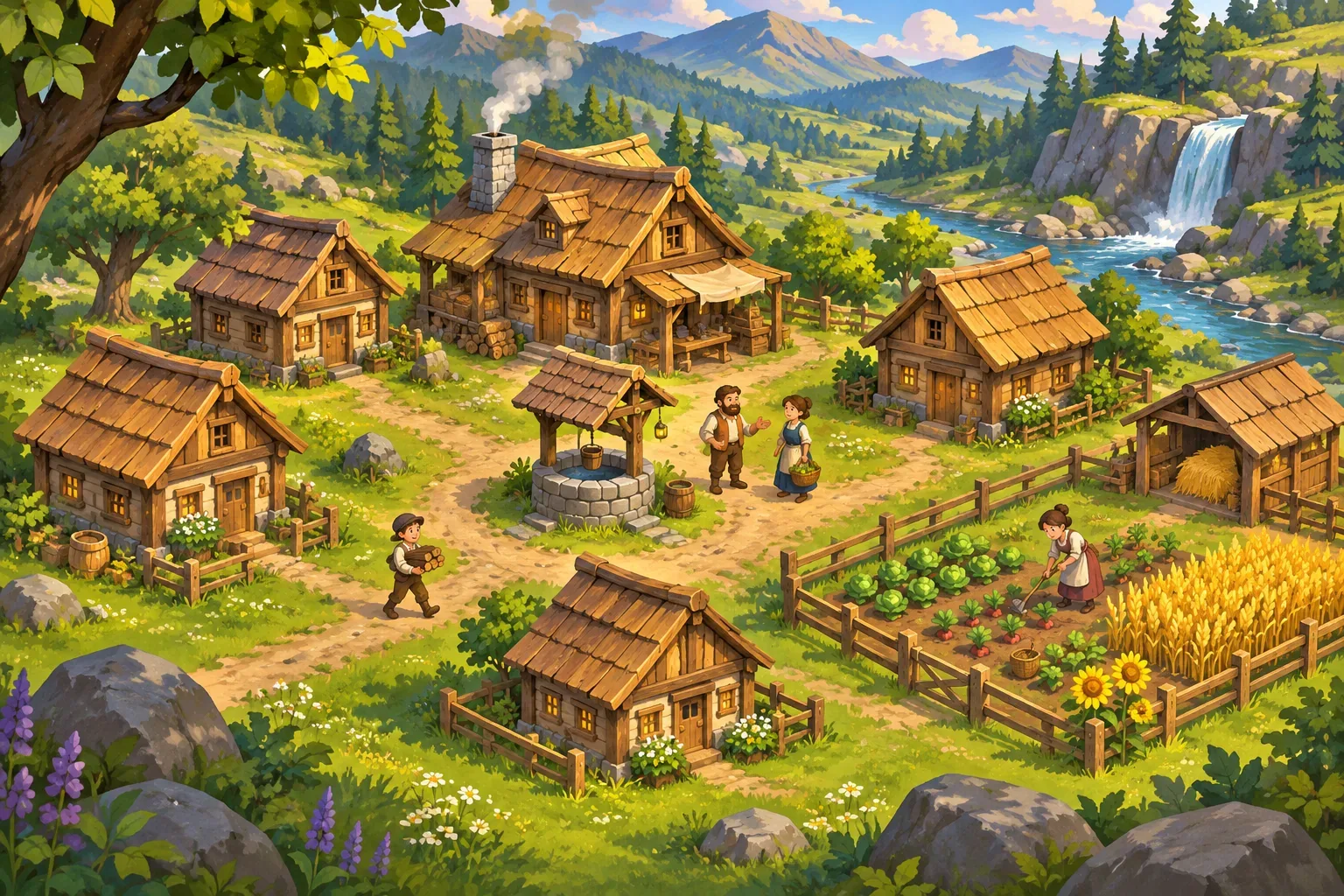
A village-building prompt should set starting supplies, building costs and the order in which production and upkeep occur. Common Ground is a fictional 3-by-3 settlement with two villagers, four food and nine wood. The player has one action per day and six days to meet a small growth goal.
A Farm costs four wood and produces three food at the end of each day after it is built. A House costs three wood and increases population capacity from two to four. A Well costs two wood. Recruiting one villager costs two food and requires a House with spare capacity.
At the end of each day, built farms produce food first, then each villager consumes one food. If the settlement cannot pay the full upkeep, the run loses. The goal is to build the Farm, House and Well, reach at least three villagers, and retain at least one food by the end of day six.
Order building, production and upkeep
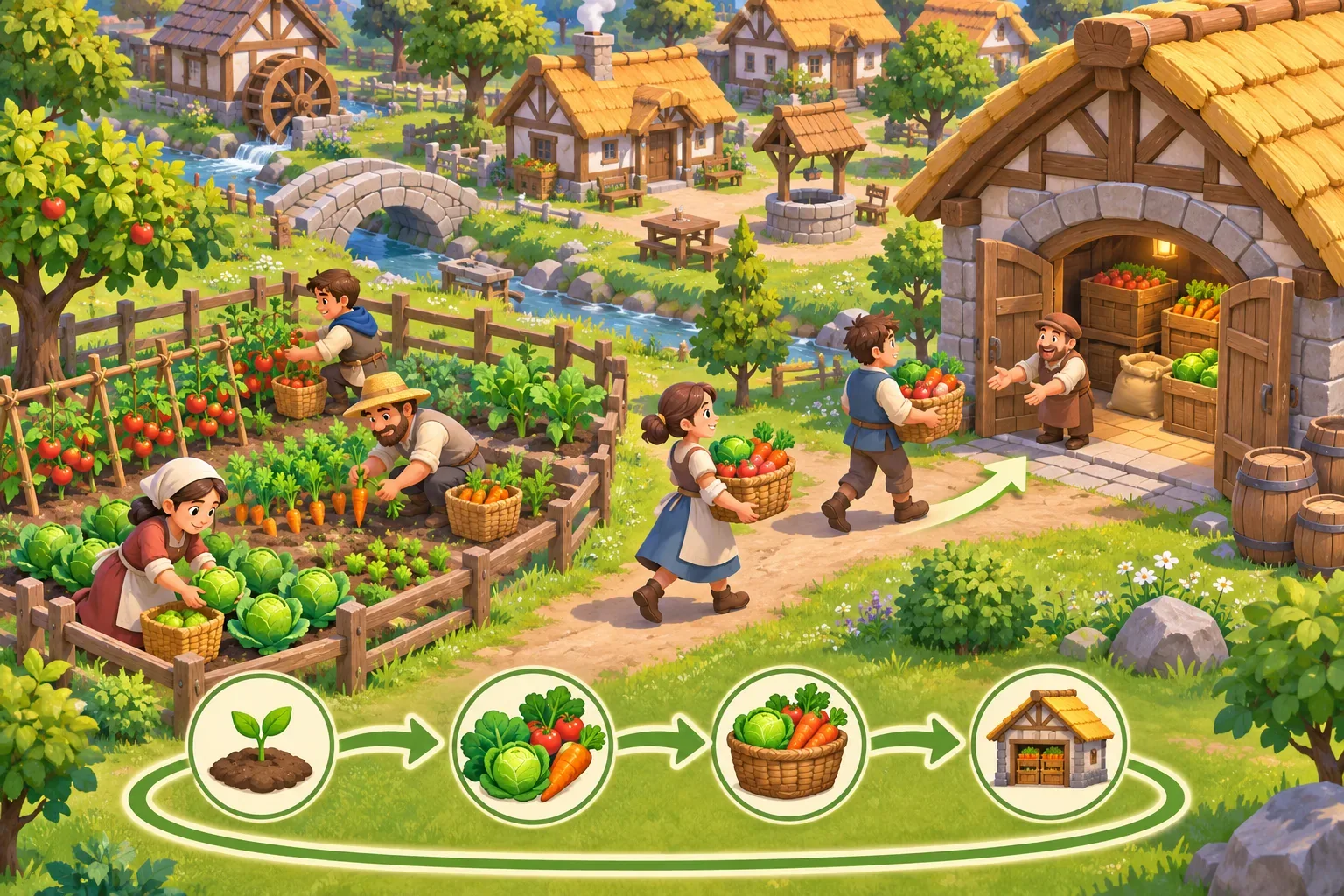
The player action happens before the end-day phase. Build or Recruit consumes one action. Then farm output is added, followed by food upkeep. If a structure is built during the action, its production begins that same day's end phase. Recruiting increases upkeep in that day's phase.
A working order is Farm, House, Well, Recruit. Day one: the Farm uses four wood, produces three food, and two villagers consume two. Food moves 4→7→5. Day two: the House uses three wood, farm adds three, and upkeep subtracts two, leaving six. Day three: the Well uses two wood, then food reaches seven. Day four: Recruit spends two food, farm produces three, and three villagers consume three, leaving five.
The plan uses all nine wood, keeps food positive and completes the required buildings and population by day four. These values are fictional game rules, not a real-world village or agriculture model.
Trace the example
The four-day sequence leaves Farm, House and Well built, population three, food five and wood zero. The village meets every stated win condition before the six-day deadline. The starting food and the farm timing matter: if production were processed after upkeep, the day-one balance would differ.
A useful prompt therefore states not just production values but also when construction begins producing, when residents consume food, and whether a newly recruited villager pays upkeep immediately. Common Ground includes the recruit in that day's upkeep.
This is a hand-calculated fictional economy, not a tested game balance result. A future build should log every action, production event and consumption event in sequence.
Write the six prompts
Use one prompt per design decision so later checks have a clear source of truth. These drafts describe Common Ground; they have not been run and do not represent a generated playable game.
Prompt 1: set settlement and starting stock
Create a 3×3 settlement with 2 villagers, food4, wood9 and a 6-day limit. Allow one player action per day.Prompt 2: define buildings
Farm costs4 wood and produces3 food at each end-of-day phase after construction. House costs3 wood and raises population capacity from2 to4. Well costs2 wood with no production.Prompt 3: add population growth
Recruit costs2 food, adds1 villager and requires a House with spare capacity. One villager consumes1 food per day.Prompt 4: specify end-of-day order
Resolve each day: player action, Farm production, then food upkeep. A building constructed this day produces immediately in that end phase. A recruited villager consumes food that day. Lose if upkeep cannot be paid.Prompt 5: set goal and reset
Win when Farm, House and Well are built, population is at least3 and food≥1 by day6. Restart resets structures, 2 villagers, food4, wood9 and day1.Prompt 6: prepare future checks
For future checks log action, wood, building state, farm production, population, consumption, food and day. Check costs, same-day production, recruit upkeep, starvation, win threshold and Restart. Do not claim unobserved checks pass.SEELE’s official page describes general plain-English prompting, a playable first version, browser testing and refinement; it does not verify Common Ground. See Free AI game maker for workflow context only.
Prepare future build checks
Record the day as action, production and consumption rather than one combined balance. Verify the four-day plan, whether a newly built Farm produces immediately, recruit upkeep and starvation behavior. These are future checks, not passed tests. Record the before and after state so a later build can be compared with the specification.
| Future check | Expected rule | Evidence to capture |
|---|---|---|
| Building cost | Farm4, House3, Well2 wood | Wood before/after |
| Production timing | Farm produces at end of build day | Build day and food delta |
| Recruitment | Costs2 food; capacity required | Population and food |
| Upkeep | One food per villager after production | Food before/after phase |
| Goal/reset | Required buildings and population by day6 | Win state and starting snapshot |
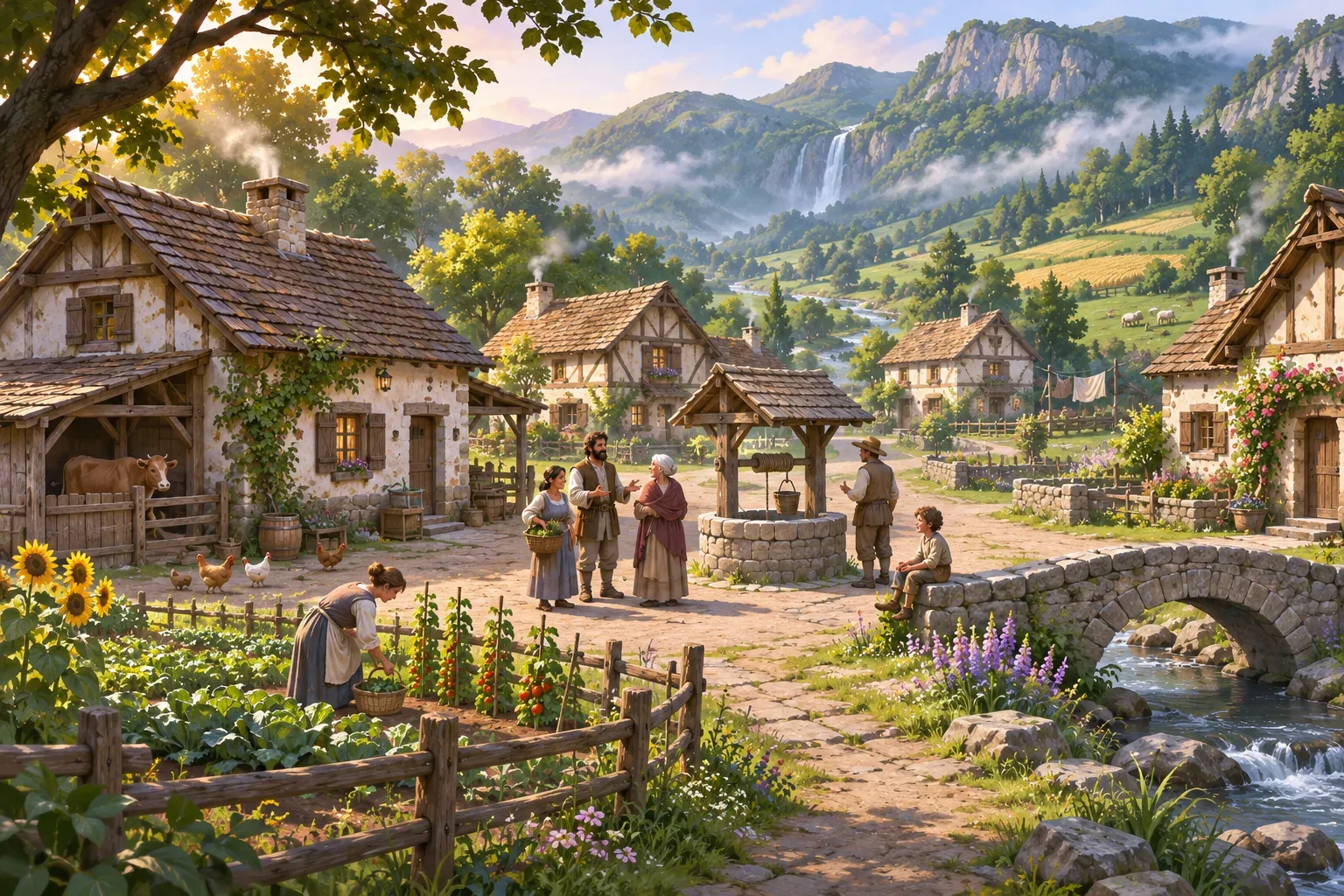
No real game run, browser test or measured result is available for this fictional example. The illustrations are original concept art and are not screenshots.
Frequently asked questions
What should a village-building prompt define?
State resources, building costs, production timing, population capacity, upkeep and the growth goal.
When does the Farm in Common Ground begin producing?
It produces three food at the end of the day it is built and on each later day.
How much food does recruitment cost?
Recruiting one villager costs two food and requires a House with spare capacity.
Were the village prompts tested in a playable game?
No. Common Ground is a fictional settlement example with hand-calculated resource totals.
What happens if food upkeep cannot be paid?
The settlement loses during the end-of-day phase.