Define the Fourfold Door loop
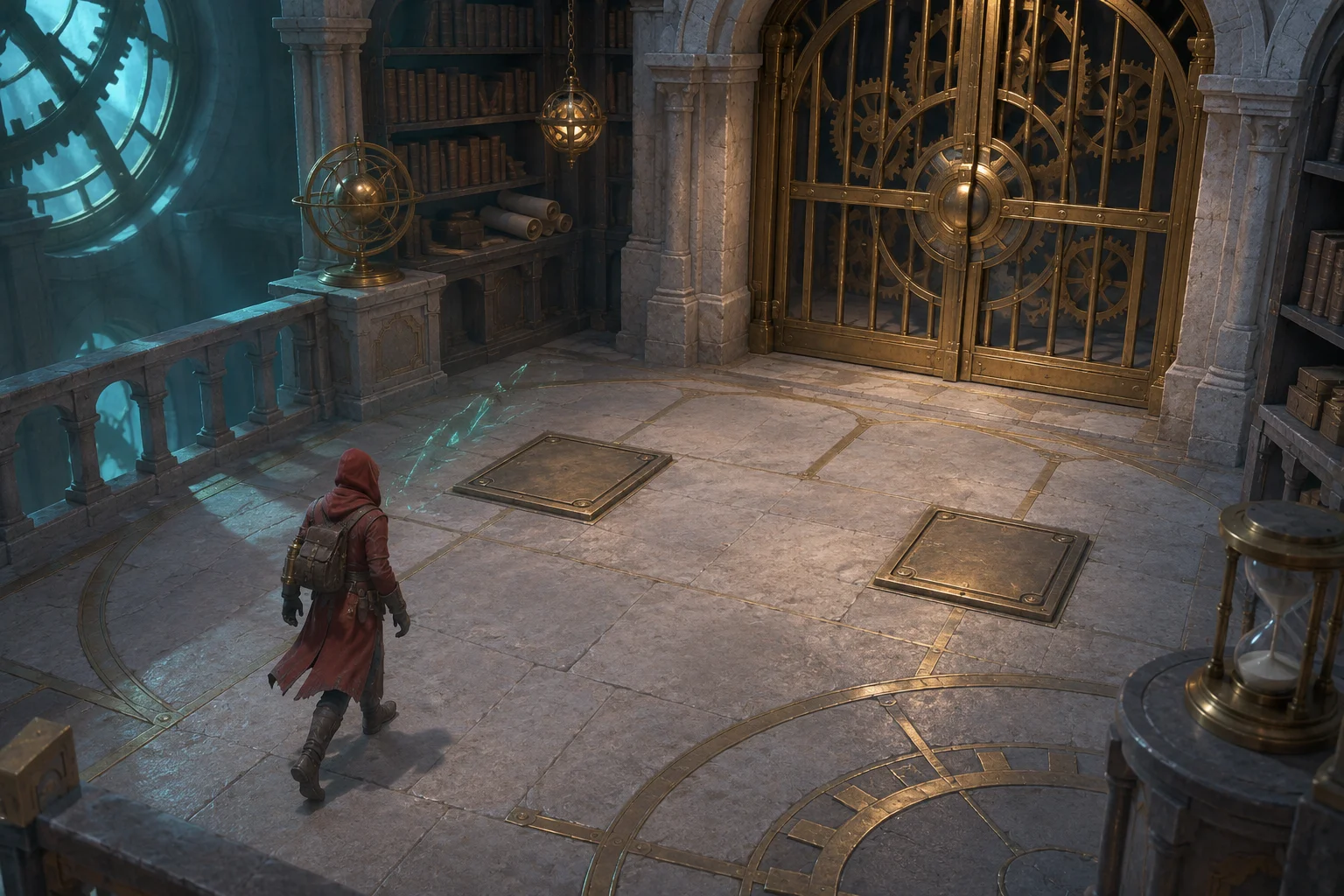
A time-loop puzzle prompt should specify what the player records, when the loop resets and which state the echo carries forward. Fourfold Door is a fictional 6-by-5 grid room with a four-action loop. The player starts at (1,4), a pressure switch sits at (3,4), and a locked door at (3,2).
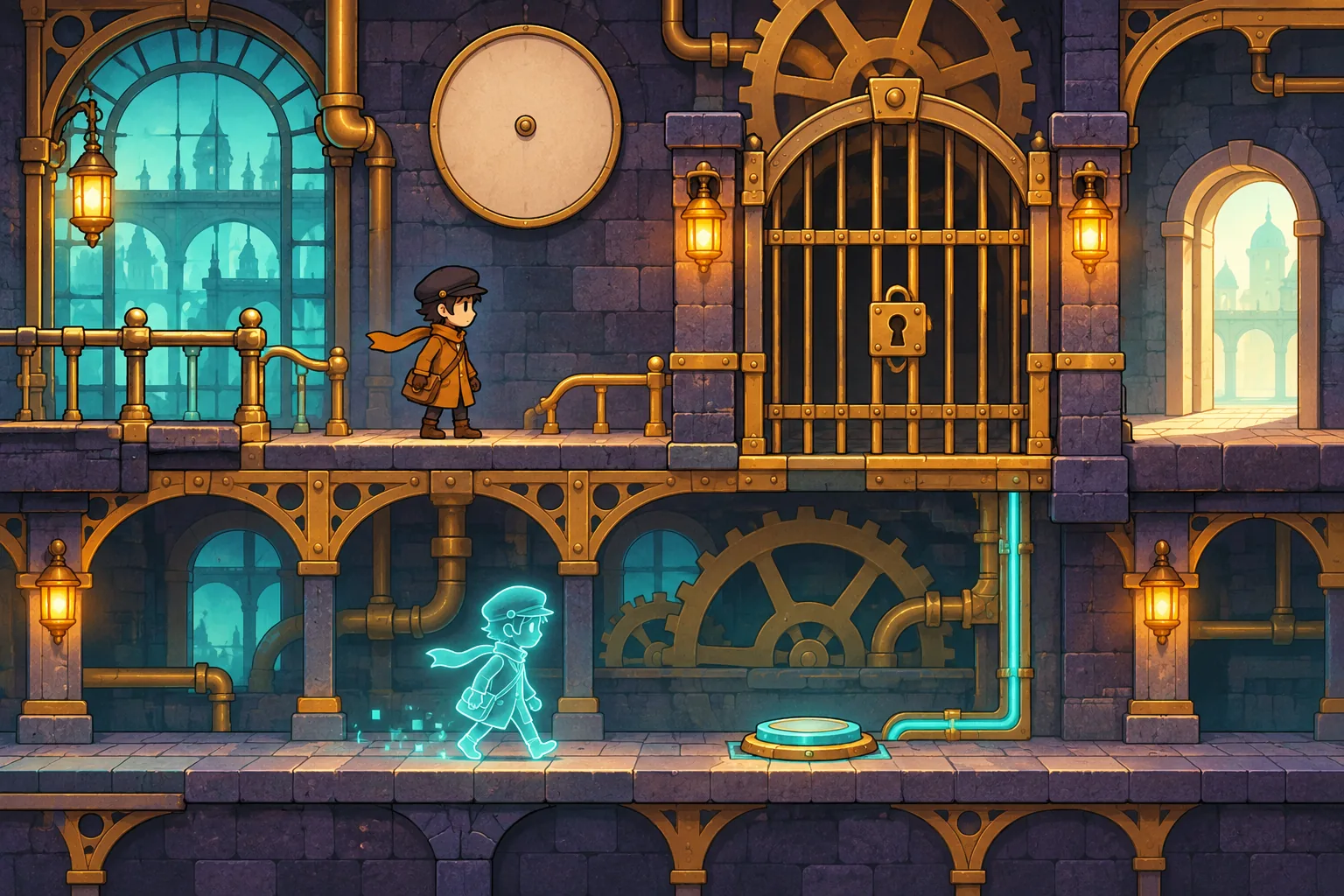
During the first loop, record exactly four commands: Right, Right, Wait, Wait. At the end of the loop the player returns to start and an echo begins replaying those four commands one per tick while the player controls a new four-action sequence.
The switch remains active while either the player or echo occupies it. The door opens during that tick. During loop two, the player moves Up, Up, Right, Right to the door. The echo repeats its first-loop path and stays on the switch from tick two through tick four.
Separate recorded commands from reset state
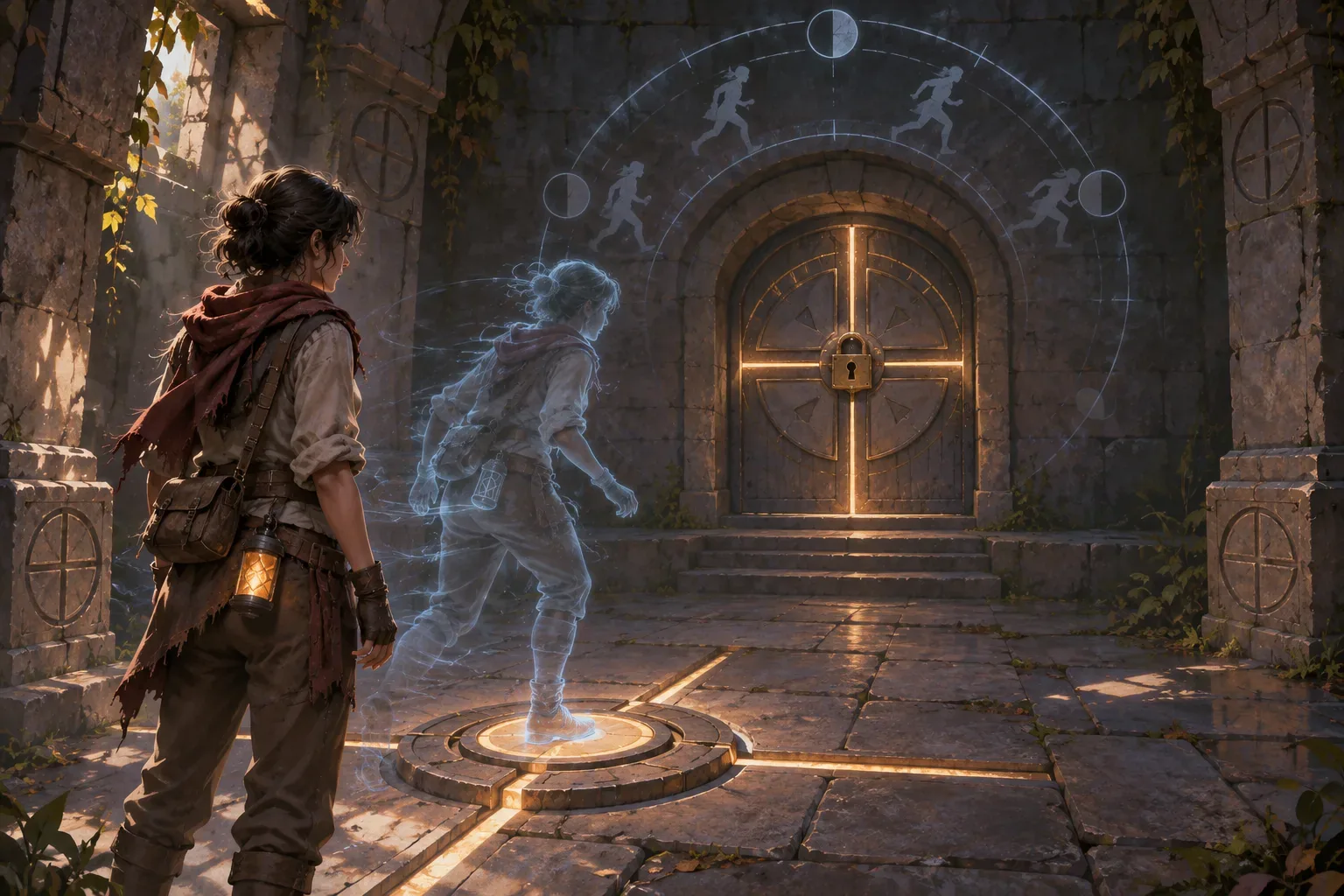
Each tick advances the player and echo once, updates switch occupancy, updates door state, then checks whether the player occupies the open door. At tick four, if no win occurred, the player resets to start for the next loop. The recorded command sequence persists; position, facing and other room state reset.
The echo repeats commands exactly; Wait leaves it on its current tile. It cannot be edited after recording except by Restart and a new first loop. The player wins on tick four before the reset phase if the door is open and they reach it.
This order avoids a timing ambiguity: the echo can hold the switch on the same tick the player reaches the door. The first version contains one room and one echo, without alternate timelines or movable objects.
Trace the example
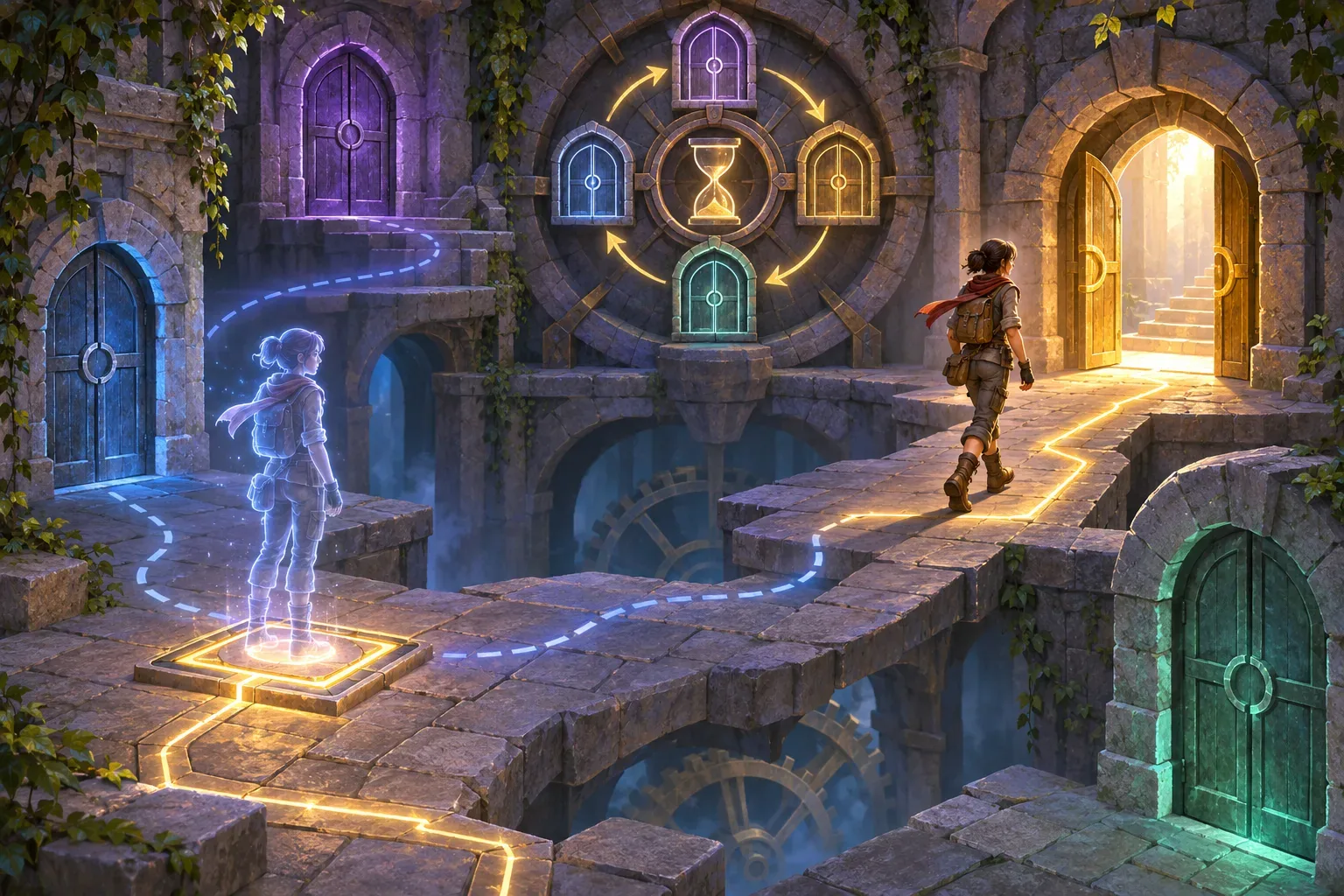
Loop one: tick1 Right moves to (2,4); tick2 Right reaches switch (3,4); ticks3 and4 Wait keep the player there. At loop end the player resets to (1,4) and the echo is created with the four saved commands.
Loop two: tick1 the player moves Up to (1,3), while the echo moves Right to (2,4). Tick2 the player moves Up to (1,2), and the echo moves Right onto the switch at (3,4), opening the door. Tick3 the player moves Right to (2,2), and echo Wait holds the switch. Tick4 the player moves Right onto door (3,2), and the echo Wait keeps it open. The win check occurs before reset.
This is a fictional command trace, not a tested game. A future build should log tick number, player position, echo position, switch occupancy, door state and phase order.

Write the six prompts
Use one prompt per design decision so later checks have a clear source of truth. These drafts describe Fourfold Door; they have not been run and do not represent a generated playable game.
Prompt 1: place room and loop length
Create a 6×5 grid room. Player starts (1,4), pressure switch (3,4), locked door (3,2). Each loop has exactly 4 ticks and one command per tick.Prompt 2: record and spawn echo
First loop records Step or Wait commands. At loop end reset player to start, preserve the command list and spawn an echo that replays one command per tick in the next loop.Prompt 3: set tick phase order
Resolve each tick: move player and echo, update switch occupancy, update door, check player-at-open-door win, then at tick4 reset if no win. Wait keeps a character in place.Prompt 4: define switch and door
The switch is active while player or echo occupies (3,4); the door is open only while switch active. Echo replays the saved sequence exactly and cannot be edited mid-loop.Prompt 5: show the two-loop solution
Use first-loop commands Right,Right,Wait,Wait. On loop two player commands Up,Up,Right,Right. Win when player reaches (3,2) on tick4 before reset.Prompt 6: prepare future checks
For future checks log tick, player/echo positions, recorded command index, switch, door and phase. Check record, reset, exact replay, wait occupancy, door timing, win-before-reset and Restart. Do not claim tests pass without a build.SEELE’s official page describes general plain-English prompting, a playable first version, browser testing and refinement; it does not verify Fourfold Door. See Free AI game maker for workflow context only.
Prepare future build checks
Compare both command streams tick by tick. Verify the echo resets at loop start, Wait preserves switch occupancy, the door updates before the goal check, and the win occurs before the tick-four reset. These are future checks, not passed tests. Record the before and after state so a later build can be compared with the specification.
| Future check | Expected rule | Evidence to capture |
|---|---|---|
| Recording | Store exactly four first-loop commands | Command list and tick index |
| Echo replay | Execute same command on corresponding tick | Player/echo positions |
| Wait | Keep actor on switch tile | Occupancy and door state |
| Phase order | Update door before goal check; win before reset | Tick event log |
| Restart | Clear echo record and restore room | Initial-state snapshot |
No real game run, browser test or measured result is available for this fictional example. The illustrations are original concept art and are not screenshots.
Frequently asked questions
What should a time-loop puzzle prompt define?
Set loop length, recorded inputs, echo timing, reset state, persistent state and when the win check occurs.
Does Fourfold Door keep the recorded commands after reset?
Yes. The command list persists so an echo can replay it in the next loop.
What happens when the echo uses Wait on the switch?
It remains on the tile, keeping the door open during that tick.
Were these time-loop prompts tested in a playable build?
No. Fourfold Door is a fictional example with a hand-traced command sequence, not observed gameplay.
Does tick-four reset happen before the goal check?
No. The open-door goal check happens first; a win prevents the reset.