A voxel-building prompt becomes easier to inspect when it names the cells the player can edit, how resources change, what makes a placed block stable, and what counts as a win. Start with that rules contract, then request only the smallest playable loop, and save a third prompt for diagnosing a mismatch after someone has an observation.
This guide uses Mosslight Span, an invented single-player bridge-to-beacon exercise. The map, rules and V0-to-V1 comparison are original teaching material resolved by hand. The three prompt templates have not been submitted to a game generator; there is no playable build, prompt run, software test, playtest or measured result here.
The practical deliverable is a short sequence: define one editable world, make mining and placement precise, ask for one bounded implementation, and compare any later build with stated checks. That sequence turns “make a voxel sandbox” into a request a reader can actually evaluate.
Define a small editable world
A useful first voxel slice needs a destination, an obstacle, a resource decision and a finish signal. Mosslight Span keeps those pieces in one narrow crossing. The explorer starts on a stable near platform at surface cell (0,1), with two stone blocks. Across a three-cell ravine are empty cells x=1, x=2 and x=3; a far platform and dark beacon occupy x=4. The only objective is to reach that beacon.
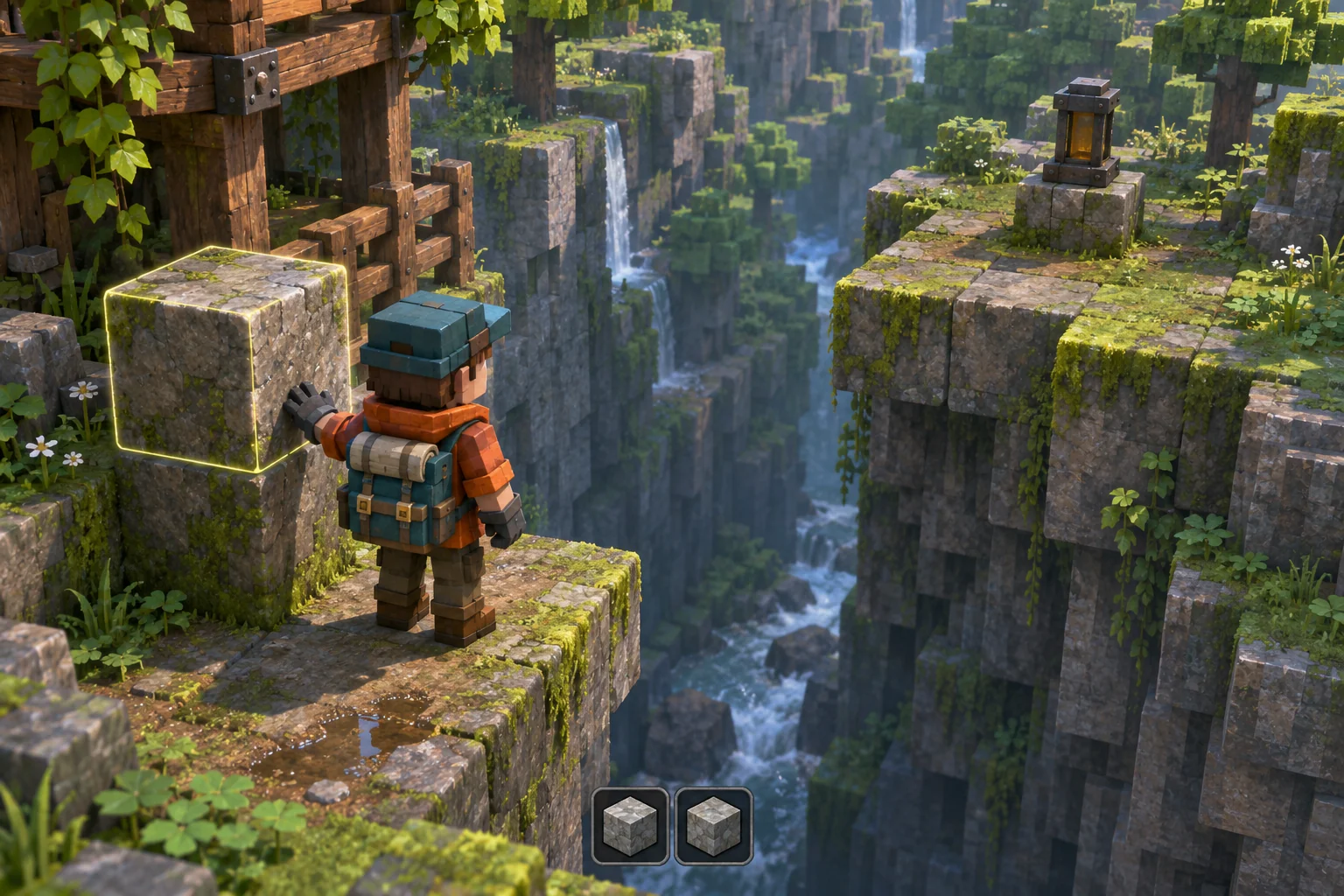
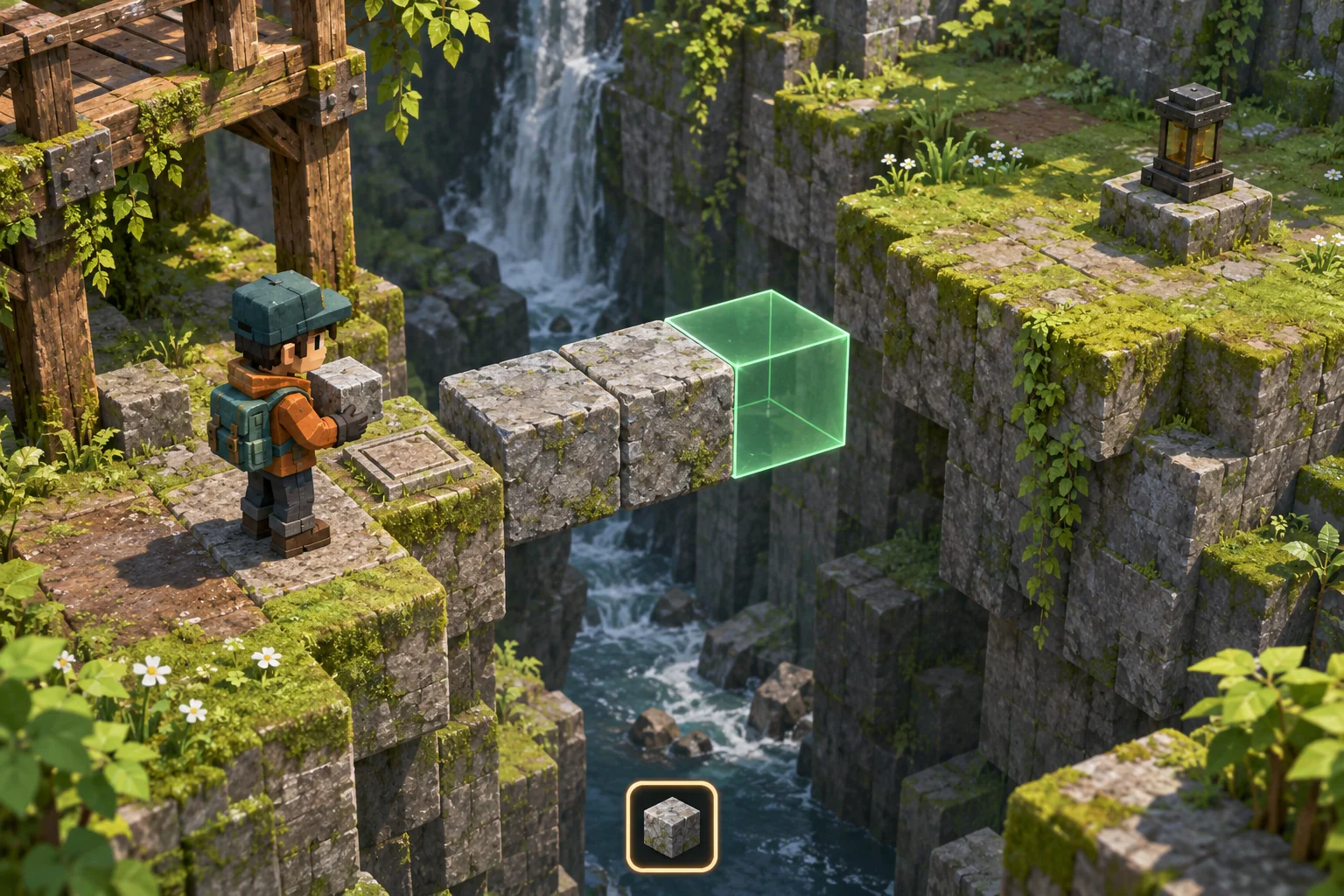
The opening view establishes a design choice rather than a successful result. Two blocks cannot fill three empty cells, so the reader needs to decide whether to revise the resource budget or make a different route. The example chooses one exposed reserve cube on a stable side pad at (0,0,y=1), above a permanent base cube. Its side face is one grid face from the start tile at interaction height. From the start, one Mine action collects it without moving; the explorer stays at (0,1), and inventory rises from two to three.
Keep the rest of the slice closed. Only the three ravine cells can receive placed blocks. A block must share a face with the near platform or the already supported bridge chain. The permanent platforms and placed bridge blocks cannot be mined. There are no enemies, crafting recipes, other resources, timers, random events or alternate paths. Invalid mining, placement or movement leaves the state unchanged. Restart restores the selected version’s exact starting state.
These limits make the prompt more useful because each requested action can be tied to a visible state. A “voxel world” by itself leaves the map, interaction range, build boundary and objective open to interpretation. Here, the five surface cells and one side reserve tell the builder what must exist before decoration is considered.
Write mining, placement and support rules
Words such as mine, place and walk need an exact state change. In this paper example, mining is a single action against only the exposed side reserve. The action does not move the player or require a separate approach step. Placement uses a build cursor over the three-cell crossing zone, so it also consumes one action without walking toward the target. Movement then advances exactly one orthogonal cell onto a supported surface.
| Action | Valid target and cost | State change to check |
|---|---|---|
| Mine reserve | From (0,1), target only the exposed cube at (0,0,y=1), face-adjacent at interaction height; cost one action. | Reserve disappears, inventory increases by one, and the explorer remains at (0,1). |
| Place bridge block | Target one empty crossing cell x=1, 2 or 3 at z=1; it must connect by a face to the near platform or supported chain. | Inventory drops by one and the contiguous supported row extends by one cell. |
| Move | Move exactly one orthogonal cell onto a supported surface. | Player position changes; entering (4,1) after the route exists lights the beacon and wins. |
The order matters. If the game lets the player place into unsupported air, the resource puzzle disappears. If mining can happen from any distance, the reserve’s location no longer matters. If placing advances the explorer, the action budget changes. Spell out these details before asking for a playable implementation, and say that rejected actions do not silently spend resources or move the player.
In the mechanism view below, the reserve has already been collected from the start without movement, then x=1 and x=2 have been placed. The explorer is still at the near platform, one stone cube remains, x=3 is a valid translucent preview, and the beacon stays dark. That is a concrete mid-loop state a future build can be checked against.
Draft three prompts in order
Do not ask one prompt to invent the rules, build the world and assess its own success all at once. Give each request a clear input and output. The first prompt closes the contract, the second asks for one small implementation, and the third waits for an actual observation before proposing a repair.
Prompt 1: lock the rules before implementation
Design a tiny single-player voxel-building loop named {game_name}. Use surface coordinates {grid_and_start}, one goal {goal}, and a starting inventory {inventory}. Define which blocks are editable, exactly how mining range works, how mining changes inventory, what makes placement valid, how support propagates, which moves are legal, and the exact win and restart states. For the supplied map, collect the exposed face-adjacent reserve from the start tile with one Mine action and no movement; return its coordinates and action cost. Return (1) a coordinate table, (2) an action/state table, (3) edge cases for empty inventory and unsupported cells, and (4) five acceptance checks. Do not add unrequested mechanics. Flag contradictions before proposing implementation.For Mosslight Span, fill the inputs with the five-cell crossing, the dark beacon at x=4, and two starting blocks. Require the reserve to be at (0,0,y=1), adjacent to start (0,1) at interaction height, and require one Mine action without movement. Ask the model to restate inventory after each action. If its contract adds a return trip, remote mining or another source, correct the rules before using the next prompt.
Prompt 2: request only the minimal loop
Implement only this approved voxel rules contract as one compact playable loop: {approved_contract}. Preserve every coordinate, inventory count and action cost, including one Mine action from the start tile to collect the face-adjacent reserve without moving. Include visible, text-free feedback for valid and invalid placement, inventory change, supported movement, beacon win and restart. Keep blocks editable only where the contract allows. Do not add enemies, crafting, extra resources, random events, multiplayer, a second objective or a larger world. Return controls, a short implementation summary and a checklist of observable evidence for each acceptance check. Mark anything not built or not observed as unverified.The restriction to one loop is a design choice, not a promise about what a generator will return. A future creator can add scenery after the resource and support rules are visible. Ask for an implementation summary and a verification checklist, but do not treat the request itself as evidence that the checks passed.
Prompt 3: repair only after an observation
Approved expected state: {expected_state}. Actual observation supplied by a person: {observed_state_or_blank}. Compare only the supplied observation with the expected rules. If the observation is blank, return a human checklist and do not diagnose a result. If it is present, identify the first mismatch, the rule it concerns, and the smallest one-variable change that could address it. State which acceptance check should be repeated and which earlier checks should remain unchanged. Do not claim that a repair worked until a new observation is supplied.This third prompt deliberately refuses to invent an outcome. If a later build stops after two blocks, a useful observation would include the starting inventory, the reserve target, the explorer’s position before mining, the reserve state after the action, and the placement rejection. With those facts, a reviewer can distinguish an access-range issue from a resource-count or support issue. Without them, the next step is to capture the state, not to declare a fix.
Hand-check the bridge resource loop
The fictional comparison changes one variable: V1 adds the exposed reserve cube; V0 has no reserve. Everything else, including the start inventory and route, remains the same. The table makes the shortage visible without claiming that an engine or model produced it.
| Version and action | Bridge cells filled | Inventory | Manual result |
|---|---|---|---|
| V0 start | 0 | 2 | No reserve cube exists. |
| V0 Place x=1, then x=2 | 2 | 0 | Both blocks are supported, but x=3 is still empty. |
| V0 attempt Place x=3 | 2 | 0 | Rejected because inventory is empty; the far platform remains unreachable. |
| V1 Mine from start; do not move | 0 | 3 | The face-adjacent reserve disappears; inventory changes from 2 to 3. |
| V1 Place x=1, x=2, then x=3 | 3 | 0 | Each block connects to the near platform or the supported chain. |
| V1 Move x=0→1→2→3→4 | 3 | 0 | Four supported moves reach the far platform; entering x=4 lights the beacon. |
Count the full V1 route as one Mine + three Place + four Move = eight actions. The final state has a contiguous three-cell bridge, an empty inventory, the explorer on the far platform and the beacon lit. This is the expected result calculated from the authored rules, not a measured result. The V0 trace shows why the one-cube change matters: without it, the third placement cannot be paid for.
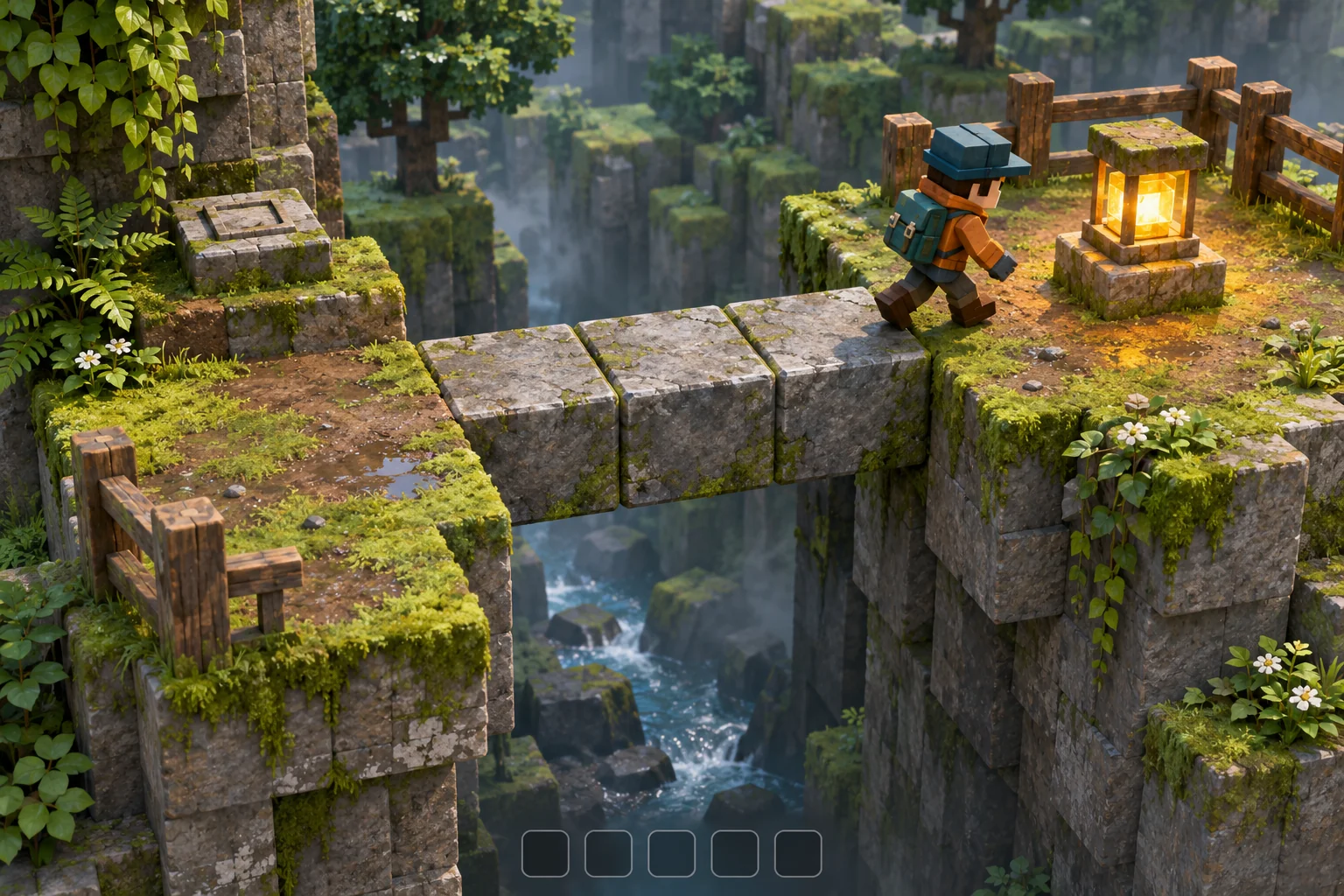
When you later build a version, check the event order as well as the ending. The reserve is collected before placement; all three placements happen before movement across the bridge; the beacon lights only when the explorer enters x=4. If a visual reward appears earlier, compare its trigger with the contract instead of assuming the image or the code defines a different rule.
Compare a future build with real observations
A useful acceptance list names a starting state, one action and the expected change. For this map, first check that one Mine from (0,1) collects only the exposed reserve at (0,0,y=1), does not move the explorer, and raises inventory from two to three. Then verify that a nonadjacent or covered block cannot be mined, Place x=1 through x=3 consumes exactly three blocks in sequence, and V0’s third placement is rejected at zero inventory.
Next, test support and movement separately. Each new bridge block must join the near platform or the prior supported block; an unsupported target must be rejected without changing inventory. The explorer should move one orthogonal cell per action and only onto a supported surface. Four moves can reach x=4 after the bridge is complete, where the beacon lights. Restart should restore the chosen version’s reserve, inventory, player position and dark beacon.
Record what you actually see: the version, action, pre-state, input, resulting position, inventory, target-cell state, and any win feedback. If a check is not run, mark it unverified. A written acceptance test is a plan for later evidence, not proof that the behavior already exists.
Take the voxel brief to a Workspace
Once the rules are bounded, a creator can hand the short contract to a game-making workflow. The current official Free AI Game Maker page lists a Voxel Sandbox Builder starter card for placing and breaking blocks to build an island world. That is broad starter-card copy; it does not confirm Mosslight Span, this bridge rule set, the support behavior or any result from these prompts.
The official Free AI Game Maker page describes a general flow: describe a game in plain English, review a playable 2D or 3D first result in the browser, then refine it with follow-up prompts. It also says to review the selected model, available Koin balance, and displayed generation cost before submitting. Carry the bounded rules, inspect whatever result is actually produced, and compare it with the checks above. Do not assume a voxel-specific implementation or a successful crossing before you observe one.
If you want to start outlining that idea, use the Free AI game maker. Keep the first request small, inspect the generated result before iterating, and verify the displayed cost before continuing. This is a general product handoff, not a claim that the Mosslight Span prompts or map have been run.
FAQ
What should an AI prompt for a voxel-building game include?
State the editable area, player start, available blocks, exact mining range, placement rules, support requirements, movement, objective, and restart behavior. Then request a small table of state changes and acceptance checks. Those details make a future output easier to inspect than a broad request for an open-ended voxel sandbox, while leaving the visual theme flexible.
Why define mining range before writing a build prompt?
Range changes the action budget. In Mosslight Span, the exposed reserve cube is face-adjacent to the start tile and costs one Mine action without movement. If a prompt leaves range open, an implementation might require a separate approach or permit remote mining, changing the route and the number of actions. Treat the exact range here as a fictional rule to test later.
How does the example get enough blocks to cross?
V0 starts with two blocks and needs three, so the third placement is rejected at inventory zero. V1 adds one exposed reserve cube that can be collected from the start tile in one action without moving. Three blocks then fill the crossing, and four supported moves reach the beacon. The eight-action count is hand-calculated, not a build result.
Were the Mosslight Span prompts run or the game tested?
No. Mosslight Span and its rules are an original fictional exercise, and the prompt templates were written for this article but not entered into a game generator. The tables are manual calculations. There is no playable build, prompt execution, software test, playtest, measured result or online case to report.
What should I do if a future build disagrees with the trace?
Capture the first state that differs, including the version, player position, inventory, target cell, action, and resulting feedback. Compare that observation with the corresponding acceptance check, then change one rule or implementation detail and repeat the same sequence. If no observation exists, use a checklist to gather one instead of writing a guessed result.