Define the Tide Ledger expedition
An exploration trading prompt has to define where a route leads, what exploration costs and how market values change between ports. Without those values, a trade result is impossible to reproduce. Tide Ledger is a fictional short expedition with a known map and stable prices so a reader can follow each resource change.
The route is Port A → Reef → Port B → Port A. The player starts with 8 coins and 5 fuel, an empty hold of three cargo slots, and a six-leg expedition limit. Each leg consumes one fuel. Exploring the Reef consumes one extra fuel and reveals one Pearl. If fuel falls to zero before return, the voyage fails.
At Port A, Glass costs 2 coins per unit and up to three units are in stock. At Port B, Glass sells for 3 coins and Pearl for 6. The player may buy or sell up to the hold capacity on a single visit. This is a fixed economy, not a claim about a tested trading system.

Specify route, market and cargo rules
Keep the route and market rules visible in the prompt. Buy and sell transactions change coins and cargo by the same quantity: purchasing one item subtracts its price and adds one cargo; selling one item adds its price and frees one cargo slot. No transaction may exceed the hold or a port's stock.
Exploration reveals the known Pearl at the Reef once per run. The player cannot repeat the same discovery for extra items. Travel consumes fuel before arrival, and the Reef exploration cost is paid only when the Explore action succeeds. Port A is the only valid finish point for the return goal.
These restrictions make a small economy understandable. They also give the future build checks specific values: starting resources, per-leg fuel, cargo count, sale prices, and return threshold. Avoid adding random market shifts until this fixed route is consistent.
Trace the example
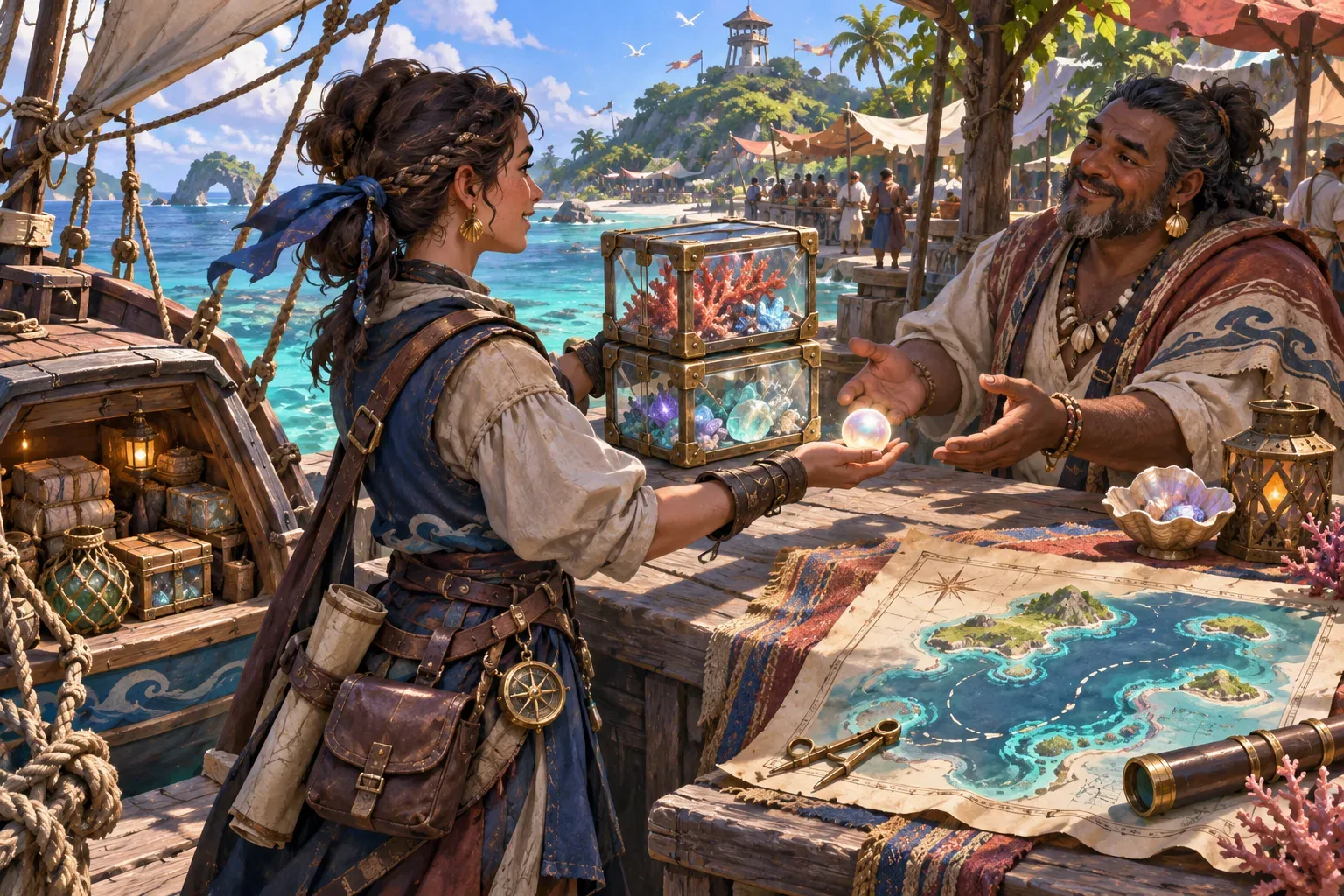
A valid fictional route begins by buying two Glass at Port A. Coins fall from 8 to 4, cargo becomes 2/3, and fuel stays at 5. The ship travels to the Reef, spending one fuel (4 remain), then explores and spends one more fuel (3 remain) to receive one Pearl. Cargo is now full at 3/3.
The next leg reaches Port B and spends one fuel (2 remain). Selling both Glass adds 6 coins, bringing the balance to 10; selling the Pearl adds 6 more, bringing it to 16. The hold is empty. Returning to Port A costs one fuel and leaves 1 fuel, so the expedition returns with 16 coins and satisfies the 14-coin goal.
This is hand-calculated design arithmetic, not observed gameplay. It demonstrates that the route can meet the goal with the stated costs. It does not establish whether the route is fun, whether the interface is clear, or whether a generated build implements the rules.

Write the six prompts
Use one prompt per design decision so later checks have a clear source of truth. These drafts describe Tide Ledger; they have not been run and do not represent a generated playable game.
Prompt 1: set the route and starting resources
Create a fixed three-stop route: Port A, Reef, Port B, then return to A. Start with 8 coins, 5 fuel, empty cargo capacity 3, and a 6-leg limit. Show current location and resources.Prompt 2: define fixed market prices
At Port A sell Glass at 2 coins each, stock 3. At Port B buy Glass at 3 and Pearl at 6. Buying subtracts coins and adds cargo; selling adds coins and frees cargo. Reject trades beyond stock, money or capacity.Prompt 3: make exploration a bounded resource action
Travel to the next known route stop costs 1 fuel before arrival. Exploring the Reef costs 1 additional fuel and reveals exactly one Pearl per run. Do not allow repeated farming of the same discovery.Prompt 4: track trading state
Track fuel, coins, cargo by item and route position. Fuel cannot be negative. If it reaches zero before return to Port A, fail. Keep market prices fixed for the full run.Prompt 5: set the return objective
Win by returning to Port A with at least 14 coins and at least 1 fuel before the six-leg limit. Restart resets 8 coins, 5 fuel, empty cargo, map and discovery state.Prompt 6: plan future checks
For a future build, log each buy/sell/travel/explore event, before/after resources, cargo slots and route node. Check capacity, stock, exact prices, travel cost, one-time Pearl, return goal and Restart. Do not mark checks passed until inspecting a build.SEELE’s official page describes general plain-English prompting, a playable first version, browser testing and refinement; it does not verify Tide Ledger. See Free AI game maker for workflow context only.
Prepare future build checks
Record coins, fuel, cargo slots and route position around every transaction and leg. Verify the successful trade trace and also test a failed purchase, full hold, repeat exploration, zero-fuel return and six-leg timeout. These are future checks, not passed tests. Record the before and after state so a later build can be compared with the specification.
| Future check | Expected rule | Evidence to capture |
|---|---|---|
| Purchase arithmetic | Two Glass cost 4 coins and occupy two slots | Balance, item count, hold capacity |
| Exploration | Reef costs one fuel and yields one Pearl once | Fuel and discovery flag |
| Sale values | Glass adds 3 each; Pearl adds 6 | Before/after coins and cargo |
| Travel | Each leg consumes one fuel | Route node and fuel |
| Goal and restart | Return with 14 coins and fuel; reset to start | Outcome and full state snapshot |
No real game run, browser test or measured result is available for this fictional example. The illustrations are original concept art and are not screenshots.
Frequently asked questions
What should an exploration trading game prompt specify?
Define the route, exploration costs, cargo capacity, prices, travel fuel, win condition and reset behavior.
How much cargo fits in Tide Ledger?
The fictional hold has three slots, with each Glass or Pearl taking one slot.
Does the Reef discovery repeat?
No. Exploring the Reef costs one fuel and reveals one Pearl once per run.
Were the prompts run in a playable build?
No. Tide Ledger is a fictional example and its trade trace is arithmetic, not observed gameplay.
What proves the sample route meets its target?
Two Glass and one Pearl produce 16 coins on sale; after paying four fuel total, the ship returns with one fuel and exceeds the 14-coin threshold.