Define the Switchyard Isles network
A transport network prompt should define stations as nodes and track as edges. Switchyard Isles is a fictional 5-by-5 rail puzzle with three stations: A at (1,3), B at (2,3), and C at (3,3). Two passengers wait at A, and the player starts with six coins and no track.
The player lays one track edge between adjacent grid cells per build action. Each edge costs two coins and cannot be duplicated. A train can travel one connected edge per turn and carries both passengers. The route A→B→C requires two track edges and costs four coins, leaving two.
The goal is to deliver both passengers to C within eight turns. Track segments connect only when their endpoints match. A train cannot move across a missing edge, jump between nearby but disconnected cells, or exceed the route graph. The example has no switches, schedules or multiple trains.

Represent tracks as connected edges
Build and travel each consume one turn. The player may lay a track edge or move the train one connected edge. Passengers remain aboard until the train reaches C; both are delivered together. If the turn limit ends first, the run fails. Restart removes all built edges, returns coins and passengers and places the train at A.
The network is a graph rather than a painted line. A visible edge record should show its two endpoint coordinates and cost. This makes it possible to distinguish a continuous A-B-C route from two disconnected segments that only look adjacent.
Keep the first prototype small enough to audit. Later prompts can add branching routes, station upgrades or transfer rules after the core build-and-deliver loop works.
Trace the example
Lay A-B for two coins: balance 4. Lay B-C for two more: balance 2. The graph now contains both required edges. Move the train from A to B on one turn, then B to C on the next. Both passengers arrive together on turn four, within the eight-turn limit.
If the player instead tries to move from A directly to C, no single edge exists and the move is rejected without changing train position. A missing B-C edge also prevents leaving B for C. These rules make route connectivity a visible condition rather than an implied drawing.
This is fictional network arithmetic, not a test of a transport game. A future build should log each edge, coin cost, train node, passenger count and turn.

Write the six prompts
Use one prompt per design decision so later checks have a clear source of truth. These drafts describe Switchyard Isles; they have not been run and do not represent a generated playable game.
Prompt 1: place stations and starting state
Create a 5×5 station grid with A(1,3), B(2,3), C(3,3). Start with 6 coins, 2 passengers at A, train at A, and no tracks. Set an 8-turn limit.Prompt 2: define edge building
Lay one edge between adjacent grid cells for 2 coins per edge. Reject duplicate edges or unaffordable builds without changing state. Store endpoints explicitly.Prompt 3: connect train movement
Train moves one connected edge per turn. It cannot cross a missing edge or jump between nearby cells. It carries both passengers together.Prompt 4: set passenger delivery
Passengers remain aboard until train reaches C, then both are delivered. Win when both arrive by turn8; otherwise fail. No transfers or extra trains.Prompt 5: resolve turn and reset
Resolve each build or move as one turn. Restart removes edges, restores six coins, passengers and train position.Prompt 6: prepare future checks
For future checks log edge endpoints, cost, graph path, train node, passengers and turn. Check A-B-C, missing-edge rejection, duplicate edge, affordability, delivery and Restart. Do not claim unobserved tests pass.SEELE’s official page describes general plain-English prompting, a playable first version, browser testing and refinement; it does not verify Switchyard Isles. See Free AI game maker for workflow context only.
Prepare future build checks
Inspect the graph after each build and compare train movement with its connected edges. Test the two-edge route, an attempted missing-edge move, duplicate construction, the coin balance and delivery timing. These are future checks, not passed tests. Record the before and after state so a later build can be compared with the specification.
| Future check | Expected rule | Evidence to capture |
|---|---|---|
| Track cost | Each adjacent edge costs two coins | Balance and endpoints |
| Connectivity | Move only across an existing edge | Graph and current node |
| Missing route | Reject move without state change | Train node and turn |
| Passenger delivery | Both arrive together at C | Cargo and destination |
| Win/reset | Deliver by turn8; reset clears edges | Outcome and snapshot |
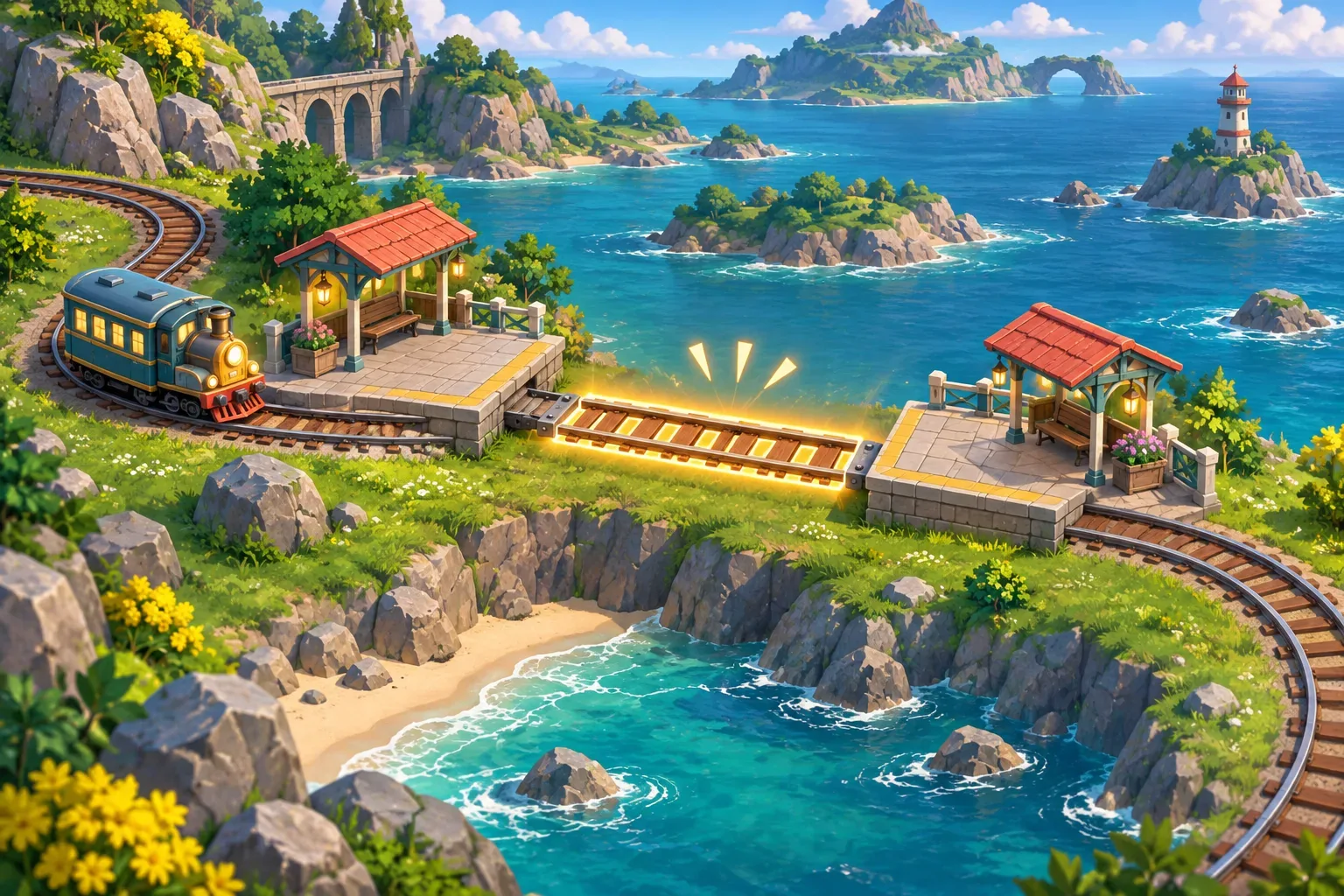
No real game run, browser test or measured result is available for this fictional example. The illustrations are original concept art and are not screenshots.
Frequently asked questions
What should a transport network prompt specify?
Define stations, track edges, build cost, connectivity, vehicle movement, cargo and the delivery goal.
How much does the sample route cost?
A-B and B-C each cost two coins, so the route costs four of the six starting coins.
Can the train jump from A to C?
No. It can move only along one built connected edge per turn.
Were these network prompts tested in a playable build?
No. Switchyard Isles is a fictional network example with hand-calculated costs, not observed gameplay.
How many passengers can the train carry?
It carries the two passengers together in this single-route prototype.