Choose a swing the player can read
A grappling hook becomes a satisfying movement tool when a player can see a reachable anchor, predict the swing, and choose a landing before committing. Start with one short route: spot an anchor, latch, build a clean arc, release, land, and move toward the next target. Leave combat, upgrades, and sprawling levels for later.
This guide turns that loop into a small design contract, a prompt you can adapt, and a checklist for the first build. The sample route and its one proposed revision are fictional design exercises, not a report of a real playtest or a game generated by SEELE.
Define the route before the rope
Plan the player's path before describing cable physics. A first room only needs a starting ledge, one reachable anchor, open swing space, a landing deck, and a second anchor that signals where to go next. If the player can see the next objective while moving through the current one, the route teaches itself.
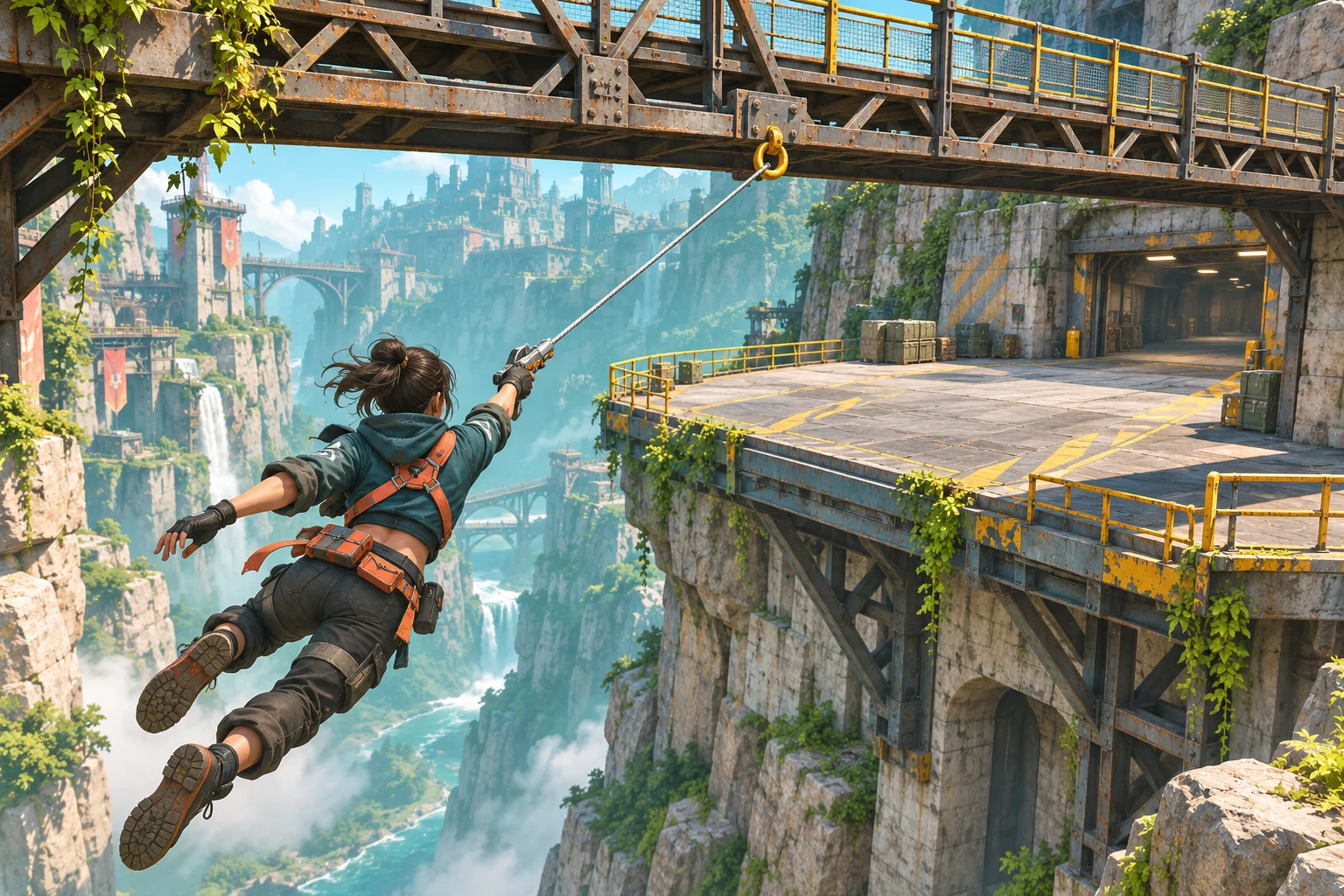
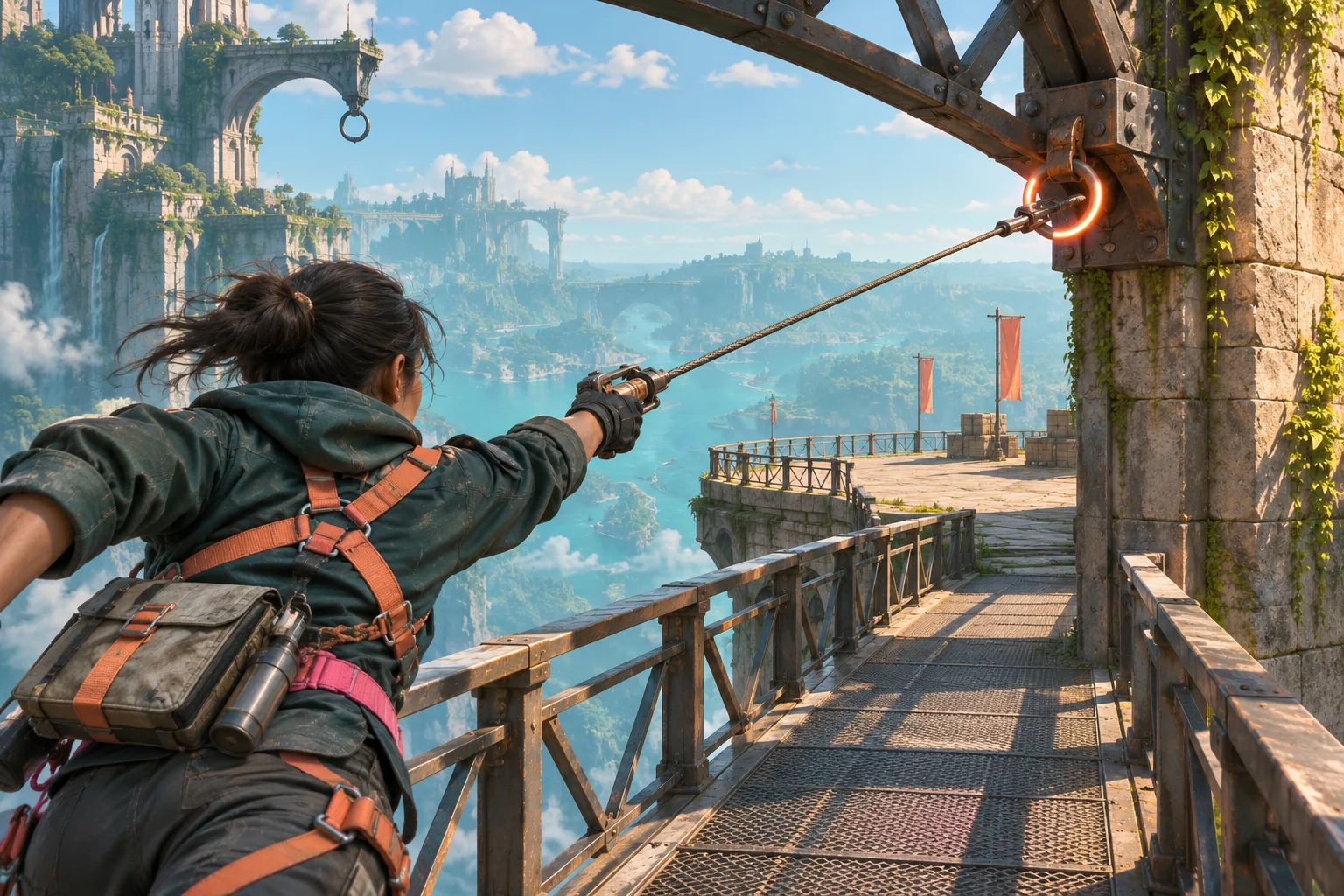
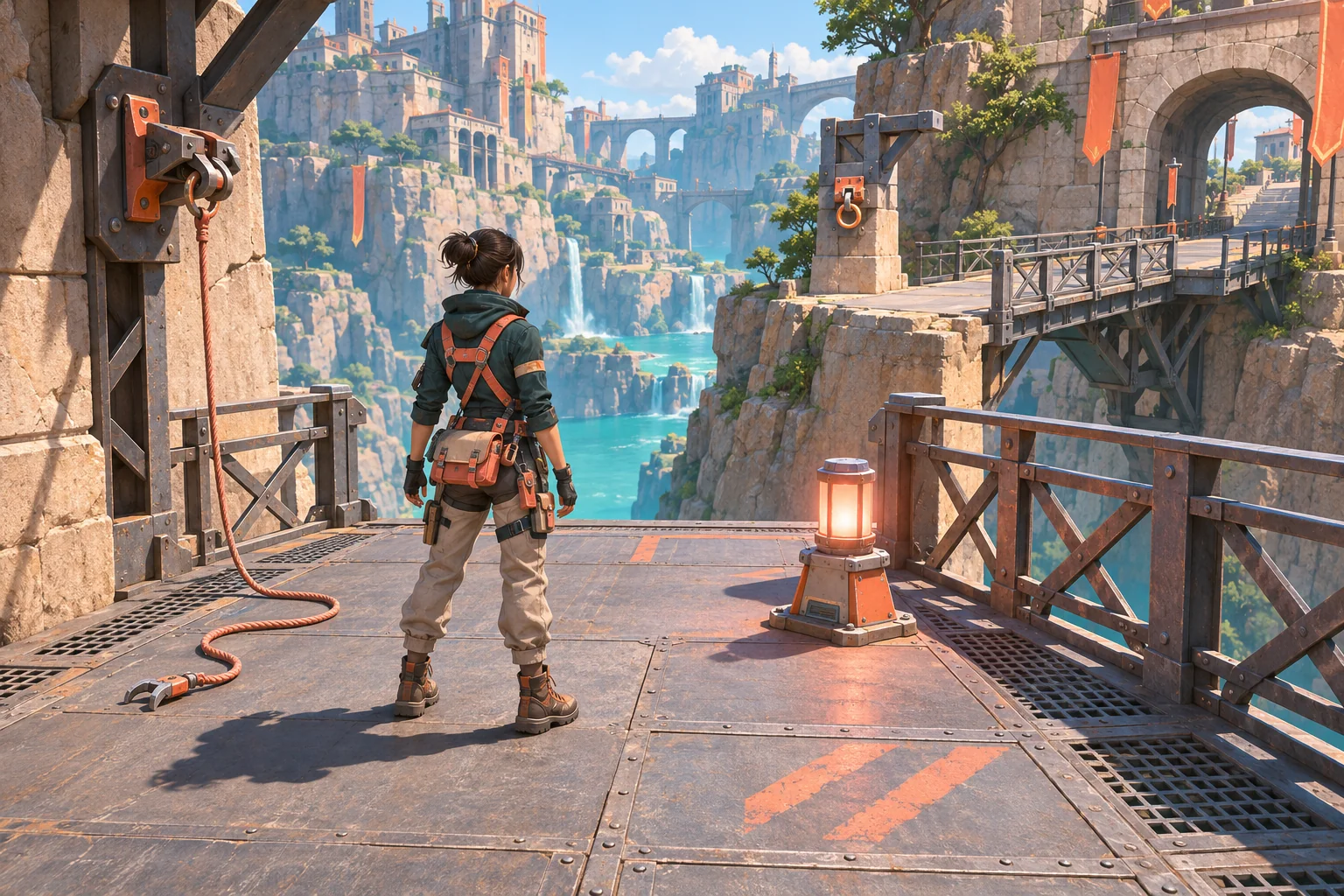
For a simple 3D vertical slice, imagine a courier crossing a bright canyon on three skybridges. The first ring hangs above a gap; the second sits beyond the landing deck. The player has one grapple action, one jump, and an air-steering input. A small checkpoint lamp turns on after the first landing. This layout gives you a complete repeatable loop without asking the player to learn combat or a new resource system at the same time.
| Route beat | Player question | Visible answer |
|---|---|---|
| Approach | Can I reach that anchor? | Only eligible rings receive a distinct rim when they are in range and in view. |
| Latch and swing | Did the hook connect, and where will it carry me? | A taut line and body motion show the connection; open space leaves the arc readable. |
| Release | When should I let go? | The landing deck stays in frame, with enough room to correct the approach. |
| Land and continue | Did I make it, and what comes next? | Stable foot contact and a lit checkpoint mark the result; another ring points forward. |
Use the table as a level-blocking tool, not a promise that every grappling game needs the same controls. Your setting can change, but each beat should answer one player question. If the destination disappears behind scenery during the swing, move the camera, the anchor, or the landing. Adding another mechanic will not fix a route the player cannot read.
Write the smallest useful prototype prompt
Give an AI game maker a bounded action, route, and review target. Avoid asking for a huge level with a perfect rope system, enemy combat, collectibles, and a boss in one request. The prompt below is a starting specification. Its keyboard and mouse choices are examples, not verified SEELE input conventions.
Make a small third-person 3D grappling-hook traversal prototype in one bright canyon room.
The courier can run, jump, steer in the air, and use one grapple action.
Start at a ledge. Place three clearly visible ring anchors along the route: one over the first gap,
one beyond the broad landing deck, and one across a second gap to a lit exit checkpoint.
Allow attachment only to an eligible anchor that is in view and within the stated range.
Use a single press to latch and a second press to release.
While attached, keep the cable visibly connected and preserve a readable swing arc.
After release, carry momentum forward but allow limited air steering.
Make it possible to miss a ring without losing the run; let the player land safely
or restart the same short course quickly.
Show attachment, release, landing, and checkpoint feedback with simple in-world effects.
Do not add enemies, upgrades, currencies, or multiple grapple types.
Return a playable starting point and identify the controls and remaining work.
I will inspect target readability, cable attachment, release timing, landing control,
and whether the checkpoint changes state after arrival.
The prompt says what the player does, what counts as a valid target, what the route contains, what feedback matters, and what should stay out. That gives you several observable checks. If a generated pass uses a different control mapping, update the prompt and test the actual controls instead of assuming the example input exists.
For the first version, treat a grapple as a short state sequence: eligible, attached, swinging, released, landed. Keep the decision rules separate. A ring should not attach if it is out of range; the line should stop reading as attached after release; landing should end the swing state. These boundaries help you find the source of a failure without changing every part of the mechanic at once.
Check attachment, swing, and landing as separate states
Review each state in the same route. First ask whether the player can identify a valid ring. Next confirm that the line connects to the ring only after the grapple action, and that the player's movement follows a visible arc. After release, check that forward momentum remains understandable. At landing, confirm that the character touches a walkable surface and the next objective is still visible.
| State | Inspect | If it is unclear |
|---|---|---|
| Eligible target | Can the player distinguish a reachable ring from distant scenery? | Reduce competing rings or make eligibility feedback more selective. |
| Attached | Does the line meet the ring and remain visible while the player moves? | Check attachment points, occlusion, and the transition after input. |
| Swinging | Can the player anticipate the arc and see the landing? | Open the route, widen the gap's margins, or adjust the camera follow. |
| Released | Does the character keep enough forward motion to reach the deck? | Change one release or steering rule, then replay the same route. |
| Landed | Do feet meet the deck, and does the checkpoint respond? | Check the collision surface and make arrival feedback distinct. |
Keep the first test short enough to repeat. A useful pass is: start at the same ledge, aim at the first ring, latch, release over the center of the deck, and move to the checkpoint. If it fails, describe the visible symptom. “The player cannot reach the deck after releasing from the second ring” is more useful than “make the movement feel better.”
Simulated iteration: clarify the next anchor
The following is a paper design walkthrough, not a real test, generated result, or measured improvement. Suppose the planned first pass shows several rings with equal brightness, including one beyond the intended route. The player may not know which ring is currently eligible.
A focused revision request would change only target feedback: “Keep the route and swing rules unchanged. Give the next reachable ring a restrained coral rim when it is within grapple range and visible. Keep out-of-range rings unlit. After attachment, show the cable connected to that ring; after release, remove the rim until a target becomes eligible again.”
Review the proposed change against observable checks: before jumping, can you identify the intended ring? Does the rim appear only when the ring is reachable? Does it disappear after release or when blocked from view? Can you still see the landing deck? If one condition fails, revise that condition alone. The point is to isolate one readability decision rather than claim that an unbuilt game improved.
Use an AI game maker for a focused first pass
The official SEELE AI Game Maker page describes entering a game idea in plain English, testing a playable first version in a browser, and refining it with follow-up prompts. Before submitting, it tells creators to review the selected AI model, available Koin balance, and displayed generation cost. Those general product details do not establish that a grappling-hook mechanic will work in a particular result.
Bring a small brief, inspect the actual build, and test the route you asked for. Confirm target selection, cable attachment, the release transition, landing, restart, and checkpoint state. If the output differs from the prompt, record the difference and request a narrow change. When you are ready to shape your own traversal idea, use the Free AI game maker to describe the route and feedback you want to inspect.
Start with one clean crossing
A useful grappling-hook prototype does not need a sprawling map. Give the player one visible target, one understandable swing, a landing they can correct toward, and a clear next step. Use the prompt to define those parts, then inspect them separately. Once the first crossing reads well, add another route choice or obstacle and test that change on its own.
Frequently asked questions
Is grappling-hook movement hard to prototype?
The rope can become complex, but the first prototype can stay small. Start with one attachable ring, one gap, and one landing deck. Decide what counts as a valid target and what release should do, then check those states on the same short route before adding enemies or upgrades.
How many anchors should the first room use?
Use only enough to teach the route. One anchor can prove the latch and swing; a second can show that the player can repeat the action after landing. Add more only when each one creates a clear choice, such as a shorter safe route or a wider swing to an optional ledge.
Should the hook pull the player or create a swing?
Choose the movement that fits the game you want to make. A direct pull can suit short repositioning, while a swing invites timing and release decisions. State the intended motion in the prompt and test whether the player can predict the landing. This guide's example uses a visible arc, not a verified product feature.
How can I make a missed grapple feel fair?
Keep failure legible and recoverable. Show which anchors are eligible, let an invalid attempt fail clearly, and provide a safe platform or quick restart before a miss becomes a long fall. If missing the hook is meant to be dangerous, show the hazard and the recovery route before the player commits.
Can an AI game maker guarantee the grapple will work?
No prompt can guarantee a specific mechanic in a generated result. Treat the prompt as a design brief, inspect the playable output, and test attachment, swing, release, collision, and landing yourself. Revise one observable problem at a time and check the selected AI model, available Koin balance, and displayed generation cost before submitting another pass.