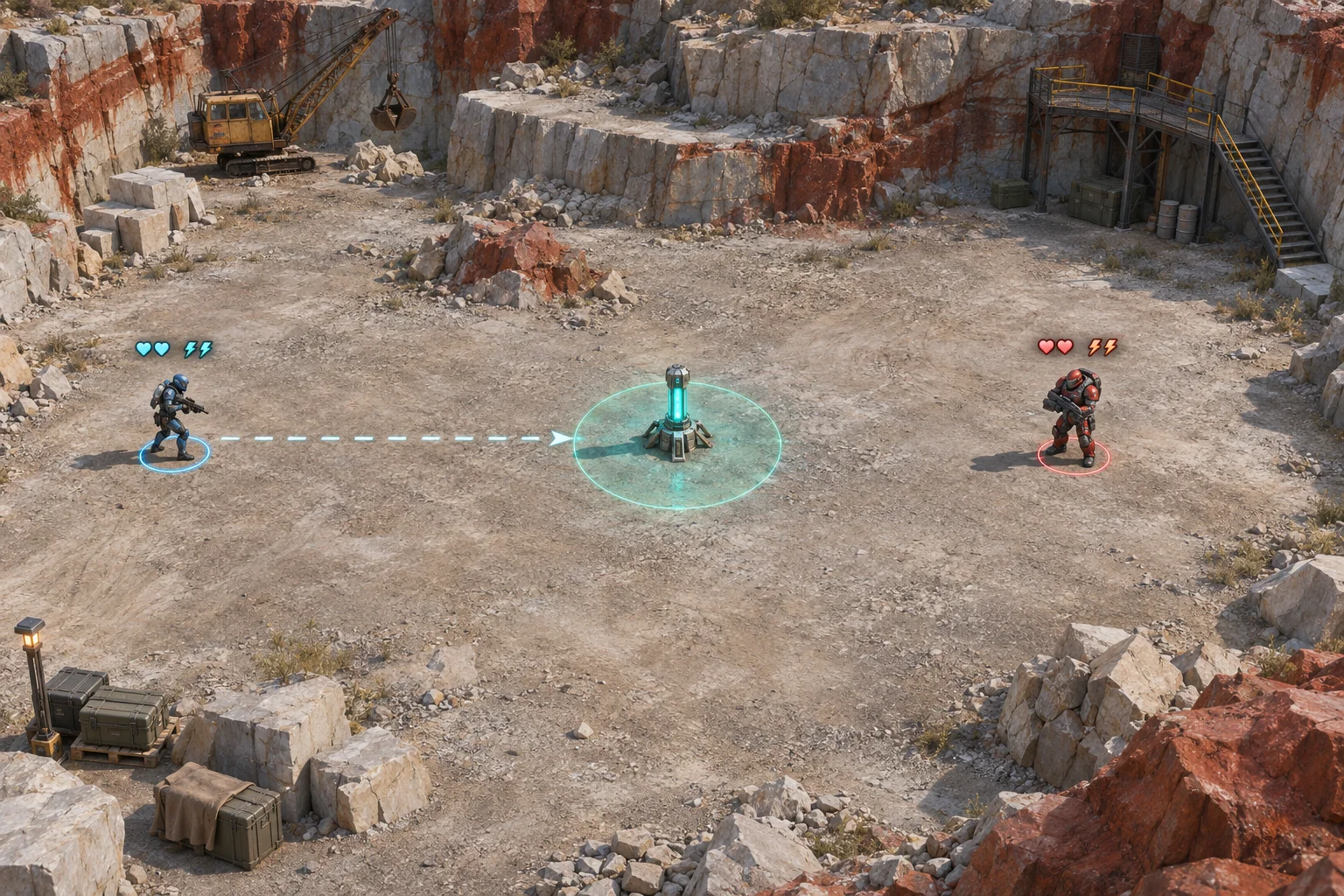
A co-op tactics game can feel tense when two players command the same squad instead of managing separate armies. In Crossfire Pact, one player is Pathfinder and plans where the four allies move. The other is Fire Control and assigns their attacks, guards, and interactions. Both players share unit health, equipment, inventory, and the same four command points, but each owns two points and a different order type.
The roles make cooperation concrete. Pathfinder locks up to two movement orders first. Fire Control then selects attacks from the projected post-move positions. Both players see the full plan before the round locks, so a shot can depend on a move without either player changing the other's order. A unit can move once and take one combat action, but never receive duplicate orders of the same type. The shared roster stays visible and each mistake affects the one army both players are trying to protect.
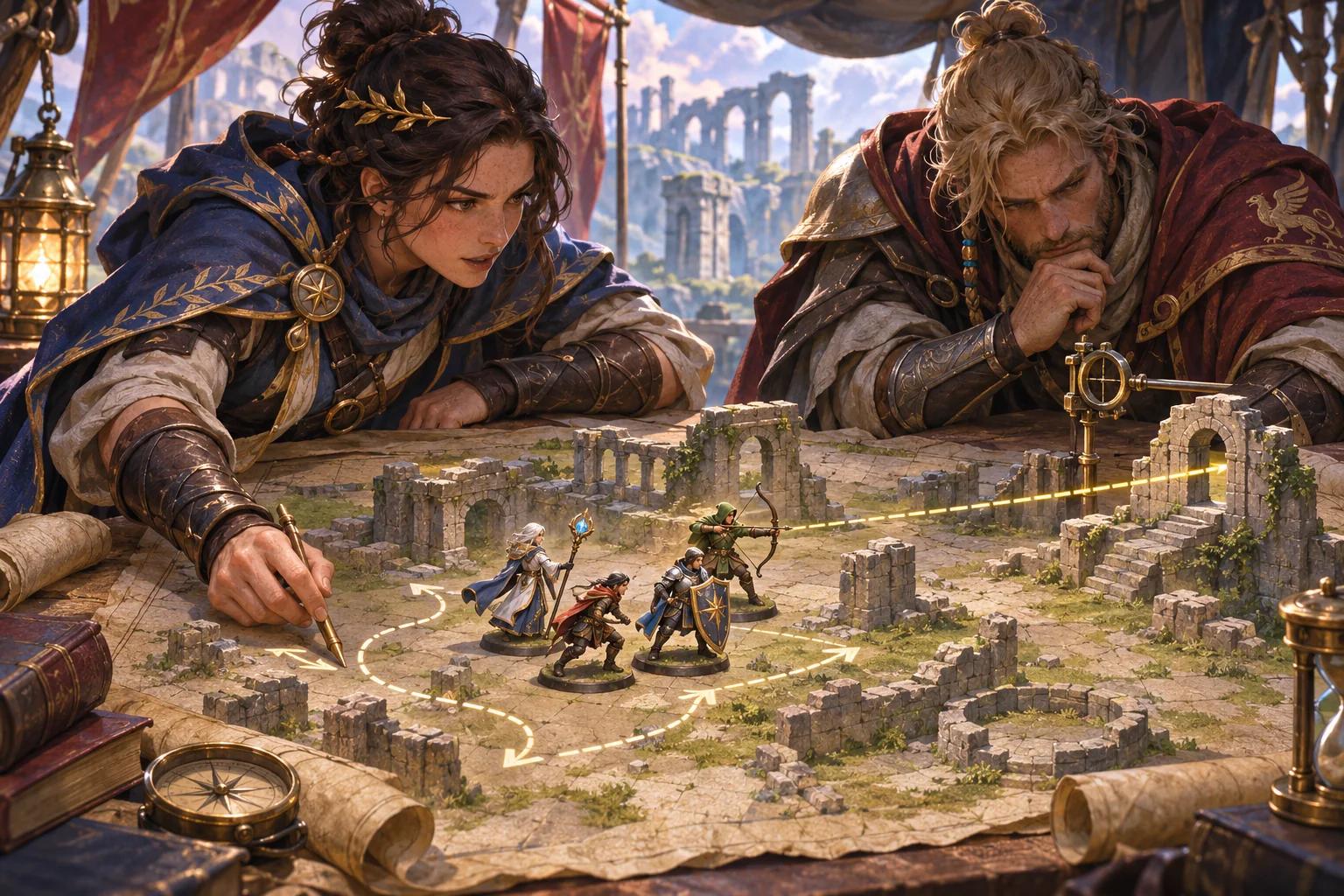
Assign complementary jobs to one shared army
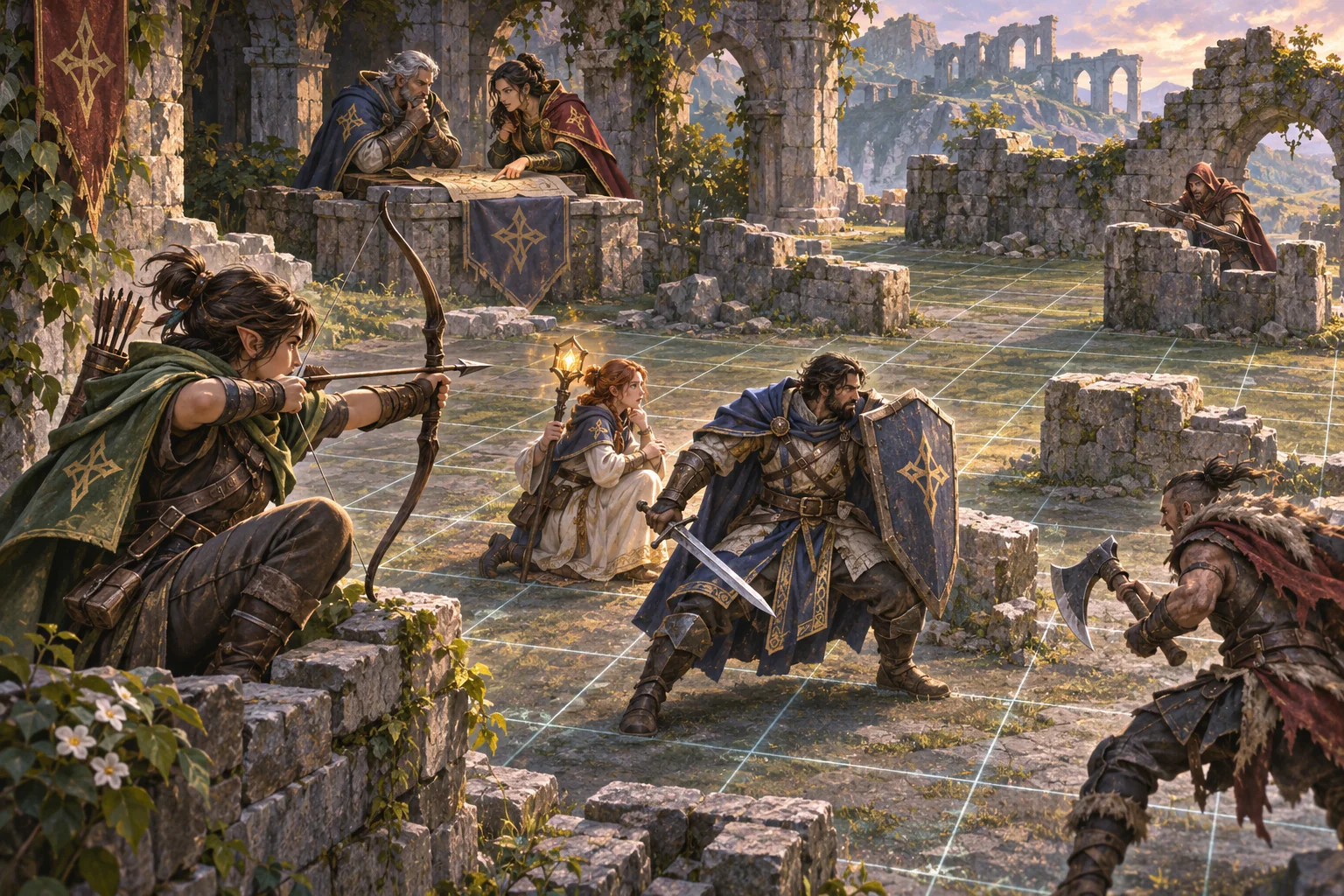
Use an 8×8 ruin grid. The shared army has Scout at (2,2), Guard at (2,4), Ranger at (1,3), and Medic at (1,4); two raiders begin at (5,2) and (5,4). The objective is to hold the center relay at (4,3) through two consecutive round ends. Pathfinder and Fire Control keep their roles for a mission. Each receives two command points per round, four total for the shared army. Pathfinder may order a unit to move one cell for one point or dash two cells for two points. Fire Control may order one attack, guard, or interact action for one point. Each unit can receive at most one movement and one combat order per round. Pathfinder locks first; Fire Control then sees projected destinations and picks legal targets. Both players can inspect all orders before lock, but cannot edit the other role's queue. Movement resolves first in unit-ID order; blocked paths stop at the last free cell. Combat then resolves in unit-ID order. An attack costs one point, has range four, needs line of sight, and deals one damage; each unit has two health. Guard protects one adjacent ally from the next hit before the next round. If a target is out of range or behind solid cover after movement, the order becomes Hold and its point stays spent. Interact captures the relay when a unit ends there and no enemy occupies it. Reset restores positions, health, equipment, inventory, relay ownership, and both two-point pools.
| System | Expected behavior |
|---|---|
| Shared roster | One Scout, Guard, Ranger, and Medic; both commanders see the same unit IDs, health, gear, inventory, and positions. |
| Role limits | Pathfinder issues movement; Fire Control issues attack, guard, or interact. A unit gets at most one order of each type. |
| Command points | Each role has two per round; the army has four total, and one role cannot spend the other's points. |
| Movement lock | Pathfinder locks routes first. One cell costs one point; a two-cell dash costs two; occupied cells block the route. |
| Combat plan | Fire Control targets projected post-move cells; one attack costs one, range four, clear line of sight, one damage. |
| Guard and failure | Guard absorbs the next hit for an adjacent ally. An illegal attack becomes Hold; spent points are not refunded. |
| Objective and reset | Hold the center relay through two round ends. Reset positions, health, gear, inventory, control, and points. |
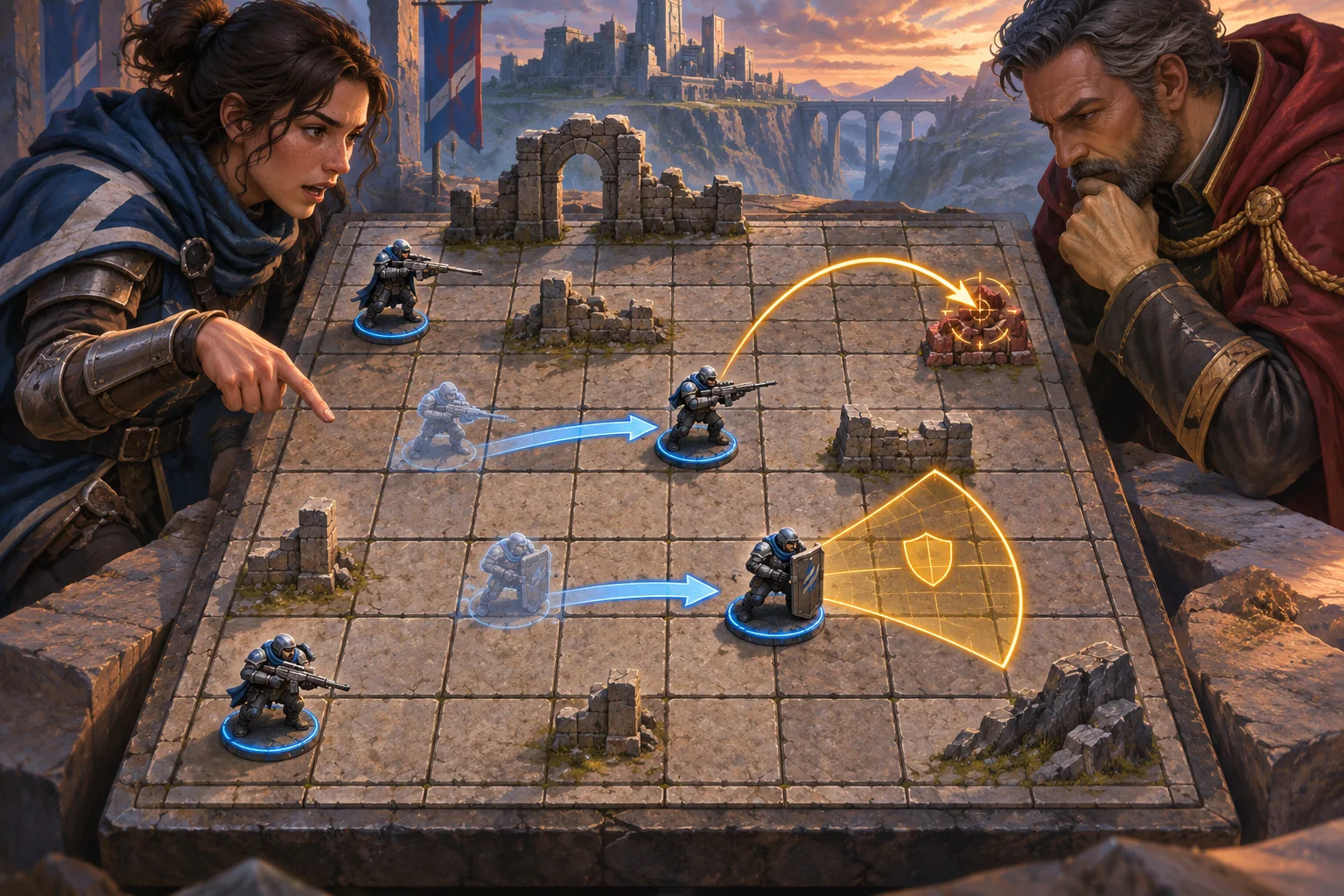
Set order points and the lock sequence
Start with Scout (2,2), Guard (2,4), Ranger (1,3), Medic (1,4), and raiders at (5,2) and (5,4). Pathfinder spends one point to move Scout to (3,2), then one to move Guard to (3,4); the two other allies hold. Fire Control previews the new positions and spends one point for Scout to attack the Raider at (5,2), which is two cells away with a clear row. The final point orders Guard to protect Ranger, who is adjacent at (2,4). Lock the plan. Movement resolves first: both paths are empty, so Scout and Guard arrive at the projected cells. The attack now has legal range and line of sight, removing one of the Raider's two health. Guard's protection token attaches to Ranger until the next round. The raiders act afterward. If a Raider had entered the lane before combat resolution, the attack would use the stated target rule: it remains locked to the chosen unit; if that unit leaves range or sight, the shot becomes Hold rather than retargeting. No points are refunded. The army still has four units and one shared state. This is a written rules trace, not a playable or user test.
| Check | Expected result |
|---|---|
| Pathfinder moves Scout to (3,2) | Spend one Pathfinder point; show the planned destination. |
| Pathfinder moves Guard to (3,4) | Spend the second point; Ranger and Medic remain unchanged. |
| Fire Control targets Raider (5,2) | Use projected Scout position; range two and clear line of sight make the shot legal. |
| Fire Control guards Ranger | Spend the last point; attach one-hit protection until next round. |
| A route is blocked before movement | Stop at the last free cell, then re-check the locked shot against the actual position. |
| The selected target leaves range or sight | Convert the attack to Hold; do not retarget or refund the command point. |
| Reset the battle | Restore four ally IDs, two raiders, health, equipment, inventory, relay, and four-point budget. |
Trace a move followed by an attack and guard
Ask SEELE to make a two-player cooperative grid encounter where the roles split one army's orders. Both players should see the same state and planned routes, but only the owner of each order type can edit that queue.
Create a local two-player grid tactics prototype called Crossfire Pact on an 8-by-8 ruin map. One shared army contains Scout at (2,2), Guard at (2,4), Ranger at (1,3), and Medic at (1,4). Two raiders start at (5,2) and (5,4); the objective relay is (4,3) and must be held through two consecutive round ends. Assign one player Pathfinder and the other Fire Control for a whole mission. Each gets two command points per round; the army has four total but neither role can spend the other's two. Pathfinder orders one-cell moves for one point or two-cell dashes for two points. Fire Control orders an attack, guard, or relay interaction for one point. Each unit may get at most one movement and one combat order. Pathfinder locks routes first; Fire Control sees projected post-move cells and chooses targets. Both players can inspect the whole plan before round lock, but cannot edit the other queue. Resolve movement in stable unit-ID order, stop a blocked route at its last free cell, then resolve combat in stable ID order. Attacks have range four, require line of sight, and deal one damage; units have two health. Guard protects one adjacent ally from the next hit until the next round. Interact captures an empty relay at phase end. If a locked target becomes out of range or sight, convert the attack to Hold and keep the spent point; never retarget secretly. Reject duplicate movement or combat orders for one unit. Show commander role, remaining points, shared unit health, projected cells, target, line of sight, relay progress, and the reason for an invalid order. Reset all four allies, raiders, state and points. Do not add separate armies, independent inventories, simultaneous hidden orders, free extra actions, or claims that this authored trace was playtested.Ask AI to keep both plans on the same board state
The first draft gave both commanders full control over every order, so they could move one unit twice or replace a teammate's target after lock. Assign movement to Pathfinder and combat to Fire Control, cap each unit at one order of each type, and show a shared plan before lock. This repair comes from the written trace, not a running game test.
Replay the Scout move, Raider shot, and Guard protection. Check that Fire Control targets the projected cell, that movement resolves first, and that a newly blocked or out-of-range shot becomes Hold without refund. Keep unit health, gear, and command points in one shared state rather than copying them into two commander profiles.
Revise duplicate orders before adding more units
Start with four allies, two raiders, two fixed roles, and four shared command points. The teamwork should come from one player setting up position and the other selecting legal follow-up actions. Add more units or a role swap only after both queues stay synchronized through a full round and reset.
Read the grid-based tactics design guide.
Explore SEELE's campaign strategy workflow.
Frequently asked questions
How can two players share one army without conflicting?
Give the commanders different order types and show both queues on the same board. Pathfinder controls movement while Fire Control chooses attacks and support. A cap of one order per type per unit prevents duplicates without splitting the roster. This keeps the turn state easy to verify.
Can both commanders issue orders to the same unit?
Yes, if the orders are complementary. One commander can move a unit and the other can attack or guard it after movement resolves. The unit cannot receive two moves or two combat actions in one round. This keeps the turn state easy to verify.
Read Godot's AStarGrid2D documentation.
What happens if a planned shot becomes impossible?
Keep the target locked. If movement, range, or line of sight makes the shot illegal at resolution, convert it to Hold and keep the spent point. Secretly choosing a new target would make the players' plan hard to trust. This keeps the turn state easy to verify.
Should the commanders share health and equipment?
Yes. The four unit IDs, health, gear, inventory, and objective state belong to one army. Each player controls a role-specific order queue, not a duplicate copy of the roster. That keeps resets and damage consistent. This keeps the turn state easy to verify.