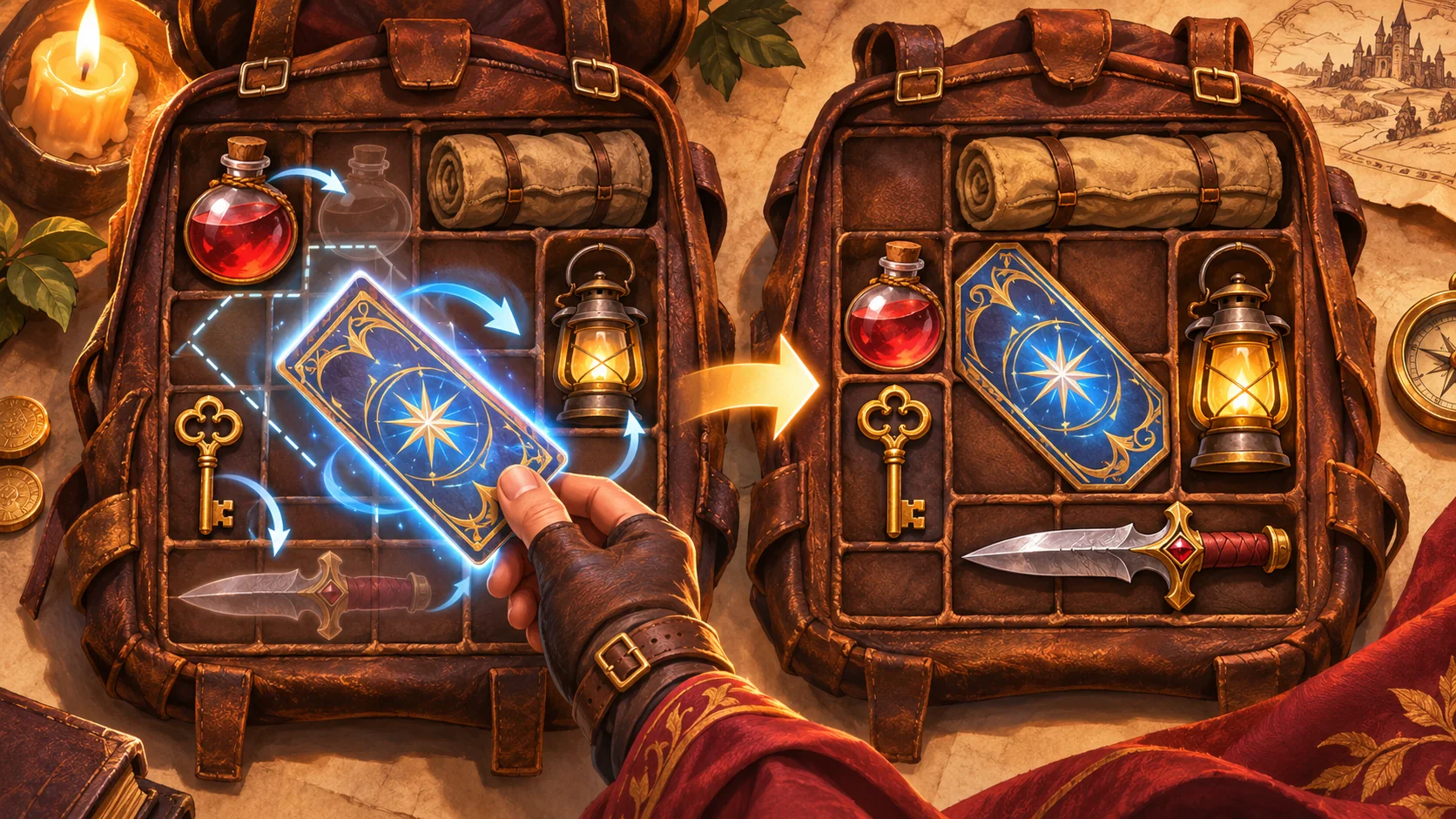
A deckbuilder usually asks which cards to add or remove. Make its inventory the main strategy board by letting item placement change how those cards work. A blade can strengthen strike cards, while a whetstone may add power only when it touches the blade in the grid. The run then grows through both deck choices and spatial decisions.
Start with a four-by-four inventory and one adjacency rule. Keep the deck and item values fixed while comparing the same whetstone in two positions. This verifies whether board placement updates a card modifier; it does not establish that the build is balanced or that the puzzle stays interesting over a full run.

Connect item positions to the cards you play
Give each item a visible footprint and tag. A short sword takes two horizontal cells and carries the Blade tag; a whetstone uses one cell and carries Sharpen. Strike cards read the equipped inventory when they resolve. This makes the board affect the deck during combat instead of serving only as storage.
Define adjacency with a simple edge rule: items count as neighbors when their cells share a side, not a corner. When Sharpen touches a Blade item, add two damage to Strike cards. Show the linked items and the updated card value before combat, then display the same modifier when a Strike is played.
Let the player rearrange items between encounters, but freeze card text, item tags and base values during the first test. Make legal cells and occupied space visible. Add larger shapes or additional tags only after the first adjacency can be planned and verified without hidden rules.
See Godot's Resource documentation for reusable card, item-footprint and modifier data definitions.
Move one item to strengthen a card
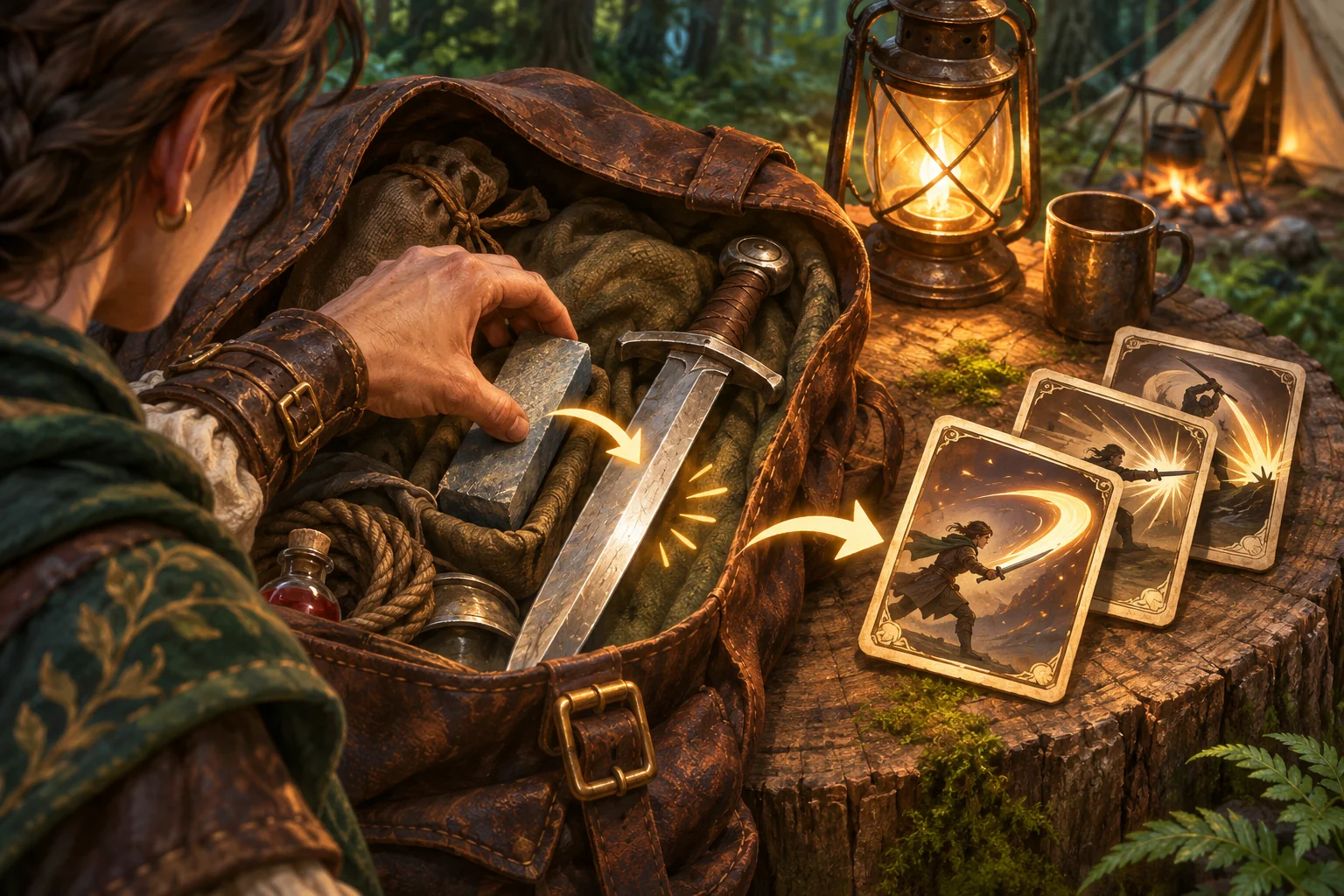
Use a four-by-four inventory. Place the two-cell sword at columns one and two of the top row. The whetstone begins in the lower-right corner, so it shares no edge with the sword. Strike deals its base five damage because the Blade and Sharpen tags are not adjacent.
Move only the whetstone to the cell directly below the sword's first cell. The board now has an edge between the two items, so Strike deals seven damage: five base plus the two-point Sharpen modifier. Keep the card, sword, whetstone and encounter values fixed while comparing the two layouts.
This deterministic grid check verifies the adjacency and arithmetic. It does not test whether rearranging feels satisfying, whether Strike becomes too strong or whether the wider run has enough meaningful choices. Those questions need playtests across multiple rewards and encounters.
Ask AI to prototype an inventory-led deckbuilder
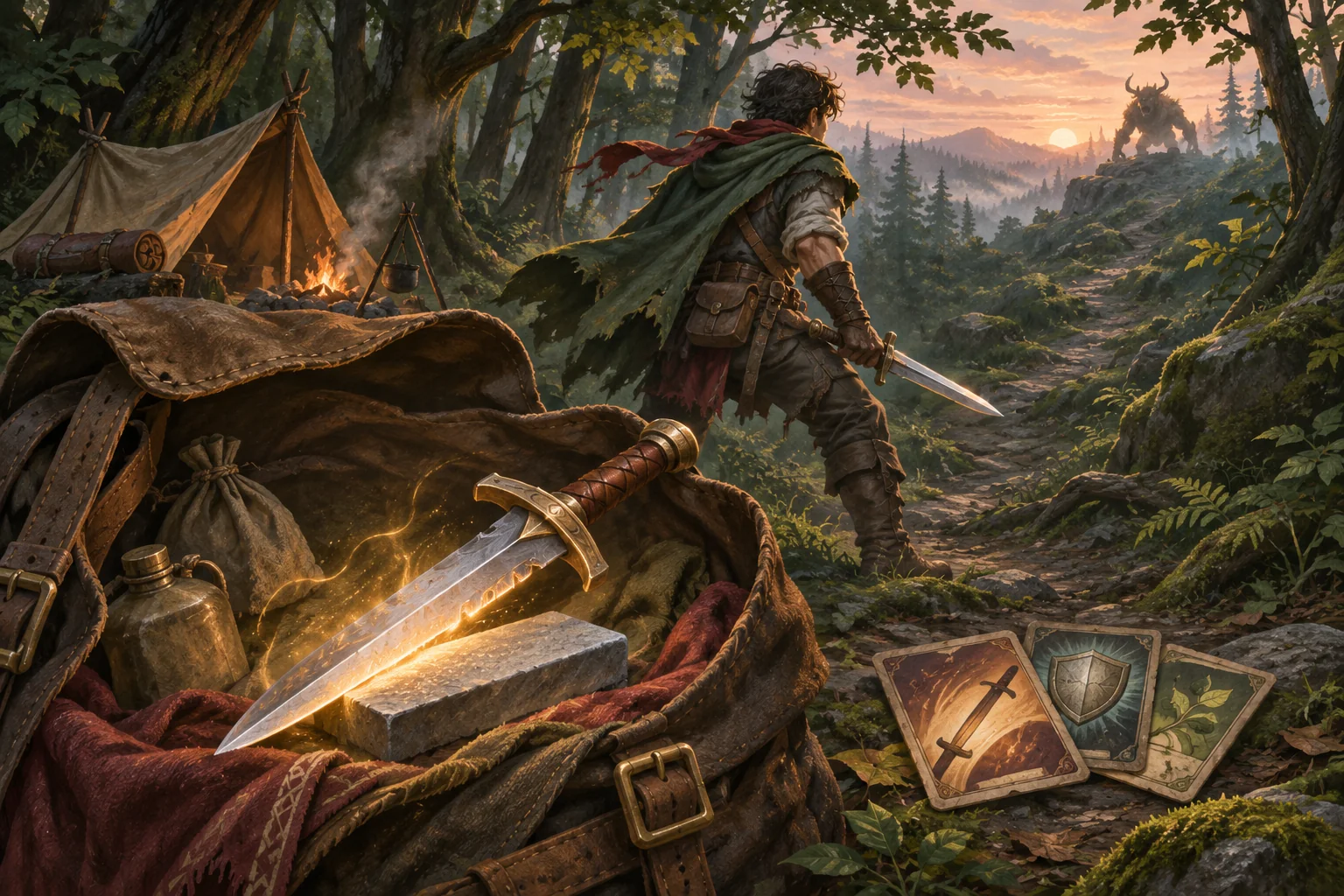
Show item footprints, legal grid cells and the matching card modifier before combat.
Change only the whetstone position while keeping card and encounter values fixed.
Create an original roguelike deckbuilder where a 4 by 4 inventory grid is the main strategy board. A short sword occupies two horizontal cells and has the Blade tag; a whetstone occupies one cell and has the Sharpen tag. Strike cards deal 5 base damage and gain +2 when Sharpen and Blade items share an edge. Compare the whetstone in the lower-right corner versus directly below the sword. Keep card, item and encounter values fixed. Show the board and updated Strike value. Do not claim this model proves balance or long-run strategy depth.
Make the inventory change the deck's decisions
A spatial inventory becomes a strategy board when its layout changes card effects that matter in the next encounter. Start with a few item shapes and one visible tag interaction, then test how rewards, rearrangement and combat connect over a full run. Expand the grid's vocabulary only when players can understand why an item changed a card.
Prototype an inventory deckbuilder with SEELE's AI game maker
Frequently asked questions
How can inventory become the main strategy board?
Let item placement change card values or effects. For example, a whetstone might strengthen blade cards only when it sits beside a blade in the grid. Players then plan both which cards enter the deck and where their equipment fits.
Should players rearrange items during combat?
Start with rearrangement between encounters so players can plan without a timer. Keep combat modifiers fixed while a fight is underway, unless changing equipment mid-battle is itself part of the intended design. This makes the first placement rules easier to inspect.
Does an adjacency model prove the deckbuilder is balanced?
No. It verifies that the specified neighboring items change a card by the specified amount. It cannot assess how often players find the combo, whether the bonus dominates other choices or whether the run stays varied. Playtest several reward sequences and encounters before tuning balance.