In the Folded Vault, your inventory is a small board with a route hidden inside it. A card called Fold does not deal damage or add an item: it shifts one complete row, carrying every item to a new cell. That single movement can bring a blade beside a spark or a key beside a gate, changing the actions available before the room turns hostile.
This fictional roguelike uses a three-by-three inventory, six one-cell tiles, and a deterministic vault room. Start with three health. In each room, play one layout card, then activate at most one item. Items that share a side form a usable pair; diagonal corners do not count. Clear the sentinel and open the exit before the end-of-room strike to continue the run.
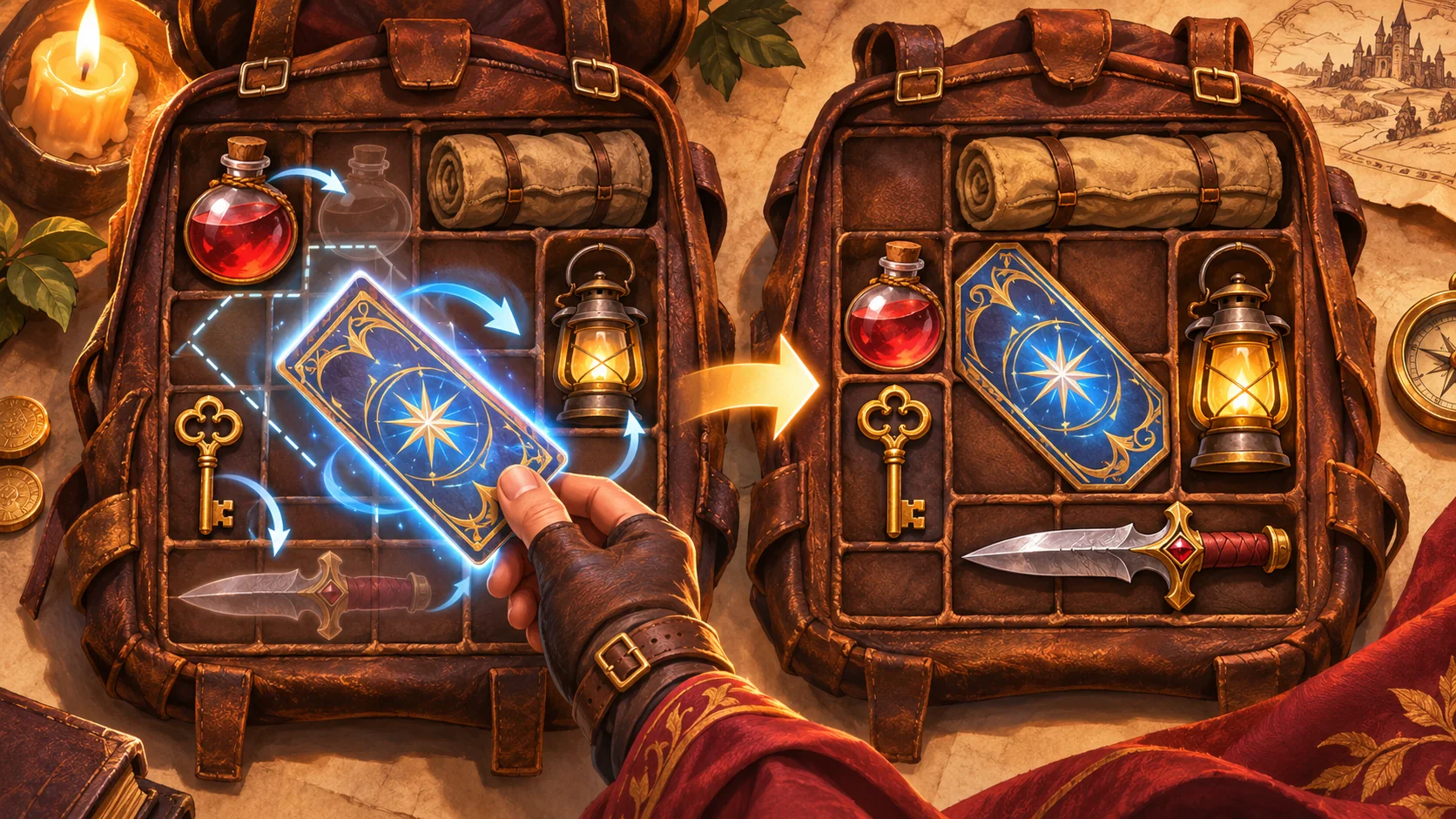
Make a row-shift card change real inventory choices
Use a three-by-three inventory with six one-cell tiles: Blade, Key, Map, Spark, Gate and Potion. The player also has one Fold card in the room deck. At the start of a room, choose one complete row and shift every tile in it exactly one cell left or right; the tile at an edge wraps to the opposite end. This is a layout action, not a free item move, so the player cannot pick up individual tiles or leave a row half-shifted. After the shift, activate at most one item. Blade defeats the Sentinel only when it shares a side with Spark; otherwise it deals no damage. Key opens the Gate when the two tiles share a side, and that check resolves automatically after the layout action. Potion restores one health up to three. A Map reveals the next room reward but does not move anything. A Gate is cleared only if it is open and the Sentinel is defeated. If the room is not clear, the Sentinel deals one damage at the end of the turn. Health at zero ends the run. Reset restores the board, Fold card, health and room order. The sample room has Blade at row 1 column 1 and Key at row 1 column 2. Its middle row starts Map, Spark, Gate. Shift that row left and it becomes Spark, Gate, Map: Blade and Spark now touch, as do Key and Gate. Shift it right instead and neither pair is formed. This makes direction, adjacency and one-action timing matter without adding hidden random resolution.
| Element | Rule and result |
|---|---|
| Fold | Shift one full row exactly one cell left or right; the edge tile wraps to the other side. |
| Blade + Spark | If their tiles share a side after Fold, one Blade action defeats the Sentinel. Corners do not count. |
| Key + Gate | When the tiles share a side after the shift, the Gate opens automatically for this room. |
| Potion | Activate at most one item per room; Potion restores 1 health, capped at 3. |
| Map | Reveals the next room reward but does not alter the grid or count as a tile move. |
| Room end | If the Sentinel remains or the Gate is closed, take 1 damage. Health at 0 ends the run. |

Trace the vault turn and a failed shift
Start the room at health 3. The grid has Blade at r1c1, Key at r1c2, Map at r2c1, Spark at r2c2, Gate at r2c3, Potion at r3c2, and empty cells elsewhere. Shift row 2 one cell left: Spark moves to r2c1, Gate to r2c2, and Map to r2c3. Blade now shares a side with Spark, and Key shares a side with Gate. The automatic Gate check opens the exit; use the single item action on Blade to defeat the Sentinel. The room clears with health 3 and the Fold card spent. Counterexample: shift row 2 right. The row becomes Gate, Map, Spark. Blade no longer touches Spark, Key does not touch Gate, so the Sentinel remains and the end-of-room strike reduces health to 2. The board layout, not a damage roll, explains the different result.
| Check | Expected result |
|---|---|
| Shift row 2 left | The row becomes Spark, Gate, Map; edge wrapping is deterministic. |
| Resolve pairs | Blade touches Spark and Key touches Gate by a side; neither pair is diagonal. |
| Activate Blade | The Sentinel is defeated; the player has used the room’s one item action. |
| Shift row 2 right instead | The row becomes Gate, Map, Spark; neither required pair forms. |
| End an uncleared room | The Sentinel deals 1 damage, taking health from 3 to 2. |
| Reset the run | Restore health 3, the original grid, Fold, and the fixed room order. |
Ask AI for a small, auditable roguelike
Ask SEELE to build one local room before adding a deck, loot economy, or procedural map. Give the builder the exact grid coordinates, row-wrap rule, side-adjacency checks, item-action limit and end-of-room order. Compare both shift directions against the written trace; the UI should make the before and after cells visible so a player can see why a pair formed.
Create a small local inventory roguelike prototype called Folded Vault. Show a three-by-three grid, health capped at 3, one Fold layout card, one Sentinel, and one Gate. Initial tiles: Blade r1c1, Key r1c2, Map r2c1, Spark r2c2, Gate r2c3, Potion r3c2; other cells are empty. In a room, the player shifts exactly one complete row by one cell left or right, with wraparound at the edge, then may activate at most one item. Items sharing a side form a pair; diagonals never count. After the shift, Key touching Gate opens the Gate automatically. Blade touching Spark lets one Blade activation defeat the Sentinel. Potion restores one health up to 3. Map reveals the next reward without moving. If the Sentinel remains or the Gate is closed, the Sentinel deals 1 damage at room end; health 0 ends the run. With row 2 shifted left, it becomes Spark, Gate, Map: both pairs form and the room clears at health 3. With row 2 shifted right, it becomes Gate, Map, Spark: neither pair forms and health falls to 2. Show the grid before and after, each adjacency check, health change, action order, and a reset that restores the exact initial state. Keep the row shift and item activation keyboard-operable without timed input.Show the before and after board states
The first draft let the player drag individual tiles after using Fold, which erased the cost of choosing a direction. Remove free rearrangement and resolve only the selected full-row shift with wraparound. Show the old and new row, then evaluate adjacency once. Keep the Sentinel strike last so the player can understand why the wrong direction costs one health.
Replay both directions against the written grid. Confirm that side neighbors count and corner contacts do not, the Gate check happens after the shift, and only one item can be activated. If this becomes a web prototype, expose row choice and item use as keyboard actions; the W3C keyboard guide is a reference, not evidence of conformance.

Expand the deck only after the room works
Keep the first vault room deterministic while checking whether row direction creates a meaningful inventory decision. A player should be able to predict the two useful pairs before committing Fold and explain why the opposite shift leaves the Sentinel active. Once both paths match the trace, add one loot reward or a second room pattern and rerun the same checks. The related inventory-management guide can help you develop item adjacency without hiding this layout-card rule.
Read the inventory-management roguelike guide.
Start a local game prototype with SEELE.
Frequently asked questions
What does the Fold card change?
Fold moves a complete row one cell left or right, carrying every tile and wrapping the edge tile to the other side. It does not move a single item or change the grid size. Show the before and after row so the player can plan around the new neighbors.
Do diagonal tiles form a pair?
No. Blade and Spark, or Key and Gate, must share a full side after the row shift. A corner-only contact has no effect. Keep the rule visible beside the board, and check the resulting grid once after Fold rather than during each animation frame.
Read Godot GridContainer documentation.
Why limit the player to one item action?
The limit keeps the layout choice readable: the player shifts one row, then chooses which item effect to spend this room. The Gate check is automatic, while Blade, Potion, or Map uses the one action. Compare a successful left shift with the failed right shift before expanding the action economy.
What should reset restore?
Restore health 3, the original three-by-three tile positions, the unused Fold card, and the fixed room order. Clear any opened Gate or defeated Sentinel state. Test reset after both a cleared room and a damaging strike so the next run starts from the same board.