A small-scale 4X game can make exploration, expansion, resource production and conflict meaningful without simulating an entire planet. Start with a few locations and make each action change the next decision: reveal a site, settle it, use its output and confront a rival.
This guide specifies a fictional turn-based prototype and an AI-assisted build request. Its map, supply values and outcomes are invented design rules, not a report of a completed playtest. Use the short walkthrough to check whether your own build follows the rules you choose.

Connect four decisions on a tiny map
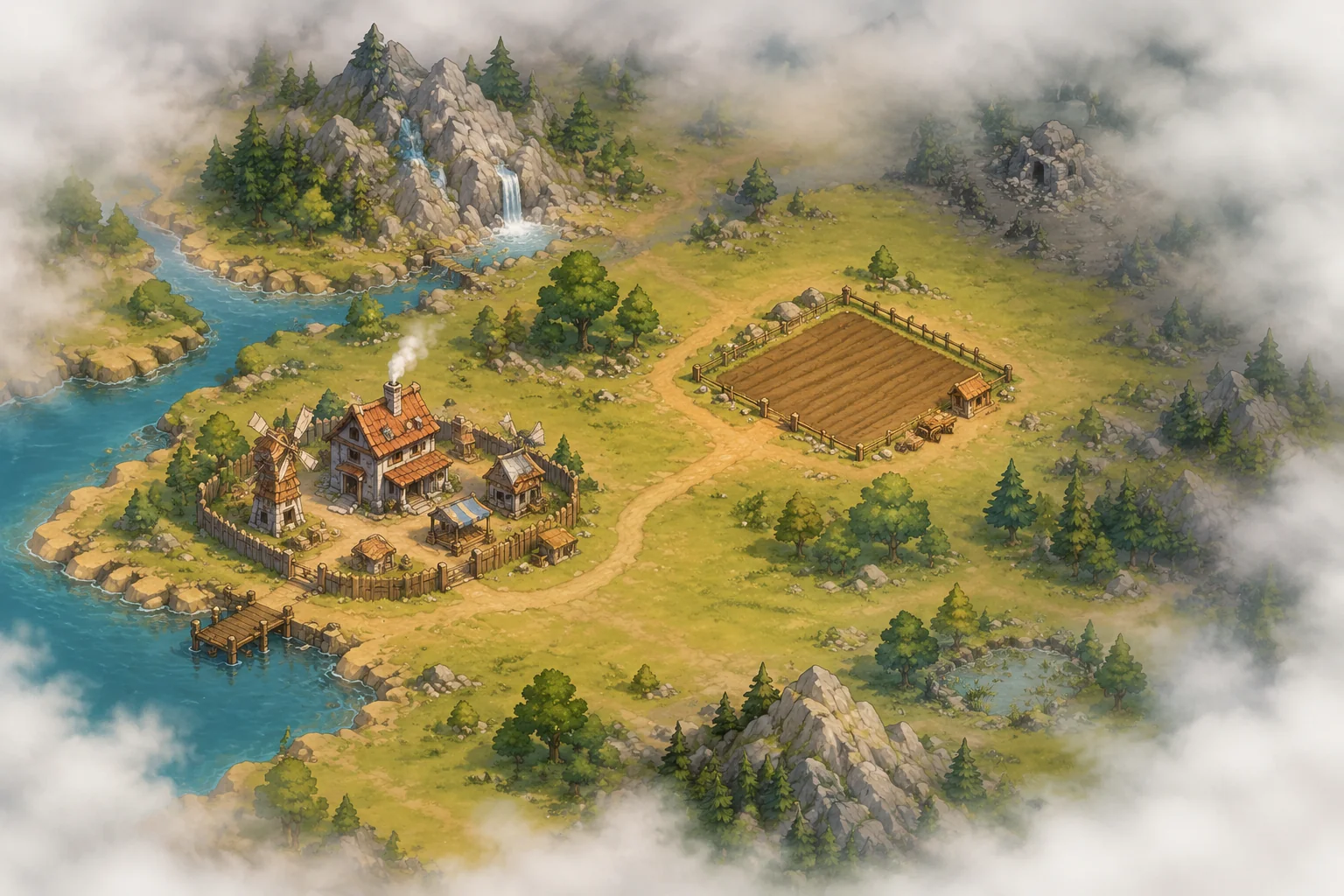
Place three locations in a line: a home settlement, a neutral site and a rival outpost. Only the home is visible at the start. Each turn, the player chooses one action: reveal an adjacent hidden location, settle the revealed neutral site or attack the revealed rival. A settled site produces supplies at the end of each non-winning turn.
| Decision | First-version action | What it changes |
|---|---|---|
| Explore | Reveal a hidden location next to visible territory | Available targets and information |
| Expand | Settle the revealed neutral site | Ownership and future production |
| Use resources | Collect supply from the settled site | What the player can afford later |
| Confront a rival | Attack a revealed outpost | The end condition for this scenario |
The rival is passive in this first build. It does not expand or attack. That makes the sequence predictable enough to verify map visibility and resource accounting before adding another faction's decisions.
Set the actions and turn order
Start with 3 supplies. Revealing one hidden location adjacent to any visible location is free. Settling the visible neutral site costs 2 supplies and can happen once. Attacking the visible rival costs 2 supplies. After a non-winning turn, the settled site produces 1 supply. A successful attack removes the outpost and wins immediately, before end-of-turn production.
Reject an action against a hidden target, a purchase the player cannot afford or a second settlement on the same site. A rejected action should not consume a turn or change the balance. Show the currently visible locations, owned site, supply total and available actions so the player can understand the next choice.
Walk through a four-turn route
| Turn | Action | Supply calculation | Result |
|---|---|---|---|
| 1 | Reveal neutral site | 3; no colony yet | Site becomes visible |
| 2 | Settle site | 3 − 2 + 1 = 2 | Site produces at turn end |
| 3 | Reveal rival | 2 + 1 = 3 | Rival becomes a valid target |
| 4 | Attack rival | 3 − 2 = 1 | Immediate victory |
The colony contributes at the end of turn two because it is already settled when that turn ends. It contributes again after turn three. There is no additional production after the winning attack. The sequence is a calculation from the example rules, not evidence of balance or a tested game.
Describe the miniature campaign in an AI build request
Specify what is hidden, which actions are legal and when production occurs. SEELE's capability catalogue describes game creation from written ideas and coordinated 2D characters, scenes and interfaces. These category descriptions do not prove that this specific strategy system has been generated and tested.
Create an original small turn-based strategy prototype.
Use three locations in a line: home, neutral site and rival outpost.
Only home is visible initially. Start the player with 3 supplies.
Each turn allow one action: reveal a hidden location adjacent to a visible
location for free; settle the visible neutral site once for 2 supplies;
or attack the visible rival outpost for 2 supplies.
At the end of every non-winning turn, a settled site adds 1 supply.
The rival does not act. A successful attack removes the rival and wins
immediately, before end-of-turn production. Reject hidden targets,
unaffordable actions and settling twice without consuming a turn or supply.
Show visibility, owned sites, supply, action availability and turn result.
Restart restores the starting map, visibility, supplies and unowned site.
Use original simple illustrated map assets without copying a known game.
Build map visibility first, then settlement and supply, and finally the rival and victory condition. If a result differs from the walkthrough, give the assistant the turn, starting supply, chosen action and expected end-of-turn balance. Keep the previous checks after each new system is added.
Make resources and legal actions visible
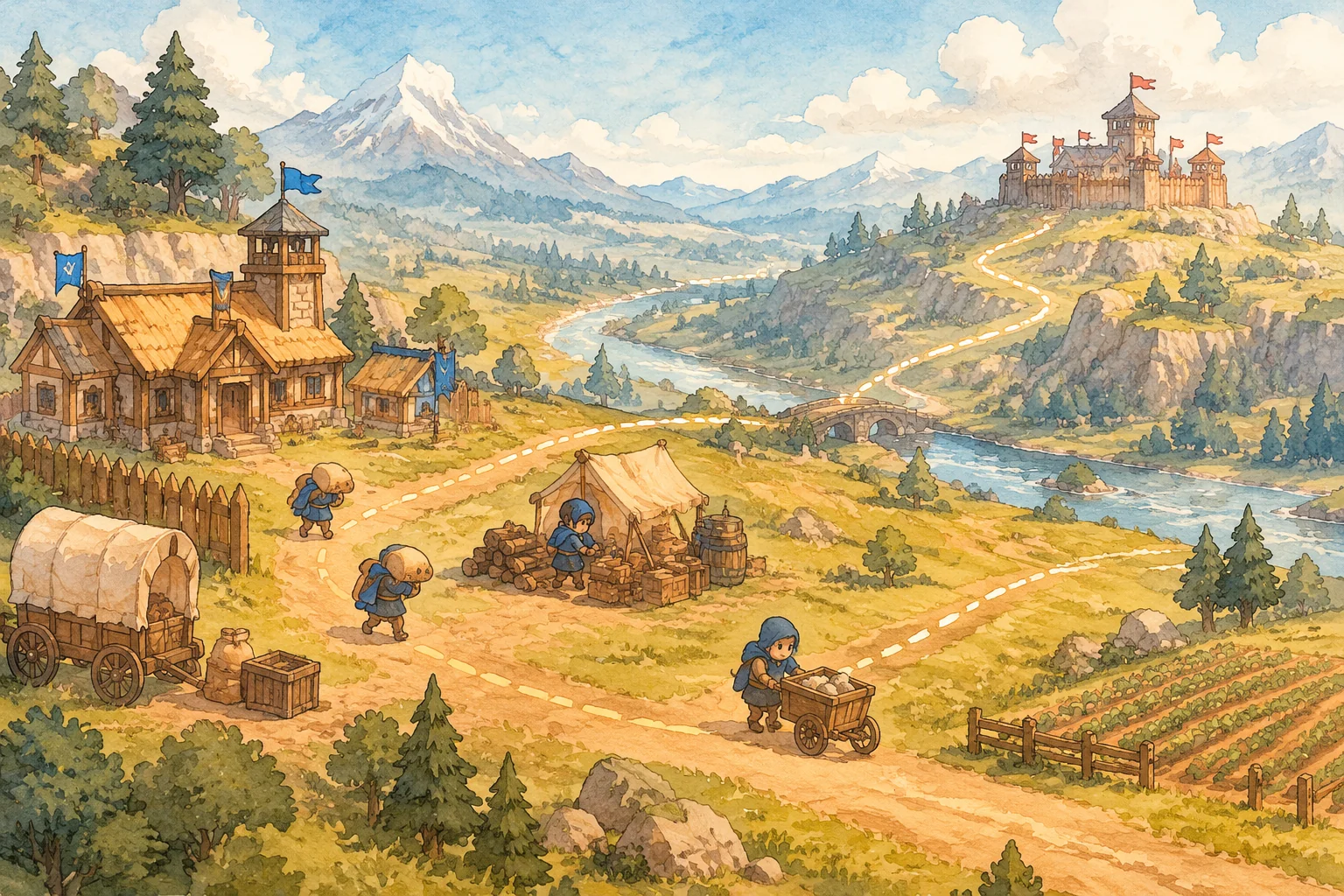
Show hidden locations as unexplored rather than displaying their identity before a reveal. After a site is revealed, distinguish neutral, owned and rival states. When the player selects settlement or attack, show the cost and current balance before applying it.
If an action is unavailable, explain whether the target is hidden, the site is already owned or supplies are insufficient. Do not silently advance the turn after a rejected action. These messages give the player a way to correct the choice and give a developer a way to see which condition failed.
Check the short campaign
- Initial visibility: only home is visible and supply is 3. Attempt to settle the hidden site or attack the hidden rival; both should fail without advancing.
- Reveal and settle: reveal the site, then settle it. After the second turn closes, expect 2 supplies and one owned site.
- Production: reveal the rival on turn three. Expect supply to rise from 2 to 3 at turn end, exactly once.
- Victory: attack on turn four. Expect supply 1 and immediate victory, with no extra production after the winning action.
- Invalid and reset: try settling twice or attacking without enough supply in an appropriate test state. Confirm no deduction or turn advance; restart restores the initial map and 3 supplies.
If a check fails, identify the phase as well as the value. For example: “The player had 3 supplies, settled for 2 and ended the turn with 1. The new colony should produce 1 at that turn end, so the expected balance is 2.” Retest the winning turn separately so a fix does not add production after victory.
Plan a rival-pressure iteration
Once the fixed sequence works, consider a hypothetical rival that can contest the neutral site after a specified turn. Before adding it, define exactly when the rival acts, what “contest” does to settlement, and whether the player has an alternate way to gain enough supplies. A deadline without a viable route can turn the game into an unwinnable sequence rather than a strategic choice.
For a controlled comparison, keep the original passive-rival scenario available and record the action and supply balance at each turn in the new version. If the rival blocks the only source of production before the player can use it, add an explicitly defined alternative or revise the timing. This is a proposed design change, not an observed iteration result.
Frequently asked questions
Can a three-location map support a 4X prototype?
It can demonstrate the relationships between revealing territory, expanding, producing resources and confronting a rival. It cannot represent the variety of a larger campaign. Use the small map to verify transitions and turn timing, then add locations when they create meaningful new choices.
How is revealing a site different from settling it?
Revealing makes the location and its possible action visible; settlement changes ownership and starts the stated production rule. Keeping those events separate lets the player see a site before spending supplies. The prototype should reject settlement while the target remains hidden.
What if the player lacks supplies for an action?
Keep the action unavailable and show its cost alongside the current balance. A rejected action should not deduct resources or advance the turn. If no legal action can ever restore supplies, revise the rules or offer an explicit recovery path rather than leaving the player stuck.
When should I add an active rival?
Add one after the player can reveal, settle, collect and win consistently. Start with a small, predictable rival rule and make its timing visible. Test whether the player still has a viable route before adding more factions or uncertain behavior.
Build a short empire loop first
A hidden site, a settlement cost, a small production rule and a rival objective are enough to connect the central decisions of a strategy prototype. Develop your own frontier in the SEELE AI Creator Game Maker, then check each turn before adding new territory. For a broader workflow, read how to create a game with AI.