A space fleet strategy game becomes easier to reason about when players can see the threat before they commit their orders. Give the enemy one telegraphed sector, give the fleet a short command window, and make every order compete with another useful action. This guide builds that loop with Signal Window, a fictional, hand-resolved paper design. It shows how a fixed sequence of threats can turn a choice between damage and survival into a compact prototype plan.
The example is not a real game, a generated SEELE result, or a playtest. Its values are invented to make the rules and the comparison easy to check by hand.
Start with one visible threat and two sectors
Signal Window uses two abstract orbital sectors: Inner and Outer. One allied fleet begins in Inner. A hostile relay core has five stability, while the fleet has two hull. At the beginning of each round, the core marks one threatened sector. The three-round sequence is fixed: Inner, Outer, Inner.
This creates a tactical question before there are any ship classes or technology trees. When the first amber signal marks Inner, should the player stay and use both orders to scan and fire, or shift out of danger and accept a weaker shot? The fleet’s position, the signal, and the target’s stability are all visible. The player can judge the cost of an order before the enemy resolves its attack.
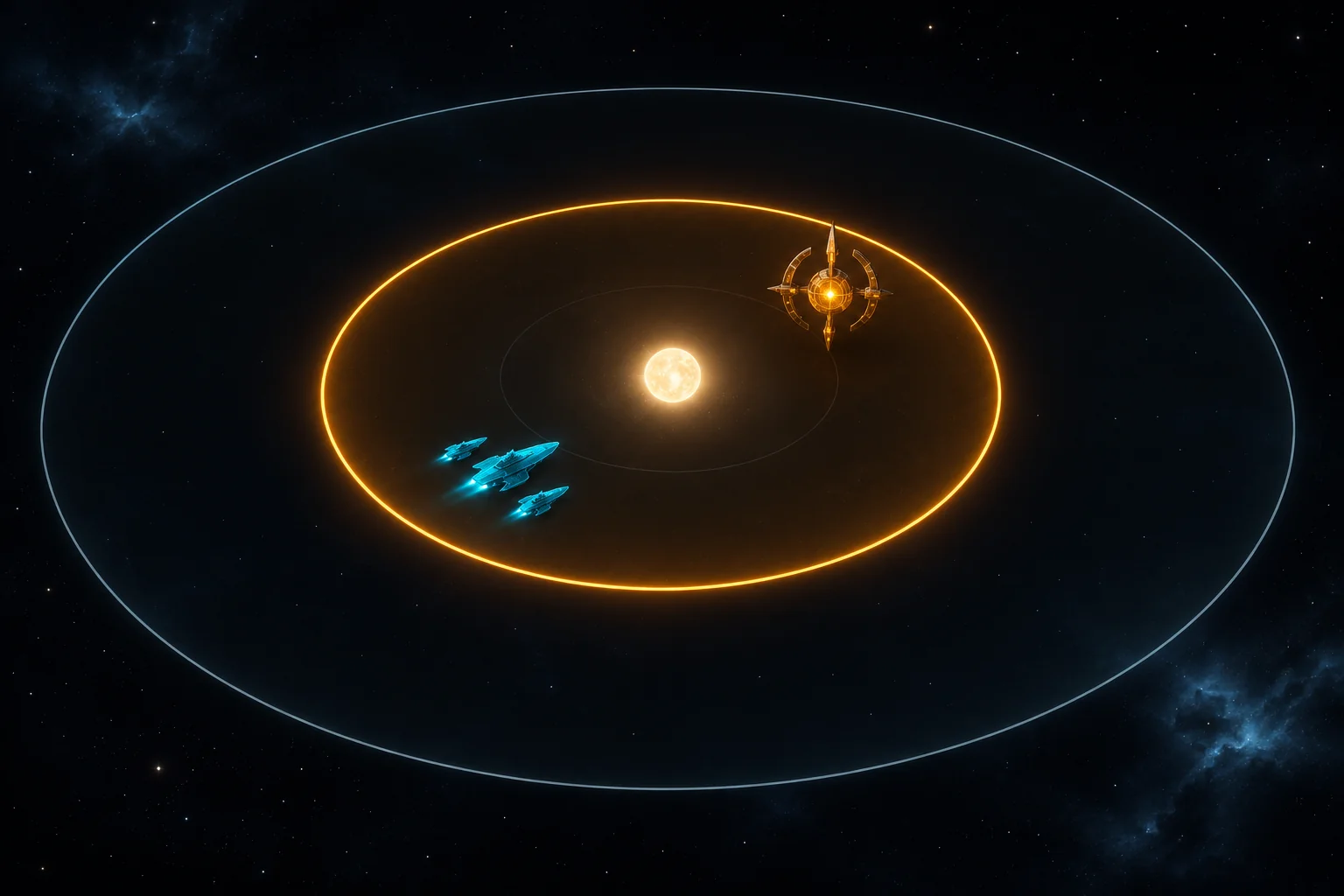
Keep the first encounter deliberately small. The fleet acts as one formation; there is no recruitment, production, settlement economy, or separate ship-role system. That keeps the design centered on fleet-level command timing rather than the settlement-to-unit pipeline explored by a different kind of space-fleet game.
Write the order contract before adding more systems
Every command costs one point, and Shift, Scan, and Fire can each be issued at most once in a round. The player chooses their order. A Scan prepares the first later Fire in that round; that shot deals two damage instead of one. Because Fire is limited to once, a scan can boost only that one shot. Any unused Scan expires at round end.
| Order or state | Rule | Why it matters |
|---|---|---|
| Threat signal | At round start, mark Inner, Outer, Inner across the three rounds. | The player knows which sector will be attacked after their orders. |
| Shift | Spend 1 point to move the whole allied fleet to the other sector; at most once per round. | Position can avoid a hit, but uses an order that could deal damage. |
| Scan | Spend 1 point to prepare the next Fire in the same round; at most once. | The scan is a temporary damage boost, not a stored resource. |
| Fire | Spend 1 point to deal 1 stability damage, or 2 if a Scan was prepared earlier in the round; at most once. | The player can choose a focused volley or combine it with a safe shift. |
| Enemy strike | After player orders, if the core still has stability and the fleet occupies the marked sector, reduce hull by 1. | A defeated core cannot fire; otherwise position decides whether the signal hits. |
| Round and restart | Fleet loses at 0 hull or if the core survives the third round. Restart restores the initial values and signal order. | The same encounter can be replayed from a known state. |
Resolve effects in the order the player selected. If Fire takes the core to zero, the fleet wins immediately and the enemy does not attack; stop resolving that encounter. Otherwise check the telegraphed sector after all orders. There is no randomness, critical hit, repair, hidden order, movement surcharge, or alternate victory condition. Fixing these edges makes it possible to check the design without guessing what a command does.
Resolve the two-order baseline
Start with version 0, which allows two orders each round. In round one the signal points at Inner, where the fleet begins. The example chooses Scan + Fire: the shot deals two damage, taking the core from five stability to three. The fleet has not shifted, so the Inner strike reduces its hull from two to one.
That is a deliberate trade in this chosen line. The player could instead Shift + Fire, leave Inner, and deal only one damage while keeping both hull. The selected trace spends both points on the stronger volley, then accepts the hit. It does not claim that this is the only possible or best player strategy; it shows exactly what that order sequence costs.
Round two marks Outer. Since the fleet is still in Inner, it is safe to Scan + Fire again. The core falls from three to one and the fleet stays at one hull. Round three marks Inner, so the player shifts to Outer and fires an unscanned shot. The last point of stability disappears before the core can attack. Version 0 wins after three rounds with one hull.
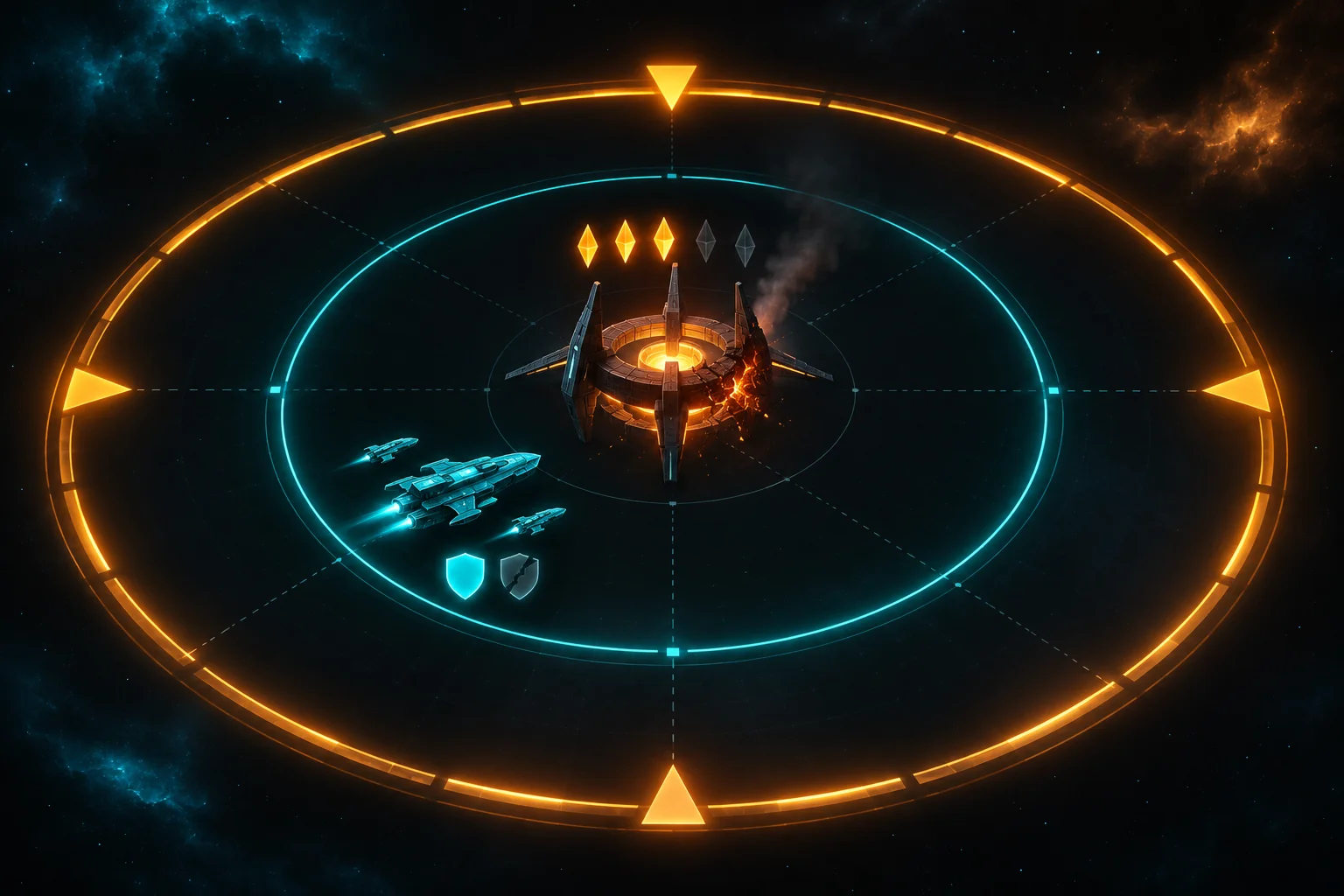
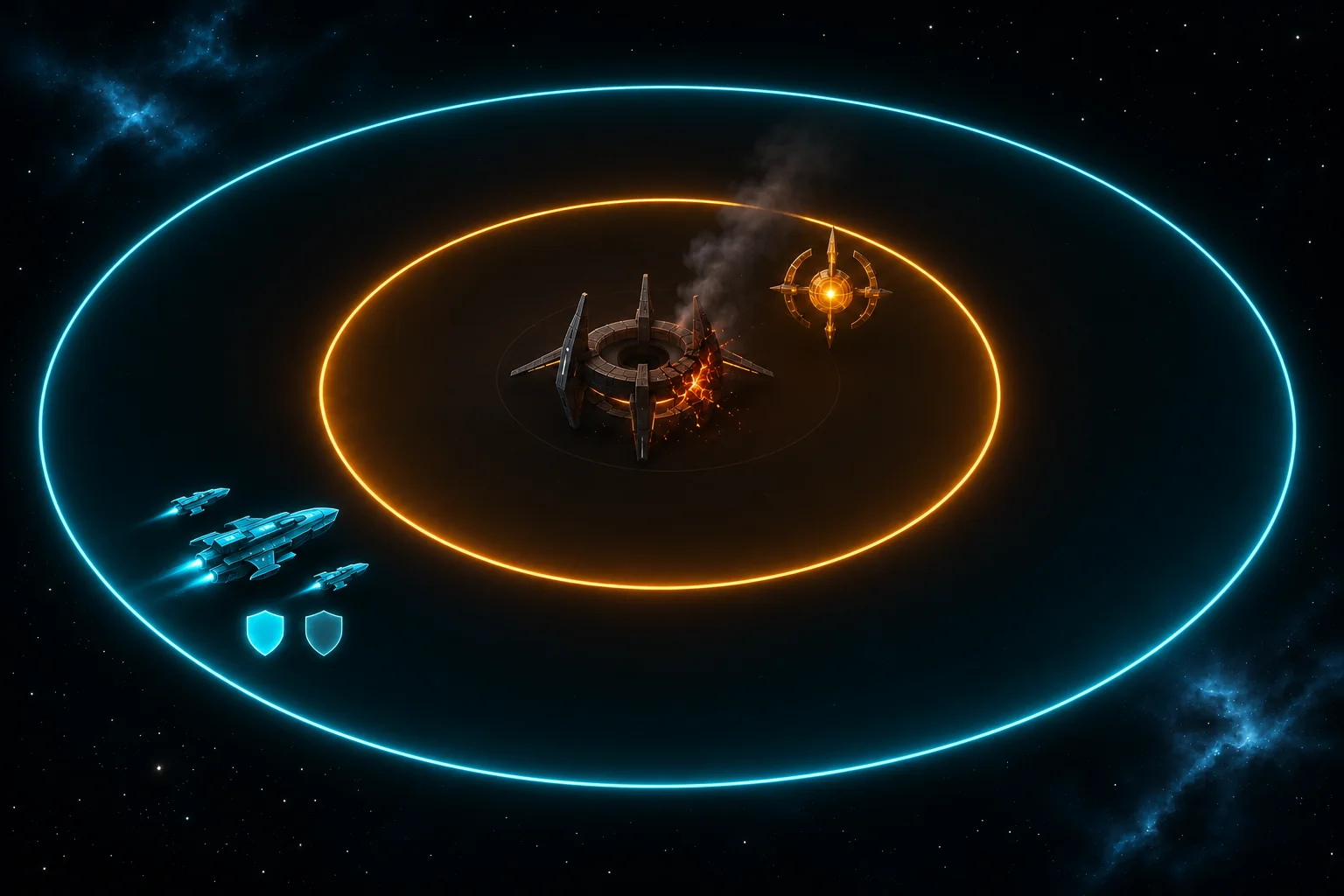
The picture represents the end of round one, not a game screenshot. The fleet is still in Inner, the relay core is weakened, one of two hull markers is dim, and the next threat has moved to Outer. Keeping the next signal visible helps explain why the fleet is safe to fire in round two.
Compare a three-order command window on paper
Version 1 changes one value only: the player has three command points instead of two. Shift, Scan, and Fire still each happen at most once in a round. During rounds one and two, the player can now shift away from the marked sector, scan, and fire in the same window. Each scan-assisted shot still deals two damage, so the core reaches three stability after round one and one after round two while the fleet keeps both hull.
In round three, the fleet shifts from Inner to Outer and fires without scanning. That final point of damage disables the core before its Inner strike. The v1 trace therefore wins with both hull markers intact. This hand calculation shows what the extra command point permits in this model: the player can preserve position and keep the two earlier scan-assisted volleys. It does not show that players prefer three orders, that the encounter is balanced, or that a game maker will implement the design correctly.
Use the same starting state and threat order for both versions. Changing only the command allowance makes the arithmetic comparable: v0 wins with one hull after taking the first hit; v1 wins with two hull after shifting clear of the signals in rounds one and two, then finishing with an unscanned Fire in round three.
| Round | Threat | Version 0: 2 orders | Version 1: 3 orders |
|---|---|---|---|
| Start | — | Fleet Inner, hull 2; core 5 | Fleet Inner, hull 2; core 5 |
| 1 | Inner | Scan + Fire: core 5→3; fleet stays Inner and takes 1 hit. Hull 1. | Shift to Outer + Scan + Fire: core 5→3; threat misses. Hull 2. |
| 2 | Outer | Scan + Fire: core 3→1; fleet is Inner and safe. Hull 1. | Shift to Inner + Scan + Fire: core 3→1; fleet is Inner and safe. Hull 2. |
| 3 | Inner | Shift to Outer + unscanned Fire: core 1→0 before its strike. Win, hull 1. | Shift to Outer + unscanned Fire: core 1→0 before its strike. Win, hull 2. |
The final image uses icon-only markers for both hull points and the order trace. Its bright scan symbols appear beside the first two shots; the last shot has no scan marker. The disabled core and the Inner threat marker make the end state distinct from the previous images. It is a concept illustration of the authored paper model, not evidence of a completed or tested game.
Hand the rules to a future prototype
A useful first build request describes the state, commands, order of resolution, and a few expected checks. The template below has not been run. It asks for a small implementation that a creator could inspect after a future build; it does not claim a generated result exists.
Build a small turn-based space fleet strategy prototype from this fictional rules brief.
Board: two sectors, Inner and Outer. One allied fleet starts in Inner. One hostile relay core starts at 5 stability. The fleet starts with 2 hull.
Round start: show the threat signal sequence Inner, Outer, Inner. The player has 2 command points in version 0 or 3 in version 1.
Orders: Shift, Scan, and Fire each cost one point and may each be used at most once per round. Shift moves the whole fleet to the other sector. Scan prepares the first later Fire in that round and expires at round end. Fire deals 1 stability damage, or 2 if Scan was used earlier in that round.
Resolution: after the player's chosen orders, if the core still has stability and the fleet is in the marked sector, reduce hull by 1. If the core reaches 0 first, win immediately before an enemy strike. Lose at 0 hull or if the core survives after round 3.
Interface: make the current threat, sector, remaining hull, core stability, and command points easy to read. Show the chosen orders and the result of each one.
Checks: from reset, reproduce the version 0 and version 1 traces in this article; confirm the scan boosts only the first Fire, shifting changes which signal can hit, the last shot can end the battle before the strike, and restart restores the exact opening state. Do not add extra actions, ship roles, repair, random events, or unlisted conditions. Treat this as a design brief, not a tested result.
When reviewing any future build, check one transition at a time: whether the signal appears before orders, whether commands decrement the correct budget, whether a scan is consumed by the next Fire, whether a fleet in the marked sector loses exactly one hull, and whether a core at zero stops the strike. Then restart and repeat the same sequence. If an output differs, record its observed state and adjust one unclear rule before adding new systems.
Use a general game-creation workflow without overpromising
The current Free AI Game Maker page says a plain-English idea can become a playable first version in 2D or 3D, then be tested in a browser and refined with follow-up prompts. These general capabilities do not confirm Signal Window as a preset or guarantee a particular build.
For a first pass, use the command contract as the brief, inspect the returned state, and replay the order sequence against the table instead of assuming the implementation matches. Before submitting, review the selected model, available Koin balance, and displayed generation cost in Workspace. Free AI game maker is the approved entry for a general game-creation task; the candidate Blog path and its attribution slug remain provisional until the route is accepted.
The transferable method is simple: expose one enemy threat, cap the player's orders, resolve a small encounter, and compare one parameter change while holding the rest constant. Signal Window is a fictional teaching example, so its results explain the arithmetic of its written rules only. A real prototype and playtest would be needed before making claims about player preference or balance.
Frequently asked questions
What makes a space fleet command window strategic?
A visible threat arrives before a limited set of orders, so the player must decide whether to move, scan, or fire. In Signal Window, Scan + Fire deals two damage but leaves the fleet in its sector; Shift + Fire avoids the marked sector but deals only one. The example uses fixed rules so the trade can be traced.
Is Signal Window a real or tested game?
No. Signal Window is an original fictional design used to explain how a command loop can be specified. The three-round comparison is calculated by hand from the rules shown here. No prompt was run, no playable build was inspected, and no player study or balance test is reported.
What happens if I Scan but do not Fire?
The Scan expires at the end of that round and does not become a saved resource. It boosts the first later Fire in the same round, if one occurs. The rules also limit each of Shift, Scan, and Fire to one use per round, so the example has no repeated shot or stacked scan behavior.
Does the three-order version prove that the game is better balanced?
No. The paper trace shows only that this chosen sequence can preserve both hull markers while disabling the five-stability core. Whether three orders feel more satisfying, make the challenge too easy, or suit real players requires a working prototype and playtesting. The extra point is a design hypothesis, not a measured improvement.
Can an AI game maker build this exact ruleset?
The page describes a general game-creation workflow, not a guaranteed Signal Window preset. You can use this contract to request a focused first version, then inspect its visible states and replay the same sequence. Before submitting, review the selected model, available Koin balance, and displayed generation cost in Workspace.