How do you make a tile-drafting strategy game that asks players to weigh both the tile in hand and the space it can complete? Start with a visible market, a small board, one placement per round, and an objective with two checks: build a continuous route and earn enough points before the last placement.
Marshlight Lines is a fictional rules exercise. Its three-round draft and the score change below were calculated on paper; no prompt has been run and no playable build or playtest is claimed. Use the example to make a first prototype brief precise, then verify the same states in an actual build.
Define the draft and placement loop
A tile-drafting turn has two decisions that should remain visible: which tile to take from the market, and where and how to place it. If a prototype hides the available tiles or changes the board automatically, a reader cannot tell whether a turn was won by drafting well, rotating well, or getting a lucky refill.
Marshlight Lines uses a three-by-three grid. The Harbor occupies the lower-left cell at (0,2), with a path port facing north. The Beacon sits at the upper-right cell at (2,0), with a west-facing port. A Rock blocks the center at (1,1). Every other cell starts empty. The board is small enough to inspect at a glance but still makes a direct diagonal route impossible.
| Tile | Open path sides | Useful choice |
|---|---|---|
| Straight | Two opposite sides | Rotate it to N–S or E–W to continue a route. |
| Bend | Two adjacent sides | Turn a path around an obstacle or toward a terminal. |
| Fork | Three sides | Keep more than one continuation available, at the cost of leaving an extra open end. |
The opening market contains one Straight, one Bend, and one Fork. Each round, choose one tile, rotate it freely, and place it in an empty cell that is not the Rock or a terminal. Replace the drafted tile from a known refill stack. Ports connect only when both neighboring cells face each other. A tile may be left with an unmatched port; it scores nothing until a later placement makes a reciprocal link.
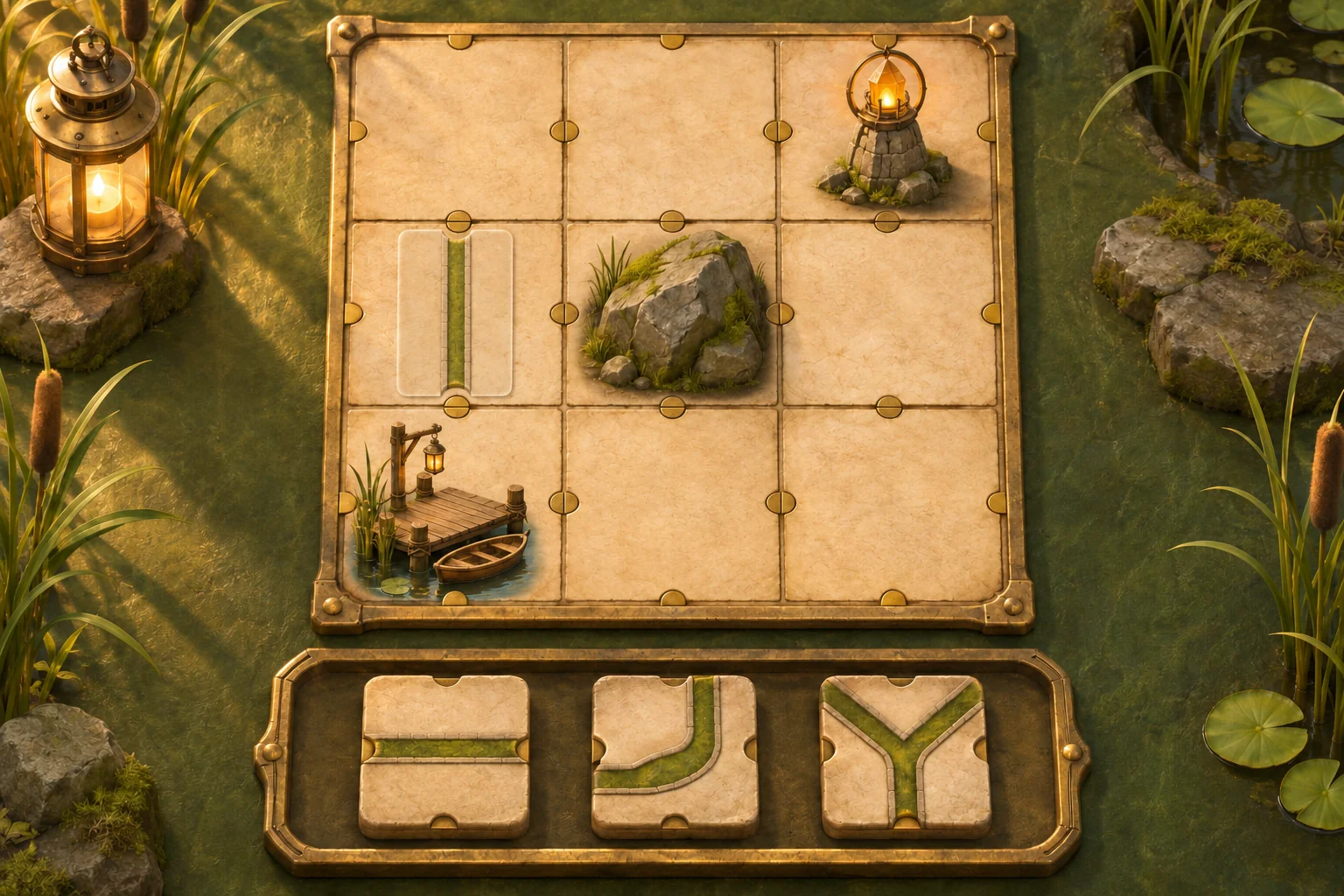
For a first prototype, show the whole grid and all market options at the same time. Make the selected tile preview its rotated ports before placement, and give a clear reason when a choice is rejected. That lets a player see the spatial cost of a draft rather than discover it after committing.
Make the objective testable
“Connect the Harbor to the Beacon” sounds like a goal, but it does not say whether a partial route is enough or what should happen at the end of the round. The example uses two acceptance checks: after three placements, a continuous chain of matching ports must join Harbor to Beacon, and the score must reach at least five.
In the starting rule set, each newly completed reciprocal link is worth one point. Count it once, immediately after a placement, and only if the neighbor is already a tile or one of the fixed terminals. This timing means an open port does not earn points on its own. It also makes scoring inspectable: the score can change only when the new tile closes a link.
| State to check | Expected rule | Why it matters |
|---|---|---|
| Cell legality | Only empty cells can take a tile; terminals and the center Rock stay fixed. | Prevents a placement from overwriting a board constraint. |
| Connection | Adjacent ports must point toward one another; score each new link once. | Stops a one-sided path from being counted as connected. |
| End of round three | Require both a Harbor-to-Beacon route and a score of five or more. | A high score cannot hide a broken route, and a route alone does not win. |
The two-part objective creates a useful tension. A Fork can offer extra options, but a Straight or Bend may close the one connection the route needs. The Rock gives placement a visible constraint, while the score target makes a short route trace meaningful. These authored rules are a teaching model, not a balance claim.
Write a first-build prompt
A build prompt should include the inputs, turn order, legal actions, expected result, and how to check an error. The deterministic market refill below removes randomness from one acceptance sequence. A future version could shuffle, but the first test should be repeatable before adding variation.
Starter prompt
Build a small digital tile-drafting strategy prototype called Marshlight Lines. Use a visible 3 by 3 grid with columns x=0..2 and rows y=0..2. Fix the Harbor terminal at (0,2) with a north-facing path port, the Beacon at (2,0) with a west-facing path port, and an unoccupiable Rock at (1,1). All remaining cells start empty.

Create three tile shapes: Straight has two opposite ports and rotates between north-south and east-west; Bend starts north-east and can rotate; Fork starts north-east-south and can rotate. A path connects only when ports in adjacent cells face each other. Unmatched ports are allowed but give no points. A tile may be placed only in an empty non-terminal, non-Rock cell. A rejected placement changes nothing and explains the occupied or blocked cell.

Show a public market with tile A Straight, tile B Bend, and tile C Fork. On each of exactly three rounds, let the player choose one market tile, rotate it, and place it. Refill in this deterministic order: D Fork, E Straight, F Bend. Award one point per newly completed reciprocal link to a previously placed tile or fixed terminal, counted once immediately after placement. The objective after round three is a continuous Harbor-to-Beacon route and at least five points. End with a clear win or miss state. Do not add random draws, extra tile types, a timer, or other scoring rules.

Acceptance trace: round 1, draft A, rotate it north-south, place at (0,1), connect Harbor for 1 point. Refill D. Round 2, draft B, rotate it south-east, place at (0,0), connect to round 1 for 1 more point. Refill E. Round 3, draft E, orient it west-east, place at (1,0), connect to the Bend and Beacon for 2 more points. The route is continuous around the Rock and the base score is 4, so the five-point objective is missed. Display the market, chosen tile, rotation, coordinate, new links, running score, and final route for each round so another person can verify the trace.
This prompt does not ask for a complete campaign or a large tile set. It asks for one controlled state that exposes the parts most likely to disagree: a rotated piece, two adjacent connections, a fixed obstacle, deterministic refill, and the end check. The explicit miss matters because a good acceptance test should be able to fail.
Hand-check three draft rounds
Before asking an AI creator to implement the loop, resolve the same three choices by hand. Coordinates are written as (x,y); each cell is one space. R1 begins next to the Harbor, R2 turns north and east, and R3 continues east to the Beacon.
| Round | Draft and placement | New reciprocal links | Running score | Route state |
|---|---|---|---|---|
| 1 | A Straight, N–S, at (0,1) | Harbor to Straight: +1 | 1 | Harbor reaches (0,1); north end remains open. |
| 2 | B Bend, S–E, at (0,0) | Straight to Bend: +1 | 2 | Route turns east; the Beacon is not reached yet. |
| 3 | E Straight, W–E, at (1,0) | Bend to Straight: +1; Straight to Beacon: +1 | 4 | Continuous route reaches the Beacon, but misses the five-point target. |
The topology can be checked from the ports. Harbor faces north into the south side of the R1 Straight. That tile's north port meets the R2 Bend's south port. The Bend's east port meets the west side of the last Straight, whose east port faces the Beacon's west port. The Rock at (1,1) is untouched. Four links are counted: one after each of the first two placements and two after the final placement.
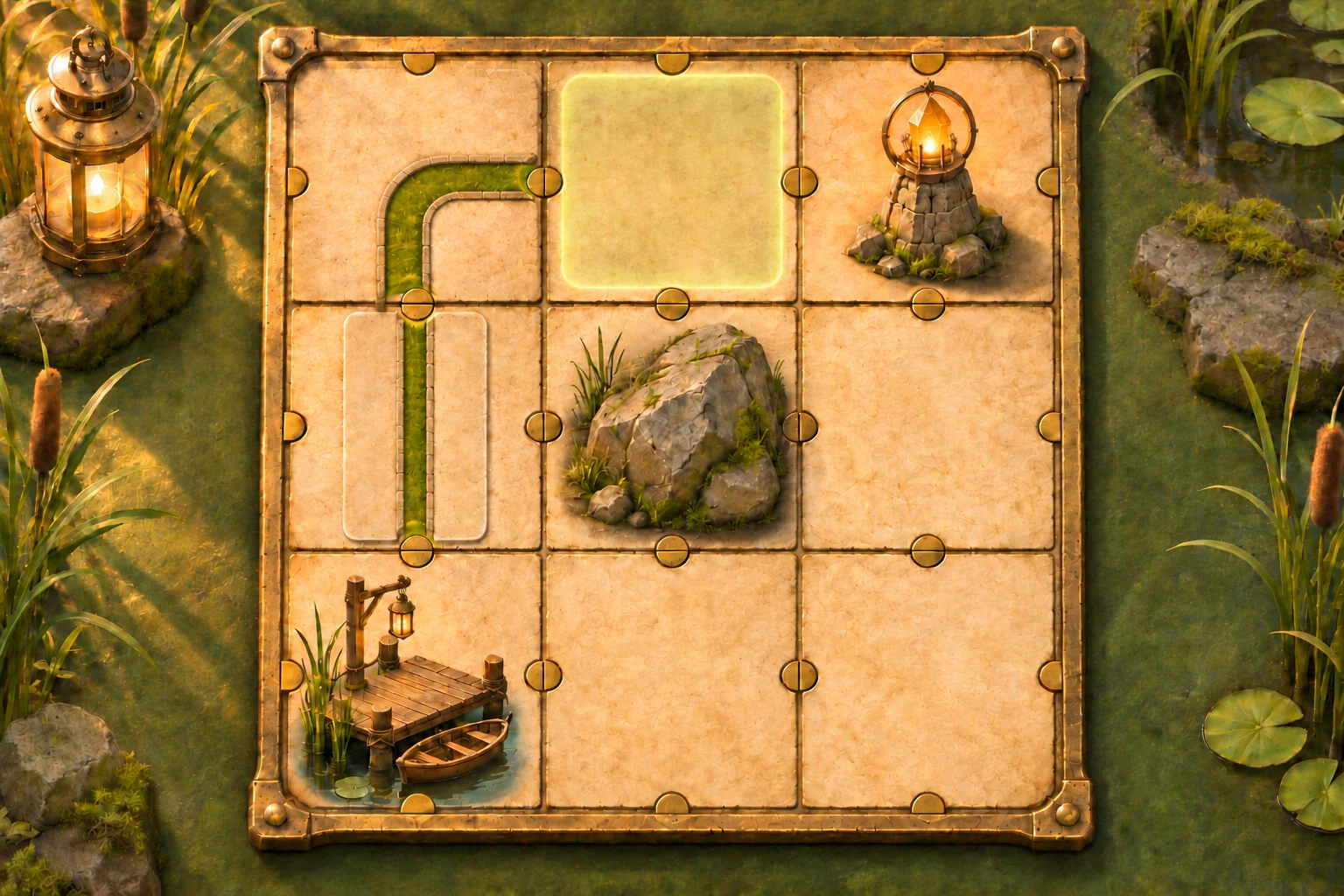
At round two, the player spends the Bend from the visible market and commits it to the upper-left cell. The placement is valuable because it extends a live Harbor route; a disconnected Bend elsewhere would not add to this path. In a future build, inspect the market before and after the choice, the tile's rotation, the occupied coordinates, and the exact score delta.
Revise one rule and recheck
The base trace reaches the Beacon but scores only four, so it fails the stated objective. To illustrate a narrow design revision, keep the board, market, refill, placements, route requirement, and target unchanged. Change only the value of a completed Beacon link from one point to two.
Re-score the same sequence: R1 remains one point; R2 remains one; R3 still closes the Bend link for one and now gives two for the Beacon link. The total becomes five, with the same continuous route. The revision changes only one scoring rule, so the two traces are comparable.
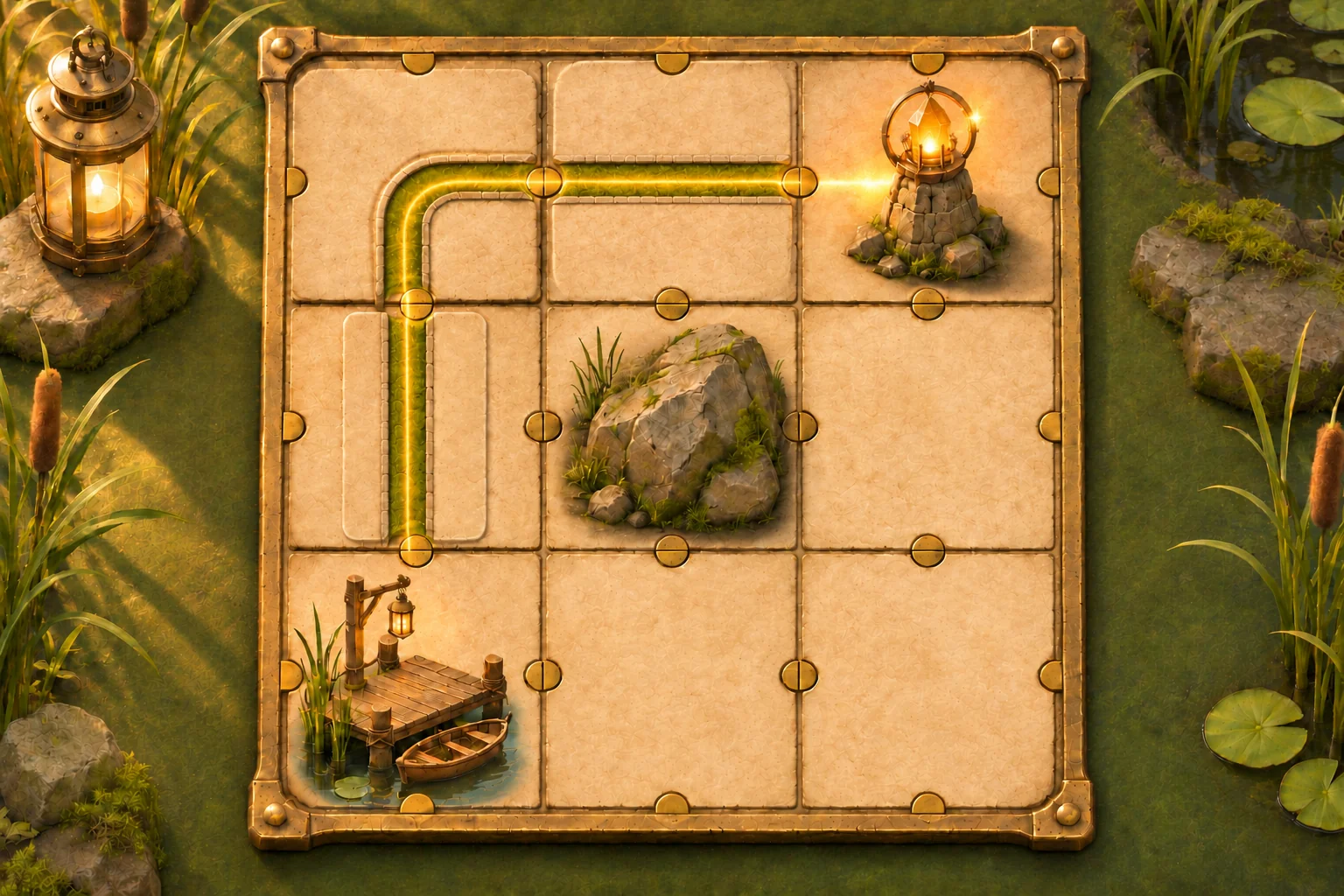
A terminal bonus is one design option, not a proven improvement. It makes reaching the Beacon more valuable and turns this particular four-point miss into a five-point pass, but it may overvalue the last link. A real prototype check would record actual player choices and outcomes before deciding whether to keep the rule. Until then, describe v1 as a manually checked variant, not an empirical iteration.
Use AI to build and review the prototype
SEELE's official Free AI Game Maker page describes a broad workflow: explain a game in plain English, review a playable 2D or 3D result, and continue iterating in Workspace. It advises checking the selected model, available Koin balance, and displayed generation cost in Workspace before submitting a generation request. Those capabilities make a focused tile-drafting brief a reasonable starting input, but they do not guarantee that this exact board, market, or scoring rule will be implemented correctly.
After a build exists, replay the three-round acceptance sequence. Confirm the initial market, deterministic refill, cell rejection, port orientation, once-only link score, route continuity, and final score. If the first mismatch appears at round two, report that state and request a focused correction; do not silently change the scoring or board at the same time.
When you are ready to bring your own idea into the creation workflow, use the Free AI game maker. The article's route is still a local candidate, so its attribution slug must be reconciled if the final route changes.
FAQ
What makes tile-drafting different from ordinary tile placement?
The player first chooses among visible pieces, then decides how to rotate and place the selected tile. The market choice and the board consequence are both part of the turn, so show both when checking a prototype. Keep the available options visible before selection; otherwise a placement test cannot confirm whether the player saw the alternatives.
Does an unmatched port score points?
No. In this example, a point is awarded only when the new tile completes a reciprocal connection to an existing tile or fixed terminal. Each new link is counted once when the placement resolves. A dangling port may stay on the board, but it neither scores nor proves the Harbor route is connected.
Should I add tiles that change between encounters?
Keep the first prototype focused on a single board and market. Persistent tile changes are a separate mechanic; add them only after the basic draft, placement, and scoring checks work. For the first pass, use a fixed market and three placements so each route and point can be traced without between-encounter state.
Has Marshlight Lines been generated or playtested?
No. Marshlight Lines is an original fictional rules exercise, the trace and scoring revision are hand-calculated, and the images are concept illustrations. No playable build, observed result, online game, or empirical test is claimed. Use the sequence as a design checklist, then compare any future build with the stated acceptance states.