A territory-control game becomes easier to design when control follows a repeatable rule: each side claims one adjacent space from the same start-of-round map, then a strict majority decides who owns it. Add one valuable landmark, a clear end condition, and a route you can recalculate by hand. The example below, Beacon Lines, is an original fictional design. Its map and outcomes are hand-calculated. No game-generation prompt was run; Codex ImageGen prompts were used only for these concept illustrations. No build or playtest exists.
Turn a Territory-Control Idea Into a Small Prototype
Start with seven regions and one action per faction. Two permanent Home regions provide a starting point, three middle regions create different frontiers, and two eastern objectives give each route a destination. Each round, both factions add one persistent influence marker. Score only regions with a strict marker majority; a tied region is neutral. The goal is to make a map choice matter before adding combat, resources, or special units.
Choose a Small Map With Two Open Frontiers
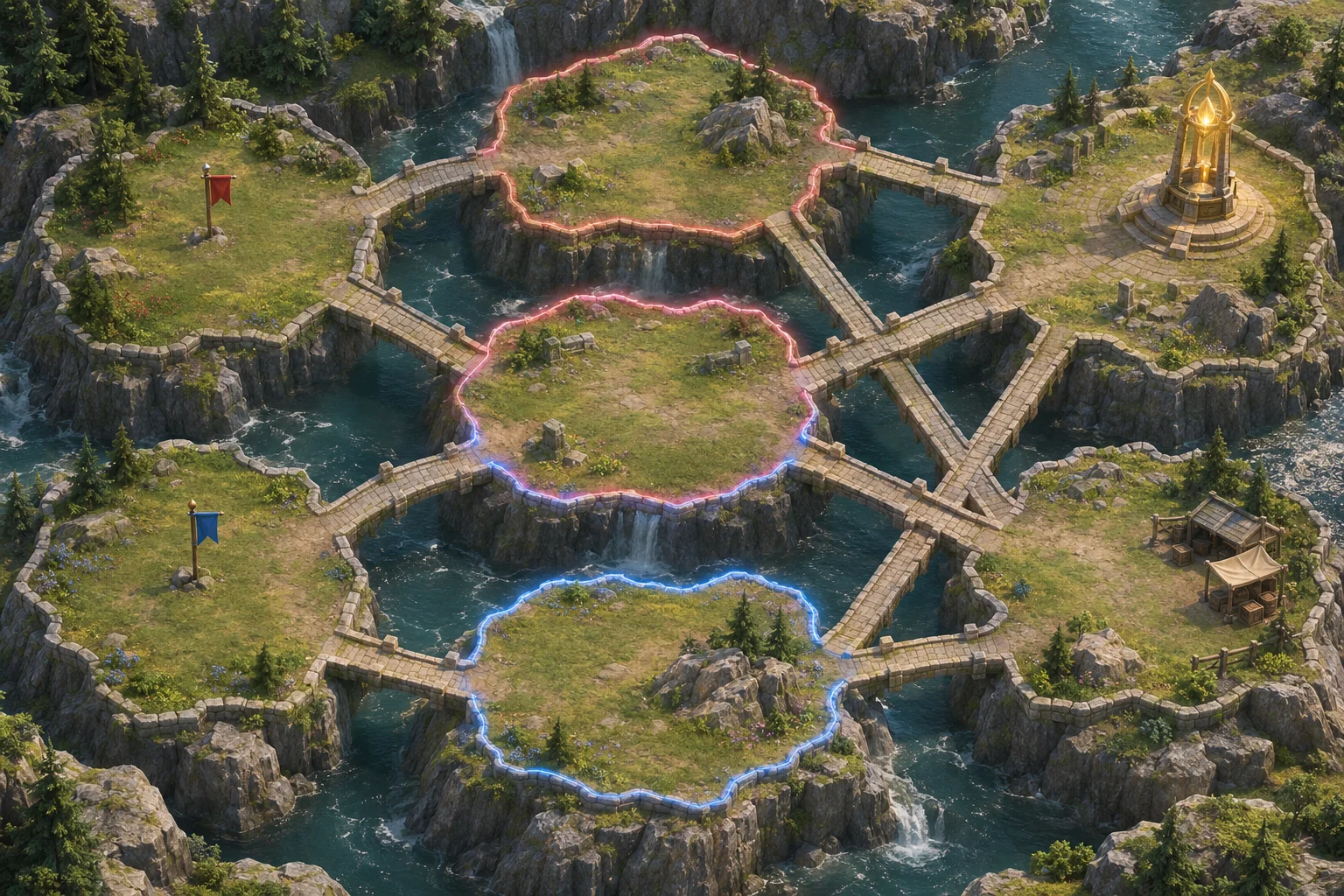
Write adjacency as a graph before drawing scenery. A route exists only when it appears in the table. In particular, the three middle regions do not connect to one another; each connects to both objectives. That keeps the legal frontier rule simple and stops a same-round claim from opening a new move.
| Region | Adjacent regions | Opening state |
|---|---|---|
| Red Home | North Pass, Crossroads | Permanently Red; 1 point |
| Blue Home | Crossroads, South Pass | Permanently Blue; 1 point |
| North Pass | Red Home, Beacon, Depot | Neutral |
| Crossroads | Red Home, Blue Home, Beacon, Depot | Neutral |
| South Pass | Blue Home, Beacon, Depot | Neutral |
| Beacon | North Pass, Crossroads, South Pass | Neutral objective |
| Depot | North Pass, Crossroads, South Pass | Neutral objective |
Red begins with two legal first claims: North Pass or Crossroads. Blue can choose Crossroads or South Pass. Beacon and Depot are not legal first targets because neither Home connects directly to them. That one-step distinction gives both players a meaningful choice without a large map or a list of exceptions.
In the concept image, colored route glows are visual cues, not extra rules. The adjacency table remains the movement contract; a scenic bridge, terrain gap, or apparent distance never creates a new edge by itself. Home pennants indicate permanent ownership. Pennants in non-Home regions represent the persistent influence markers used by the scoring rule.
Make the Frontier Rule Run on a Simultaneous Turn
Separate a marker from ownership. Markers persist, while ownership is recalculated after each round. Both players choose from the same opening snapshot and reveal their choices together. A newly claimed region cannot be used to make a second move in that round.
| Step | Rule | What the player can read |
|---|---|---|
| 1. Snapshot | Record each side’s controlled regions at the start of the round. | The legal frontier is visible before choosing. |
| 2. Choose | Each side selects exactly one adjacent non-Home region from that snapshot. | Neutral, tied, opposing, or already owned non-Home regions are valid targets. |
| 3. Resolve | Reveal both choices together and add one persistent marker to each target. | No move order or current-round capture changes the other choice. |
| 4. Recalculate | A strict marker majority controls a non-Home region; equal counts make it neutral. | A tie scores nothing, even if the region is the Beacon. |
| 5. Score | Score controlled regions, then check the win gate. | Four points and a lead of at least one wins immediately. |
Each Home is always controlled by its faction and worth one point. Each ordinary non-Home region is worth one point. The Beacon is worth one base point plus a one-point landmark bonus, for two total in the final rule. Depot and the three middle regions are worth one each. Home ownership is permanent; it is not determined by a marker majority.
The game lasts at most three rounds. After scoring a round, a faction wins immediately at four or more points if it leads by at least one. If nobody reaches that threshold by the end of Round 3, the higher score wins and a tie is a draw. Restart clears all non-Home markers and restores the opening state and rival script.
This order answers the central implementation question: can a player claim a space, then use it immediately to reach another one? No. The snapshot is taken first, both targets are chosen from it, and only then are markers resolved. A map can display many possible future routes without letting current-round captures rewrite the action that is already underway.
Replay the Same Route After One Beacon Rule Change
For a compact paper check, Red chooses North Pass in Round 1, then Beacon in Round 2. Blue follows a fixed fictional script: South Pass, Depot, Beacon. The script is an input for this hand-calculated example, not AI behavior or an observed opponent.
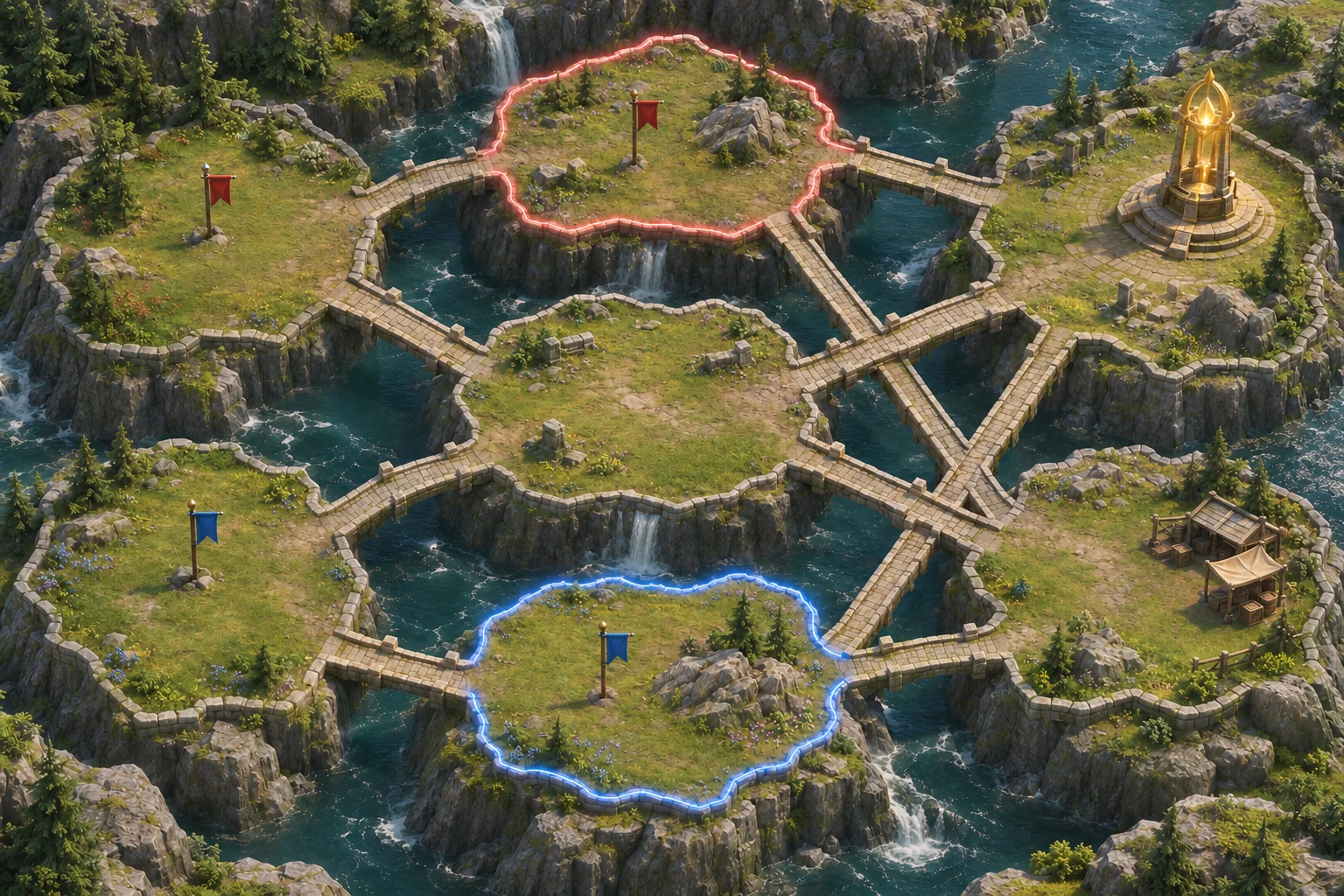
| Moment | Red | Blue | State |
|---|---|---|---|
| Start | Home: 1 | Home: 1 | Five non-Home regions neutral |
| After Round 1 | Home + North Pass = 2 | Home + South Pass = 2 | Crossroads, Beacon, Depot neutral |
| Round 2 targets | Beacon | Depot | Both targets are adjacent to a controlled pass |
At the end of Round 1, each claimed pass has one marker, so Red and Blue each score two including Home. In Round 2, Beacon receives Red’s first marker and Depot receives Blue’s first marker. Each region changes from neutral to controlled by its sole marker owner. North Pass and South Pass remain controlled; Crossroads stays neutral.
Under the initial paper rule, Beacon is worth one point. Red scores Home 1 + North Pass 1 + Beacon 1 = 3. Blue scores Home 1 + South Pass 1 + Depot 1 = 3. Neither reaches four or leads, so the game continues. Change exactly one variable: make Beacon worth two total points, with the extra point labeled as its landmark bonus. Replay the same two rounds and the same choices. Red scores 1 + 1 + 2 = 4; Blue scores 1 + 1 + 1 = 3. The win gate now ends the game at 4–3 after Round 2.
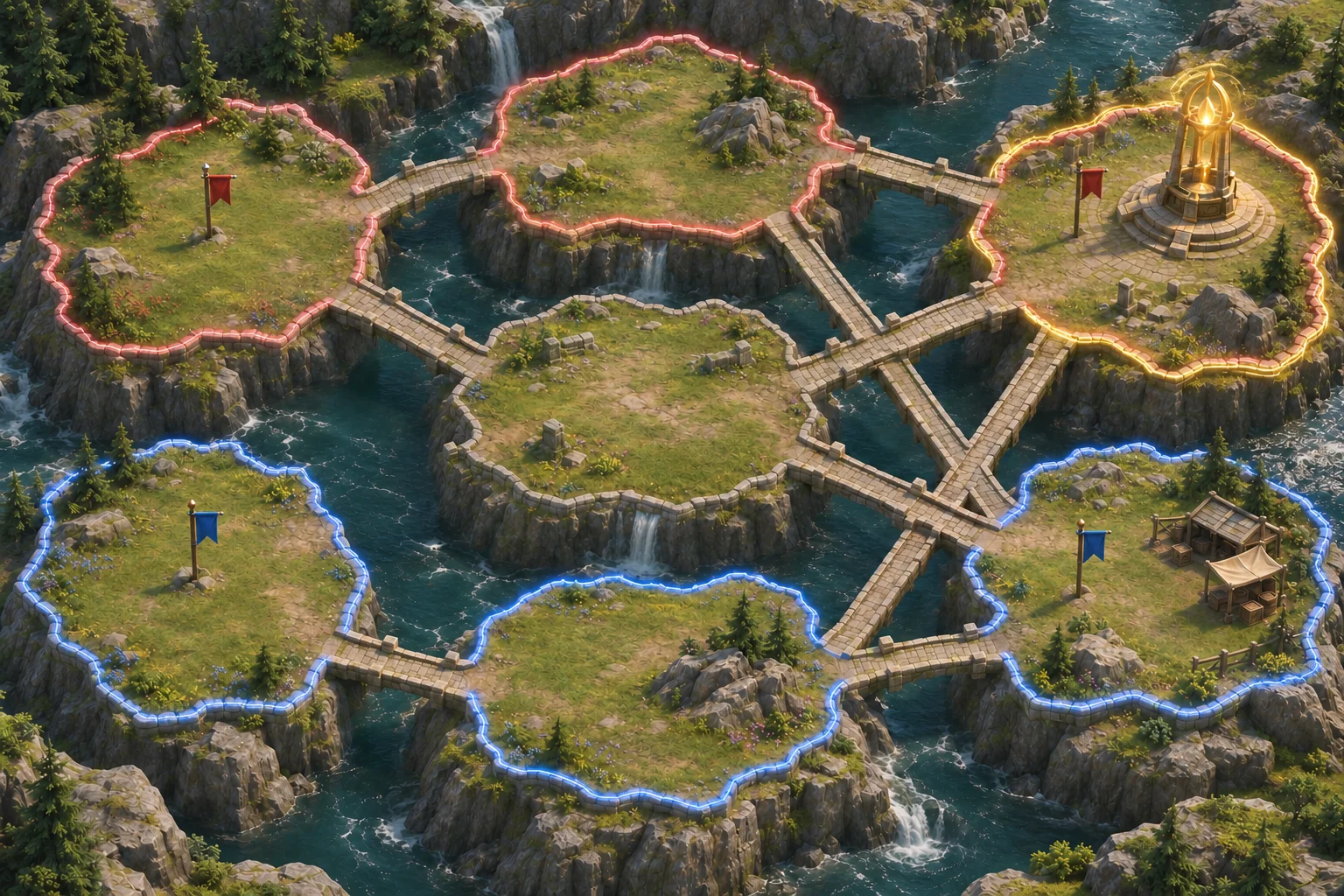
The v0 route would continue. For a defined Round 3 continuation, Red chooses Depot and Blue chooses Beacon. Each objective now has one marker from each side, so both become neutral ties. Crossroads is still neutral; the only scored spaces are the two Homes and two passes, giving a 2–2 draw. The calculation shows how a landmark value changes this chosen route. It does not show that players understood it, enjoyed it, or found the game balanced.
A failed route under final v1 rules shows the opposite. In Round 2, both sides choose Depot from their pass. Depot receives one marker each, stays tied, and neither side earns its point; the score remains 2–2. In Round 3, both choose Beacon, which also ties. The bonus is not awarded to a neutral region, Crossroads remains neutral, and the final score is again 2–2. The Beacon matters only when a route wins control.
Write One Bounded AI Build Brief
Once the paper rules are fixed, turn them into one constrained request. Keep the map, legal target rule, marker resolution, score, and restart in the same prompt so that the requested build has a testable contract. This is a proposed template, not a prompt that has been submitted or run:
Create a small turn-based territory-control game called Beacon Lines using exactly seven regions: Red Home, Blue Home, North Pass, Crossroads, South Pass, Beacon, and Depot. Use only these edges: Red Home—North Pass/Crossroads; Blue Home—Crossroads/South Pass; each of North Pass, Crossroads, and South Pass—Beacon/Depot. Do not connect the three middle regions to each other. Each round both factions choose one target adjacent to a region they controlled at the start of that round, then reveal choices simultaneously and add one persistent marker to each target. A strict marker majority owns a non-Home region; a tie is neutral and scores nothing. Homes are permanent and worth one; ordinary regions are worth one; Beacon is worth two total. Red's sample choices are North Pass then Beacon; Blue's fixed sample script is South Pass then Depot. Win after scoring with at least four and a one-point lead; otherwise compare scores after Round 3, with a tie as a draw. Include a restart that clears non-Home markers. Do not add combat, resources, randomness, extra regions, or a current-round move from a newly claimed region. Make legal choices and ownership feedback visible.The prompt names input, rules, feedback, and limits. If a future build exists, compare it with the adjacency table and state trace. Reject an implementation that allows a Crossroads-to-North Pass move, awards a tied Beacon, or places a second claim in the same round.
Check the First Result Against the Paper Contract
Before claiming a prototype works, verify a real accessible build. Record actual state after each action and compare it with the expected state; stop at the first divergence rather than smoothing over a mismatch.
- Confirm there are seven regions and only the listed edges. Check that none of the three middle regions connects directly to another.
- Confirm both factions choose from the same start-of-round ownership snapshot and get exactly one claim per round.
- Check that one marker controls a non-Home region, equal markers make it neutral, and ties score zero.
- Reproduce the safe route: after Round 1, 2–2; with the Beacon bonus, after Round 2, 4–3 and Red wins.
- Reproduce the failed v1 route: both teams tie Depot and Beacon, then finish 2–2 without awarding the Beacon bonus.
- Restart and confirm that all non-Home markers disappear and the opening script can run again.
For each round, log both chosen targets, the opening ownership snapshot, marker totals, resulting ownership, points, and whether the win gate fired. If there is no accessible build, mark validation “not run.” The Beacon Lines traces here are expected states from a manual calculation, not observed gameplay or test data.
Start a Territory-Control Prototype With AI
A checked rules brief gives a game-making workflow something concrete to interpret. SEELE’s Free AI game maker page describes entering a game idea in plain language, reviewing a playable 2D or 3D result, iterating in Workspace, and checking the selected AI model, available Koin balance, and displayed generation cost before submission. That is a general workflow, not evidence that it will build Beacon Lines or pass this checklist. Bring the rules, inspect the result, and verify each transition yourself.
Territory-Control Game FAQ
How do you decide who controls a territory?
For this design, count persistent markers after both factions make their one simultaneous claim. A strict majority controls a non-Home region; equal counts leave it neutral. Home regions are permanent and use no marker-majority check. Score only regions that are controlled when the round resolves.
Why resolve both claims at the same time?
Both choices are checked against the same start-of-round ownership snapshot. That prevents the first player from changing the second player’s legal frontier mid-turn and keeps each round reproducible. A newly claimed space becomes part of the next round’s map, not an extra action in the current one.
How can a landmark change a strategy game?
Give the landmark a clear value and keep the control rule unchanged. In Beacon Lines, the only paper revision raises Beacon from one point to two. The same safe route moves from 3–3 to 4–3, so it crosses the win gate. That is a calculation about this fictional route, not measured balance evidence.
What should I ask an AI to build first?
Specify a compact map, the exact adjacency list, one claim action per side, the simultaneous resolution rule, scoring, a win condition, and a restart. Ask for visible legal targets and ownership feedback. Leave combat, random events, and extra objectives out until the first state transitions match the contract.
Is the Beacon Lines example a playtest?
No. Beacon Lines is an original fictional design, and its route outcomes were resolved manually from the rules in this article. No game-generation prompt was run. Codex ImageGen prompts were used only for concept illustrations; no playable build or player session was observed. Treat the numbers as expected states; test a real accessible build before reporting a gameplay result.