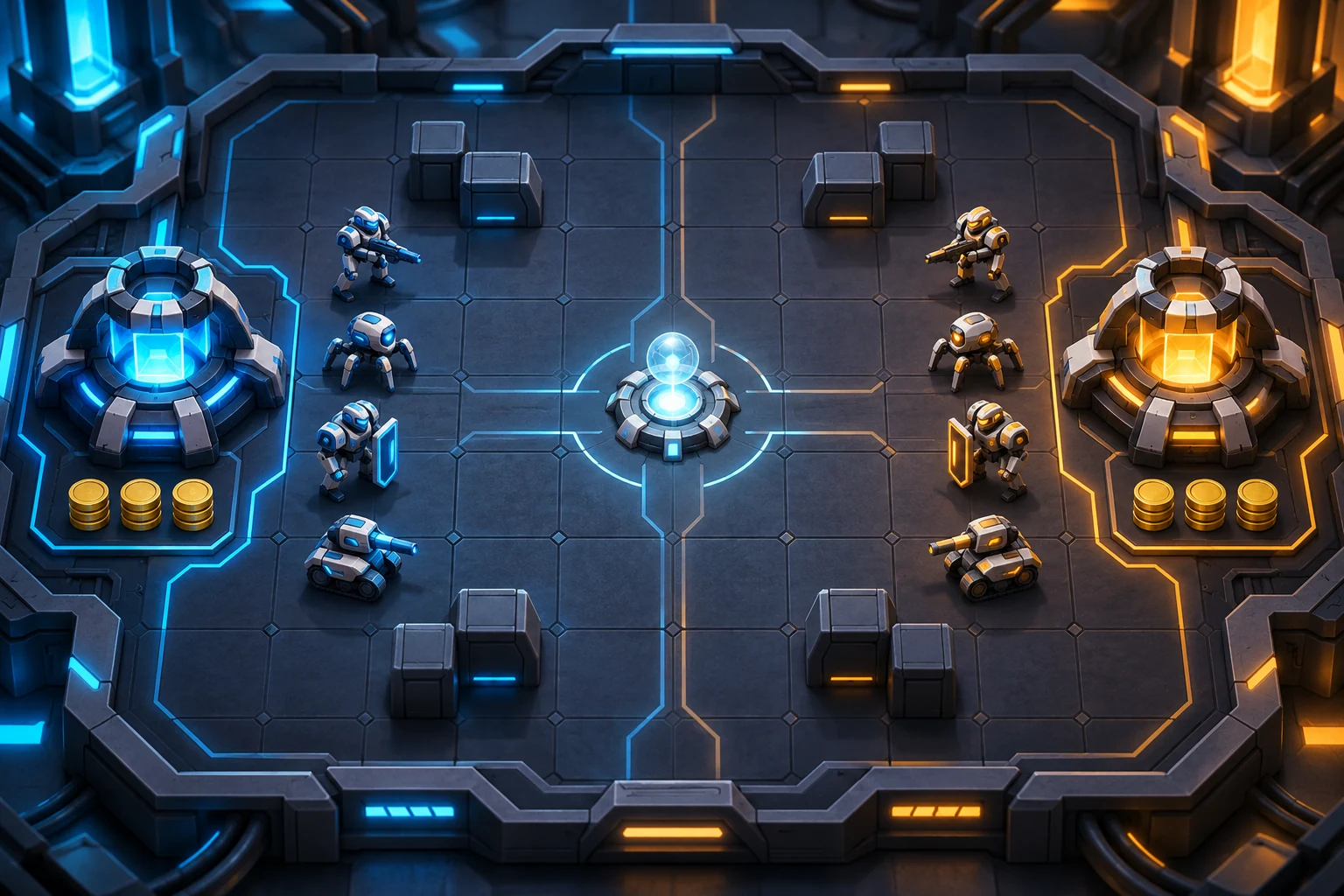
In the fictional Iron Vale, each unit uses one chassis and one module. A Scout chassis with Surveyor moves up to three connected regions but contributes one control point. A Bastion chassis with Relay moves one region and contributes three control points while holding a site. Each build costs two alloy and one module token. The local scenario tests whether the scout can reach a distant outpost first and whether the slower Bastion can secure a contested junction. These units, values, and outcomes are fictional.
Give each part a clear territory role
Start with two chassis and two modules so the combinations are easy to compare. The Scout chassis moves through three connected regions; the Bastion chassis moves through one. Surveyor adds one point of control, while Relay adds two more control points when its unit occupies a site. Together with the chassis base point, a Scout Surveyor scores one and a Bastion Relay scores three. Keep movement and control as separate stats so a fast unit does not automatically dominate a region.
Use a small connected map with a home region, a contested junction, and a distant outpost. Each unit costs two alloy and one module token to assemble. A player wins by holding two sites at the end of a round. Show the part recipe, movement range, and control value on the build screen, then display the region owner and control total after each move.

Assemble a scout and a territory holder
Build the Scout with Surveyor when reaching a remote site matters more than winning a direct contest. From the home region, it can cross three connected links and arrive at the outpost in one move. Its one control point captures an empty site, but it cannot dislodge an enemy unit contributing three points at a junction. This creates a useful route-planning role without making the scout a universal answer.
Pair the Bastion with Relay to defend a valuable junction. It moves only one link per turn, so it must be positioned early, but its three control points beat a lone scout at a contested site. If both players have equal control, leave the region disputed and award it to neither side. Make the tie rule explicit and resolve ownership after all moves so turn order does not decide the contest.

Compare mobility with holding power
Run the same map twice. In the mobility case, deploy a Scout Surveyor and move it along three links to the empty outpost. It reaches the site this round and scores one control point there. In the holding case, deploy a Bastion Relay one link from the junction. It reaches that region more slowly, but its three control points secure the site against a one-point scout. Record build cost, path length, arrival round, and control result for each configuration.
For a matched control, keep the chassis and map the same but remove the specialized module bonus: the Scout still moves three links and contributes one point, while the Bastion has only its one base point. In the fixture, the Bastion then ties the scout at the junction instead of controlling it. The comparison shows why modules should alter a meaningful decision. Iron Vale and the scenario outcomes are fictional; the local test checks only these authored rules.

Ask an AI game maker to prototype modular territory control
Create a territory-control strategy game called Iron Vale on a connected map with a home region, contested junction, and distant outpost. Each unit costs 2 alloy and 1 module token and uses one chassis plus one module. Scout chassis moves up to 3 links; Bastion moves 1. Surveyor Scout has 1 control point. Relay Bastion has 3 control points at a site. Resolve all moves before ownership; ties remain disputed. Win by holding 2 sites at round end. Show part recipes, movement paths, control totals, owner, and disputed ties.
Test a Scout Surveyor moving three links to capture an empty outpost and a Bastion Relay moving one link to hold a junction against the Scout. Then remove the Relay bonus in a matched control: Bastion and Scout each contribute 1 point, so the junction remains disputed. Keep costs, map, and movement unchanged; log arrival round and control totals.
FAQ
How do modular units make a territory-control game more strategic?
Make each component change a decision players can see on the map. A chassis can set movement range while a module changes control strength or another objective stat. Players then choose between reaching a distant site quickly and holding a contested region. Keep recipes and outcomes readable so combinations feel purposeful rather than cosmetic.
How should I balance fast units and strong territory holders?
Give mobility and control separate values, then test both on the same connected map. A fast unit can reach an empty outpost but should not automatically defeat a slower defender at a contested junction. State how ties work, resolve moves consistently, and compare arrival time, build cost, and captured sites across matched scenarios.
What should I test in a modular unit prototype?
Check that each build recipe spends the intended parts, each chassis follows its movement limit, and modules change only their defined stats. Replay a contest with and without the module bonus while keeping the map and starting state fixed. Log movement paths, control totals, region ownership, ties, and the round when victory is checked.