Define the Iron Meridian map
A territory-control game needs a clear rule for how a faction gains and loses ground. If the board only changes color without explaining why, a prompt can produce a map that looks strategic but gives each move no readable consequence. Start with a small graph, identical pieces and a visible end-of-round score.
This guide uses Iron Meridian, a fictional two-faction strategy game. Units move between connected regions, and control depends on which faction is currently present. If a unit leaves and the other side has no unit there, control can disappear. A contested region scores neither side. The six prompts below are unrun drafts; the map and traces are design examples, not a playable result, playtest or measured balance evidence.
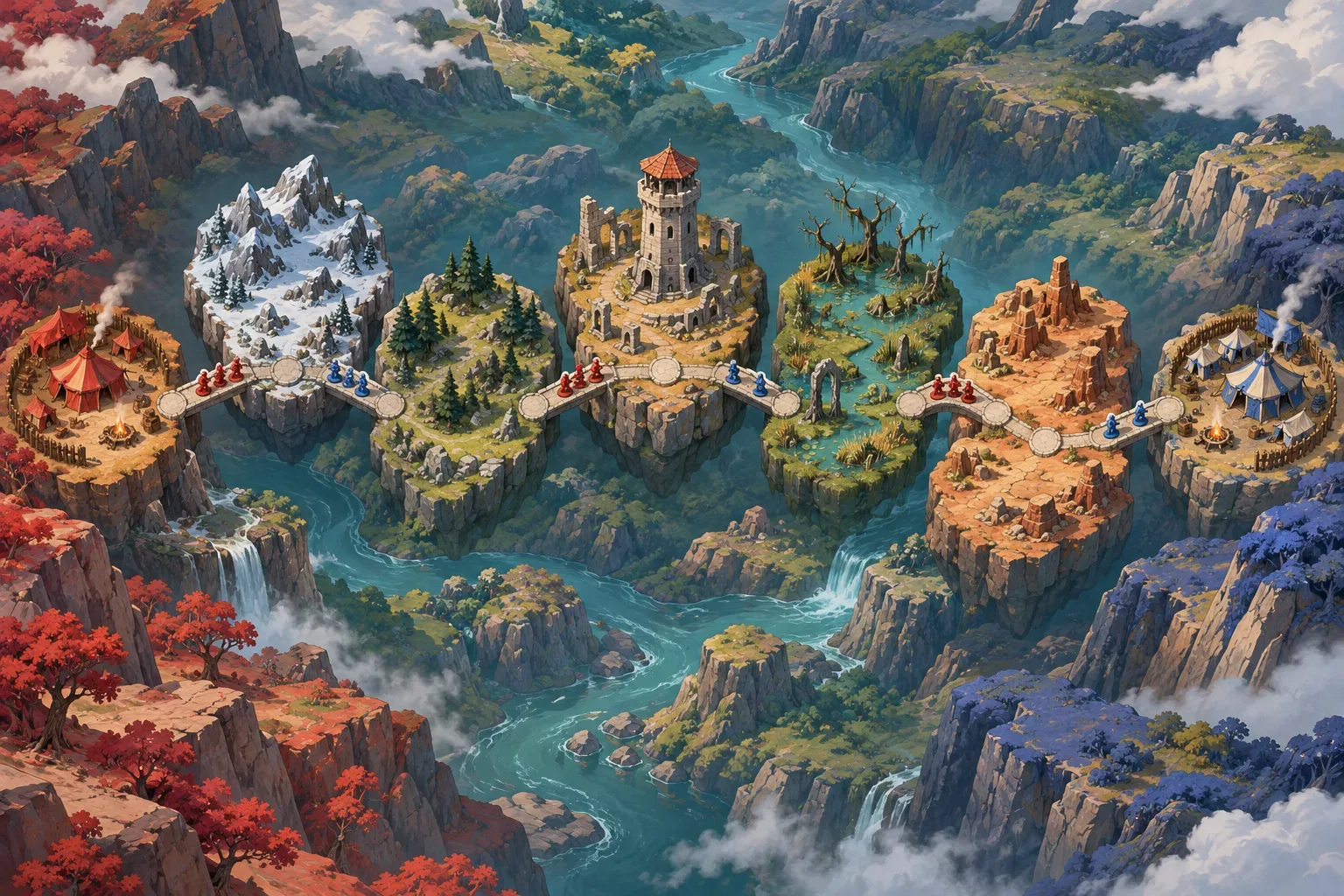
The graph has seven nodes. Red Home and Blue Home are starting bases and are not scored. The five frontier spaces form routes through North, Bridge, Tower, Marsh and South. Bridge also connects directly to Marsh, creating a cross-route around the Tower. This one extra edge gives each side another way to approach the center without adding a second map.
| Region | Connections | Round score when controlled |
|---|---|---|
| Red Home | North, Bridge | Not scored |
| North | Red Home, Bridge | 1 point |
| Bridge | Red Home, North, Tower, Marsh | 1 point |
| Tower | Bridge, Marsh | 2 points |
| Marsh | Bridge, Tower, South | 1 point |
| South | Marsh, Blue Home | 1 point |
| Blue Home | South | Not scored |
The important distinction is how the game stores control. Iron Meridian has no permanent influence tokens, no majority threshold and no simultaneous marker placement. It uses current unit presence: movement changes where a faction can score on the next snapshot. That makes it different from a marker-based territory puzzle and from a modular unit-building game. Every piece has the same role and stats; there is no combat or assembly phase.
Define movement and control
Give each side three identical units at its Home. The game lasts four rounds. In each round, a faction may issue up to two movement commands. Each command moves one unit across one listed edge. A unit may move only once in that round, and the player may skip a command to leave a useful position unchanged. Units from either side may share a region.
| State or action | Rule | Why the prompt needs it |
|---|---|---|
| Setup | Three units per faction at its Home | Both sides use the same starting force |
| Command limit | Up to two moves per faction each round | Sets the amount of board change before scoring |
| Movement | One unit crosses one edge; no unit moves twice per round | Prevents a piece from racing across the map in one turn |
| Shared space | Units may share; opposing presence makes the region contested | Creates a way to deny points without removing pieces |
| Command skipped | Allowed; a unit can hold its current position | Lets the player preserve a scoring position |
| Combat | None; units cannot damage or remove another unit | Keeps the first prototype about routes and control |
At round end, inspect each non-home region. If one faction has one or more units there and the other has none, the first faction controls it. If both factions have units, it is contested and scores zero. If no units remain, the space is neutral and also scores zero. Presence, not the number of pieces, decides control; sending a second unit into a region already held by the same side does not double its value.
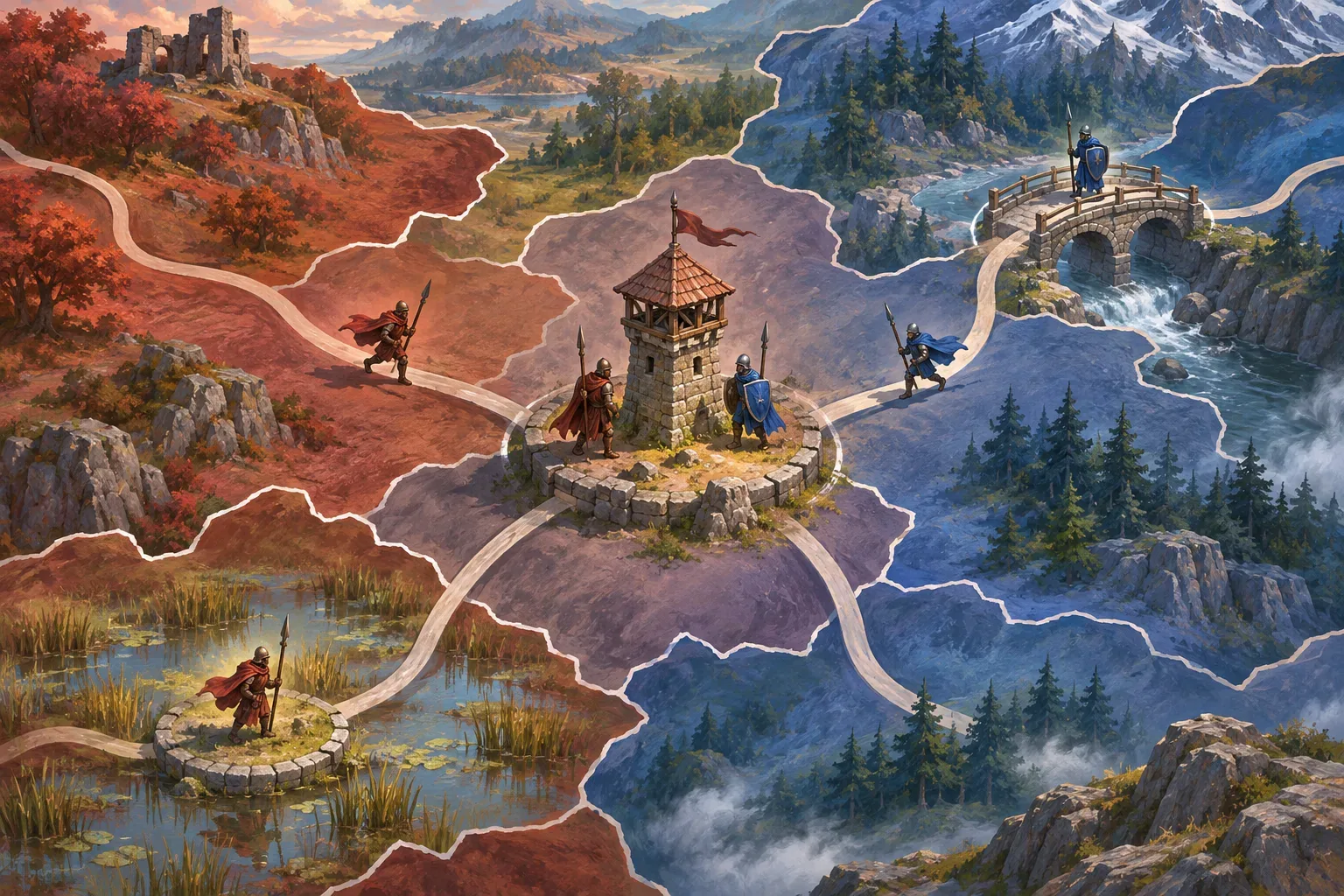
This rule makes a move reversible. If Red moves its only unit out of North, North stops scoring for Red immediately unless another Red unit remains there. If Blue enters a Red-held Bridge, the region becomes contested at the next score check. The board does not preserve an earlier claim after its units leave.
Do not resolve the example as combat. A prompt that invents attacks, unit health, reinforcements, capture timers or a majority rule changes the design. For version one, the player reads a route, moves pieces, checks sole presence and adds the listed score. More elaborate tactics can come after this loop behaves predictably in a real build.
Score the board each round
Score the board as a snapshot at the end of each of the four rounds. North, Bridge, Marsh and South are each worth one point while solely controlled. Tower is worth two. Home bases do not count. Add that round's points to the faction's running total; do not remove prior points when a faction later abandons a region.
After round four, the higher cumulative total wins and an equal total is a draw. There is no early victory threshold. Restart moves all six units back to their own home bases, clears both scores and returns the game to round one. The fixed duration makes it possible to compare two movement plans under the same conditions.
| End-of-round board state | Control outcome | Score |
|---|---|---|
| Red has units at North; Blue has none there | Red controls North | Red +1 |
| Both sides have one or more units at Tower | Tower is contested | Neither side scores there |
| No units at South | South is neutral | Neither side scores there |
| Blue has units at Tower; Red has none there | Blue controls Tower | Blue +2 |
Keep cumulative score separate from current control. A territory can stop contributing next round without erasing points already earned. That distinction is easy to miss if a prompt only says “score controlled land”; name both the snapshot and the carry-forward total.
Trace the four-round example
Use a fixed rival script to make the arithmetic repeatable. The script is only an example input; it is not an AI opponent or a product behavior. The trace below puts both sides on similar routes, then lets their units collide around the center.
| Round | Red movement | Blue movement | Round score | Cumulative score |
|---|---|---|---|---|
| 1 | R1: Home→North; R2: Home→Bridge | B1: Home→South; B2: Home→Marsh | Red 2, Blue 2 | Red 2, Blue 2 |
| 2 | R1: North→Tower; R2 holds Bridge | B1: South→Tower; B2 holds Marsh | Red 1, Blue 1; Tower contested | Red 3, Blue 3 |
| 3 | R2: Bridge→North; R3: Home→Bridge | B2 holds Marsh; B3: Home→South | Red 2, Blue 2; Tower contested | Red 5, Blue 5 |
| 4 | R1: Tower→Marsh; R2: North→Bridge | B1: Tower→Bridge; B3: South→Marsh | 0–0; Bridge and Marsh contested | Red 5, Blue 5 — draw |
In round one, each side controls its two occupied frontier regions. In round two, Tower contains a unit from both sides, so its two-point value is suspended for that snapshot; Bridge still scores for Red and Marsh for Blue. At the next round, Red's two moves restore sole control of North and Bridge, while Blue's standing Marsh unit and new South unit produce the same two points.
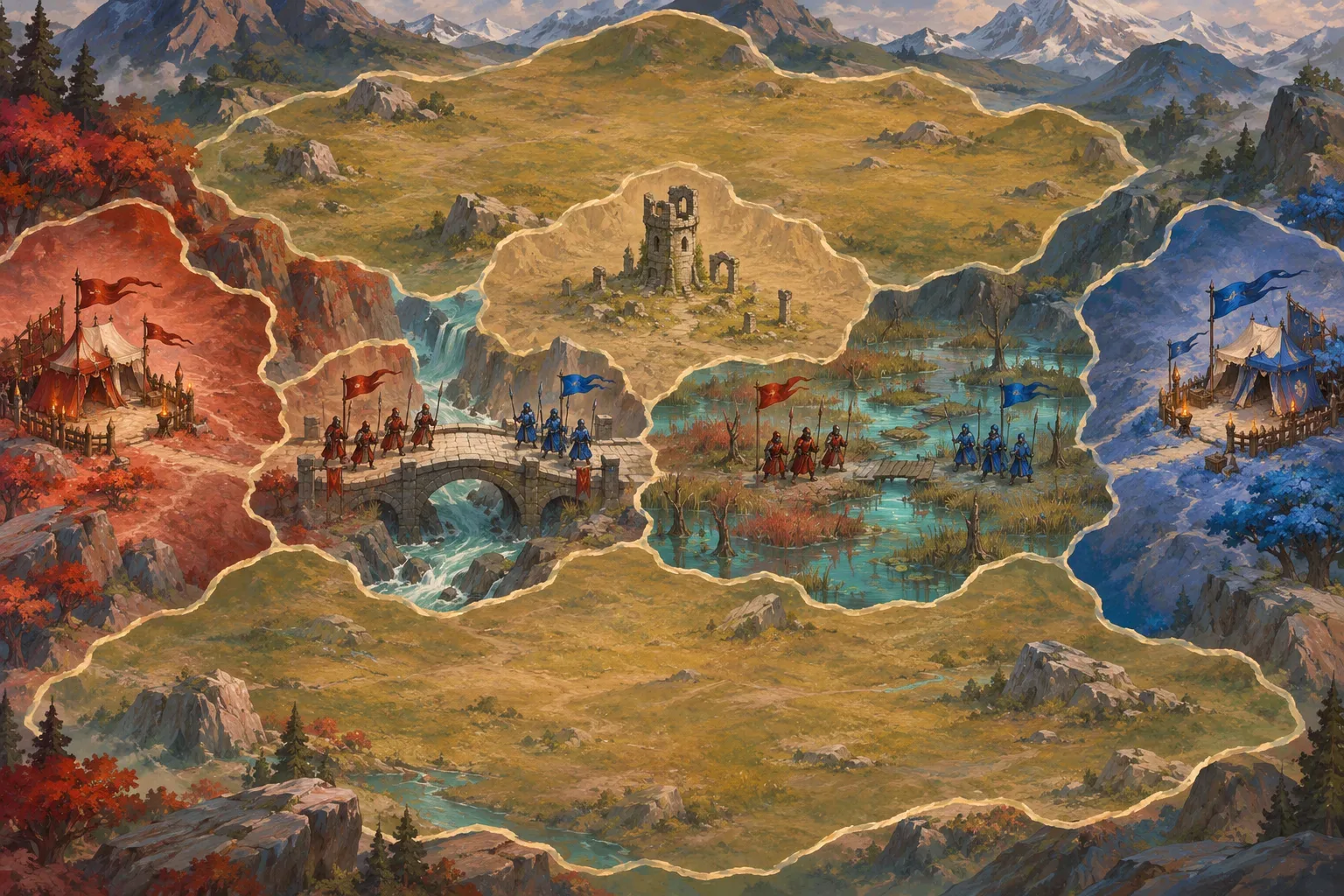
In round four, units converge at Bridge and Marsh. Tower has been vacated, but no one occupies it; North and South are also empty. The round adds no points, leaving the prior 5–5 tie unchanged. This trace shows why a valuable center does not guarantee a win: timing and route overlap matter, and contested spaces award nothing.
The table is not evidence of balance or strategic fun. It is a hand calculation from stated rules. A later playable check should verify that the same positions, control labels and score totals appear after each round.
Write the six prompts in sequence
Keep each prompt focused so an unexpected rule is easy to find. First ask for the board and setup; then specify state, movement, scoring, a concrete trace and future checks. These drafts are for Iron Meridian and have not been run.
Prompt 1 — map and scope
Create a deterministic two-faction territory-control game called Iron Meridian on a fixed seven-node map: Red Home, North, Bridge, Tower, Marsh, South, Blue Home. Connections are Red Home–North, Red Home–Bridge, North–Bridge, Bridge–Tower, Bridge–Marsh, Tower–Marsh, Marsh–South, South–Blue Home. Use identical mobile units. Do not add combat, resources, modular parts, upgrades, random events or extra map nodes.Prompt 2 — starting state
Give Red and Blue three identical units at their respective Home nodes. Track each unit's location and moved-this-round flag, the current round and both cumulative scores. Play exactly four rounds. Restart returns all six units to their Home nodes, clears both scores and begins round 1.Prompt 3 — movement
At the start of each round, clear every unit's moved flag. Each faction may issue up to two commands. A command moves one of its units across exactly one listed edge. A unit may move at most once per round. The player may skip a command and leave a unit in place. Units may share nodes. Do not add combat or remove units.Prompt 4 — control and score
At the end of a round, inspect each non-home node. If at least one unit from only one faction is present, that faction controls it. If both factions are present, it is contested and scores 0. If empty, it is neutral and scores 0. North, Bridge, Marsh and South score 1 each; Tower scores 2. Add the snapshot score to cumulative totals. After round 4, higher total wins and a tie is a draw.Prompt 5 — trace the sample
Follow these manual examples exactly. Round 1 Red moves R1 to North and R2 to Bridge; Blue moves B1 to South and B2 to Marsh; score 2–2. Round 2 move R1 North to Tower and B1 South to Tower, leaving the other units still; Tower is contested, Bridge and Marsh score, totals 3–3. Round 3 Red moves R2 Bridge to North and R3 Home to Bridge; Blue keeps B2 at Marsh and moves B3 Home to South; each scores 2, totals 5–5. Round 4 Red moves R1 Tower to Marsh and R2 North to Bridge; Blue moves B1 Tower to Bridge and B3 South to Marsh; Bridge and Marsh are contested, the other regions are empty, score 0–0. Final is a 5–5 draw. Label this as authored rule arithmetic, not generated gameplay.Prompt 6 — checks for a future build
For a future playable version, log round, command, unit, origin, destination, moved flag, controlled nodes, contested nodes, round score and cumulative score. Check all graph edges, the one-move limit, skipped commands, contested and empty scoring, Tower value 2, four-round finish and Restart. Do not mark a check passed until an actual build is inspected.For general workflow context, SEELE describes turning a plain-English prompt into a playable first version, testing in a browser and refining it with follow-up prompts. That official page does not verify Iron Meridian or its mechanics. Explore the general workflow at Free AI game maker.
Prepare future build checks
If a playable version is generated later, compare its state after each command with the fixed graph and scoring rules. Record the game version and actions so a mismatch can be reproduced. The table lists expected design behavior; none of these checks has been run.
| Check | Expected behavior | Evidence to capture later |
|---|---|---|
| Legal edge | Move only across one listed connection | Unit origin, destination and graph edge |
| Move limit | No unit moves twice in one round | Unit ID and moved flag before/after |
| Contested node | Presence from both sides scores zero | Occupants, control label and round total |
| Tower value | Sole control adds two points for that snapshot | Tower occupants and score calculation |
| Finish and reset | Four rounds decide result; Restart restores three units at each Home and zero scores | Terminal round and reset state |
Until those observations exist, keep the result language conditional. The prompt sequence is useful for communicating a design, but a coherent specification does not prove that an AI tool or an implemented game followed it.
Frequently asked questions
What should a territory-control game prompt define?
Define the region graph, unit movement, the condition for control, how contested spaces score and when the match ends.
How is current unit presence different from influence markers?
In this fictional design, units can move away and control can disappear next round. Influence markers in other designs may remain and build a majority.
How many regions should a first territory-control prototype use?
A small fixed graph is easier to trace. Iron Meridian uses seven nodes and one high-value Tower region.
Does a contested territory score points here?
No. A region with both factions present is contested and scores zero for that round.
Were these territory-control prompts tested in a playable game?
No. Iron Meridian and its traces are fictional design material. The prompts are unrun and no playable build or observed test result is included.