Set up the Tideglass hand
A trick-taking game needs a precise answer to three questions: which cards may be played, which card wins, and who leads next. A prompt that says only “follow suit and win tricks” leaves too much to interpretation once a special rule is added. Define one compact hand and resolve every card before asking for more decks, powers or modes.
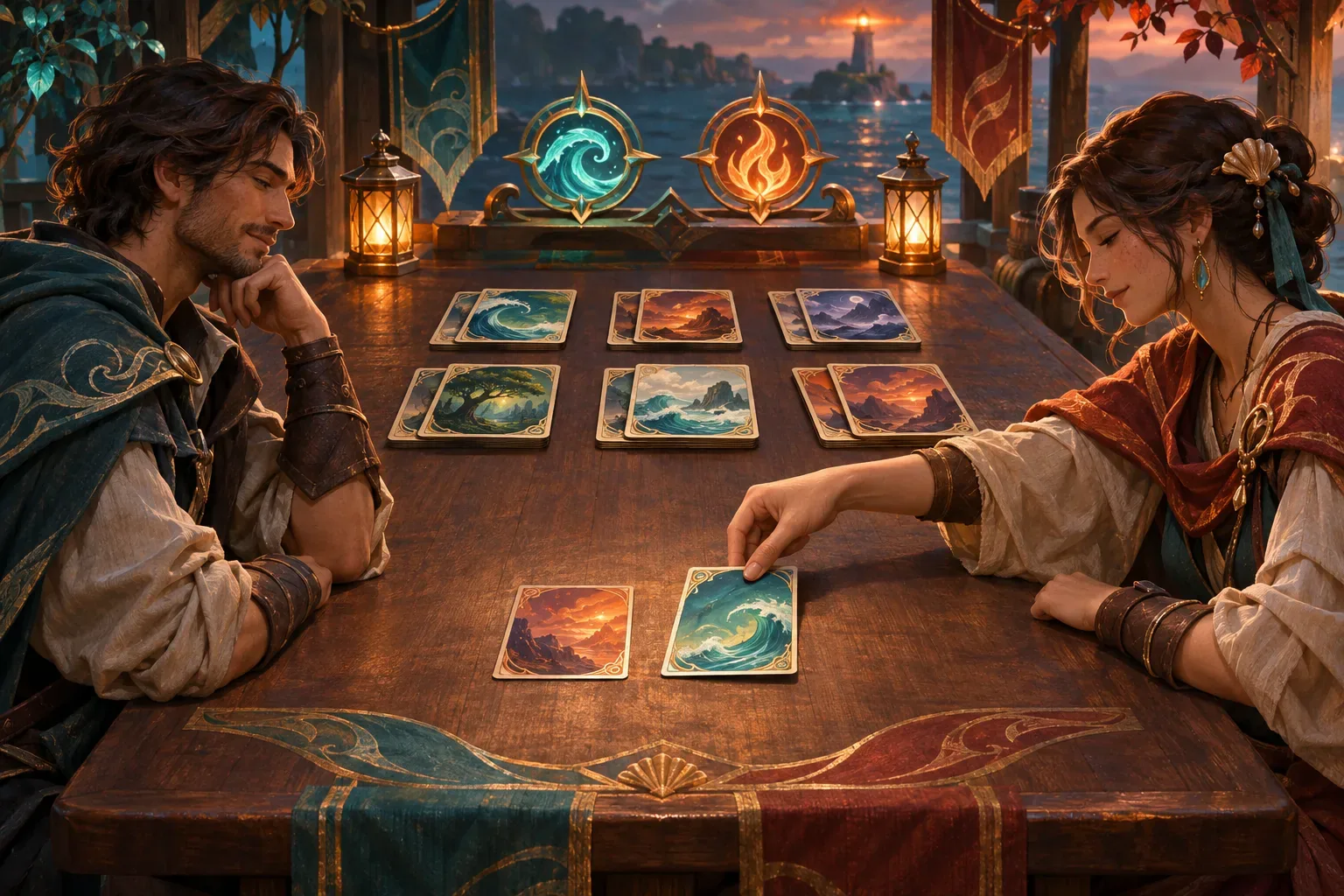
This guide uses Tideglass, a fictional two-player game with fixed hands and a public Beacon suit that changes each trick. The Beacon can override the suit that was led, which creates a different decision from ordinary highest-led-suit play. The prompt drafts are unrun and the six-trick hand below is hand-calculated design material. There is no playable build, observed deal or empirical result.

Use three suits: Tide (T), Moss (M) and Ember (E), each numbered 1 through 6. Red begins with T6, T2, M5, M1, E4 and E2. Blue begins with T5, T1, M6, M3, E6 and E3. Each player holds six cards, and every trick removes its played cards from the hand. No cards are drawn during the example.
This prompt library is distinct from a four-player partnership tutorial that focuses on ordinary led-suit ranking, and from a dice-based game where players permanently reshape their dice. Tideglass uses two players, fixed cards and a rotating public suit priority. It does not use partnerships, dice, bidding or persistent card changes.
Define follow suit and the Beacon
Red leads the first trick. The other player must follow the led suit if they have a card of that suit. If they are void, they may play any remaining card. Each trick has two cards, one from each player. The winner takes the trick and leads the next one. The card rank ranges from 1 to 6, with a higher number winning when comparing cards in the same qualifying suit.
The public Beacon sequence is Tide, Moss, Ember, Tide, Moss, Ember across tricks one through six. If at least one Beacon-suit card appears in a trick, the highest-ranked Beacon card wins even if another suit was led. If no Beacon card appears, the highest card in the led suit wins. Because each trick has only two cards and ranks do not repeat within a suit, there is no tie-break rule to invent.
| Situation | Winner rule | Example |
|---|---|---|
| At least one Beacon card is played | Highest rank in the Beacon suit wins | With Moss Beacon, M6 beats M5 |
| No Beacon card appears | Highest rank of the led suit wins | With Ember led, E6 beats E4 |
| Follower has the led suit | Must play that suit | Red holds Moss, so must follow a Moss lead |
| Follower is void in led suit | May play any card | A Beacon card can then take priority |
Do not silently make Beacon a conventional trump suit that always wins or changes the lead requirement. It only changes how the two cards are ranked after they are played. The follower still has to follow the lead suit when possible. That keeps legal choice separate from winner resolution.
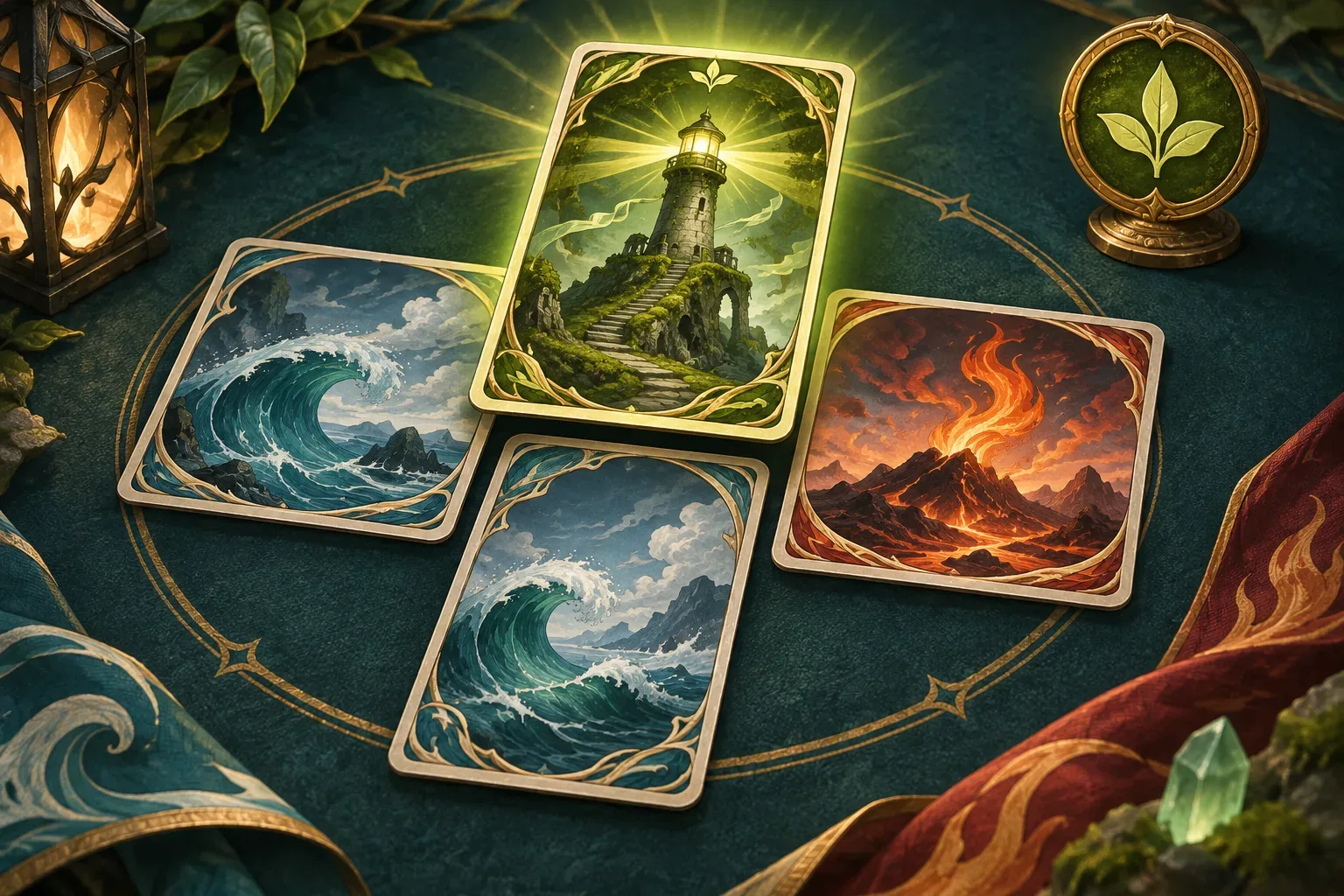
The winning card also matters for scoring. Each trick is worth one point. If the winning card belongs to the Beacon suit for that trick, its winner gets one additional point. A Beacon card that loses does not score the bonus, and merely playing a Beacon card does not award a point. Add both values to the same trick winner's total.
Score the trick and change the lead
Resolve a trick in this order: announce its Beacon suit, identify the leader's card as the led suit, require the follower to follow if able, compare the Beacon cards if any, otherwise compare cards in the led suit, award the point and optional bonus, then make the winner lead next. Remove both cards before starting again.
| Trick state | Resolution order | State update |
|---|---|---|
| Start | Show trick number and Beacon suit | Current leader and hand contents |
| First play | Leader chooses one card | Led suit is fixed |
| Second play | Follower follows suit if able; otherwise any card | Two cards form the trick |
| Winner | Highest Beacon card, or highest led-suit card if no Beacon appears | Winner takes one trick point |
| Bonus and next lead | Winning card in Beacon suit adds one; winner leads | Update scores, hands and next trick |
Writing this order prevents two common rule gaps. First, the model should not compare a high led-suit card before checking whether a Beacon card appeared. Second, a winner should not lead until both played cards have left their hands and the score change is recorded. These small state transitions make a trick-taking prompt easier to inspect later.
Trace all six tricks
The fixed deal below shows which player leads, which cards are played and why the winner changes. Follow-suit legality is checked against the follower's original hand for that trick. The table includes one extra point whenever the winning card matches that trick's Beacon suit.
| Trick / Beacon | Cards played | Why it wins | Score change |
|---|---|---|---|
| 1 / Tide | Red E4; Blue E6 | No Tide appears; led Ember, Blue has higher rank | Blue +1 |
| 2 / Moss | Blue M6; Red M5 | Moss Beacon appears; Blue's M6 is higher | Blue +2 |
| 3 / Ember | Blue T5; Red T6 | No Ember appears; led Tide, Red has higher rank | Red +1 |
| 4 / Tide | Red M1; Blue M3 | No Tide appears; led Moss, Blue has higher rank | Blue +1 |
| 5 / Moss | Blue E3; Red E2 | No Moss appears; led Ember, Blue has higher rank | Blue +1 |
| 6 / Ember | Blue T1; Red T2 | No Ember appears; led Tide, Red has higher rank | Red +1 |
After trick one, Blue leads trick two. Blue wins that trick with M6 and leads trick three; Red's T6 then wins. Red leads M1 for trick four, which Blue takes with M3. Blue leads the last two tricks: E3 wins over E2, then Red's T2 wins the final Tide-led trick. The completed totals are Red 2 and Blue 5.
These results follow the written rules but are not evidence of balance or playable behavior. A later test could inspect whether Beacon leads are understandable, whether a player can predict when voiding suit is useful, and whether the bonus alters decisions. Do not call those checks complete until an actual build has been observed.
Write the six prompts in sequence
These six drafts keep the same Tideglass deal and ranking. First establish the scope and fixed hands, then add legal play, Beacon resolution, scoring, a complete trace and future checks. They have not been run.
Prompt 1 — scope and deck
Create a deterministic two-player trick-taking card game called Tideglass. Use only fixed cards in three suits, Tide (T), Moss (M), Ember (E), ranks 1–6. Each player begins with the six-card hand listed in the article. Play six tricks, no redraw, no dice, reshaping, bidding or partnership.Prompt 2 — define legal play
Red leads trick 1. Each trick both players play one card. The second player must follow the led suit if able; if void, they may play any remaining card. Played cards leave hands and cannot be used again. The trick winner leads the next trick.Prompt 3 — rotate the Beacon
Use public Beacon sequence T,M,E,T,M,E for tricks 1–6. If one or more Beacon-suit cards appear, the highest rank in that suit wins, even when the led suit differs. If no Beacon card appears, highest rank of the led suit wins. Ranks are unique within each suit; no ties.Prompt 4 — score the hand
Each trick winner gains 1 point. If the winning card is in that trick's Beacon suit, the winner gains 1 additional point. After six tricks, higher total wins and an equal score draws. Restart restores both exact starting hands, trick 1, Red lead, and the Beacon sequence.Prompt 5 — trace six tricks
Use Red T6,T2,M5,M1,E4,E2 and Blue T5,T1,M6,M3,E6,E3. T1 Beacon T: Red E4, Blue E6, Blue wins +1. T2 Beacon M: Blue M6, Red M5, Blue wins +2. T3 Beacon E: Blue T5, Red T6, Red wins +1. T4 Beacon T: Red M1, Blue M3, Blue wins +1. T5 Beacon M: Blue E3, Red E2, Blue wins +1. T6 Beacon E: Blue T1, Red T2, Red wins +1. Final Red 2, Blue 5. These are hand calculations, not observed game output.Prompt 6 — prepare future checks
For a future playable build, log trick, Beacon suit, leader, each card, whether the follower followed suit, winner rule applied, next leader and both score changes. Check Beacon priority, led-suit fallback, void play, card removal, six-trick termination and Restart. Do not mark checks passed until a build is inspected.For general workflow context, SEELE describes using plain-English game prompts to make a playable first version, test it in a browser and refine it with follow-up prompts. Its official page does not verify Tideglass or its rotating Beacon mechanic. See Free AI game maker for that general workflow.
Prepare future build checks
If a build is made later, record the trick number, Beacon suit, leader, both cards, follow-suit legality, winning comparison and score change. Check that cards leave the hand and that the winner leads next. This evidence separates a rules bug from a scoring or state-reset problem.
| Future check | Expected rule | Evidence to capture |
|---|---|---|
| Follow suit | Follower uses led suit if available | Hand before play and selected card |
| Beacon priority | Highest Beacon rank wins if any appears | Beacon, both cards and comparison |
| Fallback | Without Beacon, highest led suit wins | Led suit and both ranks |
| Lead transition | Winner leads next trick | Winner and next leader state |
| Hand completion | Six tricks consume all cards and total 2–5 for this deal | Remaining cards and score after each trick |
Those are future acceptance checks, not passed tests. Until a build is inspected, describe the hand as an authored example and the prompt sequence as a draft.
Frequently asked questions
What should an AI prompt define for a trick-taking game?
Define the deal, follow-suit rule, card ranking, lead transition, trick score and how the round ends.
What does the Beacon suit do in Tideglass?
If a Beacon-suit card appears, the highest Beacon rank wins the trick; otherwise the highest card of the led suit wins.
What happens when a player cannot follow suit?
That player may play any remaining card. If it matches the Beacon suit, it can win under the Beacon priority rule.
How many cards are in the Tideglass example?
Each player starts with six fixed cards and plays one card per trick for six tricks, with no redraw.
Were these trick-taking prompts tested in a playable game?
No. Tideglass and its deal are fictional design material. The prompts are unrun and no playable result or observed test is included.