Define the Edgeglass arena
An arena fighting game prompt should explain how fighters move, when an attack can connect and what happens at the edge. If knockback is described only as “strong,” a build has no clear distance or boundary rule to follow. Begin with a small ring and one decisive interaction, then add more moves only after the first round can be traced.
This guide uses Edgeglass, a fictional two-fighter game where the only round victory is a ring-out. There is no health bar or damage total. The fighters use short steps and a close-range Push Jab to move each other across a flat arena. The six prompts and example are unrun design material; no playable game, observed behavior or measured result is included.
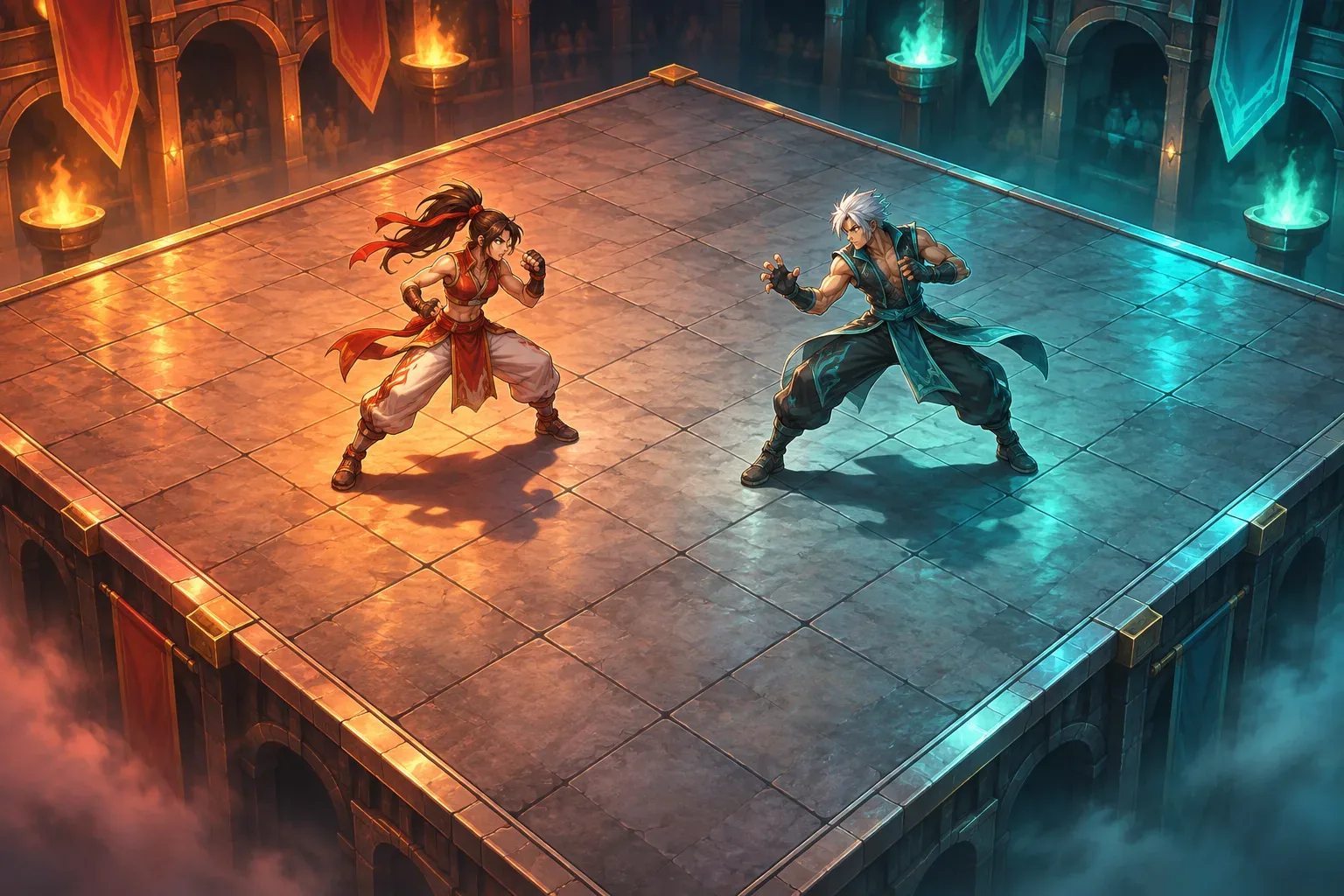
The ring is a 7-column by 3-row grid. Blue starts at (4,2) and Red at (6,2), with one fighter per cell. There are no walls, hazards, platforms or player-built obstacles. The match is a best of three rounds, and each new round resets both fighters to the same starting cells.
This prompt library builds on the arena-fighting genre but narrows its information gain to push direction and ring-out timing. A general “make an arena fighter” tutorial covers the genre broadly. A separate concept uses player-built obstacle courses; Edgeglass has a fixed empty ring and no construction phase.
Specify actions before combat effects
Blue acts first, then Red. That pair of actions is one beat. On a turn, a fighter chooses one of three actions: Step one orthogonal cell into an empty in-bounds cell, use Push Jab if the opponent is orthogonally adjacent, or Hold and remain in place. There are no diagonal steps and no movement into an occupied cell.
| Action | When it is legal | Result |
|---|---|---|
| Step | Destination is one edge away, inside the ring and empty | Move one cell |
| Push Jab | Opponent is in an orthogonally adjacent cell | Push opponent one cell directly away |
| Hold | Any time | No position change |
| Ring-out | Forced push destination is outside the grid | Round ends immediately |
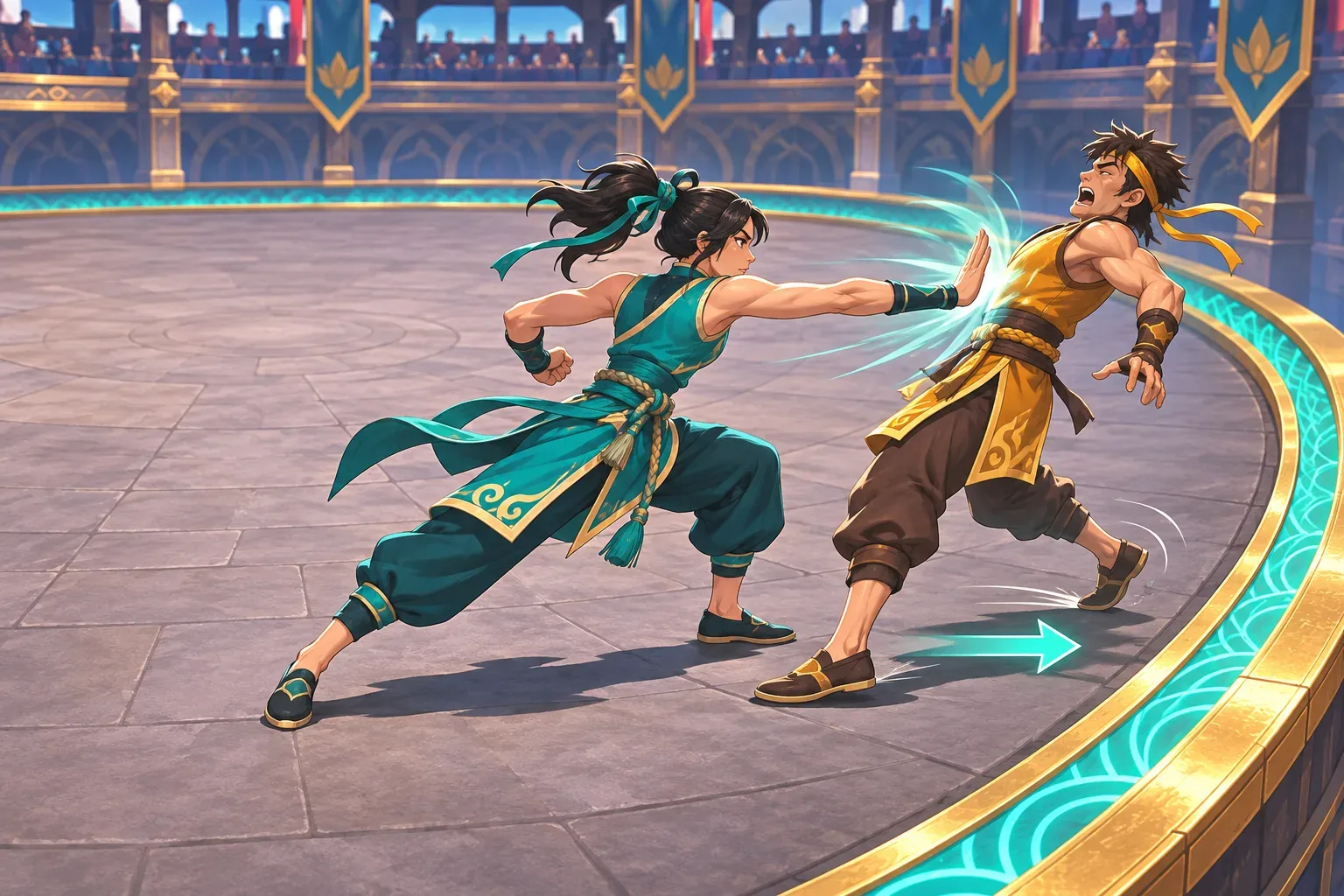
Push Jab does not reduce health or apply extra force. It moves the opponent exactly one cell along the same row or column, away from the attacker. If the target is at (7,2) and the attacker at (6,2), the target is pushed toward (8,2). Because column 8 is outside the ring, the target is ringed out. If the target's destination stays between columns 1 and 7 and rows 1 and 3, it simply moves there.
These rules keep a fighting decision visible: advance to change spacing, hold to wait, or attack when close enough. They also avoid hidden modifiers. There are no move weights, armor, hit points, stun counters, combo multipliers, recovery frames or random hit chances in the first version.
Resolve the push and ring-out
Check the attack condition before moving the target. If fighters are not orthogonally adjacent, Push Jab is unavailable. If they are adjacent, find the cell one step beyond the target in the same direction, away from the attacker. Check the boundary before changing the target's position. An outside destination causes immediate ring-out; an in-bounds destination updates the target's position and play continues.
Each round lasts at most six beats. If no one leaves the ring after the sixth Red action, the round is a draw. The first player to win two rounds wins the match. If the three-round limit ends without either fighter reaching two wins, the match is a draw. A ring-out takes precedence over the beat limit and resolves as soon as the push destination is checked.
| Round state | Resolution | Next state |
|---|---|---|
| Push target remains inside grid | Move target one cell away | Continue with next scheduled action |
| Push target lands outside grid | Ring-out occurs immediately | Award round to attacker |
| Six full beats without ring-out | No round winner | Record draw; reset positions |
| One fighter reaches two round wins | Match ends | Declare that fighter winner |
| Three rounds end without two wins | Match draw | Reset only when starting a new match |
Restart restores the match score to 0–0, begins round one, sets Blue and Red to their starting cells and returns the action order to Blue first. Do not carry an edge position, round result or attack state into the next round. There is no hidden damage state to reset.
Trace a push-out round
Start a round with Blue at (4,2) and Red at (6,2). The example reaches a ring-out in three beats. Red moves toward the boundary, Blue follows, then the final jab pushes Red beyond the grid.
| Beat | Blue action | Red action | Positions and result |
|---|---|---|---|
| 1 | Step (4,2)→(5,2) | Step (6,2)→(7,2) | Blue (5,2), Red (7,2) |
| 2 | Step (5,2)→(6,2) | Hold | Blue (6,2), Red (7,2) |
| 3 | Push Jab | No action after ring-out | Red would move to (8,2), outside; Blue wins round |
The trace is a hand-checked rule example, not a real match or test. The attack is legal because Blue and Red occupy adjacent cells at (6,2) and (7,2). The forced destination is outside the defined arena. Since the round ends immediately, Red does not get an action after the push.
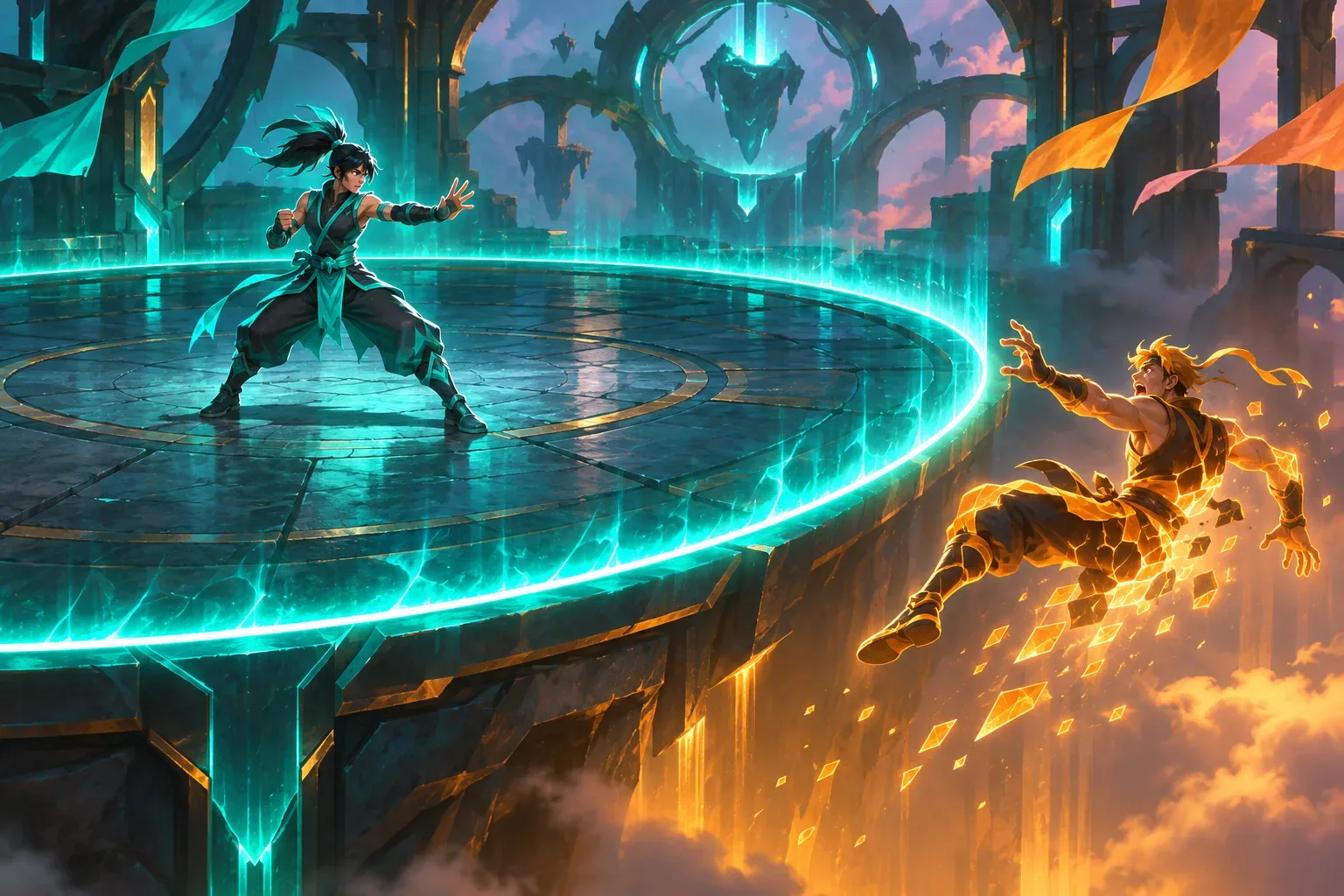
A future playable version should make the edge visible before an attack and show which fighter moves, but the exact animation is an implementation choice. The acceptance condition is the state change: adjacent Push Jab, one-cell movement away, and immediate round win if the destination lies outside.
Write the six prompts in sequence
Use a prompt sequence to add the ring, actions, push rule, match length, example and future checks without asking for several combat systems at once. These drafts are for Edgeglass and have not been run.
Prompt 1 — define the arena
Create a deterministic two-fighter arena game called Edgeglass on a flat 7-column by 3-row grid, columns 1–7 and rows 1–3. There are no obstacles. Blue starts at (4,2), Red at (6,2). One fighter per cell.Prompt 2 — define actions
Blue acts first and players alternate one action each. Choose Step one orthogonal cell into an empty in-bounds cell, Push Jab, or Hold. A fighter cannot move diagonally or enter the opponent's occupied cell. No HP or damage system.Prompt 3 — define Push Jab
Push Jab is legal only when the opponent is orthogonally adjacent. Move the opponent one cell directly away from the attacker along the same row or column. If the destination is inside the arena, move them there. If it is outside columns 1–7 or rows 1–3, ring them out and end the round immediately.Prompt 4 — define round and match
One beat is one Blue action followed by one Red action. A round lasts at most six beats. If neither fighter is ringed out after six beats, the round is a draw. Play best of three rounds; first to two round wins wins the match. A drawn match after three rounds is a draw. Each new round restores Blue (4,2) and Red (6,2).Prompt 5 — trace the push-out
Beat 1 Blue steps (4,2) to (5,2); Red steps (6,2) to (7,2). Beat 2 Blue steps (5,2) to (6,2); Red holds. Beat 3 Blue Push Jabs adjacent Red from (7,2); the forced destination (8,2) lies outside the ring, so Red is ringed out and Blue wins before Red acts. This is a fictional manual rule trace.Prompt 6 — future checks
For a future build, log beat, acting fighter, action, positions before/after, push direction, boundary check and round/match result. Check all four movement directions, occupied-cell rejection, adjacency range, one-cell push, each arena edge, six-beat draw and round reset. Do not mark a check passed until inspecting a real build.For general workflow context, SEELE describes plain-English prompting, a playable first version, browser testing and follow-up refinement. Its official page does not verify Edgeglass or the ring-out mechanic. See Free AI game maker for that general workflow.
Prepare future build checks
When a build is available, log each action and position before checking the round result. The boundary tests matter on every side of the ring, not only columns 1 and 7. An in-bounds push should move a fighter; an out-of-bounds push should stop the round immediately.
| Future check | Expected behavior | Evidence to capture |
|---|---|---|
| Step legality | One orthogonal move into empty in-bounds cell | Origin, destination and occupancy |
| Jab range | Only orthogonally adjacent opponent may be pushed | Both positions and selected action |
| Push direction | Target moves one cell away along same row/column | Attacker, target and resulting cell |
| Ring-out | Outside destination ends round before opponent acts | Boundary check and turn log |
| Match reset | New round resets positions; Restart resets score and round | Positions, round score and match score |
These are future checks, not passed tests. The example defines one valid resolution path, but only an inspected build can establish whether the game follows the rules.
Frequently asked questions
What should an AI prompt define for an arena fighting game?
Define the arena bounds, actions, attack range, knockback direction, ring-out rule, turn order and match end.
How does Push Jab work in Edgeglass?
If the opponent is orthogonally adjacent, move them one cell directly away from the attacker.
Does Edgeglass use health points?
No. Fighters take no damage; a round ends when a push sends one outside the ring or six beats finish.
Does the example include a player-built arena?
No. It uses a fixed empty grid and has no obstacle construction.
Were these arena-fighting prompts tested in a playable game?
No. Edgeglass and its push-out trace are fictional design material. The prompts are unrun and no playable result or observed test is included.