Map the Quiet Signal corridor
A turn-based stealth game needs a readable relationship between player action and patrol movement. If a prompt does not say whether the guard moves before or after the player, the same route can be safe in one interpretation and a collision in another. Start with a small map and a repeating guard path, then trace exactly when both actors occupy each space.
This guide uses Quiet Signal, a fictional infiltration puzzle. The player must recover evidence from a vault and reach an exit while a sentinel follows a fixed loop. The rules and route examples are authored design exercises; the six prompts have not been run. No playable game, observed test or generated result is included.
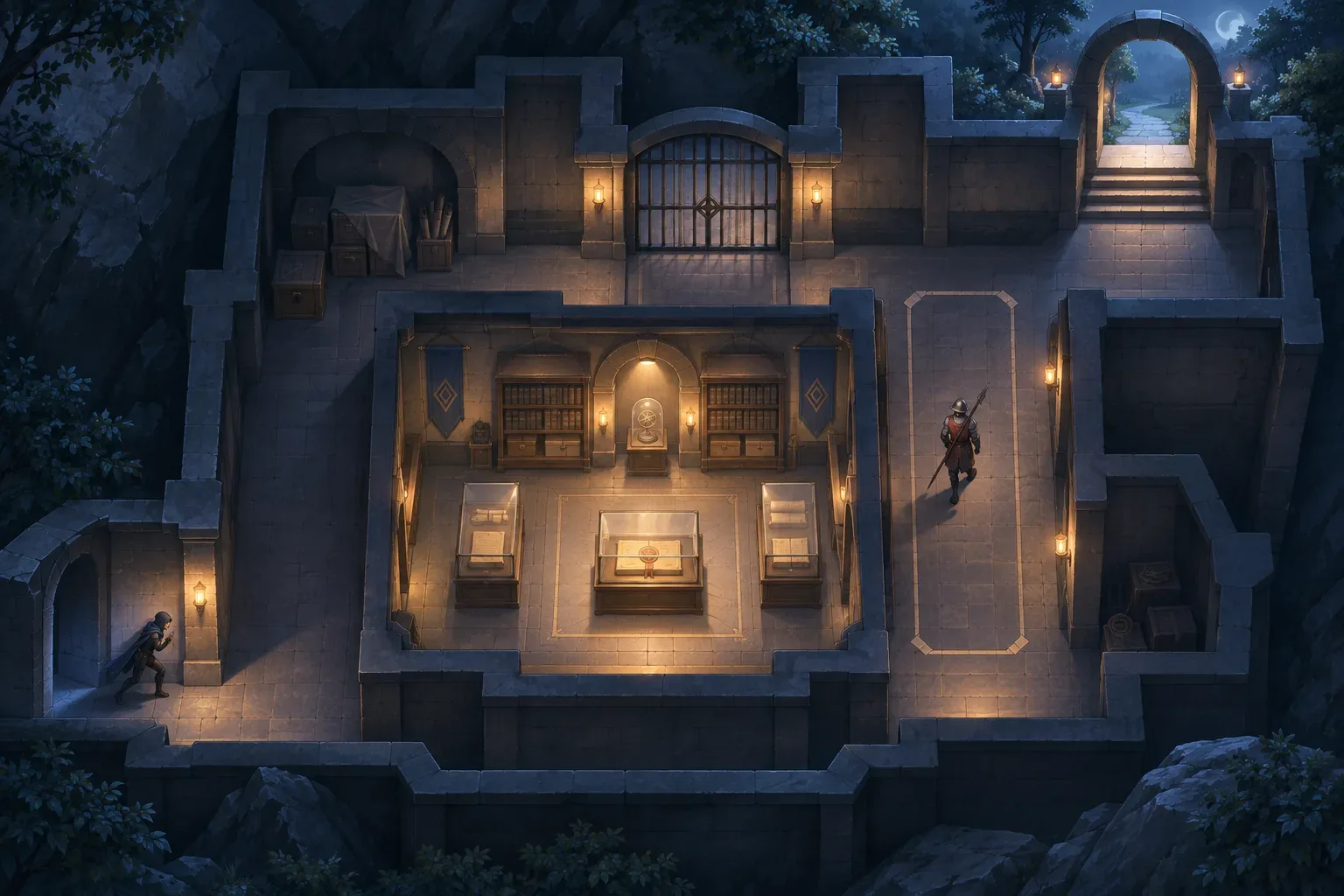
The player's path contains five nodes: Entry (E), Bend (B), Vault (V), Gate (G) and Exit (X). The guard uses a short four-step loop through P1, P2 and Vault. The guard-only P1 and P2 nodes are not player destinations. There are no other walkable spaces, shortcuts, vents, doors or random encounters in the first version.
| Actor or objective | Start | Rule |
|---|---|---|
| Player | Entry E | Move one connected edge or Hide in place each turn |
| Sentinel | P1 | Moves one step after player action along P1→P2→V→P2→P1 |
| Evidence | Vault V | Collected automatically when player enters V |
| Exit | X | Win immediately when entered with evidence |
| Deadline | Turn 1 | Reach X by the end of turn 6 |
This is a turn-based stealth prompt about timing a patrol crossing. It does not build units from modular components or move a headquarters across the map. Its information gain is the action order: player acts, collision is checked, the sentinel advances, and collision is checked again.
Define the player action and patrol
On each turn, choose one action. Move travels exactly one edge on the player path. Hide leaves the player in the current node while the patrol advances. Hiding does not make the player invisible if the sentinel moves into the same node; it simply lets the player wait for a different phase of the loop.
After the action, first check whether player and sentinel share a node. If they do, the player is caught. If not, move the guard one step along its loop and check again. This two-part collision rule matters at the Vault: if the player enters it while the guard is there, the first check catches them; if the guard walks into the player's location after their action, the second check catches them.
| Turn phase | State change | Check |
|---|---|---|
| 1. Player chooses | Move one edge or Hide | Is the destination connected? |
| 2. First collision check | Player remains where action placed them | Same node as sentinel means caught |
| 3. Patrol advances | Sentinel moves one step on its loop | Reverse at P1 and P2 as listed |
| 4. Second collision check | Player and guard positions are compared again | Same node means caught |
| 5. Objective and turn | Vault pickup is automatic; exit resolves immediately | Evidence plus Exit wins; turn 6 is deadline |
Resolve exit success as soon as the player enters X with the evidence. The sentinel does not get an extra move after that successful action. This keeps the objective condition consistent with the danger checks: the player must avoid both collision windows before the exit, and reaching the exit ends the scene.
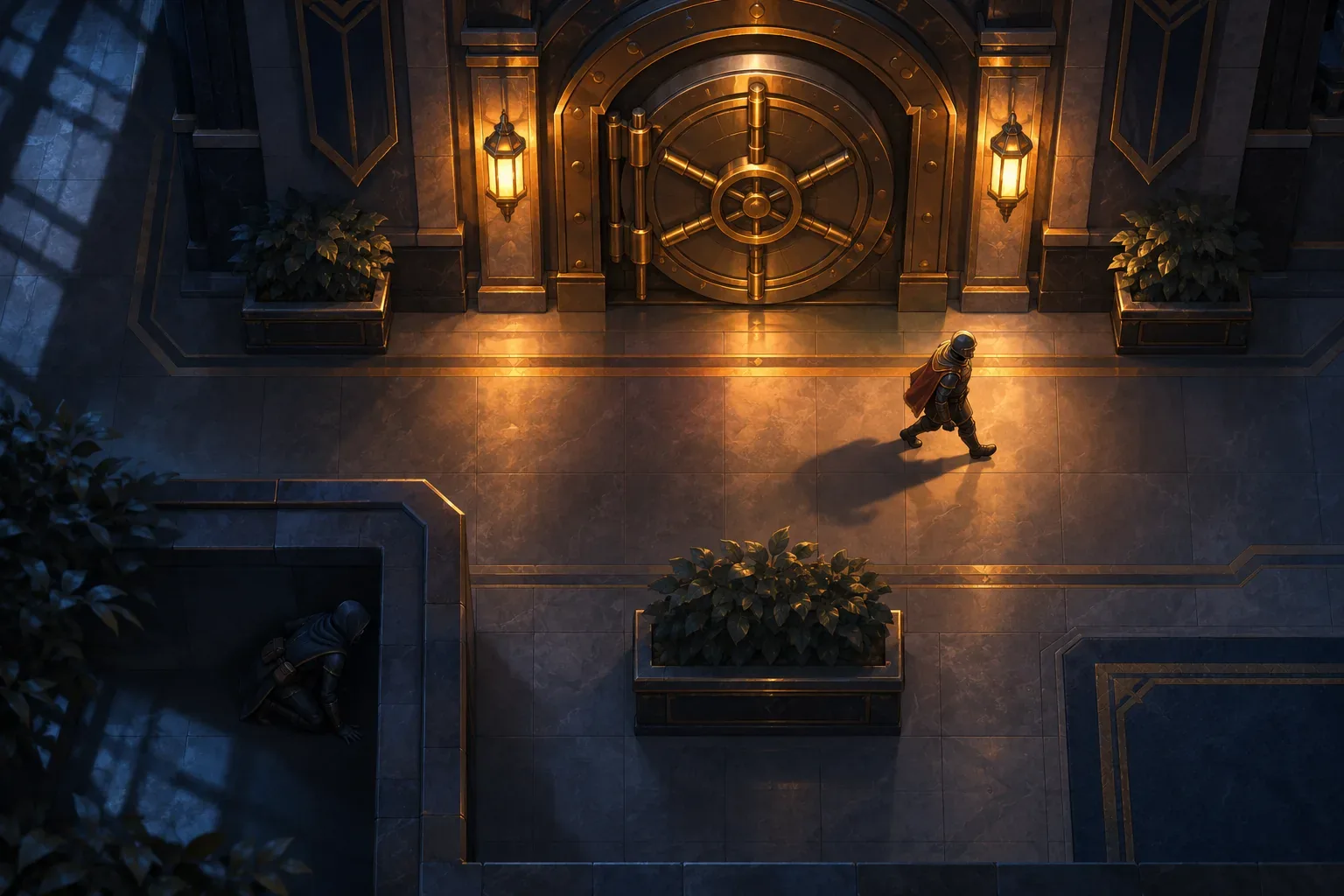
When caught, show a clear fail state and allow Restart. Restart returns the player to E, sentinel to P1, evidence to V and turn count to one. If six turns pass without the player reaching X with evidence, fail the attempt. The first version has no health, combat, vision cones, sound meter, equipment or extra lives; adding them would change what the route trace demonstrates.
Resolve the patrol after each action
The sentinel's loop can be written as a repeating sequence: P1, P2, V, P2, then P1 again. Each player action causes exactly one guard move. If the guard starts at P2 and advances to V, it occupies Vault for the post-move check. The player must time entry to arrive after the sentinel has left.
The route example waits at Entry first, then moves to Bend. While the player waits at B, the guard passes through V and returns to P2. The player can then enter V safely, collect the evidence, pass through Gate and leave. Hiding is useful because it shifts timing by one full turn without changing the map.
There is no hidden perception calculation in this example. A guard does not see adjacent rooms, detect a diagonal, hear a sprint or chase the player. Those mechanics can be requested later as focused additions, but mixing them into the first prompt would make the collision trace harder to verify.
Trace the safe and caught routes
Read each row as the player action followed by the patrol move. The safe route uses six turns, the full deadline. The rushed route reaches the Vault sooner but collides there when the sentinel advances onto the same node.
| Turn | Player action | Sentinel move | Result |
|---|---|---|---|
| 1 | Hide at E | P1→P2 | Safe |
| 2 | E→B | P2→V | Guard occupies Vault |
| 3 | Hide at B | V→P2 | Vault clears |
| 4 | B→V; collect evidence | P2→P1 | Safe at Vault |
| 5 | V→G | P1→P2 | Evidence retained |
| 6 | G→X | No move after success | Escape with evidence |
The caught route skips the waits: turn one moves E→B while the sentinel moves P1→P2. On turn two, the player enters V while the sentinel is at P2, so the first check is safe. The guard then advances P2→V and the second check catches the player. Both checks are necessary; checking only after the player action would miss this collision.

These examples do not show that the six-turn limit is balanced or that waiting is enjoyable. They show the exact state sequence a future build should follow. If the game later moves the sentinel before the player, the safe route must be traced again because its timing assumptions have changed.
Write the six prompts in sequence
Use six focused drafts to add one rules layer at a time. The sequence below is for Quiet Signal and is unrun. The fixed map, guard loop and trace should stay aligned if you copy the prompts into a future game-making workflow.
Prompt 1 — map and objective
Create a deterministic turn-based stealth puzzle called Quiet Signal. Player graph: Entry E–Bend B–Vault V–Gate G–Exit X, one edge per step. Guard-only patrol path: P1–P2–V–P2–P1. Player cannot enter P1 or P2. Evidence is at V. Win by reaching X with evidence within six turns. No other walkable nodes.Prompt 2 — starting state and actions
Start player at E, sentinel at P1, evidence at V, turn 1. On each turn the player chooses Move to one adjacent player node or Hide in place. Entering V collects evidence automatically. Restart restores this exact state.Prompt 3 — patrol timing
After each player action, advance the sentinel one step along P1→P2→V→P2→P1, repeating at the ends. Check whether the player and sentinel share a node immediately after the player action and again after the sentinel move. If so, the player is caught. Exit success occurs immediately on entering X with evidence, before the sentinel moves.Prompt 4 — failure and feedback
If caught, show a caught state and allow Restart. If turn 6 ends without reaching X with evidence, fail. Show player location, sentinel location, evidence status, turn number and the next patrol node after every action. Do not add vision cones, noise, combat, random behavior, equipment or extra lives.Prompt 5 — trace safe and caught routes
Safe: T1 Hide at E, guard P1→P2. T2 Move E→B, guard P2→V. T3 Hide at B, guard V→P2. T4 Move B→V and collect evidence, guard P2→P1. T5 Move V→G, guard P1→P2. T6 Move G→X and win before guard movement. Caught: T1 E→B, guard P1→P2; T2 B→V, guard P2→V, so player and sentinel share V and the player is caught. Label both as manual fictional examples, not generated output.Prompt 6 — future checks
For a future playable build, log turn, player action, origin/destination, sentinel location before/after, evidence state, collision check and terminal outcome. Check every edge, player restriction on P1/P2, patrol reversal, collision at both checks, evidence pickup, exit timing, six-turn deadline and Restart. Do not mark any test passed before inspecting a real build.For general workflow context, SEELE describes plain-English prompts, a playable first version, browser testing and follow-up prompt refinement. The official page does not verify Quiet Signal or its patrol behavior. See Free AI game maker for the general workflow.
Prepare future build checks
When a real version is available, capture both actor positions after every action and after each patrol step. That record can show whether a failure came from an illegal move, a patrol timing mismatch, a missed evidence pickup or an incorrect exit condition.
| Check | Expected behavior | Evidence to capture later |
|---|---|---|
| Player map | Only E–B–V–G–X are player-walkable | Origin, destination and graph edge |
| Patrol loop | P1→P2→V→P2→P1 repeats | Sentinel before/after each move |
| Collision timing | Check after player action and after guard move | Both positions at both checkpoints |
| Evidence and exit | Entering V collects; X wins only with evidence | Evidence state and terminal event |
| Deadline and restart | Six turns maximum; Restart restores exact setup | Turn count and reset state |
These are future checks, not completed tests. The prompt sequence describes a design and a paper trace. A playable build must still be inspected before any statement about its behavior is made.
Frequently asked questions
What should a turn-based stealth game prompt define?
Define the walkable map, player actions, patrol order, detection timing, objective and what resets after failure.
How does the guard move in Quiet Signal?
The sentinel follows a fixed loop from P1 to P2 to Vault, then back through P2 to P1 after each player action.
Can the player enter the guard patrol nodes?
No. P1 and P2 are guard-only nodes; the player uses the separate Entry-to-Exit corridor.
What does Hide do in this prototype?
Hide keeps the player in place for a turn while the sentinel advances one step along its loop.
Were these stealth prompts tested in a playable game?
No. Quiet Signal and its route traces are fictional design material. The prompts are unrun and no playable result or observed test is included.