Set up the Last Marker battle
A turn-based war game prompt needs more than opposing colors on a board. It needs an action order, a clear movement limit, a combat result and an objective that decides the match. If those rules stay vague, an AI-made prototype can turn a small skirmish into a campaign, add a pile of extra systems or resolve attacks in a different order than intended.
This guide uses Last Marker, a fictional four-round battle on one fixed grid. Each side has two units with the same health. A side can move, attack an adjacent enemy or hold. At the end of the fourth round, the side with a surviving unit on the center objective wins. The six prompts and trace below are unrun design material; they are not a playable result, observed match or measured test.
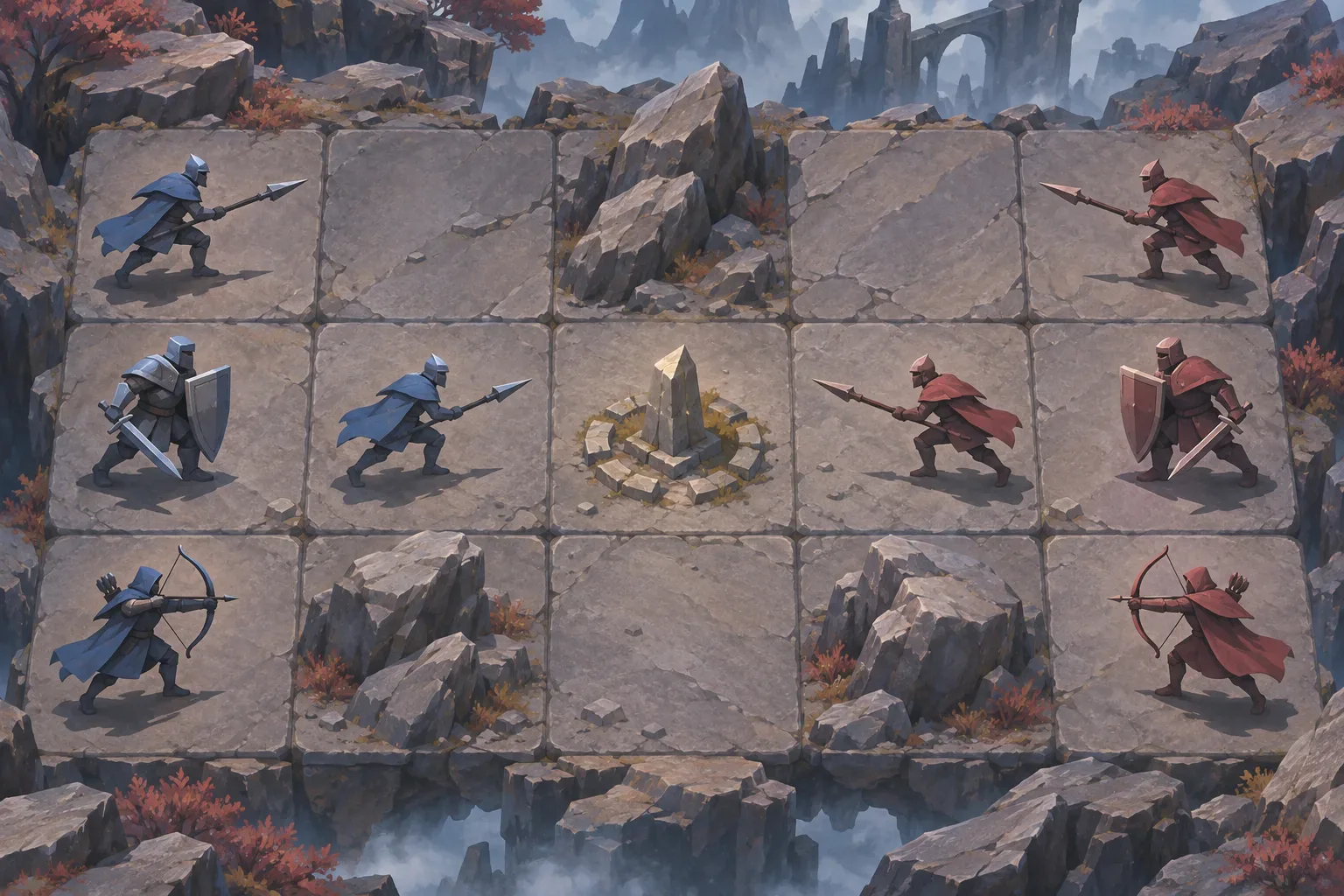
The scope matters because a related campaign concept might connect several small maps and carry forces between them. Last Marker has one battlefield and ends after four rounds. Its prompt library focuses on movement and adjacent attacks inside that single encounter, without map progression, reinforcements or persistent upgrades.
Keep the first battle compact. A 5-by-3 grid is large enough for two forces to approach a center point but small enough to trace. Each side gets one action per round, which makes every decision visible. The objective gives those moves a purpose, while unit health gives attacks a concrete outcome.
Define the grid and force
Use columns 1 through 5 and rows 1 through 3. Blue begins on the left and Red on the right. The center objective is cell (3,2). Units move orthogonally, so a move changes either the column or row by one, never both. A unit cannot move outside the grid or into a cell another unit occupies.
| Unit | Faction | Start cell | Starting HP |
|---|---|---|---|
| B1 | Blue | (1,2) | 2 |
| B2 | Blue | (1,1) | 2 |
| R1 | Red | (5,2) | 2 |
| R2 | Red | (5,3) | 2 |
Each round Blue chooses one living unit and one action first; Red then chooses one living unit and one action. The unit may move one cell, attack an enemy in an orthogonally adjacent cell, or hold its position without changing state. Attacks deal one damage. A unit at zero HP is removed immediately and cannot act later.
This ruleset deliberately has no ranged fire, cover, armor, ammunition, healing or random hit rolls. It also does not award points for ordinary grid cells. Removing those systems keeps the first request about a tactical choice: advance toward the center, strike a nearby opponent or hold a position for the final capture check.
Resolve movement and adjacent attacks
Movement and attacking are separate actions. A unit cannot move and attack in the same activation. A move can enter only an empty in-bounds cell one edge away. An attack targets one opposing unit exactly one edge away and leaves the attacker in place. The target loses one HP; if it reaches zero, remove it before the other faction chooses its action.
| Action | Legal when | Resolution |
|---|---|---|
| Move | Destination is in bounds, empty and orthogonally adjacent | Update unit cell by one grid edge |
| Attack | Target is opposing and orthogonally adjacent | Deal 1 damage; remove at 0 HP |
| Hold | Any living unit may hold | No position or HP changes |
| End of round 4 | After Blue and Red actions | Faction on (3,2) wins; empty objective is a draw |
The objective uses occupancy at the end of the final round. A unit standing there remains vulnerable to a later attack during the round. If it is eliminated before the final check, the cell becomes empty and no side wins through control. Because a cell can contain only one unit, the opposing side must attack the holder or occupy the objective after it becomes vacant.
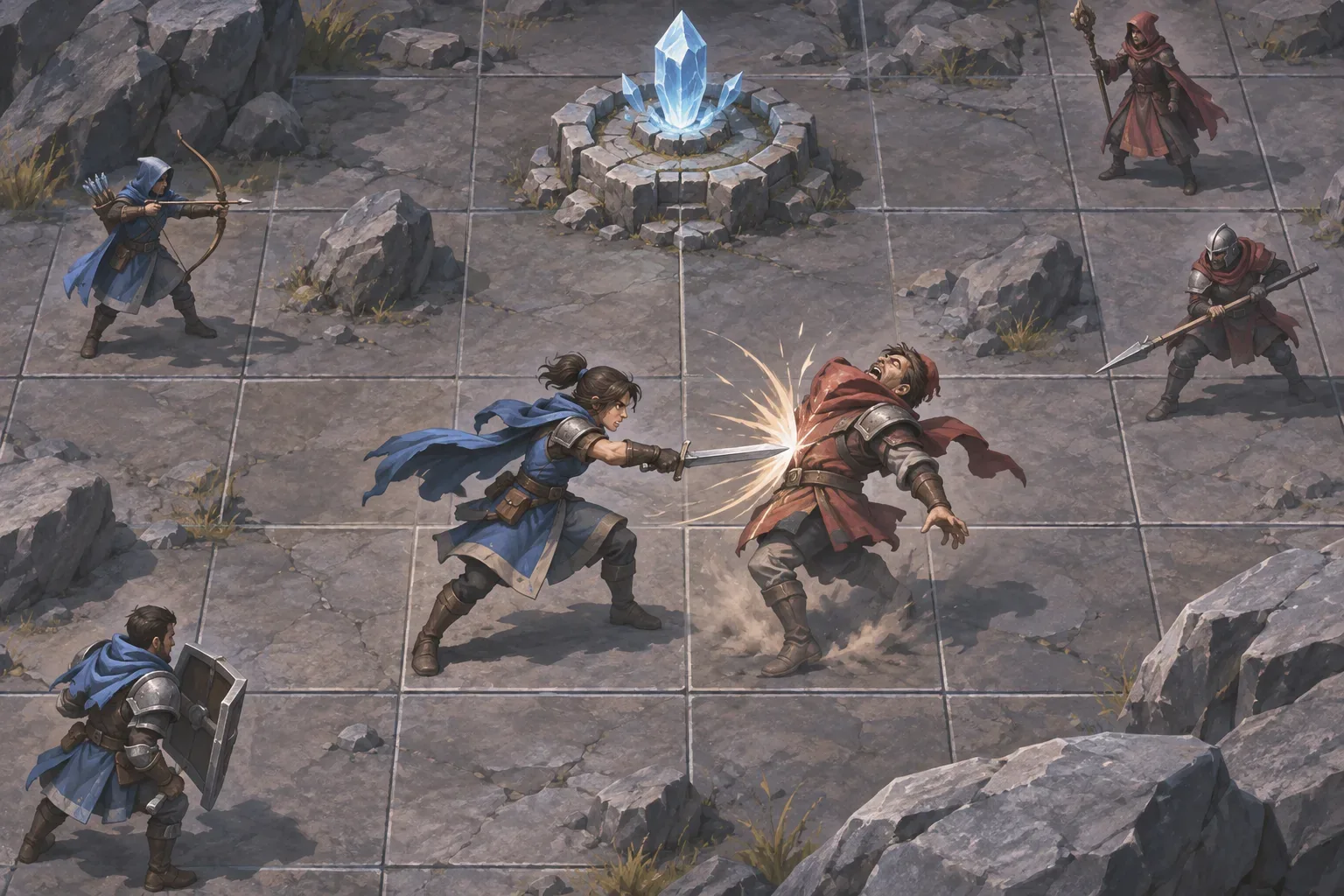
Turn order is fixed throughout: Blue, then Red, for four rounds. Do not skip Red's action after Blue moves onto the center. Do not end early just because one side has lost a unit. The battle checks only the objective at the end of round four, so both sides continue to make choices until that point unless a unit has no legal action—in which case Hold remains available.
Restart restores the four listed starting cells, two HP per unit and round one. It does not preserve damage, add a replacement unit or randomize the map. A precise reset is useful because the example below can be replayed from the same positions.
Trace the four-round objective fight
The example advances B1 toward the center while R1 closes from the opposite side. Blue captures the objective, then Red attacks twice. B1 is removed, but a second Blue unit reaches the objective before the last check. The result demonstrates both combat and a replacement route without adding a new unit.
| Round | Blue action | Red action | Objective / health result |
|---|---|---|---|
| 1 | B1 moves (1,2)→(2,2) | R1 moves (5,2)→(4,2) | Center empty |
| 2 | B1 moves (2,2)→(3,2) | R1 attacks B1 from (4,2) | B1 HP 2→1; Blue holds center |
| 3 | B2 moves (1,1)→(2,1) | R1 attacks B1 again | B1 HP 1→0 and is removed |
| 4 | B2 moves (2,1)→(3,2) | R1 attacks B2 from (4,2) | B2 HP 2→1; Blue holds center and wins |
Every move is one orthogonal step into an empty cell. Both Red attacks are adjacent: R1 stays at (4,2) next to the center. B2 begins at (1,1), moves to (2,1) in round three, then to (3,2) in round four. The last attack reduces B2 to one HP but does not remove it, so the final objective check awards Blue the battle.
This example does not establish that four rounds, two HP or the center objective is balanced. It defines a case for a future build to implement. A useful inspection would compare cell positions and health after each action, then verify that Blue wins only after the round-four check.
Write the six prompts in sequence
Use six prompt drafts to move from match scope to testable state. Keep the same four units, action order, damage and objective so an implementation mismatch is easy to locate. These prompts have not been run.
Prompt 1 — scope
Create a deterministic two-sided turn-based skirmish called Last Marker on one fixed 5-column by 3-row grid. The objective is the center cell (3,2). The match lasts four rounds. Do not add campaigns, connected maps, reinforcements, terrain bonuses, random events or persistent upgrades.Prompt 2 — setup and units
Blue starts with B1 at (1,2), B2 at (1,1); Red starts with R1 at (5,2), R2 at (5,3). Every unit has 2 HP. One unit may occupy each cell. Track each unit's faction, cell and HP. Restart restores the listed positions and health.Prompt 3 — actions and movement
In every round Blue acts once, then Red acts once. Each side selects one living unit and chooses Move one orthogonal cell into an empty in-bounds cell, Attack one opposing unit in an orthogonally adjacent cell, or Hold. An attack deals 1 damage. Remove a unit immediately when HP reaches 0. No range attacks, healing, armor or extra actions.Prompt 4 — objective and end
After both actions in round 4, the side with a living unit on (3,2) wins. If the objective is empty, the battle is a draw. The opposite side cannot enter an occupied cell. Do not score other map cells, and do not end early for elimination.Prompt 5 — trace the battle
R1 Blue moves B1 (1,2) to (2,2); Red moves R1 (5,2) to (4,2). R2 Blue moves B1 to (3,2); Red attacks adjacent B1, HP 2 to 1. R3 Blue moves B2 (1,1) to (2,1); Red attacks B1 again, HP 1 to 0 and removes it. R4 Blue moves B2 to (3,2); Red attacks from (4,2), B2 HP 2 to 1. At the end Blue holds the objective and wins. This is a manual fictional trace, not generated output.Prompt 6 — future checks
For a future playable build, log round, faction order, unit, action, origin/destination or target, HP before/after, removals and objective occupant. Check board bounds, one-unit-per-cell, movement adjacency, attack adjacency, damage/removal, Blue-first order, four-round ending and Restart. Do not mark tests passed before inspecting an actual build.For general workflow context, SEELE describes starting from a plain-English idea, generating a playable first version, testing it in a browser and refining it with follow-up prompts. Its official page does not verify Last Marker or its combat rules. See Free AI game maker for the general workflow.
Prepare future build checks
If a playable build is available later, log every action and state change rather than judging only by whether the final screen says victory. A short record can show whether the bug is in movement, target selection, damage, removal or the final objective check.
| Future check | Expected rule | Evidence to capture |
|---|---|---|
| Grid movement | One orthogonal step into empty in-bounds cell | Unit origin and destination |
| Attack | Adjacent enemy loses exactly 1 HP | Attacker, target and HP before/after |
| Elimination | Unit at 0 HP is removed immediately | Board before/after attack |
| Turn order | Blue acts before Red each round | Round, actor and action sequence |
| Objective | Round 4 holder wins; empty center draws | Center occupant after both actions |
Those are future checks, not passed tests. Last Marker is a bounded prompt design with a hand-calculated scenario. A written example makes an implementation easier to inspect, but it does not prove that a game generator followed the rules.
Frequently asked questions
What should a turn-based war game prompt define?
Define map bounds, unit locations and health, action order, movement, attack range, damage, objective and ending.
How many maps are in the Last Marker example?
One fixed 5-by-3 grid. It has no campaign or transfer between maps.
How does an attack work in this prototype?
A unit attacks an opposing unit in an orthogonally adjacent cell, dealing one damage; units start with two health.
What decides the winner in Last Marker?
At the end of round four, the side with a living unit on the center objective wins; if it is empty, the result is a draw.
Were these war-game prompts tested in a playable build?
No. Last Marker and its battle trace are fictional design material. The prompts are unrun and no playable result or observed test is included.