To make a theme park management game with AI, start with one attraction, a connected path, and a queue. The player opens a route from the entrance, checks who is waiting, and runs the ride. A full ride leaves some guests behind for the next cycle. Each completed ride changes the queue, the served count, and the park’s cash.
Use a four-guest park as a fictional design exercise. With two seats and a fixed ticket price, you can calculate the results before building. That gives you a way to spot problems such as a ride that starts without a path or charges a guest twice.
Give guests a route, a line, and an exit
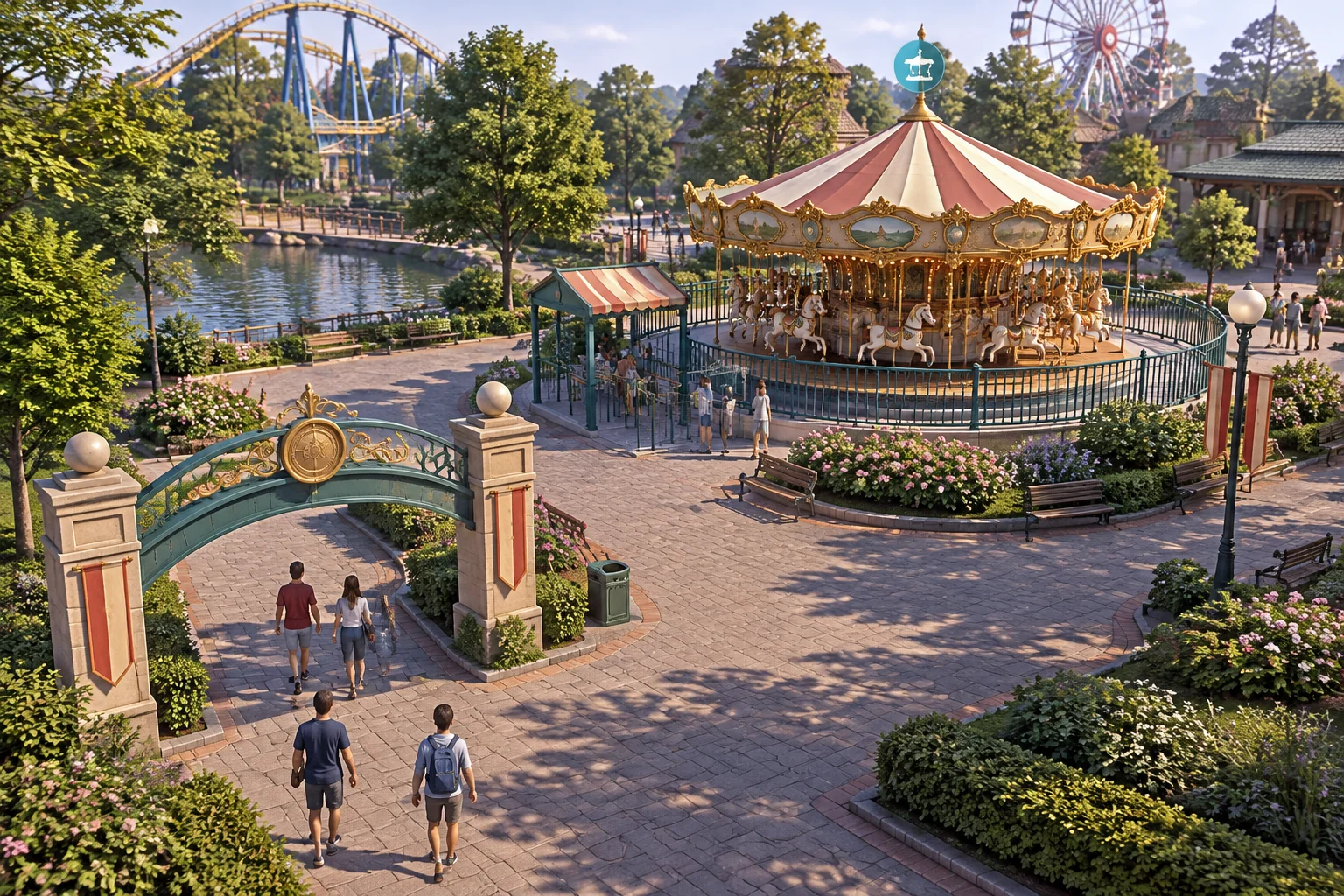
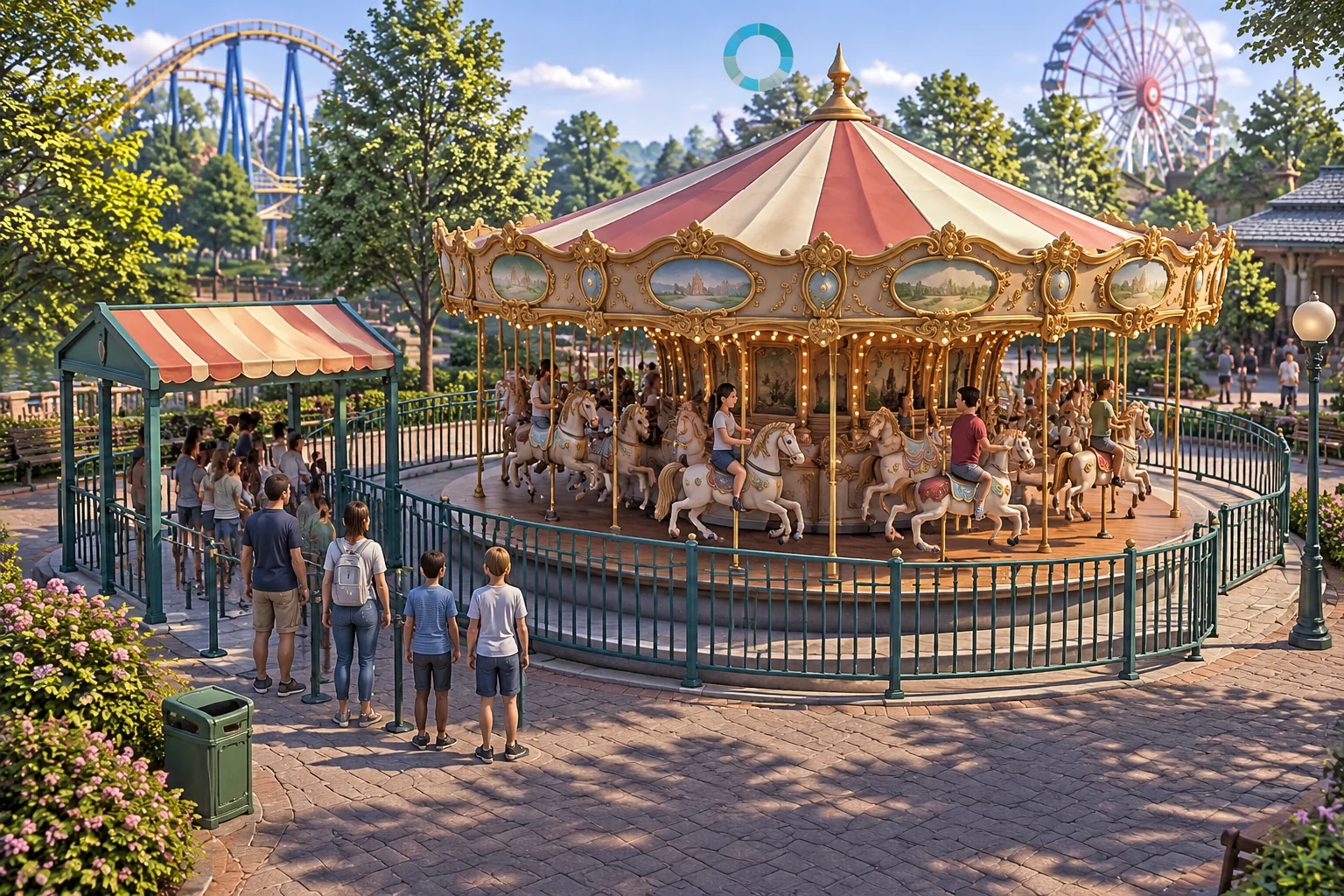
Place the entrance and the carousel on a small overhead map. Give the attraction a queue entrance and a separate exit marker. The player’s first job is to finish the path to the queue entrance. Show the existing route and its missing segment on the map, so a closed queue has an obvious cause.
In this version, the path is either connected or disconnected. Let the player connect it before opening the queue. Once the four guests have joined, keep the path fixed until restart. That leaves changes to live routes, such as removing a path under a waiting guest, for a later build.
| Guest state | What changes it | What the player sees |
|---|---|---|
| At the entrance | A connected path and room in the queue let the guest join | A blocked route or a guest heading to the ride |
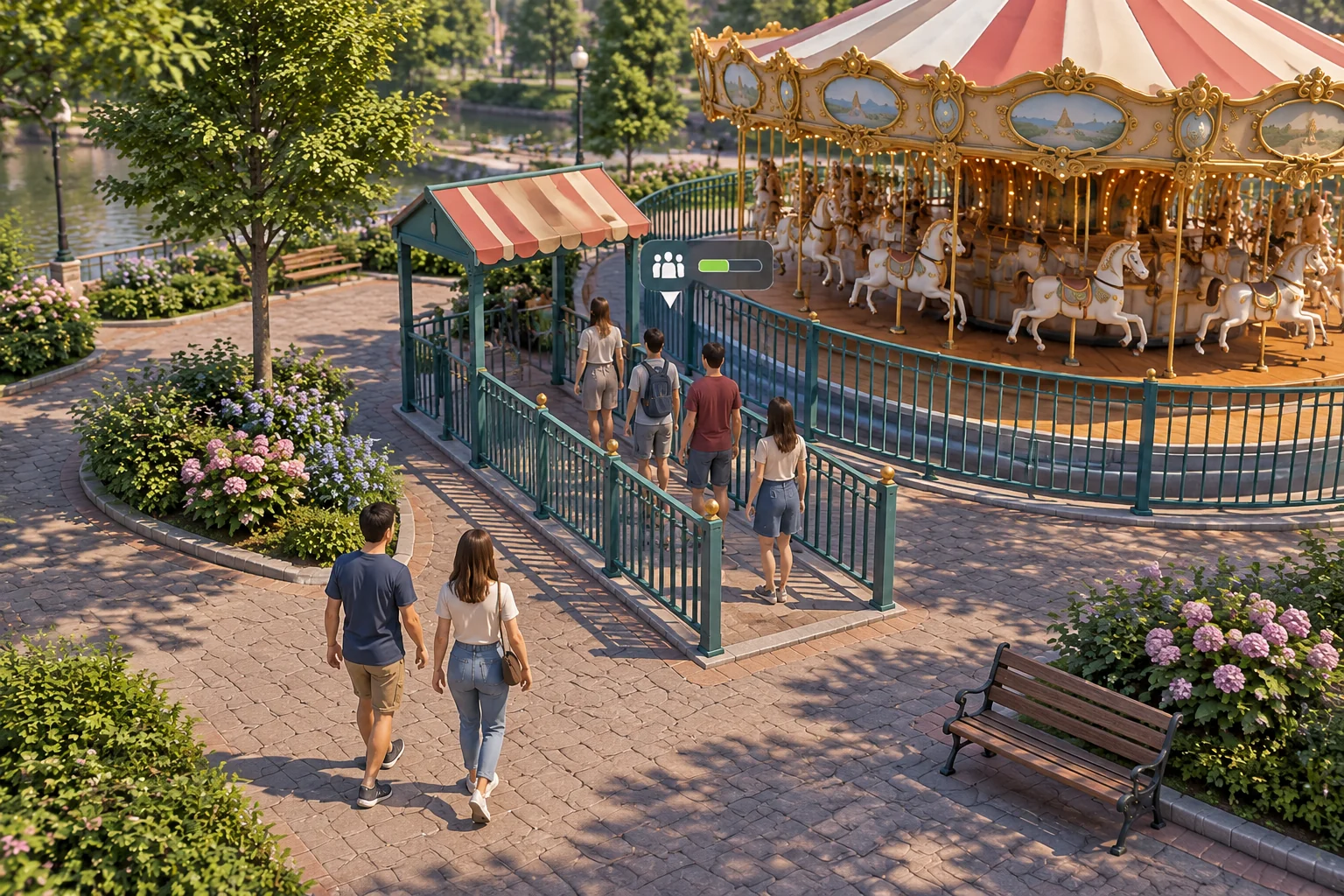
| Waiting | An open seat lets the guest board in arrival order | A place in line and the number still waiting |
| On the ride | The current cycle finishes | A seat becomes free and the guest moves to the exit |
| Served | The guest exits the loop after one completed ride | The served count rises and the cash total updates |
Give each guest a unique ID. Move the same ID from one state to the next and use that move to update the display. Two counters that happen to agree can hide a duplicate guest. If you inspect the waiting, riding, and served lists, you can see which guest ended up in the wrong place.
Work out the first two ride cycles
Start with 20 coins, four guests, four queue spots, and a two-seat carousel. Queue spots determine how many guests can wait. Seats determine how many can ride at once. Once the path is connected, all four guests join the queue in order. A single button advances one cycle. Board up to two waiting guests at its start and collect five coins per guest who finishes at its end. This version has no operating costs.
| Checkpoint | Waiting | Served so far | Cash |
|---|---|---|---|
| Queue fills before the first cycle | 4 | 0 | 20 coins |
| Cycle 1 ends | 2 | 2 | 30 coins |
| Cycle 2 ends | 0 | 4 | 40 coins |
When the fourth guest finishes, close the run and show the final cash total. Check the first row before advancing. If the cash changes as soon as a guest joins the queue, look for a payment event attached to the wrong state. If the served count jumps straight to four on the first cycle, inspect how the ride fills its two seats.
Ask AI for the small park first
SEELE’s game creator takes a written idea as a starting point for a browser prototype. Give it the park layout and state rules along with the visual theme. A request for a carousel and a crowd might produce a scene with no way to tell who has paid or who can board. The prompt below gives you specific behavior to check in the first draft.
Build a small browser theme park management prototype on one overhead map.
Show the park entrance, an incomplete path, one carousel, a four-place
queue, and an exit marker. The player connects the missing path segment.
Only then can guests A, B, C, and D join the queue, in that order. Keep
the path fixed after the queue opens.

Start with 20 coins. Add a Run Cycle button. A valid cycle boards up to
two waiting guests in order. At the end of the cycle, move each rider to
Served and add five coins per rider. Each guest can board and pay once.
Keep waiting, riding, and served IDs separate. Reject a cycle if the
path is disconnected, another cycle is active, or no guests are waiting.
Invalid actions leave the state unchanged.

Show waiting guests, occupied seats, served guests, and cash. The run
ends after all four guests are served. Add Restart to reset the path,
guests, and cash. Keep the map to one ride. Include a short explanation
of the state transitions and how to check them in the browser.
If the first draft handles the layout but skips the queue, keep the map and ask for one change. Have guests enter a first-in, first-out list when the route connects. Check the waiting count before asking for boarding. The guide to building and checking a game with AI in small steps shows how to phrase these follow-up requests.
Check the park before adding another ride
- Try to run a cycle with the gap in the path still visible. The queue should stay closed and cash should remain at 20.
- Connect the path and run one cycle. Watch A and B board, then confirm C and D remain waiting when the ride stops. Cash should be 30 only after completion.
- If the cycle has a visible animation, press Run Cycle again while it plays. One click should start one ride cycle. The second click should leave the current riders and payment unchanged.
- Finish the second cycle and try to run the ride again. No guest should rejoin or pay again. Restart should restore the path gap, four guests at the entrance, and 20 coins.
If you can see the right cash total but guests disappear from the map, inspect the state transition that sends them to the exit. Use the guest ID and state to place each marker. That helps distinguish a display problem from a lost or duplicated guest.
Compare the cost of adding a second carousel
Try this design change on paper first. Offer a second two-seat carousel for six coins, with its own path and queue. Let the player assign two guests to each ride before the first cycle, then advance both rides together. Each guest still finishes once and pays five coins.
| Layout | Cycles to serve four guests | Extra build cost | Final cash |
|---|---|---|---|
| One carousel | 2 | 0 coins | 40 coins |
| Two connected carousels | 1 | 6 coins | 34 coins |
Both layouts earn 20 coins from tickets. The extra carousel buys one fewer cycle at a cost of six coins. If the only goal is cash, the player has no reason to buy it in this setup. Give the second ride a purpose by introducing a one-cycle service goal. Check both routes before running the rides and make sure a guest can join only one queue.
Build the first ride around one clear decision
Start with the moment the player connects the path and sees the line fill. Keep the run short enough to watch who boards, who waits, and what happens to the cash when the ride stops. Once those events agree, you can decide whether faster service is worth a second attraction. Start your theme park prototype with SEELE’s AI game creator and use the two-cycle table to check your first build.
Frequently asked questions
Should I show the path and the queue separately?
Yes. Give the path and the queue different visual markers so the player can tell a disconnected ride from a full line. A broken path means no one can reach the queue. A full line means guests can reach the ride, but there is no room to wait.
What happens if fewer guests are waiting than there are seats?
For this prototype, let the ride leave with any positive number of guests up to its seat count. If one guest is waiting, board one and leave the other seat empty. A minimum load can become a separate rule later if you want players to balance waiting time against operating cost.
How can I catch double payments?
Record which guest IDs finish each cycle and compare the cash change with five coins times the number of new IDs served. If the same ID shows up twice, check the move to Served and the code that handles cycle completion before changing the price or cash display.
When should I add a ride with different capacity?
Keep the second ride identical while you check that two queues can run side by side. Once guests cannot enter both queues and both rides pay correctly, change one ride’s capacity. Compare how many guests each line serves before changing its cycle length or ticket price.