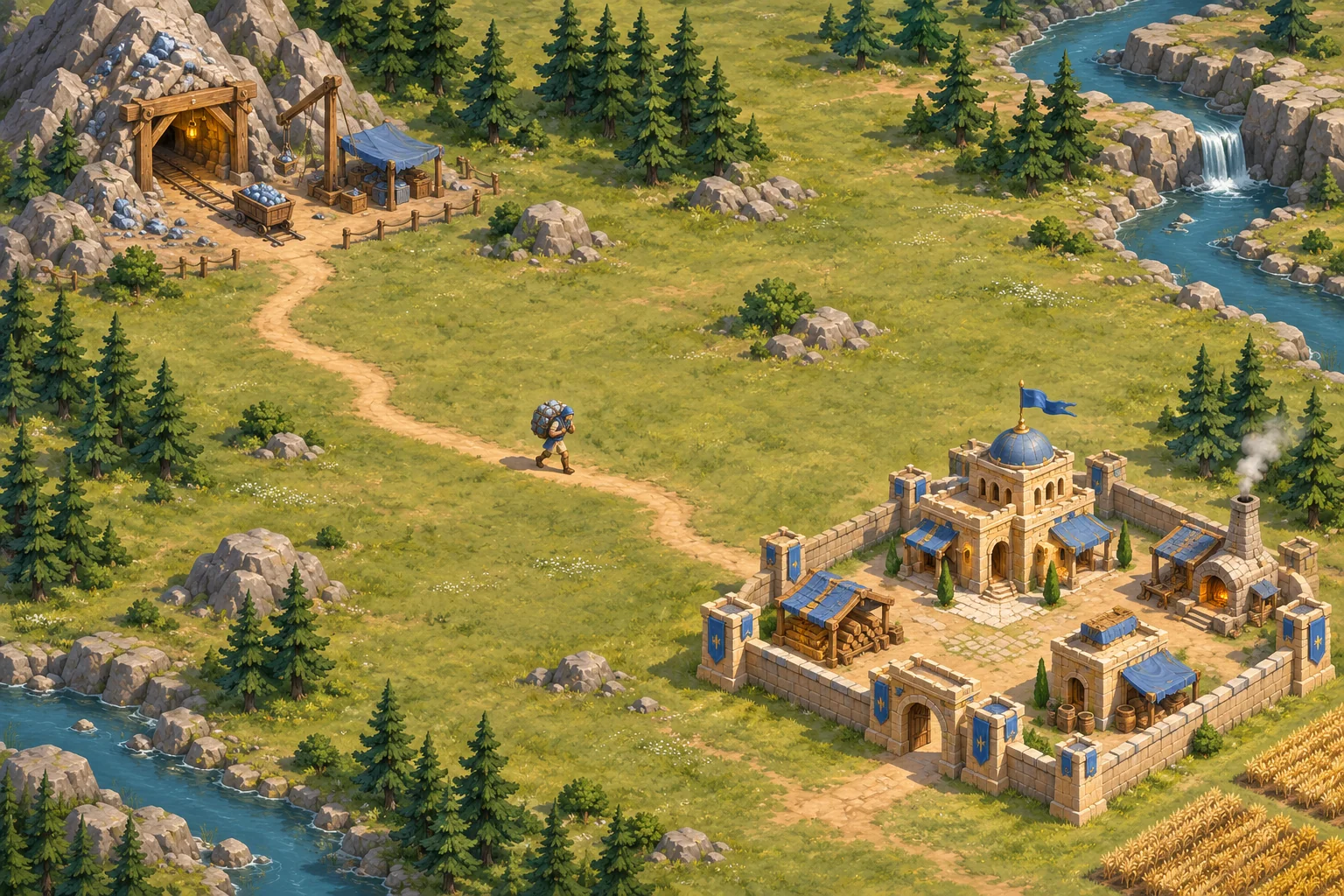
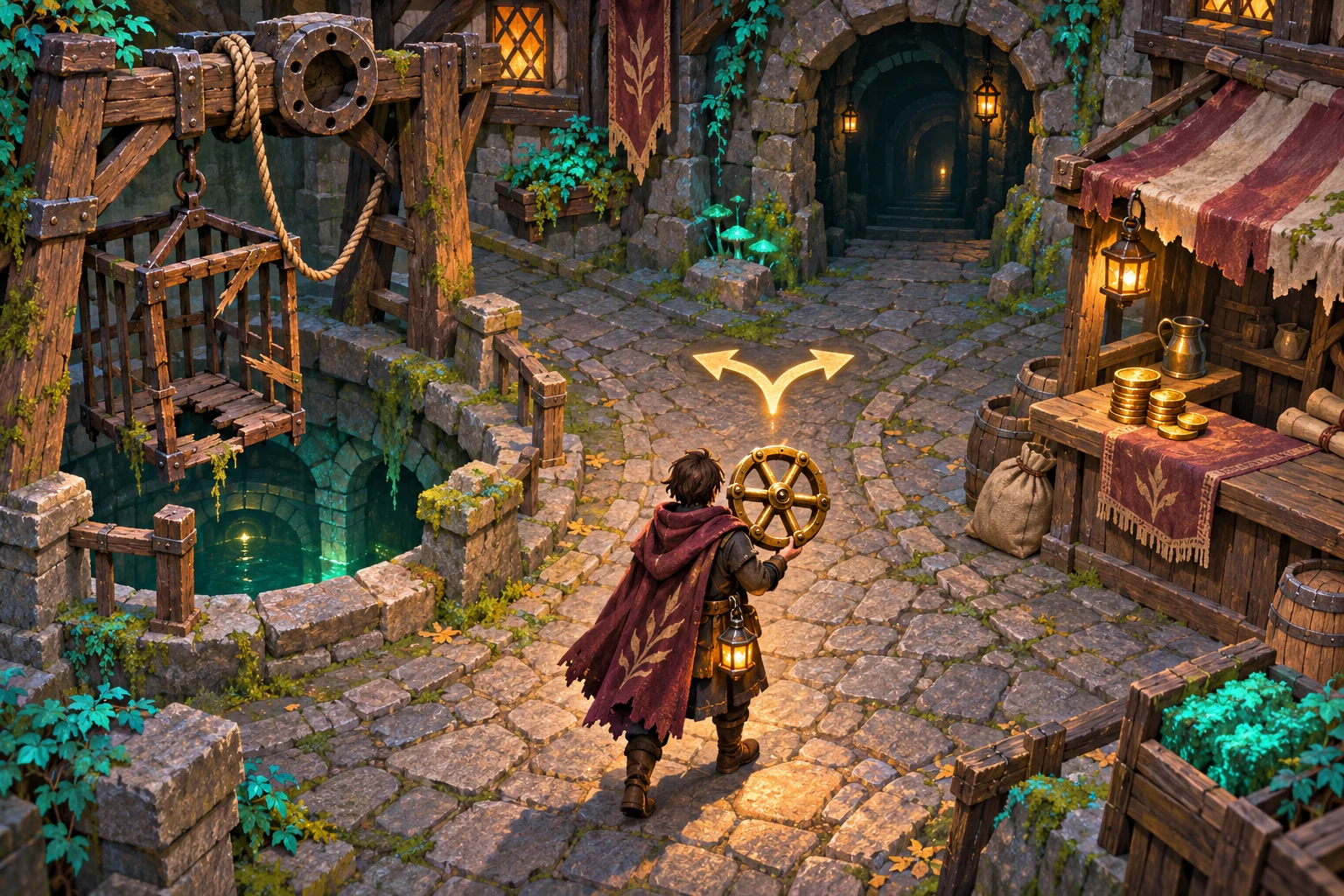
In The Last Bell, a harbor town repeats the same six-hour night. The player can inspect one archived scene per loop, then reset the clock while keeping each clue. Four verified clues reveal the links between five districts, so the town map is assembled from what the player learns instead of being handed over at the start.
The prototype has five place cards, four edge slots, and six scene cards. A clue is accepted only when it names two districts and a direction. After four loops, the evidence yields a single chain from Bell Tower to Observatory. The final route check is deterministic: each edge must match one clue, every district must connect, and no district can appear twice.

Let discoveries build the map
Make The Last Bell a deterministic deduction puzzle with a six-hour night divided into six one-hour turns. The player may inspect one archived scene per loop, then reset to hour zero; inspected evidence persists, while time and scene availability reset. The map starts with five unplaced district cards and four blank undirected edge slots. Four evidence cards, revealed in a fixed scene order, each specify exactly one district pair and direction: Bell Tower east to Lantern Square; Lantern Square south to Tide Gate; Tide Gate east to Clockmaker Alley; Clockmaker Alley north to Observatory. Place a clue only if both endpoint cards are present and the direction is unused. The route succeeds only when all five districts form one connected, non-branching chain from Bell Tower to Observatory with four matching edges. Wrong placements are reversible and give a specific conflict; reset never erases verified clues. The final check reports each edge, connectivity, branches, missing cards and the result. Restart clears all evidence and placements.
| System | Prototype rule |
|---|---|
| Night loop | Six turns, one hour each; reset returns to hour zero and restores scene access. |
| Action | Inspect one available archived scene per loop; no second inspection in the same loop. |
| Persistent state | Verified clue cards remain after reset; time, position and scene access reset. |
| District cards | Bell Tower, Lantern Square, Tide Gate, Clockmaker Alley and Observatory. |
| Clue edges | Bell Tower east to Lantern Square; Lantern Square south to Tide Gate; Tide Gate east to Clockmaker Alley; Clockmaker Alley north to Observatory. |
| Map board | Five place cards and four undirected edge slots; each clue occupies one matching edge. |
| Validation | Require four distinct matching edges, one connected component, no branches, and a Bell Tower-to-Observatory route. |
| Feedback | Reject a duplicate direction or mismatched pair with the conflicting clue named; allow undo without losing evidence. |
| Reset | Reset time and scenes but preserve inspected evidence and current map placements. |
| Restart | Clear time, scenes, clues and placements to begin the puzzle again. |
| Interface | Show loop and hour, scene availability, evidence archive, map slots and validation status. |
Set loop, clue and route rules
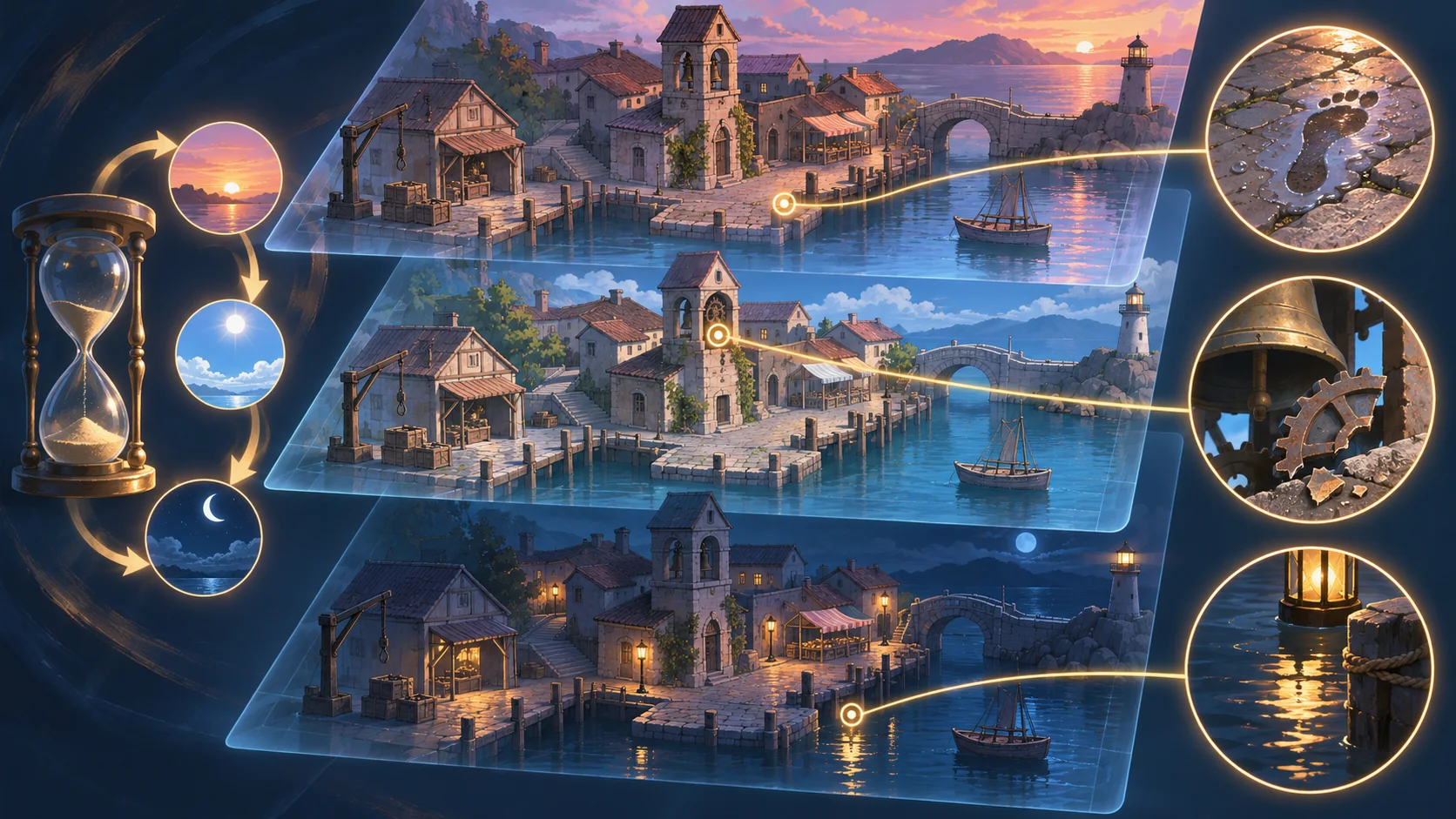
Start at loop 1, hour 0, with an empty archive and blank map. Inspect the Bell Tower ledger: clue 1 places Lantern Square east of Bell Tower. Reset; at loop 2 inspect the ferry schedule: clue 2 places Tide Gate south of Lantern Square. Reset; at loop 3 inspect the tide chart: clue 3 places Clockmaker Alley east of Tide Gate. Reset; at loop 4 inspect the clockmaker's note: clue 4 places Observatory north of Clockmaker Alley. The archive now has four clues, and the map has four edges. Check from Bell Tower: Lantern Square is reached in one edge, Tide Gate in two, Clockmaker Alley in three, and Observatory in four. Every district has degree one or two, the graph is connected, and the two endpoints are Bell Tower and Observatory. The result is one valid route. This is an authored state trace, not a playable or user test.
| Loop and scene | Expected persistent state |
|---|---|
| 1 · Bell Tower ledger | Archive 1/4; Bell Tower—east—Lantern Square. |
| Reset to loop 2 | Evidence remains; scene access and hour reset. |
| 2 · Ferry schedule | Archive 2/4; add Lantern Square—south—Tide Gate. |
| Reset to loop 3 | Two clues remain available on the map board. |
| 3 · Tide chart | Archive 3/4; add Tide Gate—east—Clockmaker Alley. |
| Reset to loop 4 | Three verified edges persist. |
| 4 · Clockmaker's note | Archive 4/4; add Clockmaker Alley—north—Observatory. |
| Validate | One connected chain, four matching edges, no branches; Bell Tower reaches Observatory in four steps. |
| Restart | Clear all four clues and all placements. |
Trace four clue discoveries
Ask the generator to keep the night clock and clue archive as separate state. The clock and inspected-scene limit reset every loop, but evidence and map placements persist until Restart. Request a conflict report for every rejected edge and a route trace for the final check.
Create a deterministic time-loop deduction puzzle called The Last Bell. The harbor repeats a six-hour night with six one-hour turns. Allow one scene inspection per loop, then let the player reset. Reset restores hour and scene availability but preserves verified clues and map placements; Restart clears everything. The map begins with five district cards—Bell Tower, Lantern Square, Tide Gate, Clockmaker Alley and Observatory—and four blank edge slots. Reveal these clues in order: Bell Tower east to Lantern Square; Lantern Square south to Tide Gate; Tide Gate east to Clockmaker Alley; Clockmaker Alley north to Observatory. Each clue must name two districts and one direction. Permit undo, reject mismatched or duplicate edges with an explicit conflict, and never invent clues. Win only if all four edges match evidence and form one connected, non-branching chain from Bell Tower to Observatory. Display loop, hour, scene access, archive, map and validation trace. Include this replay: one clue per loop for four loops, then validate a four-step route.Prompt AI to build the puzzle
The first draft reset the clue board together with the clock, which made each loop repeat the same search. The revised state model separates ephemeral night state from persistent evidence: reset restores time and scene access but keeps verified clues and map placements. A separate Restart clears both layers. This is a design revision in the authored specification, not a measured playtest.

Revise contradictions before the final loop
Build reset and persistence first, then add the five district cards and four evidence-backed edges. Replay the four-loop trace and verify that a reset cannot erase clues or reveal a second scene in the same loop. The related SEELE guide offers a clue-led deduction structure; Godot's saving-games reference is useful when deciding how persistent evidence might be serialized. These references do not establish an implemented prototype. Use SEELE AI Game Maker to turn the authored rules into a starting brief.
Read the SEELE guide to evidence-led deduction.
Review Godot's official saving-games guide.
Frequently asked questions
What makes the map part of the puzzle?
The map begins as five place cards and four empty connections. Each verified clue supplies one endpoint pair and direction, so the player constructs the route from evidence instead of exploring a complete map that was already visible. The validator shows which clue supports each edge, so the player can audit the route.
What carries over when the night resets?
Inspected clue cards and map placements persist. The hour, current position and scene availability reset, which gives the player another chance to inspect a different archived scene without repeating already verified evidence. This lets the player change the order of discoveries without losing progress already earned.
How do you prevent generated clues from changing the answer?
Treat the four authored clues as data, not improvisational dialogue. The prototype should only reveal a listed clue, reject unsupported edges, and show the evidence behind each placed connection. New clue content requires a puzzle review before it can enter the route.
Has The Last Bell been tested as a playable game?
No. The five districts, six-hour loop, clue order, edge directions and route check are authored prototype specifications. This package does not claim an implemented game, browser test, user test or measured difficulty. Its local previews are static HTML and the result is an authored state trace.