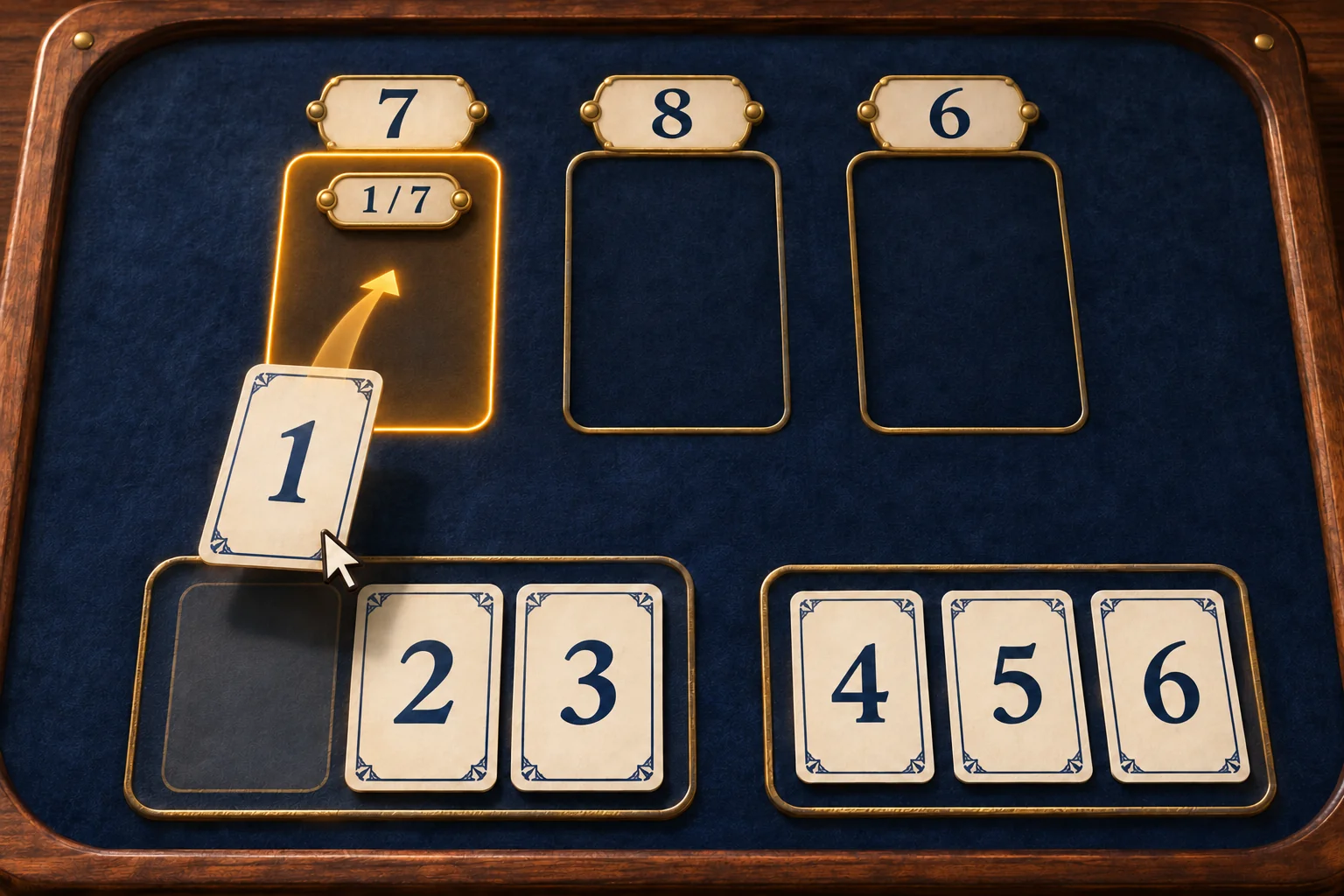
A small trick-taking prototype becomes easier to build when four rules are visible: who leads, which cards are legal, which card wins, and who leads next. Fix a short deal before adding a shuffle, trump suit, bidding, or special cards. That gives you a sequence you can audit without guessing what happened between turns.
Four Lanterns is an original fictional rules exercise for this article. The deal and scores below are manually resolved from the written rules; no game-building prompt was run, and no playable game or playtest was supplied. Treat each result as an expected paper state, not as observed gameplay.
Define the Deal and Seats
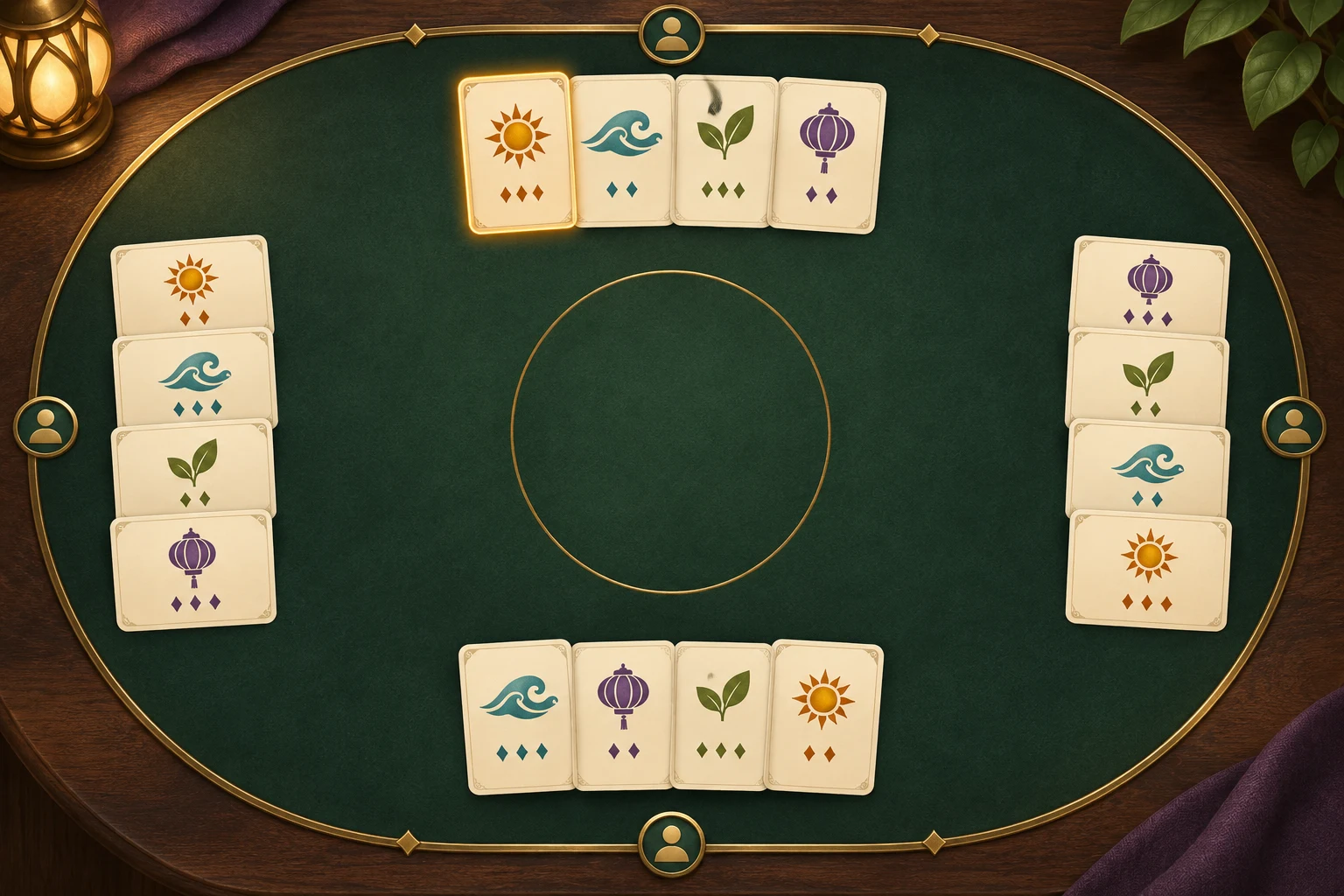
Start with four seats in clockwise order: North, East, South, and West. North partners with South; East partners with West. The teaching deck has sixteen cards: four suits—Amber, Teal, Moss, and Violet—with ranks 1 through 4 in each suit. Every player gets one card of each suit. North is the first leader in the example hand.
| Seat | Team | Amber | Teal | Moss | Violet |
|---|---|---|---|---|---|
| North | North / South | 4 | 1 | 2 | 3 |
| East | East / West | 2 | 4 | 1 | 1 |
| South | North / South | 1 | 3 | 4 | 2 |
| West | East / West | 3 | 2 | 3 | 4 |
The fixed deal is deliberate. It removes shuffle variation from the first acceptance check, so a disagreement points to a rule or turn-order mismatch rather than a different draw. Each suit contains its ranks 1, 2, 3, and 4 exactly once. Each hand contains one of each suit, so every player can follow whichever suit is led during this four-trick example.
Specify Legal Play and Trick Resolution
The leader may play any card from their hand. Each seat contributes exactly one card to a trick, and a played card leaves that player’s hand. The next three players act clockwise and must follow the led suit if they still hold it. A player with no card in that suit may discard any remaining card. There is no trump suit: only cards matching the lead suit can win the trick, and the highest rank in that suit takes the four cards.
The trick winner leads the next trick. The hand ends when all sixteen cards have been played, after four complete tricks. This order separates three ideas that are easy to blur together: a card can be legal without being able to win; an off-suit discard stays out of the comparison; and the winner changes the next lead. In the fixed deal below, each player begins with every suit, so all four players follow suit in every trick.
Keep the first version free of trump, bidding, hidden powers, and mid-round scoring bonuses. Add those only after the base order is clear. Otherwise, a surprising result could come from several rules at once, and a builder or reviewer would have no small test case to isolate.
Write a First Build Prompt
A useful request names the intended game, the full input state, the action order, what counts as a win, and what the first result should expose. It also says what to leave out. This keeps the request narrow enough to inspect rather than asking for a complete card-game product in one step.
Make a small playable prototype of an original four-player partnership trick-taking card game called Four Lanterns. Use a top-down digital card table with North, East, South, and West seats clockwise. North and South are partners; East and West are partners. The fixed 16-card deck has Amber, Teal, Moss, and Violet suits, each with ranks 1 through 4. Deal these exact hands and let North lead the first trick:
North: Amber 4, Teal 1, Moss 2, Violet 3.
East: Amber 2, Teal 4, Moss 1, Violet 1.
South: Amber 1, Teal 3, Moss 4, Violet 2.
West: Amber 3, Teal 2, Moss 3, Violet 4.

The leader may play any card. Then players act clockwise. If a player holds the led suit, require a card of that suit; otherwise allow any discard. There is no trump. The highest rank in the led suit wins the trick, and its winner leads the next trick. Put all four cards into a visible trick area before resolving. Award one point to the winning partnership for each trick; after four tricks show each partnership's total and whether the hand is a draw or has a winner. Allow a restart to restore the exact same hands and first leader.

Show the current leader, whose turn it is, each player's remaining cards, the four plays in order, the winner, the next leader, and the running partnership score. If a player attempts an off-suit play while holding the led suit, reject it and explain the rule. Do not add a shuffle, trump, bidding, wild cards, special powers, contracts, extra players, or a larger campaign. Return a concise rules summary and a checklist for comparing the displayed sequence with the fixed deal. Do not claim the result is correct until someone actually runs and inspects the prototype.
Before using a request like this, check that its fixed inputs are complete and internally consistent. This game-building prompt is a proposed template, not a prompt run for this article. If an actual result later differs from the paper trace, record the exact turn and state that first diverges before asking for a targeted correction.
Hand-Check One Complete Deal
Resolve each trick by following the clockwise seats, enforcing the led suit, and comparing ranks only among matching cards. The “next leader” column carries the winning seat into the next row. With v0, each trick is worth one point.
| Trick | Leader and clockwise plays | Winner | Running score (N/S – E/W) | Next leader |
|---|---|---|---|---|
| 1 — Teal | North Teal 1; East Teal 4; South Teal 3; West Teal 2 | East | 0–1 | East |
| 2 — Amber | East Amber 2; South Amber 1; West Amber 3; North Amber 4 | North | 1–1 | North |
| 3 — Moss | North Moss 2; East Moss 1; South Moss 4; West Moss 3 | South | 2–1 | South |
| 4 — Violet | South Violet 2; West Violet 4; North Violet 3; East Violet 1 | West | 2–2 | Hand ends |
The Teal trick belongs to East because 4 is the highest Teal, even though North led. On the Amber trick, North's 4 beats the other Amber cards. Moss goes to South, whose 4 is highest. Violet goes to West. Under the one-point rule, each partnership wins two tricks, so v0 ends in a 2–2 draw.
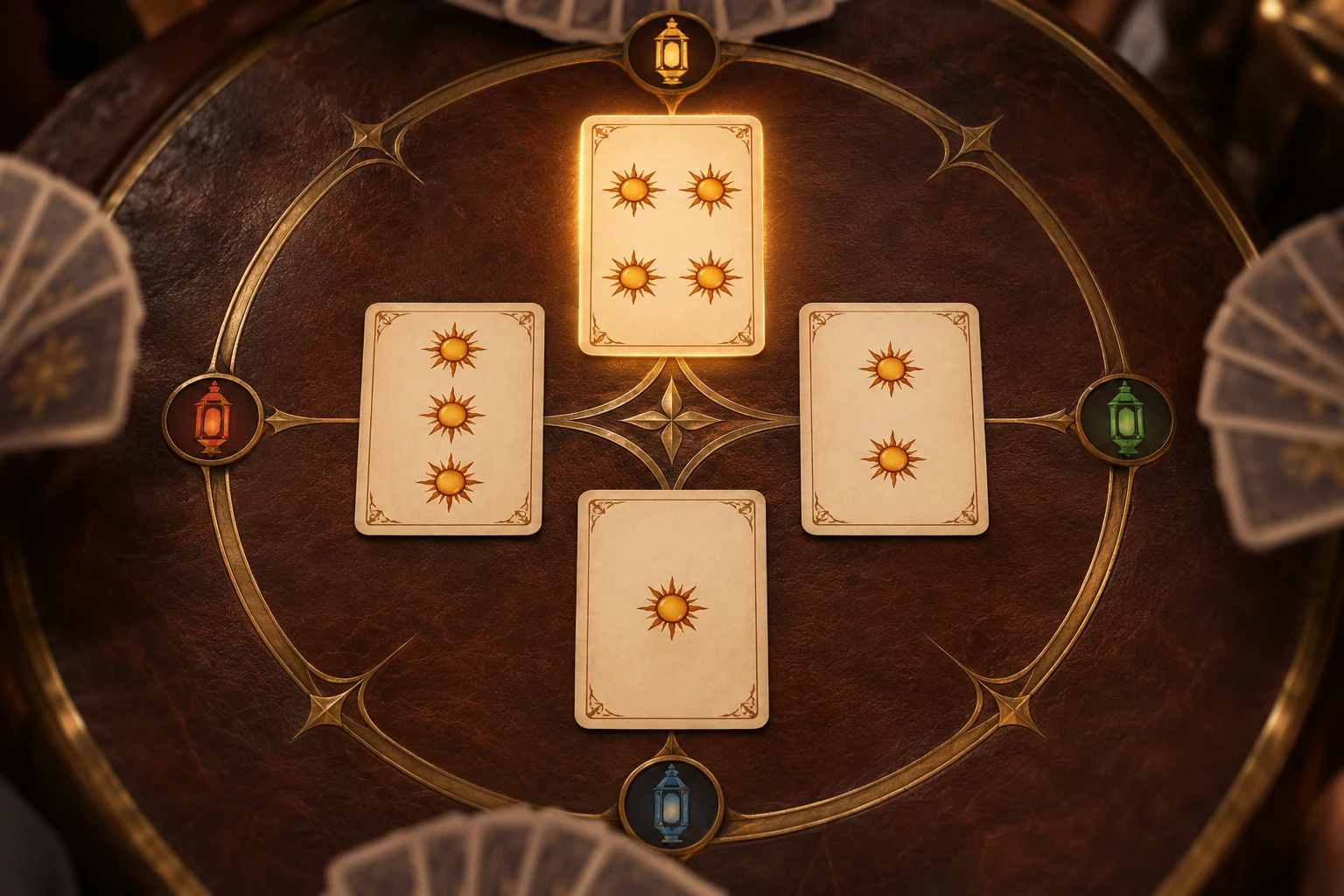
The image maps to the second row: East is at the right, South at the bottom, West at the left, and North at the top. The warm outline marks the winning Amber 4. The seats and cards visualize the written paper example; they do not establish that a game has been built or tested.
For a future build check, compare the exact four plays, the winner, and the next leader after each trick. A skipped or unavailable interaction is “not run,” not a pass. A concrete record should separate the expected sequence above from what the build actually displays.
Revise One Score Rule Without Changing the Deal
Once v0 is readable, you can ask a separate design question: what changes if the final trick is worth two points? Keep all sixteen cards, all plays, the suit rule, and every trick winner fixed. Change only T4's value.
| Rule version | North / South | East / West | Hand result | Changed input |
|---|---|---|---|---|
| v0 — each trick is 1 | 2 | 2 | Draw | None; baseline |
| v1 — final trick is 2 | 2 | 3 | East / West win 3–2 | Only T4's point value |
North/South still take T2 and T3 for two points. East/West take T1 for one and T4 for two, giving three. The revision makes this one hand decisive, but that arithmetic alone does not show whether the rule is more enjoyable or balanced. That would require real play, player feedback, and a separate record; none is available here.
Connect the Plan to a Build Workflow
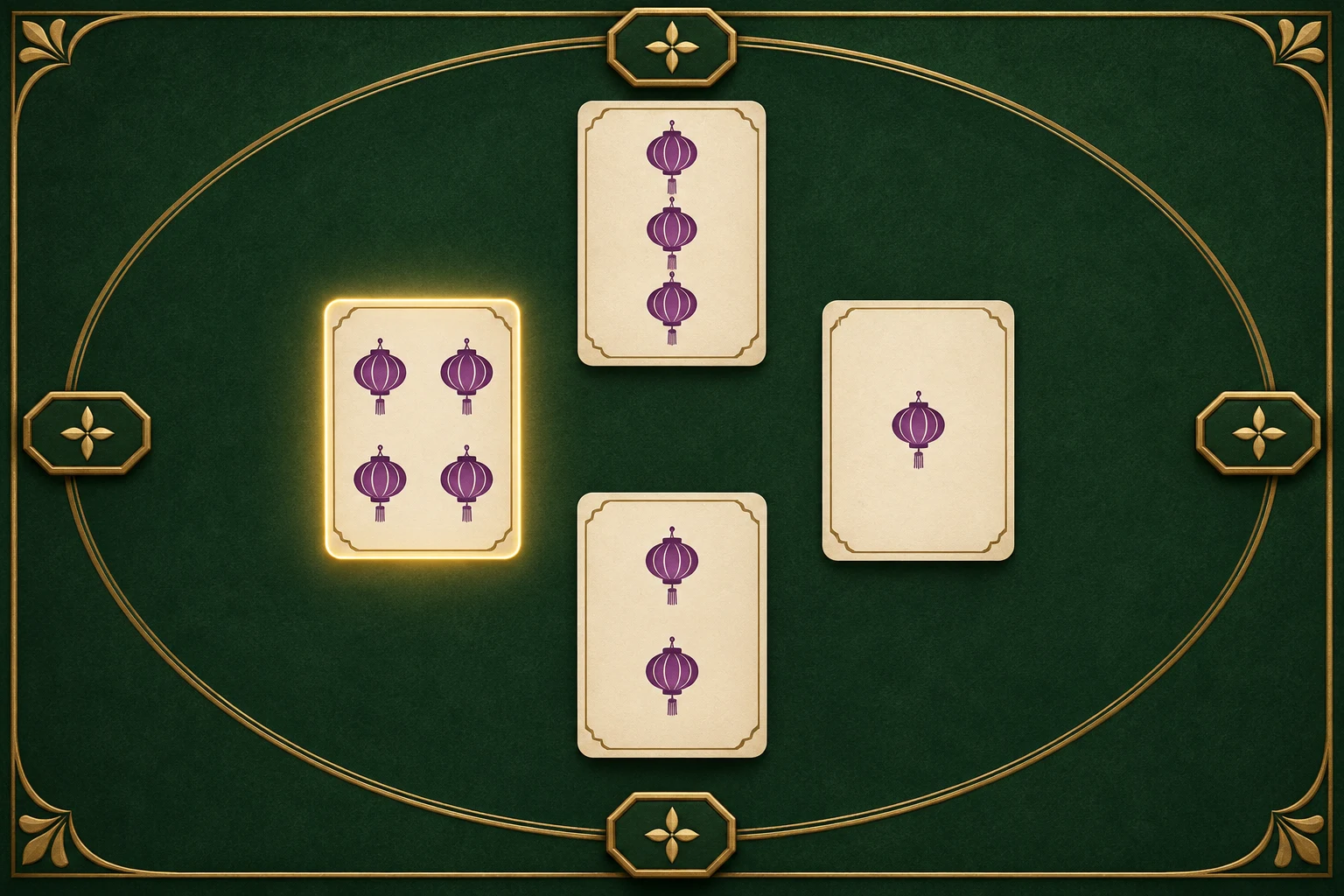
Carry the fixed deal into the first build request, then review the result against the same short contract. SEELE's current Free AI Game Maker page describes writing a game idea in plain English, reviewing a playable 2D or 3D result, and iterating in Workspace. It advises checking the selected model, available Koin balance, and displayed generation cost in Workspace before submitting a generation request. Those are general workflow facts; they do not confirm that these exact partnership rules will be implemented correctly.
If you choose to try a builder, begin with the seat order, fixed hands, follow-suit rule, and winner-to-lead transition. Then inspect an actual turn, the displayed cards, and the final score yourself. Keep the design trace beside the result so any mismatch can be described precisely. The examples on this page are still paper-only.
FAQ
What happens if a player cannot follow suit?
In Four Lanterns, a player who has no remaining card in the led suit may discard any card. That off-suit card is legal, but it cannot win the trick because the highest card of the led suit takes it. The example deal gives each player one card of every suit, so every play in its four-trick trace follows suit.
Can an off-suit card win the trick?
No. There is no trump suit in this design. The winner is the highest-ranked card that matches the lead suit, so off-suit discards stay outside the comparison. A later variant could add trump, but it should be specified as a separate rule and checked with a new trace.
Who leads after a trick ends?
The player who wins the trick leads the next one. That is why East leads T2 after winning the Teal trick, North leads T3 after taking Amber, and South leads T4 after winning Moss. The hand ends after the fourth complete trick.
Was Four Lanterns built or playtested?
No. Four Lanterns, the rules, the deal, and the 2–2 paper score are fictional and manually resolved for this article. No game-building prompt was run. Codex ImageGen was used only for concept art; no playable build, play session, player feedback, or measured balance result was supplied for this article.